
Using dynamics for optical lattice simulations Anatoli Polkovnikov
- Slides: 32
Using dynamics for optical lattice simulations. Anatoli Polkovnikov, Boston University Ehud Altman - Weizmann Eugene Demler – Harvard Vladimir Gritsev – Harvard Bertrand Halperin - Harvard Misha Lukin - Harvard g. BECi and OLE/MURI Meeting AFOSR
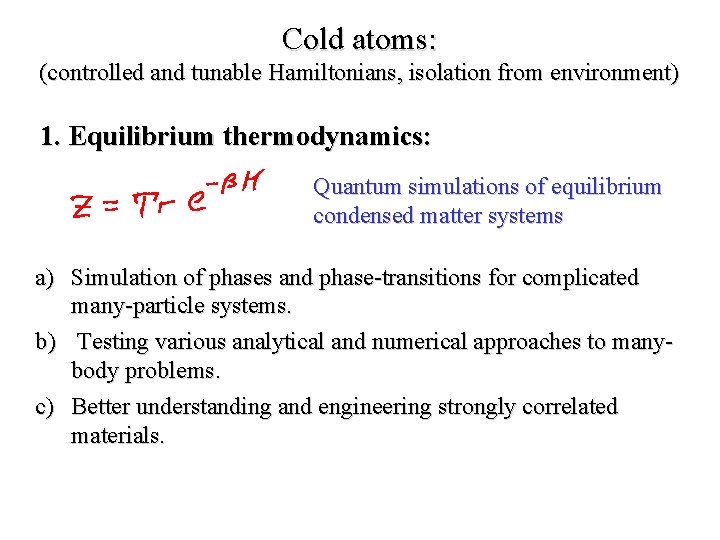
Cold atoms: (controlled and tunable Hamiltonians, isolation from environment) 1. Equilibrium thermodynamics: Quantum simulations of equilibrium condensed matter systems a) Simulation of phases and phase-transitions for complicated many-particle systems. b) Testing various analytical and numerical approaches to manybody problems. c) Better understanding and engineering strongly correlated materials.
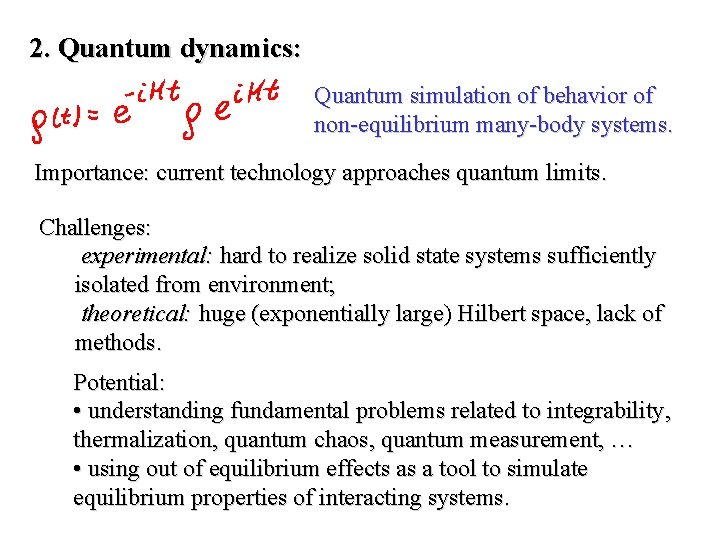
2. Quantum dynamics: Quantum simulation of behavior of non-equilibrium many-body systems. Importance: current technology approaches quantum limits. Challenges: experimental: hard to realize solid state systems sufficiently isolated from environment; theoretical: huge (exponentially large) Hilbert space, lack of methods. Potential: • understanding fundamental problems related to integrability, thermalization, quantum chaos, quantum measurement, … • using out of equilibrium effects as a tool to simulate equilibrium properties of interacting systems.
This talk. 1. Phase diagram of a moving condensate in an optical lattice. 2. Response of generic gapless systems to slow ramp of external parameters. 3. Quench dynamics in coupled one dimensional condensates.
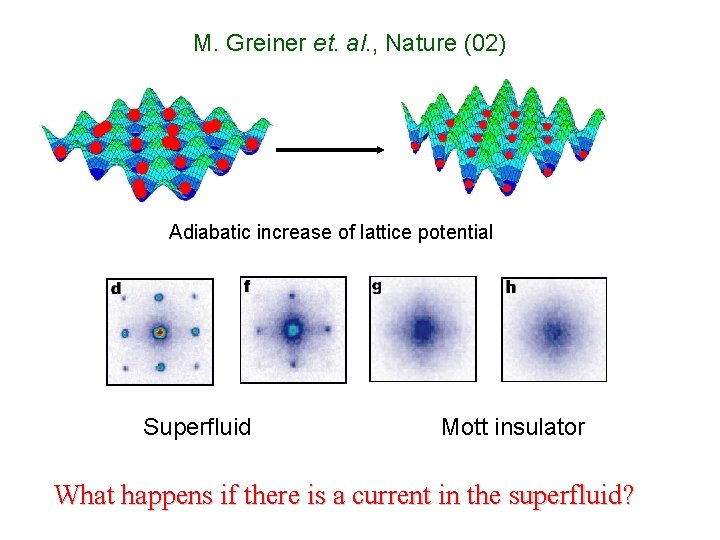
M. Greiner et. al. , Nature (02) Adiabatic increase of lattice potential Superfluid Mott insulator What happens if there is a current in the superfluid?
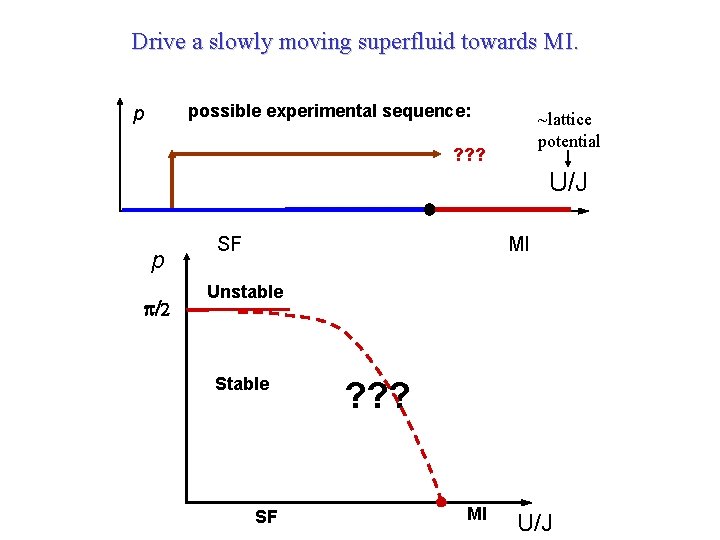
Drive a slowly moving superfluid towards MI. possible experimental sequence: p ~lattice potential ? ? ? U/J p p/2 SF MI Unstable SF ? ? ? MI U/J
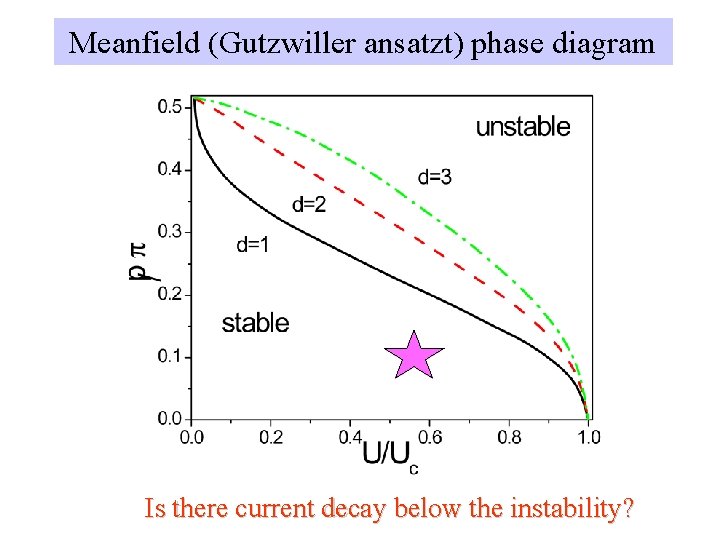
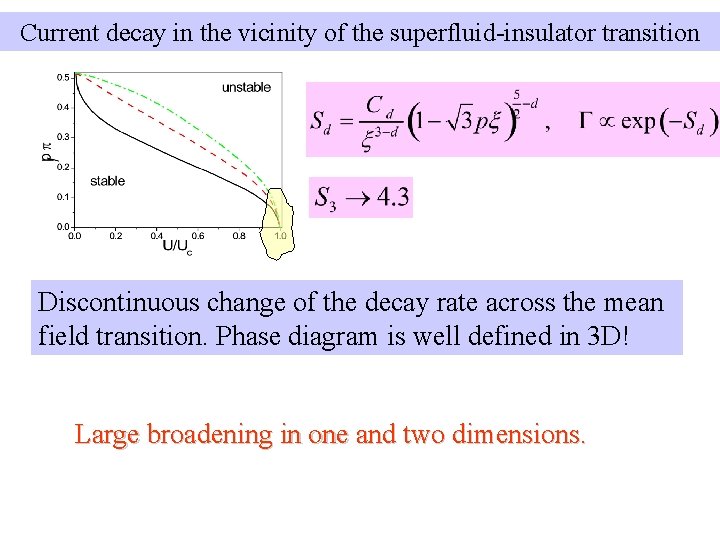
Meanfield (Gutzwiller ansatzt) phase diagram Is there current decay below the instability?
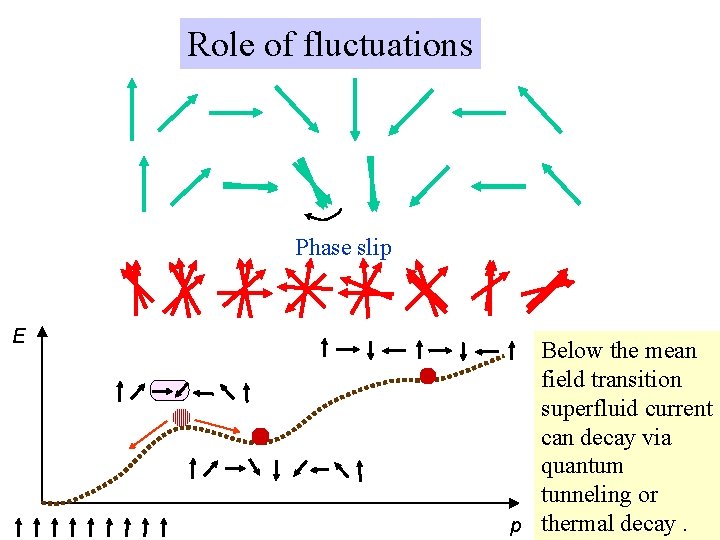
Role of fluctuations Phase slip E Below the mean field transition superfluid current can decay via quantum tunneling or p thermal decay.
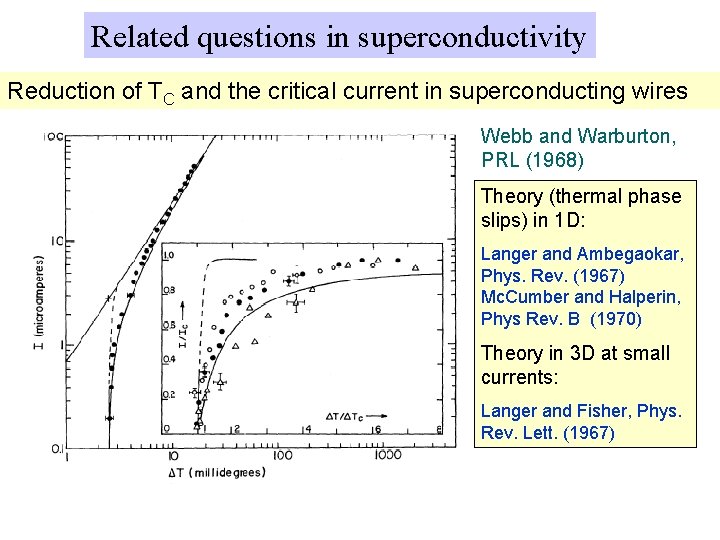
Related questions in superconductivity Reduction of TC and the critical current in superconducting wires Webb and Warburton, PRL (1968) Theory (thermal phase slips) in 1 D: Langer and Ambegaokar, Phys. Rev. (1967) Mc. Cumber and Halperin, Phys Rev. B (1970) Theory in 3 D at small currents: Langer and Fisher, Phys. Rev. Lett. (1967)
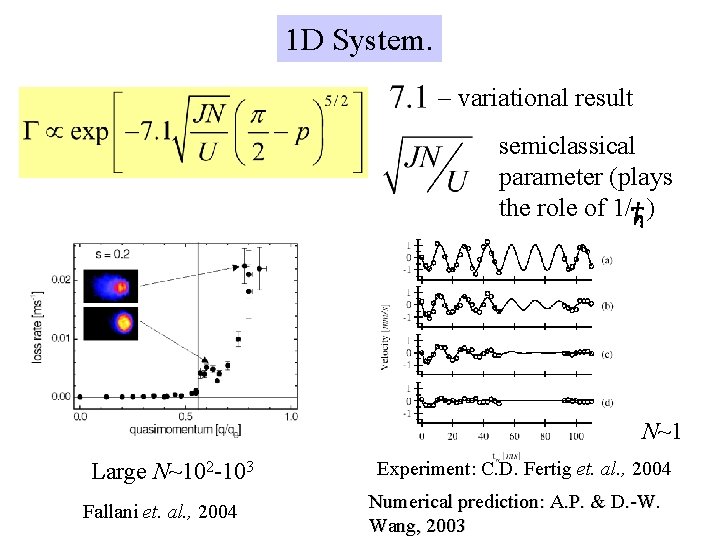
1 D System. – variational result semiclassical parameter (plays the role of 1/ ) N~1 Large N~102 -103 Fallani et. al. , 2004 Experiment: C. D. Fertig et. al. , 2004 Numerical prediction: A. P. & D. -W. Wang, 2003
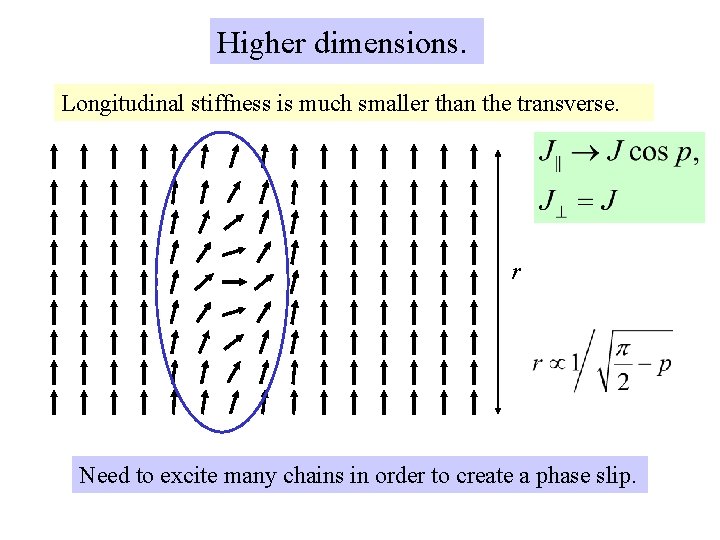
Higher dimensions. Longitudinal stiffness is much smaller than the transverse. r Need to excite many chains in order to create a phase slip.
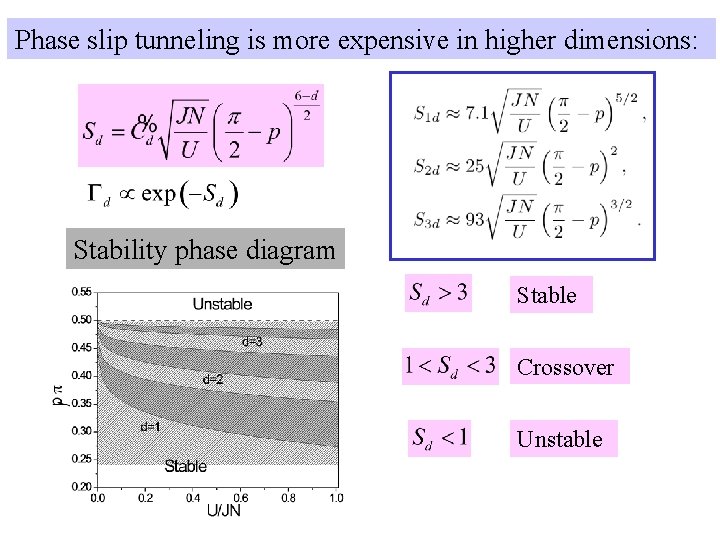
Phase slip tunneling is more expensive in higher dimensions: Stability phase diagram Stable Crossover Unstable
Current decay in the vicinity of the superfluid-insulator transition Discontinuous change of the decay rate across the mean field transition. Phase diagram is well defined in 3 D! Large broadening in one and two dimensions.
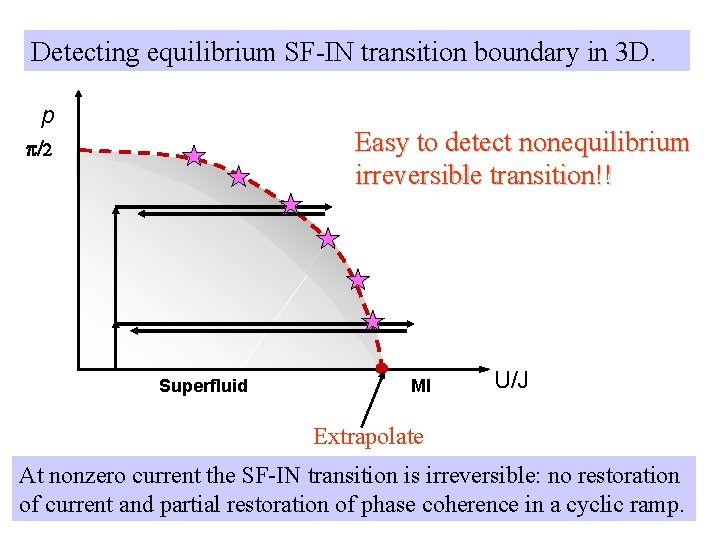
Detecting equilibrium SF-IN transition boundary in 3 D. p Easy to detect nonequilibrium irreversible transition!! p/2 Superfluid MI U/J Extrapolate At nonzero current the SF-IN transition is irreversible: no restoration of current and partial restoration of phase coherence in a cyclic ramp.
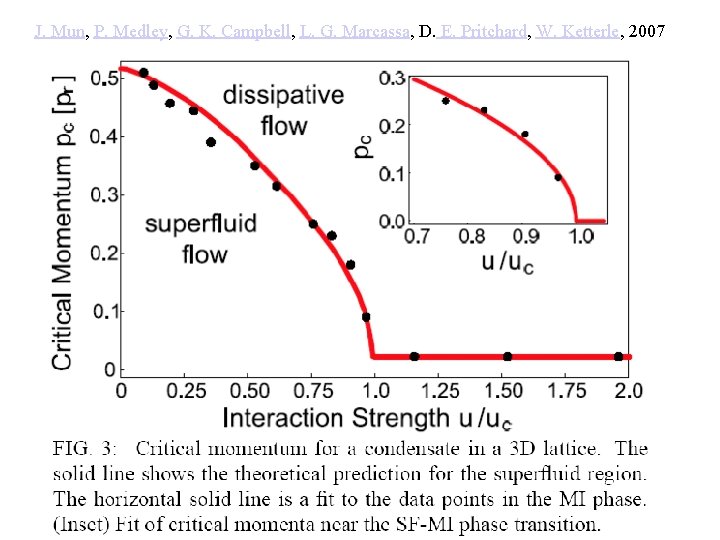
J. Mun, P. Medley, G. K. Campbell, L. G. Marcassa, D. E. Pritchard, W. Ketterle, 2007
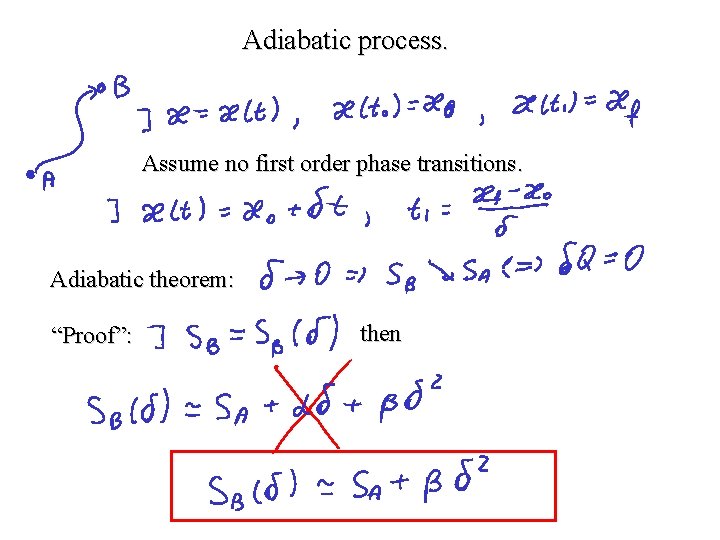
Adiabatic process. Assume no first order phase transitions. Adiabatic theorem: “Proof”: then
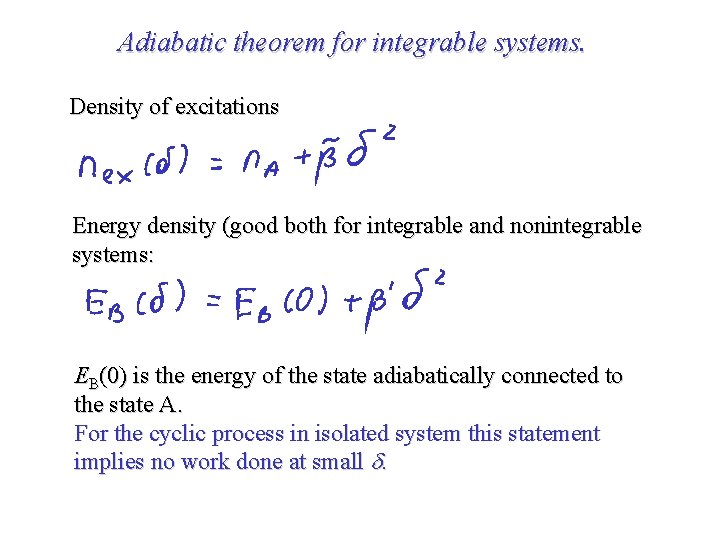
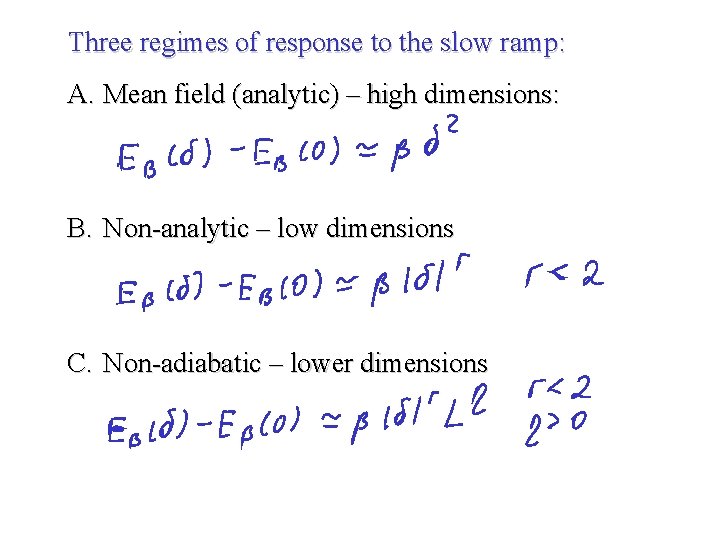
Adiabatic theorem for integrable systems. Density of excitations Energy density (good both for integrable and nonintegrable systems: EB(0) is the energy of the state adiabatically connected to the state A. For the cyclic process in isolated system this statement implies no work done at small .
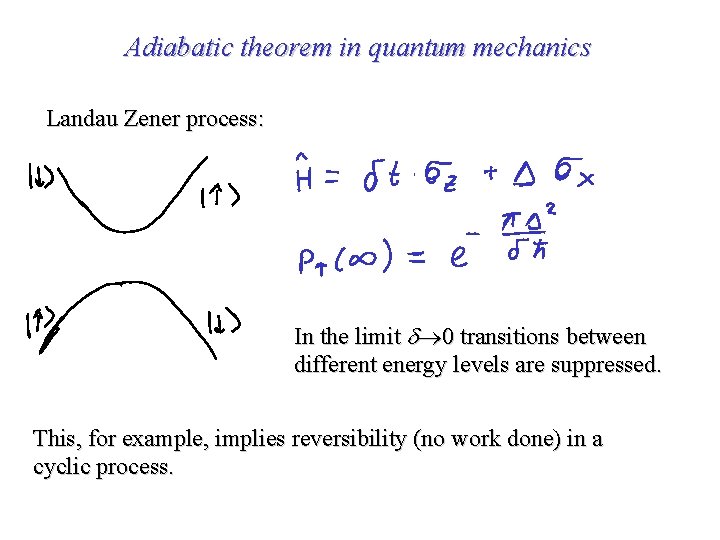
Adiabatic theorem in quantum mechanics Landau Zener process: In the limit 0 transitions between different energy levels are suppressed. This, for example, implies reversibility (no work done) in a cyclic process.
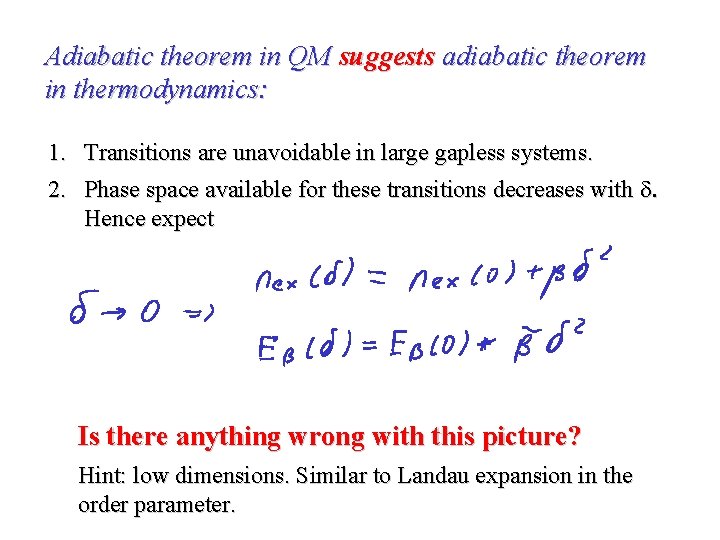
Adiabatic theorem in QM suggests adiabatic theorem in thermodynamics: 1. Transitions are unavoidable in large gapless systems. 2. Phase space available for these transitions decreases with d. Hence expect Is there anything wrong with this picture? Hint: low dimensions. Similar to Landau expansion in the order parameter.
More specific reason. Equilibrium: high density of low-energy states -> • strong quantum or thermal fluctuations, • destruction of the long-range order, • breakdown of mean-field descriptions, Dynamics -> population of the low-energy states due to finite rate -> breakdown of the adiabatic approximation.
Three regimes of response to the slow ramp: A. Mean field (analytic) – high dimensions: B. Non-analytic – low dimensions C. Non-adiabatic – lower dimensions
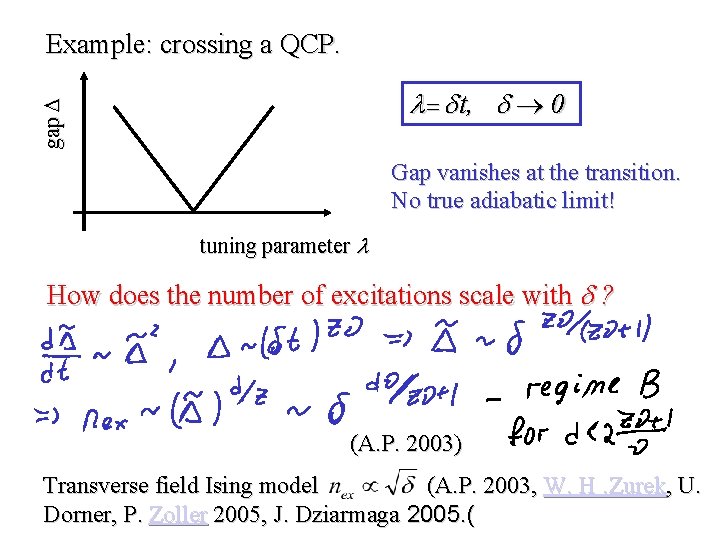
Example: crossing a QCP. gap t, 0 Gap vanishes at the transition. No true adiabatic limit! tuning parameter How does the number of excitations scale with ? (A. P. 2003) Transverse field Ising model (A. P. 2003, W. H. Zurek, U. Dorner, P. Zoller 2005, J. Dziarmaga 2005. (
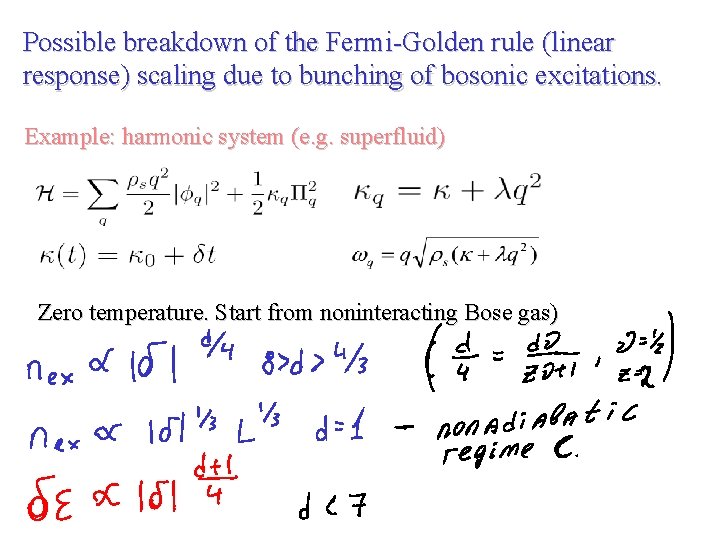
Possible breakdown of the Fermi-Golden rule (linear response) scaling due to bunching of bosonic excitations. Example: harmonic system (e. g. superfluid) Zero temperature. Start from noninteracting Bose gas)
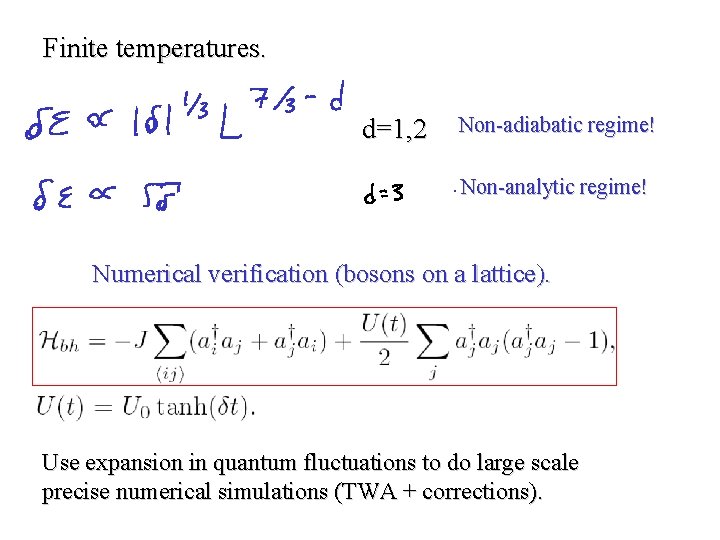
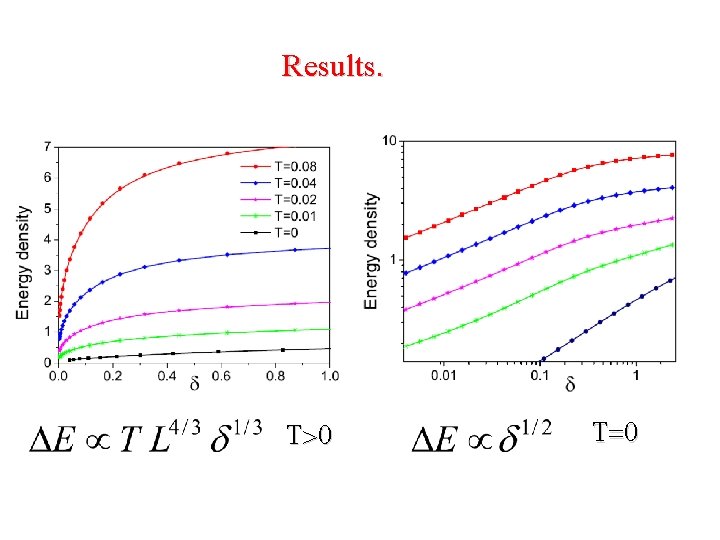
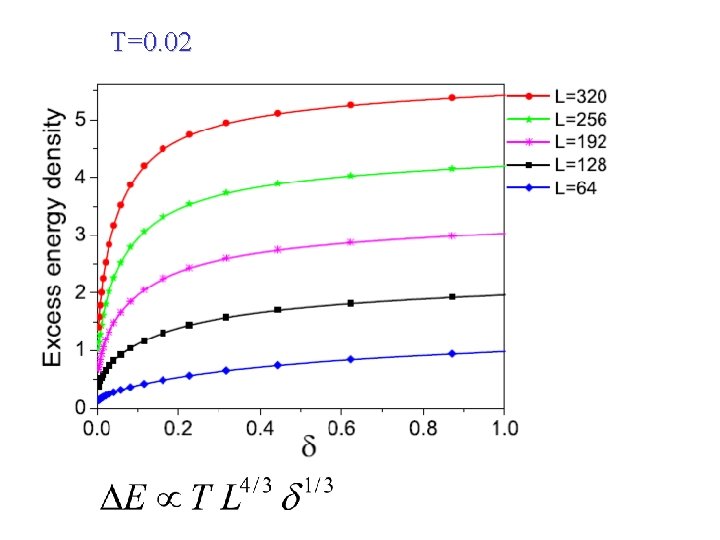
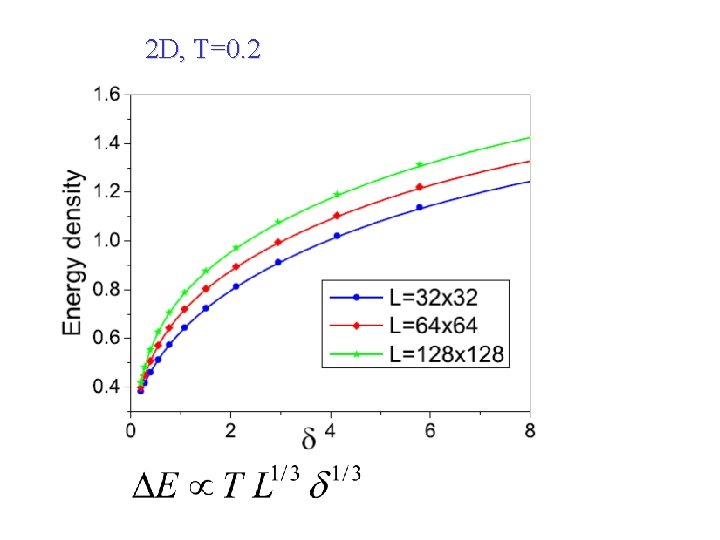
Finite temperatures. d=1, 2 Non-adiabatic regime! Non-analytic regime! Numerical verification (bosons on a lattice). Use expansion in quantum fluctuations to do large scale precise numerical simulations (TWA + corrections).
Results. T>0 T 0
T=0. 02
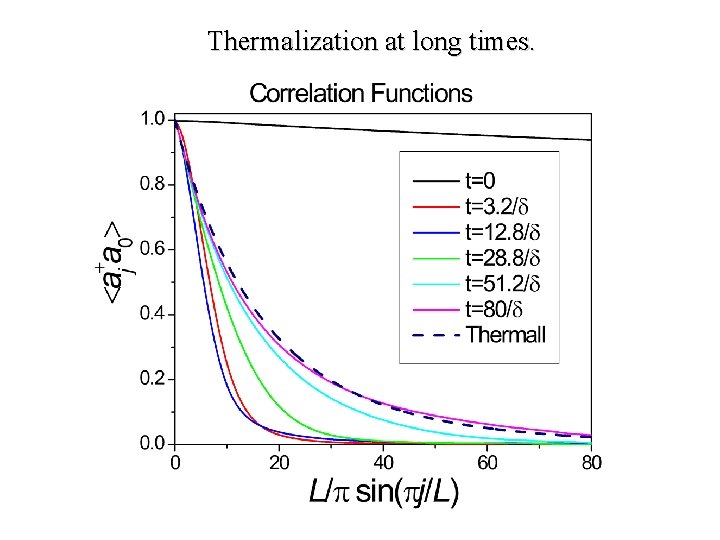
Thermalization at long times.
2 D, T=0. 2
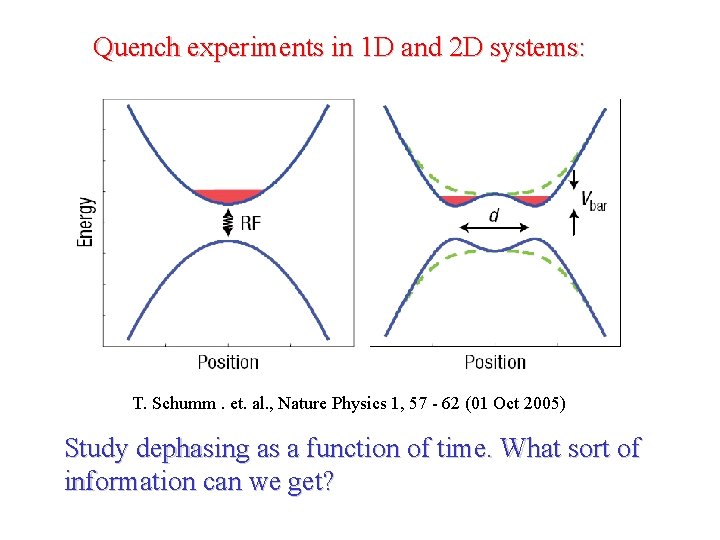
Quench experiments in 1 D and 2 D systems: T. Schumm. et. al. , Nature Physics 1, 57 - 62 (01 Oct 2005) Study dephasing as a function of time. What sort of information can we get?
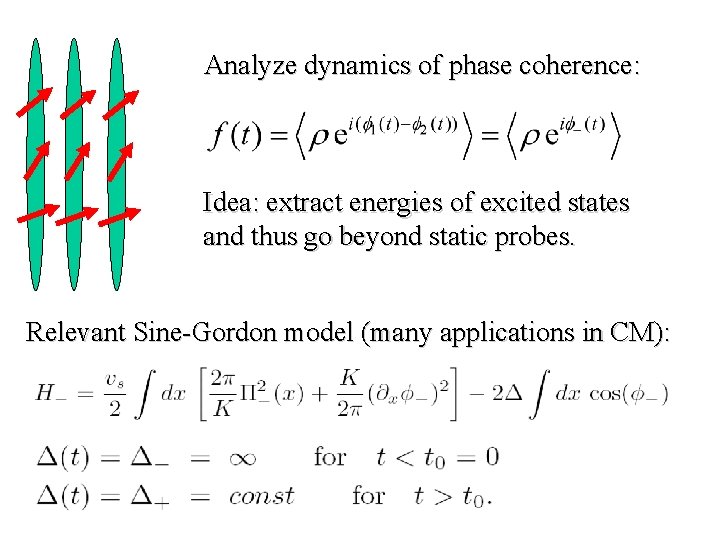
Analyze dynamics of phase coherence: Idea: extract energies of excited states and thus go beyond static probes. Relevant Sine-Gordon model (many applications in CM):
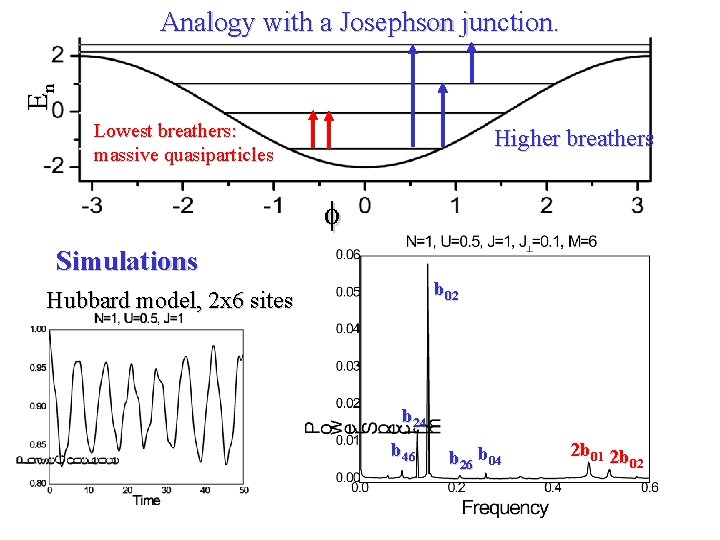
En Analogy with a Josephson junction. Lowest breathers: massive quasiparticles Higher breathers f Simulations b 02 Hubbard model, 2 x 6 sites b 24 b 46 b 26 b 04 2 b 01 2 b 02
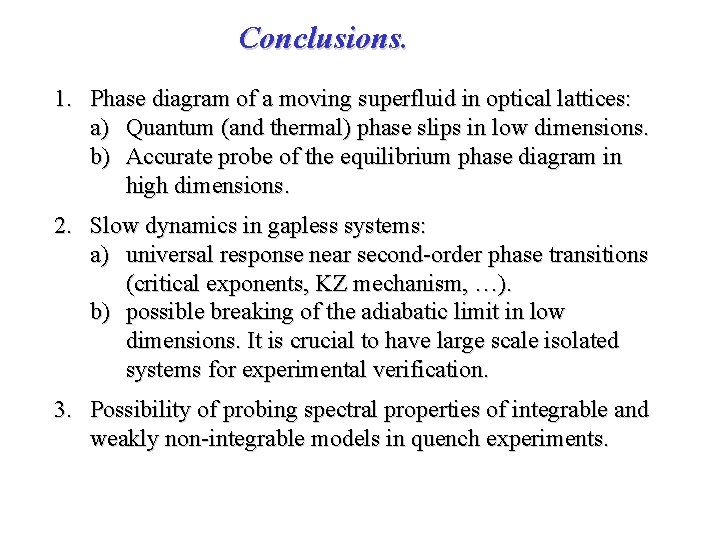
Conclusions. 1. Phase diagram of a moving superfluid in optical lattices: a) Quantum (and thermal) phase slips in low dimensions. b) Accurate probe of the equilibrium phase diagram in high dimensions. 2. Slow dynamics in gapless systems: a) universal response near second-order phase transitions (critical exponents, KZ mechanism, …). b) possible breaking of the adiabatic limit in low dimensions. It is crucial to have large scale isolated systems for experimental verification. 3. Possibility of probing spectral properties of integrable and weakly non-integrable models in quench experiments.