
Using Direct Observation to Guide Implementation Facilitation Bo
Using Direct Observation to Guide Implementation Facilitation Bo Kim Ph. D 1, 2, Christopher J. Miller Ph. D 1, 2, Mark S. Bauer MD 1, 2, A. Rani Elwy Ph. D 1, 3 (1) HSR&D Center for Healthcare Organization and Implementation Research; Veterans Health Administration (2) Department of Psychiatry; Harvard Medical School (3) Department of Health Law, Policy, and Management; Boston University School of Public Health
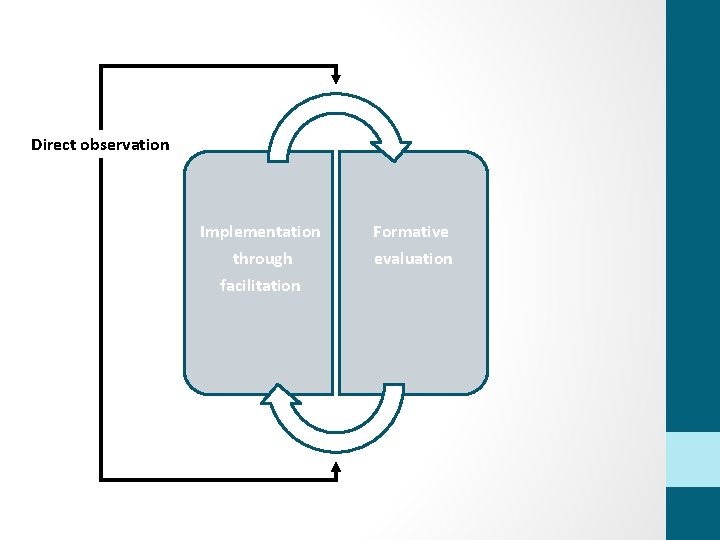
Direct observation Implementation through facilitation Formative evaluation
Formative Evaluation (FE) From Stetler et al. (2006): • “A rigorous assessment process designed to identify potential and actual influences on the progress and effectiveness of implementation efforts” • Challenge – inaccurate but still widespread view that “FE involves only qualitative research or that it is not rigorous”
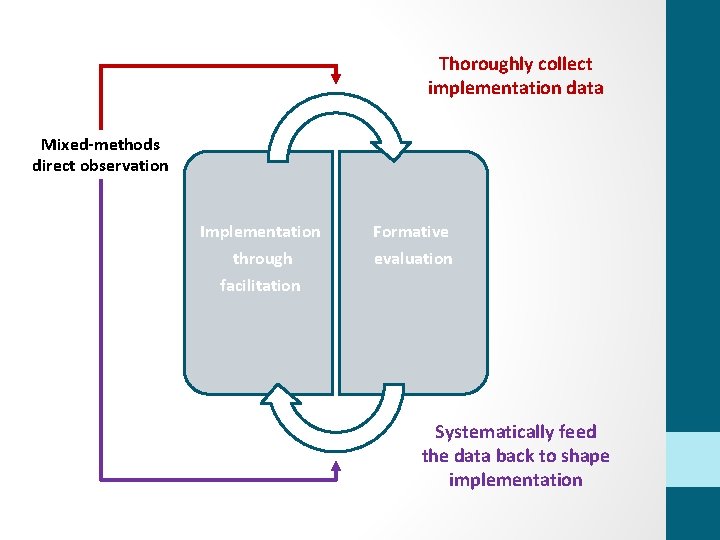
Thoroughly collect implementation data Mixed-methods direct observation Implementation through facilitation Formative evaluation Systematically feed the data back to shape implementation
![Direct Observation “…observation is about stalking culture in the wild…[it] is a strategic method…](http://slidetodoc.com/presentation_image_h/24ee473f3415c6852af8a4013d0c00b9/image-5.jpg "Direct Observation “…observation is about stalking culture in the wild…[it] is a strategic method…")
Direct Observation “…observation is about stalking culture in the wild…[it] is a strategic method… [which] puts you where the action is and lets you collect data. . . ” (Bernard, 2002) World Health Organization’s Kikwawila Study Group, 1994: • To understand • processes, events, norms, values, and social context • human behavior that is largely unknown (hidden) or complex • conceptions and attitudes of study group and their points of view • To complement other findings • To help researcher formulate ideas in local “language”
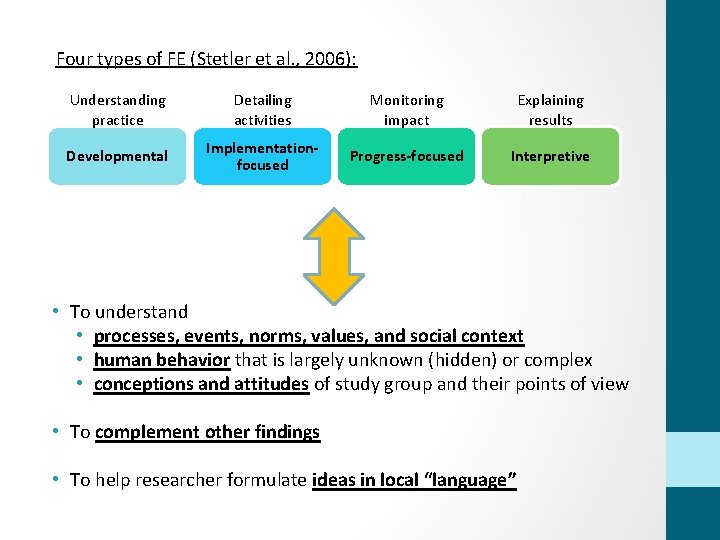
Four types of FE (Stetler et al. , 2006): Understanding practice Detailing activities Monitoring impact Explaining results Developmental Implementationfocused Progress-focused Interpretive • To understand • processes, events, norms, values, and social context • human behavior that is largely unknown (hidden) or complex • conceptions and attitudes of study group and their points of view • To complement other findings • To help researcher formulate ideas in local “language”
Acknowledgements • Mc. Cullough MB, Kim B, Ruben M, Wang S, Fix GM. Direct Observation Methods for Health Services and Implementation Research. Academy. Health Annual Research Meeting, Boston, 26 -28 June 2016. • The contents do not represent the views of the U. S. Department of Veterans Affairs (VA) or the United States Government. • This work is supported by VA HSR&D Quality Enhancement Research Initiative QUE 15 -289, Behavioral Health QUERI Program, “Hybrid Controlled Trial to Implement Collaborative Care in General Mental Health. ” • Authors have no conflicts of interest.
• Implementation Study: Multi-site stepped-wedge controlled trial to implement interdisciplinary teambased behavioral health care at VA medical centers • Conceptual Framework: Integrated Promoting Action on Research Implementation in Health Services (i-PARIHS) framework (Harvey & Kitson, 2016) • Facilitation Model: Blended external-internal facilitation (Kirchner et al. , 2014)
Population Involved • Three external facilitators (EFs) • Each EF worked with the internal facilitator (IF) at three sites (N=9 sites) • Each site’s interdisciplinary team of providers • Each site’s additional stakeholders including leadership
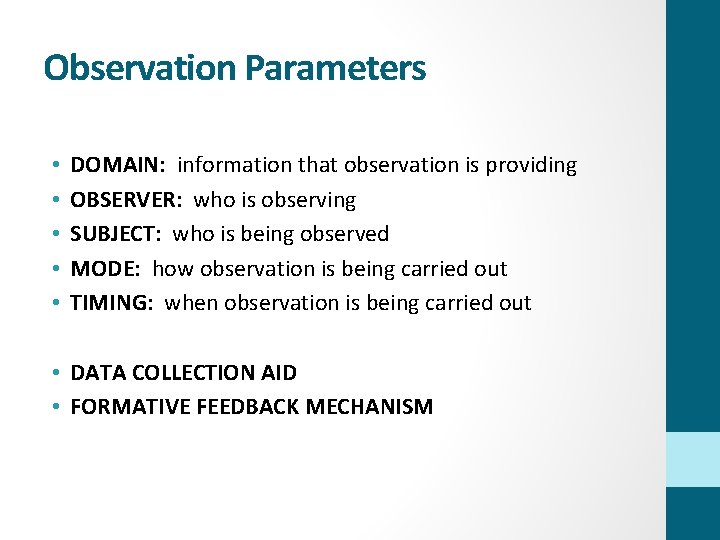
Observation Parameters • • • DOMAIN: information that observation is providing OBSERVER: who is observing SUBJECT: who is being observed MODE: how observation is being carried out TIMING: when observation is being carried out • DATA COLLECTION AID • FORMATIVE FEEDBACK MECHANISM
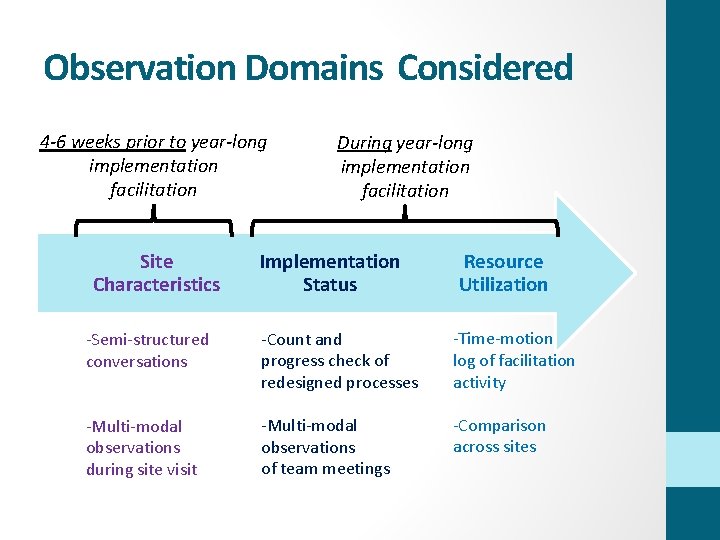
Observation Domains Considered 4 -6 weeks prior to year-long implementation facilitation Site Characteristics During year-long implementation facilitation Implementation Status Resource Utilization -Semi-structured conversations -Count and progress check of redesigned processes -Time-motion log of facilitation activity -Multi-modal observations during site visit -Multi-modal observations of team meetings -Comparison across sites
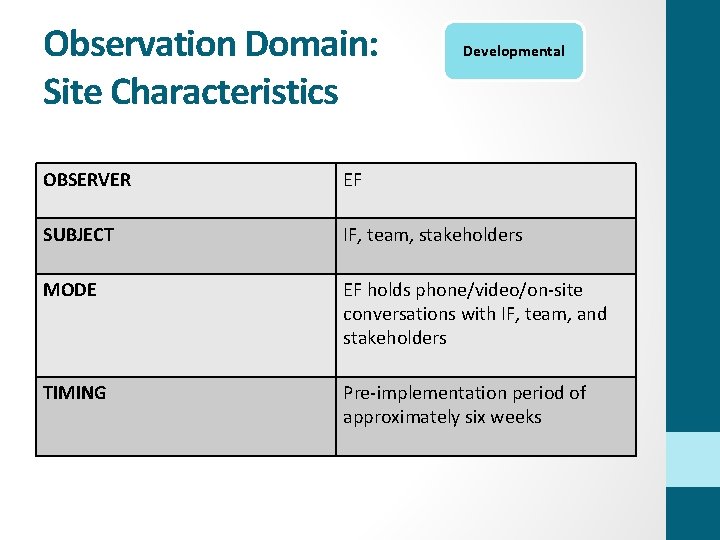
Observation Domain: Site Characteristics Developmental OBSERVER EF SUBJECT IF, team, stakeholders MODE EF holds phone/video/on-site conversations with IF, team, and stakeholders TIMING Pre-implementation period of approximately six weeks
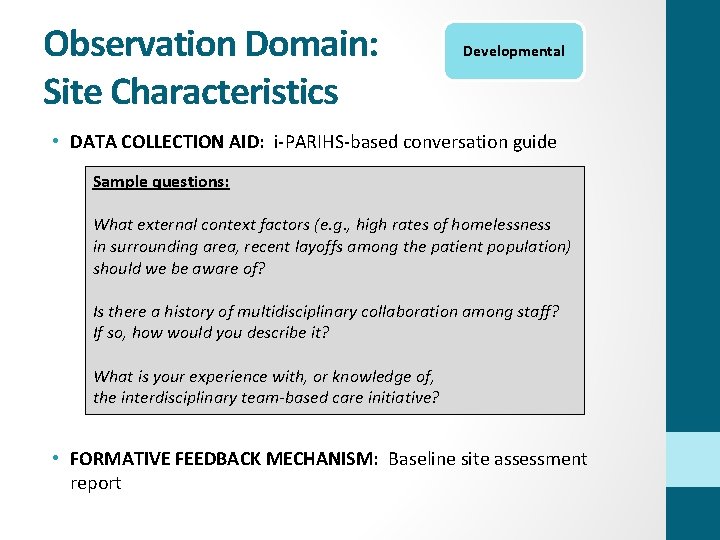
Observation Domain: Site Characteristics Developmental • DATA COLLECTION AID: i-PARIHS-based conversation guide Sample questions: What external context factors (e. g. , high rates of homelessness in surrounding area, recent layoffs among the patient population) should we be aware of? Is there a history of multidisciplinary collaboration among staff? If so, how would you describe it? What is your experience with, or knowledge of, the interdisciplinary team-based care initiative? • FORMATIVE FEEDBACK MECHANISM: Baseline site assessment report
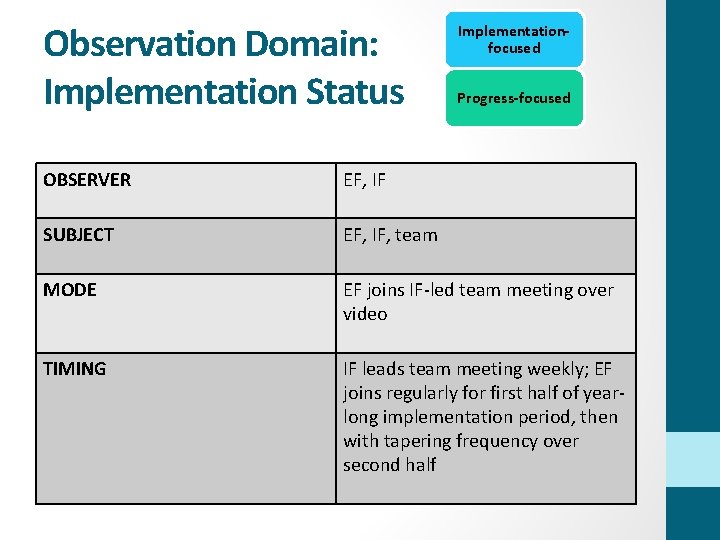
Observation Domain: Implementation Status Implementationfocused Progress-focused OBSERVER EF, IF SUBJECT EF, IF, team MODE EF joins IF-led team meeting over video TIMING IF leads team meeting weekly; EF joins regularly for first half of yearlong implementation period, then with tapering frequency over second half
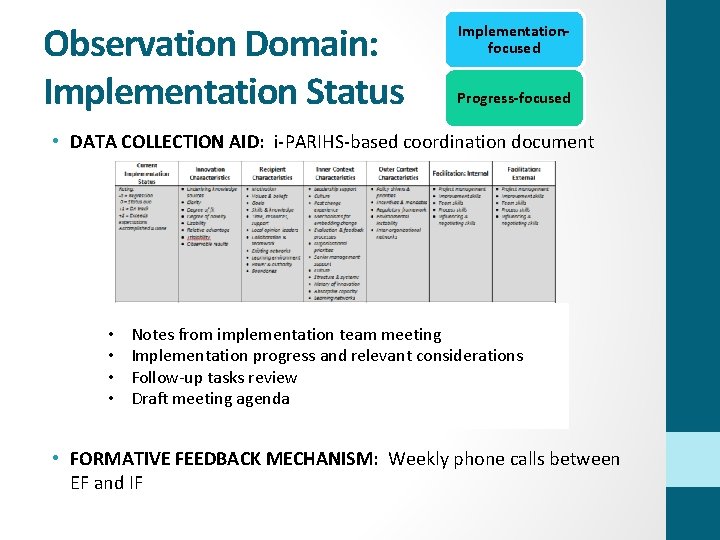
Observation Domain: Implementation Status Implementationfocused Progress-focused • DATA COLLECTION AID: i-PARIHS-based coordination document • • Notes from implementation team meeting Implementation progress and relevant considerations Follow-up tasks review Draft meeting agenda • FORMATIVE FEEDBACK MECHANISM: Weekly phone calls between EF and IF
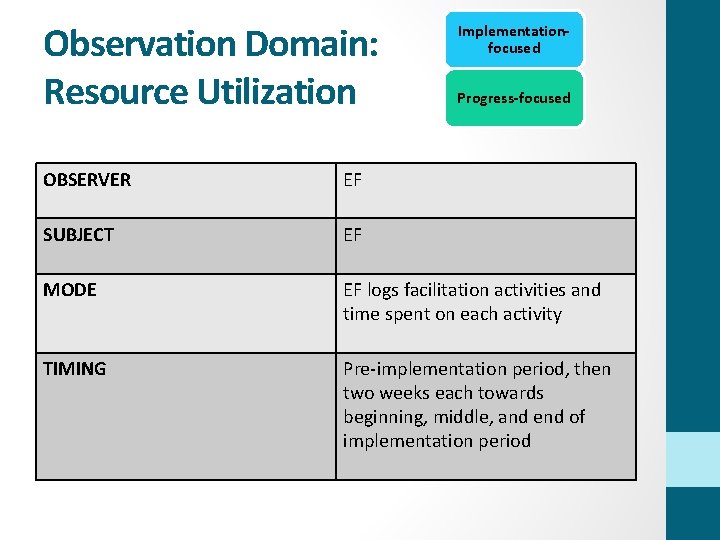
Observation Domain: Resource Utilization Implementationfocused Progress-focused OBSERVER EF SUBJECT EF MODE EF logs facilitation activities and time spent on each activity TIMING Pre-implementation period, then two weeks each towards beginning, middle, and end of implementation period
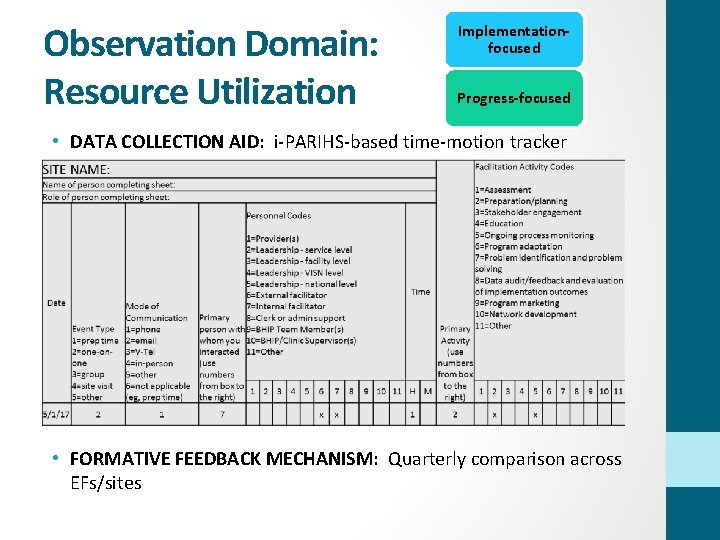
Observation Domain: Resource Utilization Implementationfocused Progress-focused • DATA COLLECTION AID: i-PARIHS-based time-motion tracker • FORMATIVE FEEDBACK MECHANISM: Quarterly comparison across EFs/sites
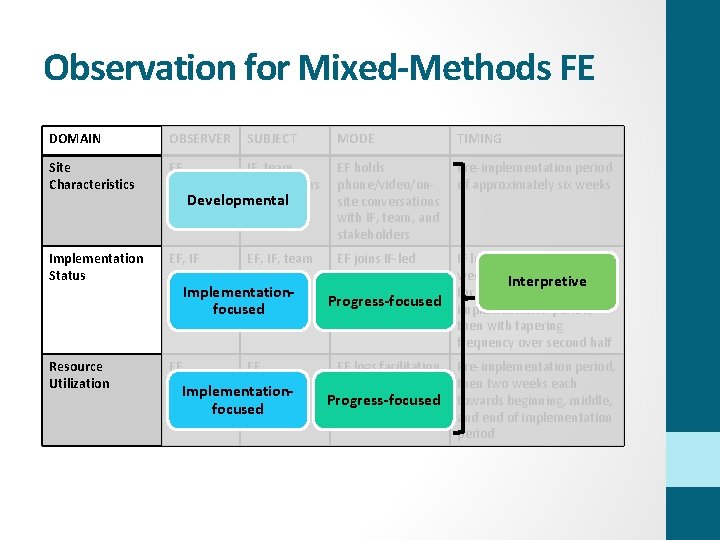
Observation for Mixed-Methods FE DOMAIN OBSERVER SUBJECT MODE TIMING Site Characteristics EF IF, team, stakeholders EF holds phone/video/onsite conversations with IF, team, and stakeholders Pre-implementation period of approximately six weeks Implementation Status EF, IF, team EF joins IF-led team meeting over video IF leads team meeting weekly; EF joins bi-weekly Interpretive for first half of year-long implementation period, then with tapering frequency over second half Resource Utilization Developmental Implementationfocused EF EF Implementationfocused Progress-focused EF logs facilitation activities and time spent on each Progress-focused activity Pre-implementation period, then two weeks each towards beginning, middle, and end of implementation period
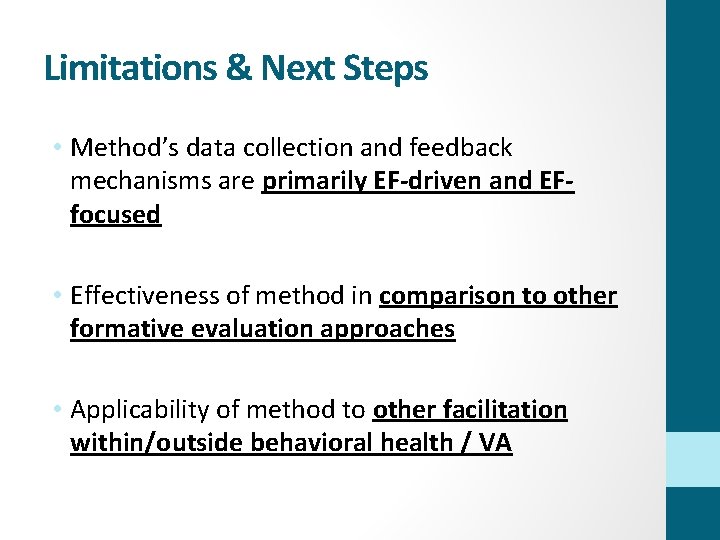
Limitations & Next Steps • Method’s data collection and feedback mechanisms are primarily EF-driven and EFfocused • Effectiveness of method in comparison to other formative evaluation approaches • Applicability of method to other facilitation within/outside behavioral health / VA
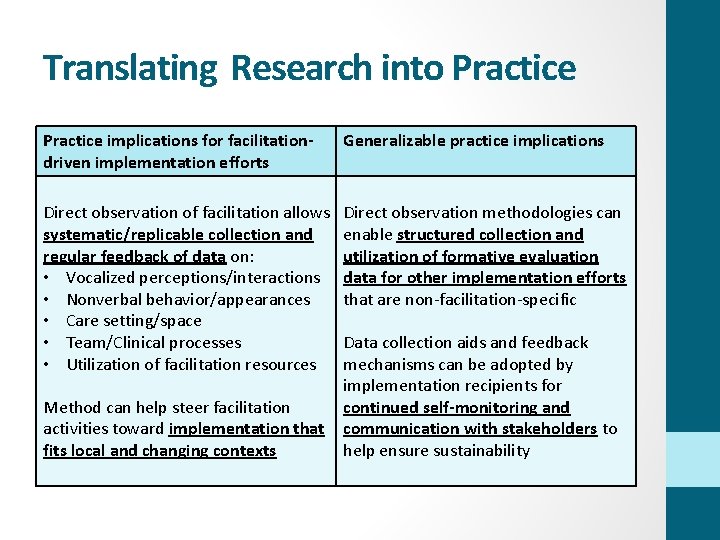
Translating Research into Practice implications for facilitationdriven implementation efforts Generalizable practice implications Direct observation of facilitation allows systematic/replicable collection and regular feedback of data on: • Vocalized perceptions/interactions • Nonverbal behavior/appearances • Care setting/space • Team/Clinical processes • Utilization of facilitation resources Direct observation methodologies can enable structured collection and utilization of formative evaluation data for other implementation efforts that are non-facilitation-specific Method can help steer facilitation activities toward implementation that fits local and changing contexts Data collection aids and feedback mechanisms can be adopted by implementation recipients for continued self-monitoring and communication with stakeholders to help ensure sustainability
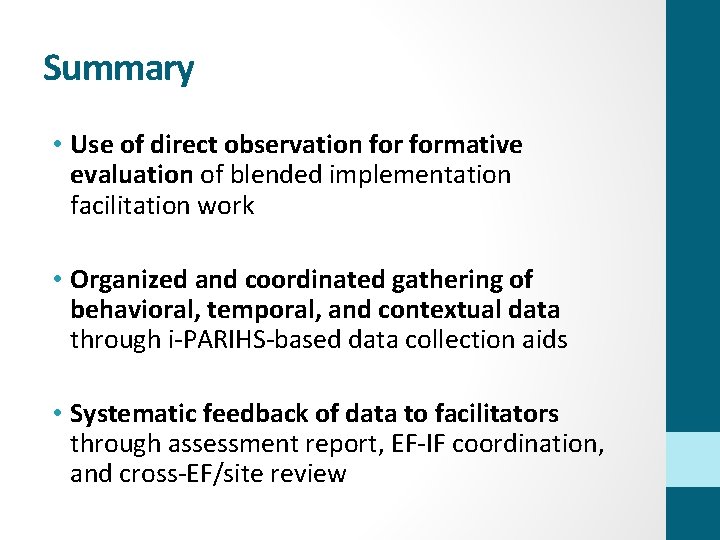
Summary • Use of direct observation formative evaluation of blended implementation facilitation work • Organized and coordinated gathering of behavioral, temporal, and contextual data through i-PARIHS-based data collection aids • Systematic feedback of data to facilitators through assessment report, EF-IF coordination, and cross-EF/site review
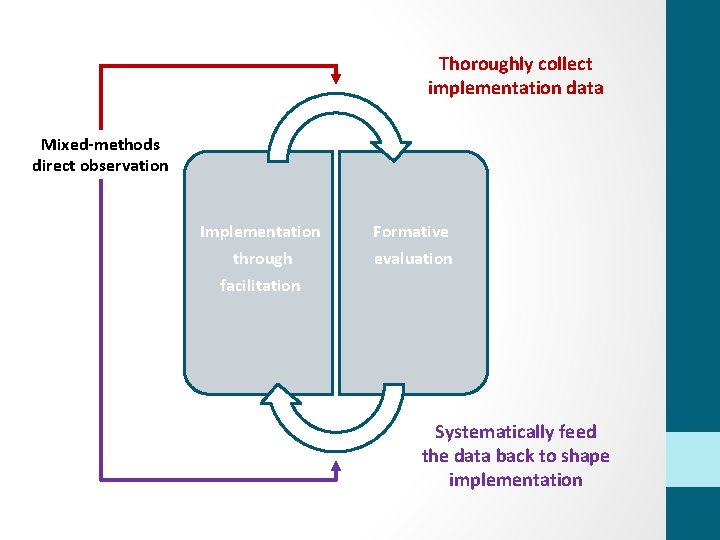
Thoroughly collect implementation data Mixed-methods direct observation Implementation through facilitation Formative evaluation Systematically feed the data back to shape implementation
Appendices
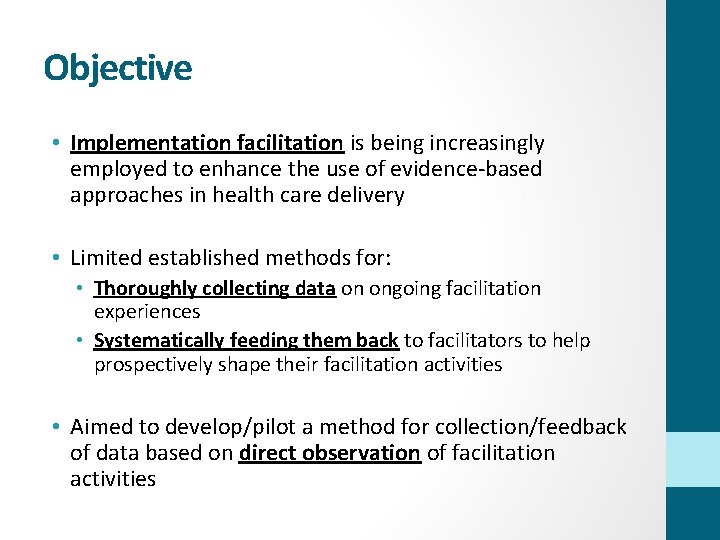
Objective • Implementation facilitation is being increasingly employed to enhance the use of evidence-based approaches in health care delivery • Limited established methods for: • Thoroughly collecting data on ongoing facilitation experiences • Systematically feeding them back to facilitators to help prospectively shape their facilitation activities • Aimed to develop/pilot a method for collection/feedback of data based on direct observation of facilitation activities
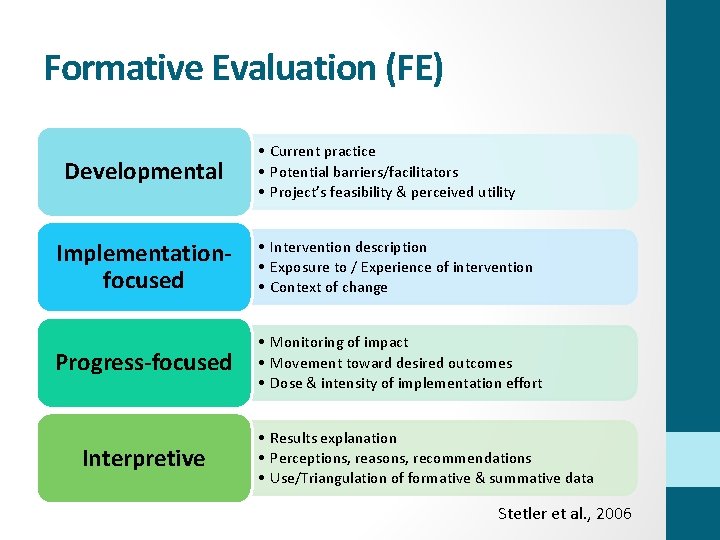
Formative Evaluation (FE) Developmental • Current practice • Potential barriers/facilitators • Project’s feasibility & perceived utility Implementationfocused • Intervention description • Exposure to / Experience of intervention • Context of change Progress-focused • Monitoring of impact • Movement toward desired outcomes • Dose & intensity of implementation effort Interpretive • Results explanation • Perceptions, reasons, recommendations • Use/Triangulation of formative & summative data Stetler et al. , 2006
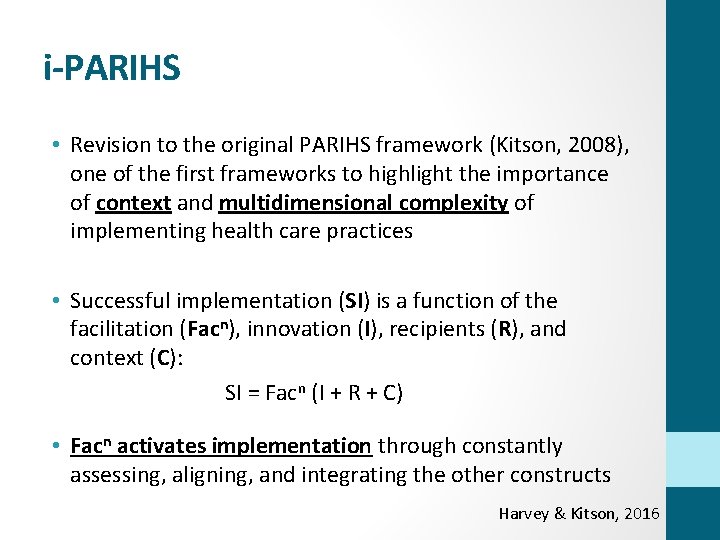
i-PARIHS • Revision to the original PARIHS framework (Kitson, 2008), one of the first frameworks to highlight the importance of context and multidimensional complexity of implementing health care practices • Successful implementation (SI) is a function of the facilitation (Facn), innovation (I), recipients (R), and context (C): SI = Facn (I + R + C) • Facn activates implementation through constantly assessing, aligning, and integrating the other constructs Harvey & Kitson, 2016
Implementation Facilitation From Ritchie et al. (2017)’s Implementation Facilitation Training Manual Version 2: • A multi-faceted process of enabling and supporting individuals, groups and organizations in their efforts to adopt and incorporate clinical innovations into routine practices • Can incorporate or include many other implementation strategies, e. g. , audit and feedback, education and training, and stakeholder engagement
Blended Facilitation • External Facilitator (EF): Brings the content and process expertise to a site • Internal Facilitator (IF): Offers the experience and knowledge of the site’s organizational culture and existing procedures Kirchner et al. , 2014
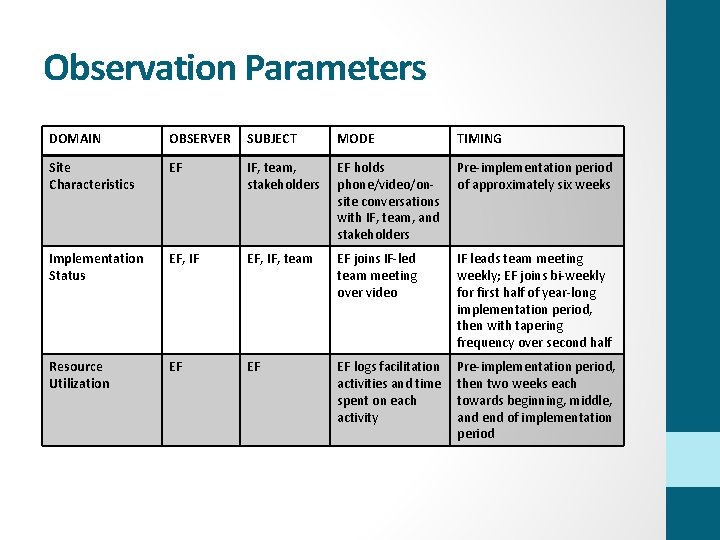
Observation Parameters DOMAIN OBSERVER SUBJECT MODE TIMING Site Characteristics EF IF, team, stakeholders EF holds phone/video/onsite conversations with IF, team, and stakeholders Pre-implementation period of approximately six weeks Implementation Status EF, IF, team EF joins IF-led team meeting over video IF leads team meeting weekly; EF joins bi-weekly for first half of year-long implementation period, then with tapering frequency over second half Resource Utilization EF EF EF logs facilitation activities and time spent on each activity Pre-implementation period, then two weeks each towards beginning, middle, and end of implementation period
- Slides: 29