
Using Design Patterns to Elaborate upon Design Models
Using Design Patterns to Elaborate upon Design Models Moving from Analysis to Design Examine Design models and initial code to: • Improve cohesion • Reduce coupling • Enhance Reusability Go. F Design Patterns should be used to rewrite code to promote these goals
Concordance Example A Concordance consists of an alphabetized list of words appearing in a short document together with an ordered list of the distinct line numbers of lines in which each word appears. Design and implement a short document concordance program. Your program should be able to accept any document, generate a Concordance for the document, and display (or print) the document with its concordance. The domain model will contain the following classes: Concordance Document Word. List Line. Number. List
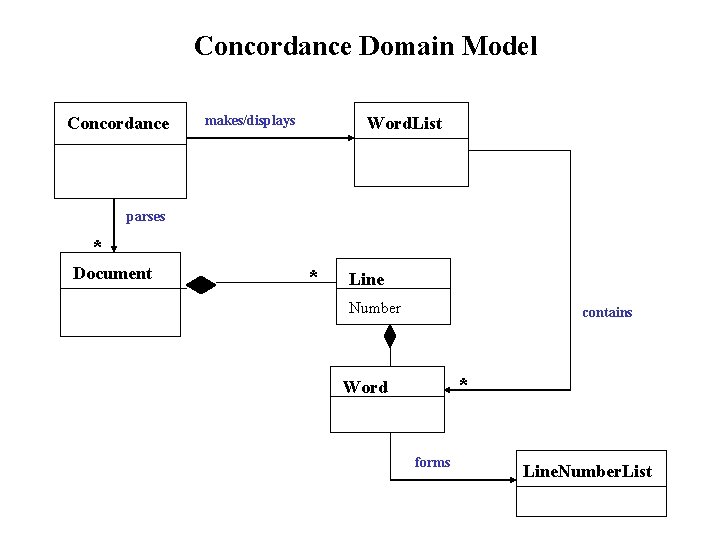
Concordance Domain Model Concordance makes/displays Word. List parses * Document * Line Number contains * Word forms Line. Number. List
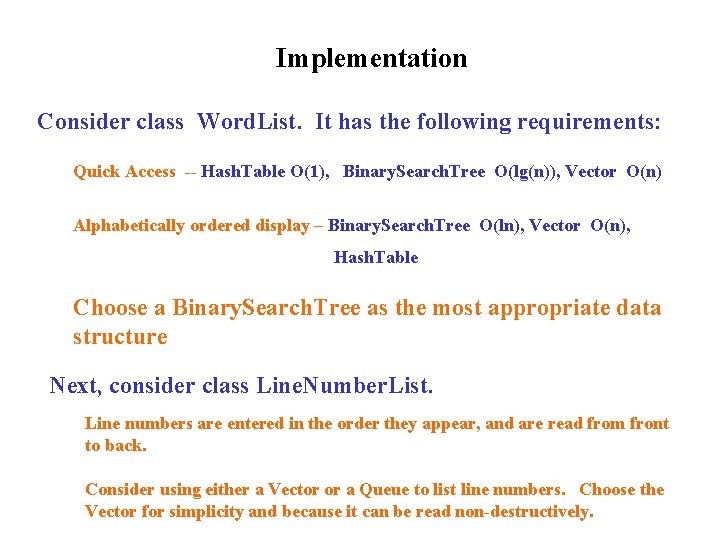
Implementation Consider class Word. List. It has the following requirements: Quick Access -- Hash. Table O(1), Binary. Search. Tree O(lg(n)), Vector O(n) Alphabetically ordered display – Binary. Search. Tree O(ln), Vector O(n), Hash. Table Choose a Binary. Search. Tree as the most appropriate data structure Next, consider class Line. Number. List. Line numbers are entered in the order they appear, and are read from front to back. Consider using either a Vector or a Queue to list line numbers. Choose the Vector for simplicity and because it can be read non-destructively.
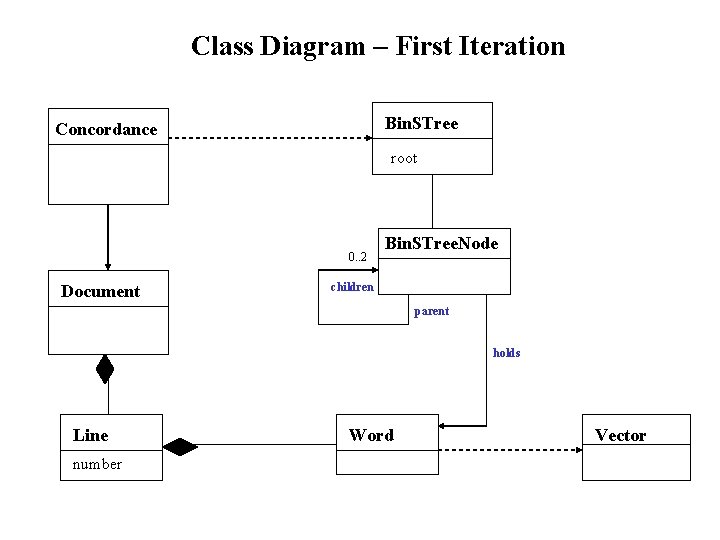
Class Diagram – First Iteration Bin. STree Concordance root 0. . 2 Document Bin. STree. Node children parent holds Line number Word Vector
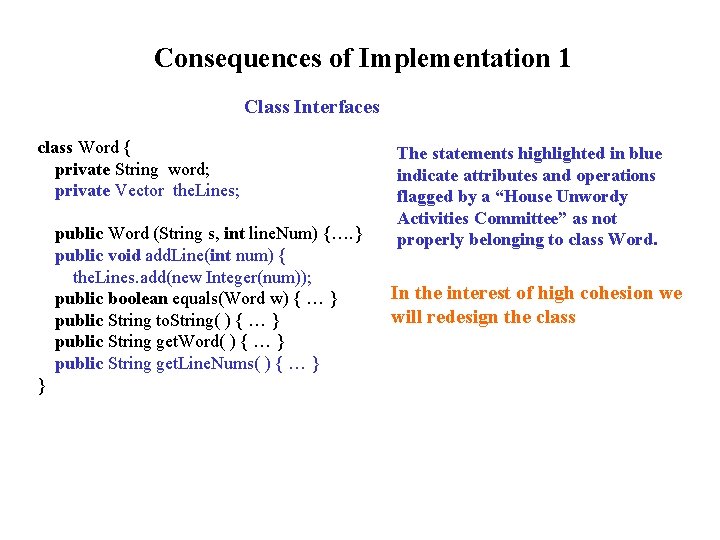
Consequences of Implementation 1 Class Interfaces class Word { private String word; private Vector the. Lines; public Word (String s, int line. Num) {…. } public void add. Line(int num) { the. Lines. add(new Integer(num)); public boolean equals(Word w) { … } public String to. String( ) { … } public String get. Word( ) { … } public String get. Line. Nums( ) { … } } The statements highlighted in blue indicate attributes and operations flagged by a “House Unwordy Activities Committee” as not properly belonging to class Word. In the interest of high cohesion we will redesign the class
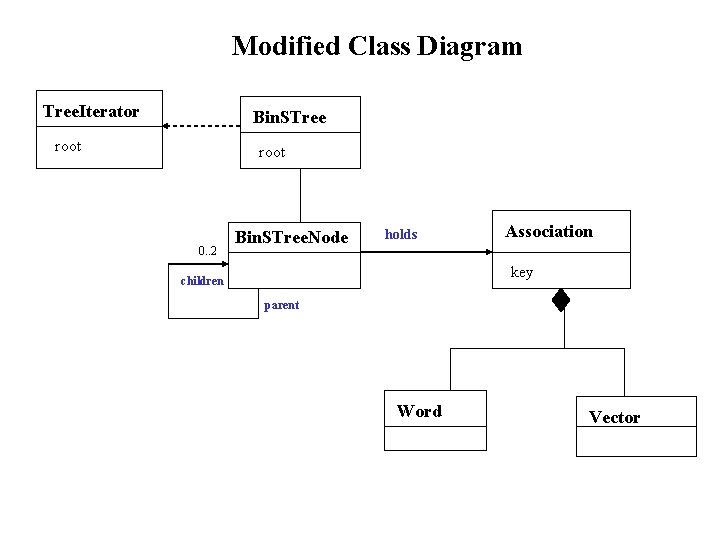
Modified Class Diagram Tree. Iterator Bin. STree root 0. . 2 Bin. STree. Node holds Association key children parent Word Vector
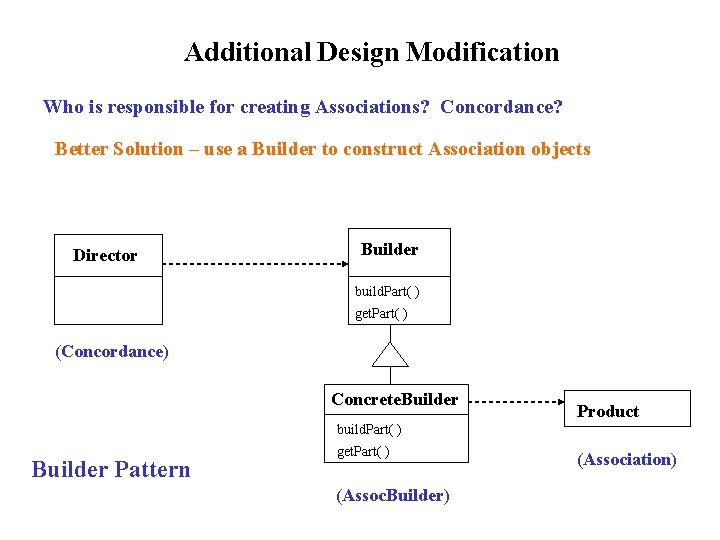
Additional Design Modification Who is responsible for creating Associations? Concordance? Better Solution – use a Builder to construct Association objects Director Builder build. Part( ) get. Part( ) (Concordance) Concrete. Builder Product build. Part( ) Builder Pattern get. Part( ) (Assoc. Builder) (Association)
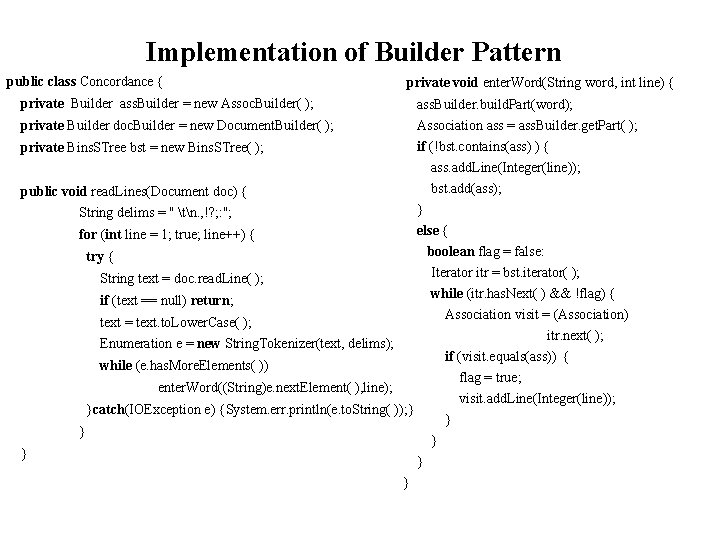
Implementation of Builder Pattern public class Concordance { private void enter. Word(String word, int line) { private Builder ass. Builder = new Assoc. Builder( ); ass. Builder. build. Part(word); private Builder doc. Builder = new Document. Builder( ); Association ass = ass. Builder. get. Part( ); if (!bst. contains(ass) ) { ass. add. Line(Integer(line)); bst. add(ass); public void read. Lines(Document doc) { } String delims = " tn. , !? ; : "; else { for (int line = 1; true; line++) { boolean flag = false: try { Iterator itr = bst. iterator( ); String text = doc. read. Line( ); while (itr. has. Next( ) && !flag) { if (text == null) return; Association visit = (Association) text = text. to. Lower. Case( ); itr. next( ); Enumeration e = new String. Tokenizer(text, delims); if (visit. equals(ass)) { while (e. has. More. Elements( )) flag = true; enter. Word((String)e. next. Element( ), line); visit. add. Line(Integer(line)); }catch(IOException e) {System. err. println(e. to. String( )); } } } } private Bins. STree bst = new Bins. STree( );
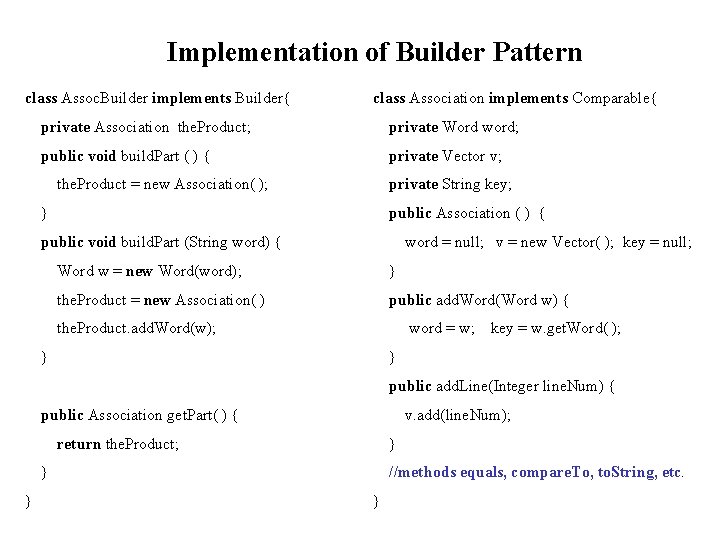
Implementation of Builder Pattern class Assoc. Builder implements Builder{ class Association implements Comparable{ private Association the. Product; private Word word; public void build. Part ( ) { private Vector v; the. Product = new Association( ); private String key; } public Association ( ) { public void build. Part (String word) { word = null; v = new Vector( ); key = null; Word w = new Word(word); } the. Product = new Association( ) public add. Word(Word w) { the. Product. add. Word(w); word = w; } key = w. get. Word( ); } public add. Line(Integer line. Num) { public Association get. Part( ) { v. add(line. Num); return the. Product; } } } //methods equals, compare. To, to. String, etc. }
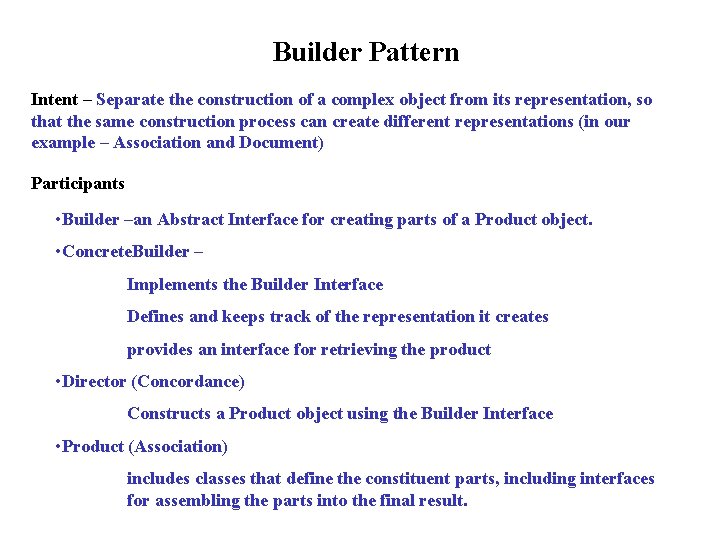
Builder Pattern Intent – Separate the construction of a complex object from its representation, so that the same construction process can create different representations (in our example – Association and Document) Participants • Builder –an Abstract Interface for creating parts of a Product object. • Concrete. Builder – Implements the Builder Interface Defines and keeps track of the representation it creates provides an interface for retrieving the product • Director (Concordance) Constructs a Product object using the Builder Interface • Product (Association) includes classes that define the constituent parts, including interfaces for assembling the parts into the final result.
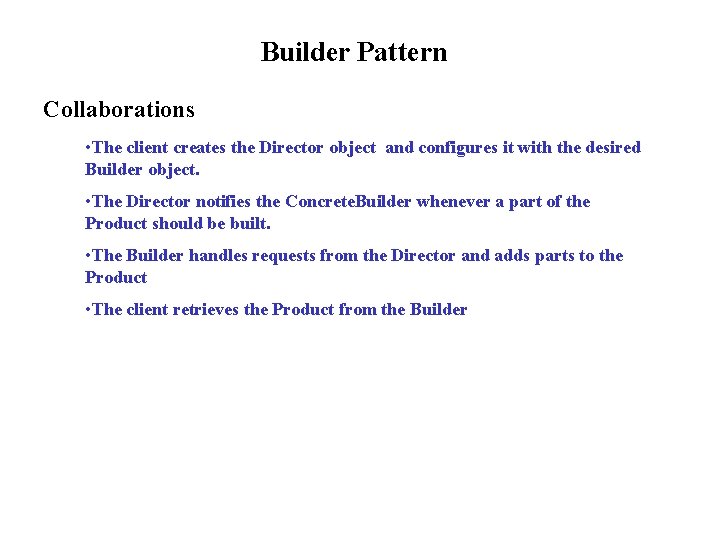
Builder Pattern Collaborations • The client creates the Director object and configures it with the desired Builder object. • The Director notifies the Concrete. Builder whenever a part of the Product should be built. • The Builder handles requests from the Director and adds parts to the Product • The client retrieves the Product from the Builder
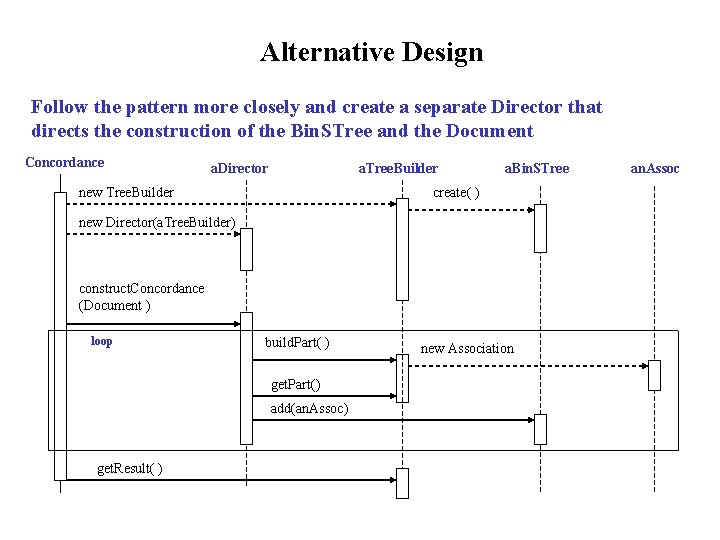
Alternative Design Follow the pattern more closely and create a separate Director that directs the construction of the Bin. STree and the Document Concordance a. Director a. Tree. Builder new Tree. Builder a. Bin. STree create( ) new Director(a. Tree. Builder) construct. Concordance (Document ) loop build. Part( ) get. Part() add(an. Assoc) get. Result( ) new Association an. Assoc
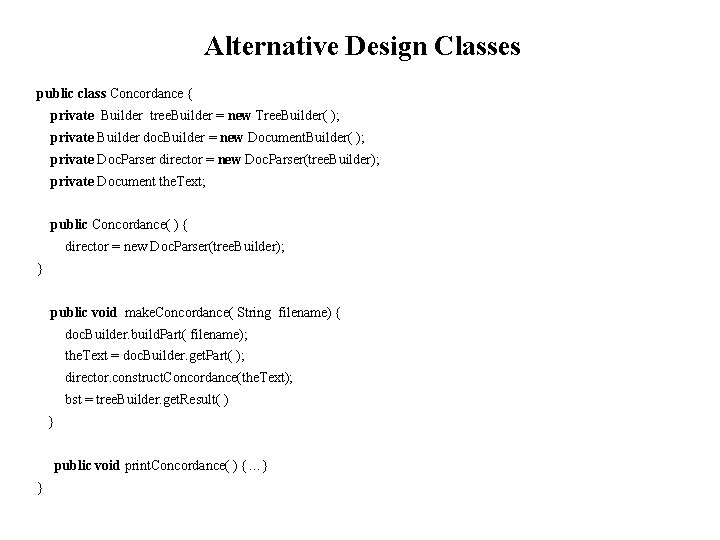
Alternative Design Classes public class Concordance { private Builder tree. Builder = new Tree. Builder( ); private Builder doc. Builder = new Document. Builder( ); private Doc. Parser director = new Doc. Parser(tree. Builder); private Document the. Text; public Concordance( ) { director = new Doc. Parser(tree. Builder); } public void make. Concordance( String filename) { doc. Builder. build. Part( filename); the. Text = doc. Builder. get. Part( ); director. construct. Concordance(the. Text); bst = tree. Builder. get. Result( ) } public void print. Concordance( ) {…} }
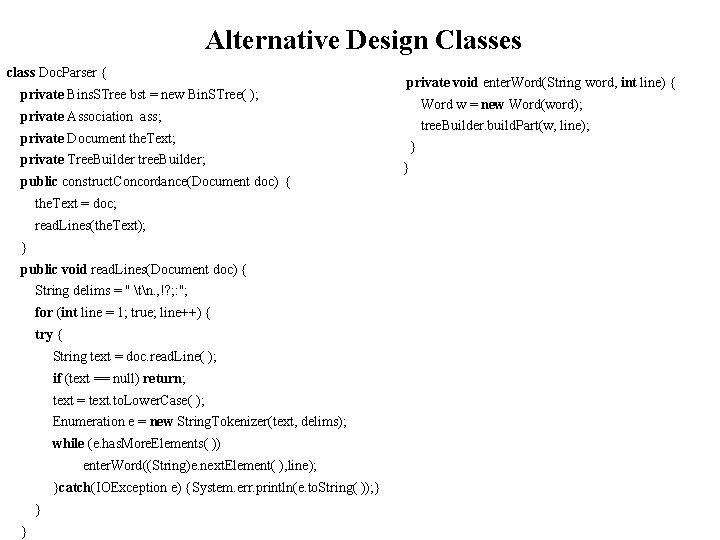
Alternative Design Classes class Doc. Parser { private Bins. STree bst = new Bin. STree( ); private void enter. Word(String word, int line) { Word w = new Word(word); private Association ass; tree. Builder. build. Part(w, line); private Document the. Text; private Tree. Builder tree. Builder; public construct. Concordance(Document doc) { the. Text = doc; read. Lines(the. Text); } public void read. Lines(Document doc) { String delims = " tn. , !? ; : "; for (int line = 1; true; line++) { try { String text = doc. read. Line( ); if (text == null) return; text = text. to. Lower. Case( ); Enumeration e = new String. Tokenizer(text, delims); while (e. has. More. Elements( )) enter. Word((String)e. next. Element( ), line); }catch(IOException e) {System. err. println(e. to. String( )); } } }
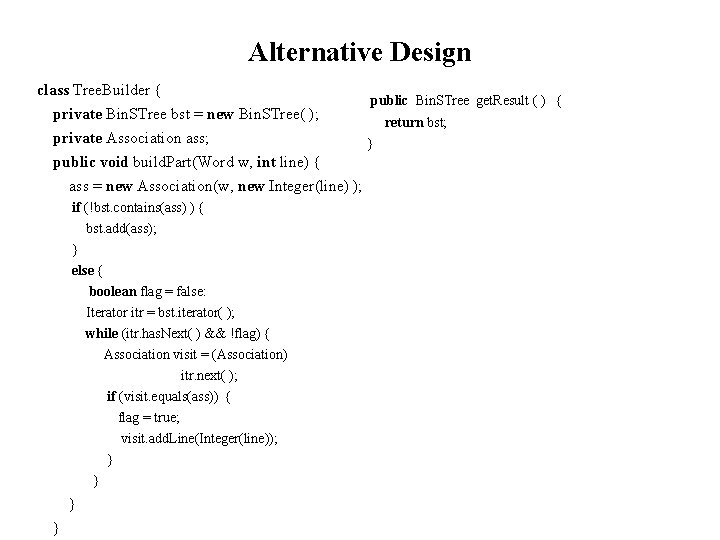
Alternative Design class Tree. Builder { private Bin. STree bst = new Bin. STree( ); private Association ass; public void build. Part(Word w, int line) { ass = new Association(w, new Integer(line) ); if (!bst. contains(ass) ) { bst. add(ass); } else { boolean flag = false: Iterator itr = bst. iterator( ); while (itr. has. Next( ) && !flag) { Association visit = (Association) itr. next( ); if (visit. equals(ass)) { flag = true; visit. add. Line(Integer(line)); } } public Bin. STree get. Result ( ) { return bst; }
Additional Patterns Singleton Adapter Composite
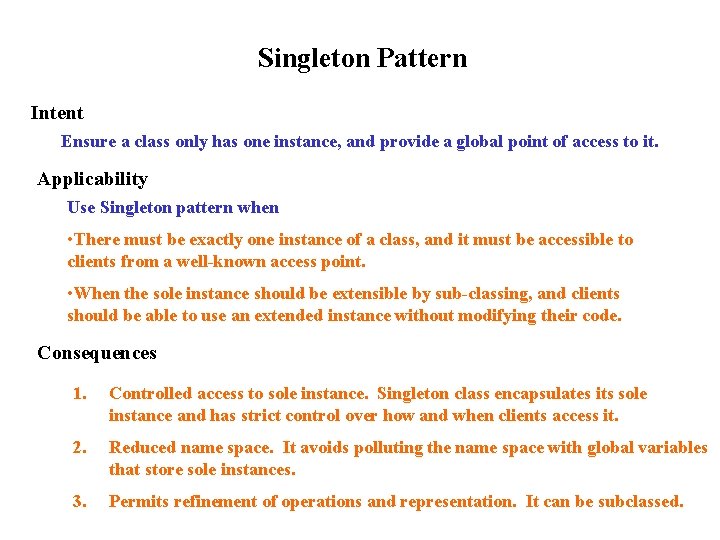
Singleton Pattern Intent Ensure a class only has one instance, and provide a global point of access to it. Applicability Use Singleton pattern when • There must be exactly one instance of a class, and it must be accessible to clients from a well-known access point. • When the sole instance should be extensible by sub-classing, and clients should be able to use an extended instance without modifying their code. Consequences 1. Controlled access to sole instance. Singleton class encapsulates its sole instance and has strict control over how and when clients access it. 2. Reduced name space. It avoids polluting the name space with global variables that store sole instances. 3. Permits refinement of operations and representation. It can be subclassed.
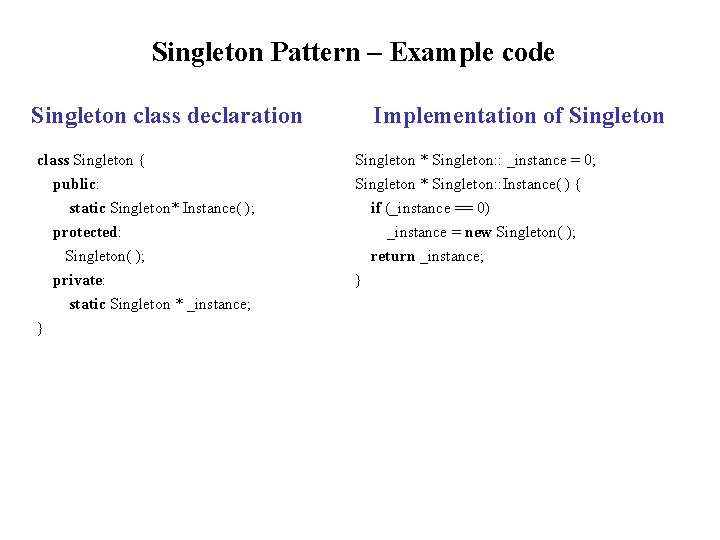
Singleton Pattern – Example code Singleton class declaration class Singleton { } Implementation of Singleton * Singleton: : _instance = 0; public: static Singleton* Instance( ); protected: Singleton( ); Singleton * Singleton: : Instance( ) { if (_instance == 0) _instance = new Singleton( ); return _instance; private: static Singleton * _instance; }
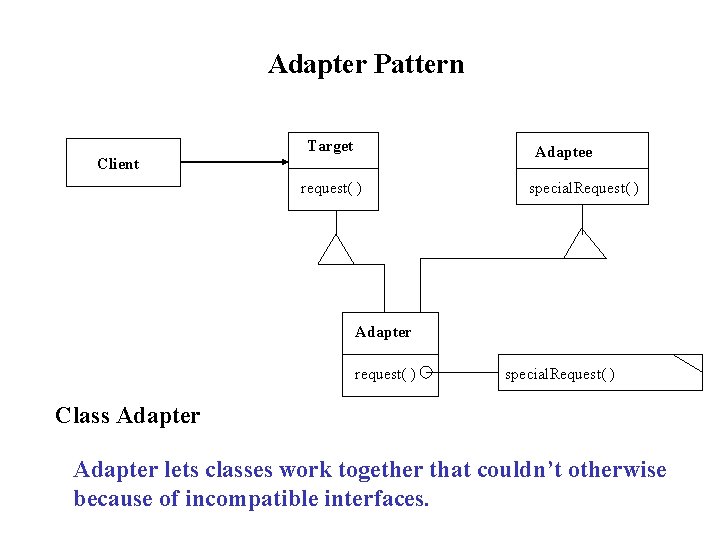
Adapter Pattern Target Adaptee Client request( ) special. Request( ) Adapter request( ) special. Request( ) Class Adapter lets classes work together that couldn’t otherwise because of incompatible interfaces.
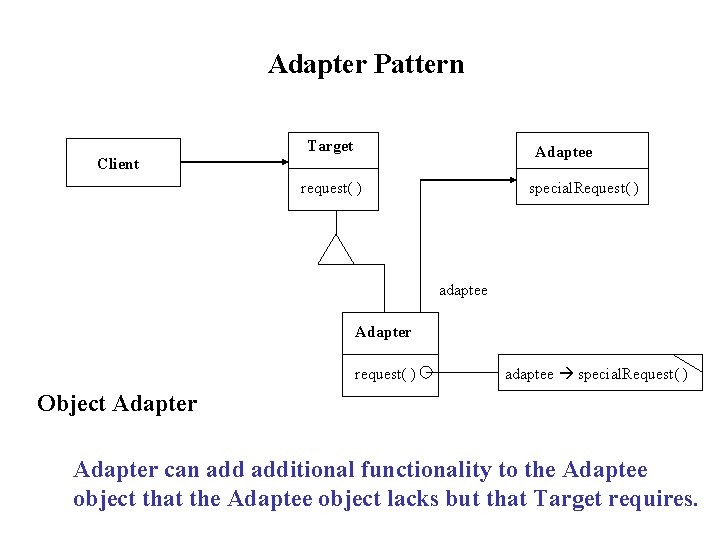
Adapter Pattern Target Adaptee Client special. Request( ) request( ) adaptee Adapter request( ) adaptee special. Request( ) Object Adapter can additional functionality to the Adaptee object that the Adaptee object lacks but that Target requires.
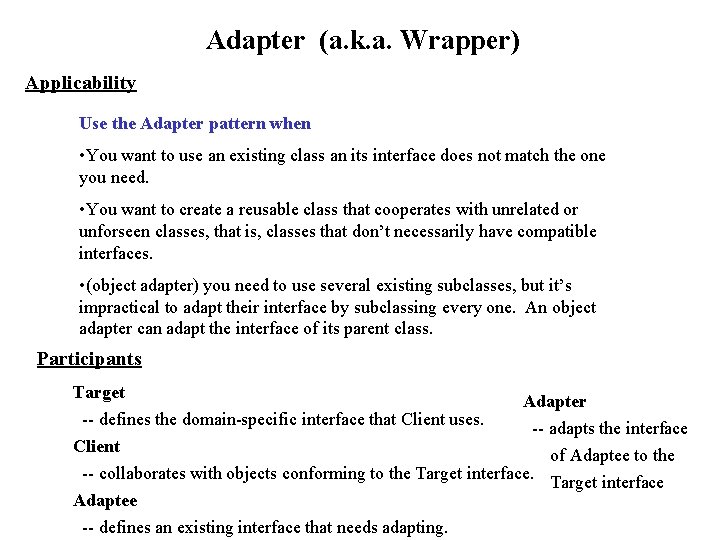
Adapter (a. k. a. Wrapper) Applicability Use the Adapter pattern when • You want to use an existing class an its interface does not match the one you need. • You want to create a reusable class that cooperates with unrelated or unforseen classes, that is, classes that don’t necessarily have compatible interfaces. • (object adapter) you need to use several existing subclasses, but it’s impractical to adapt their interface by subclassing every one. An object adapter can adapt the interface of its parent class. Participants Target -- defines the domain-specific interface that Client uses. Adapter -- adapts the interface Client of Adaptee to the -- collaborates with objects conforming to the Target interface Adaptee -- defines an existing interface that needs adapting.
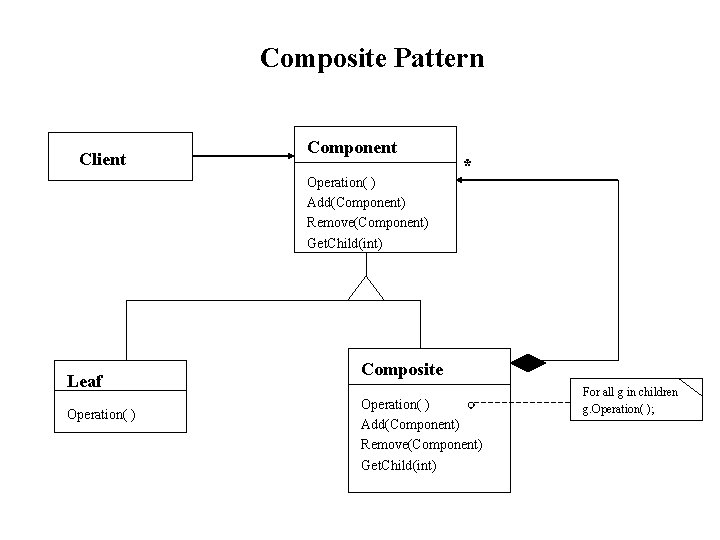
Composite Pattern Client Component Operation( ) Add(Component) Remove(Component) Get. Child(int) Leaf Operation( ) * Composite Operation( ) Add(Component) Remove(Component) Get. Child(int) For all g in children g. Operation( );
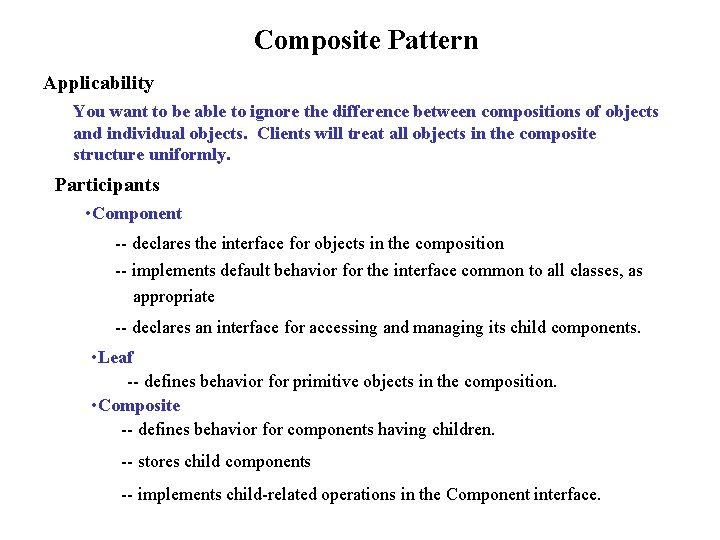
Composite Pattern Applicability You want to be able to ignore the difference between compositions of objects and individual objects. Clients will treat all objects in the composite structure uniformly. Participants • Component -- declares the interface for objects in the composition -- implements default behavior for the interface common to all classes, as appropriate -- declares an interface for accessing and managing its child components. • Leaf -- defines behavior for primitive objects in the composition. • Composite -- defines behavior for components having children. -- stores child components -- implements child-related operations in the Component interface.
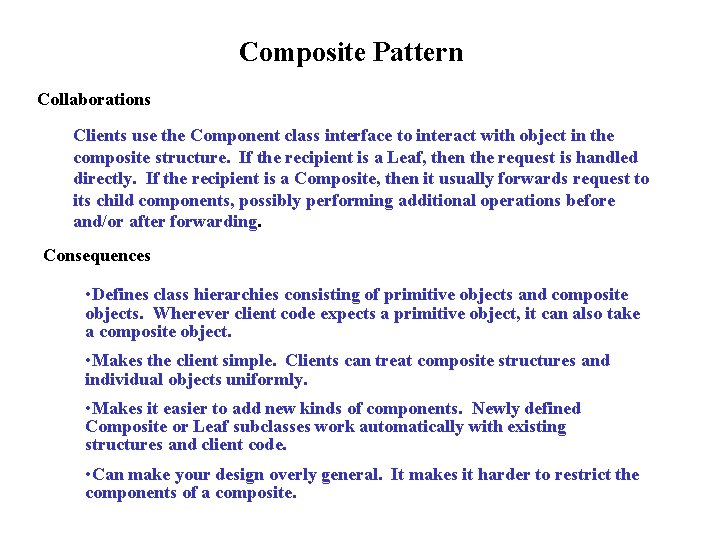
Composite Pattern Collaborations Clients use the Component class interface to interact with object in the composite structure. If the recipient is a Leaf, then the request is handled directly. If the recipient is a Composite, then it usually forwards request to its child components, possibly performing additional operations before and/or after forwarding. Consequences • Defines class hierarchies consisting of primitive objects and composite objects. Wherever client code expects a primitive object, it can also take a composite object. • Makes the client simple. Clients can treat composite structures and individual objects uniformly. • Makes it easier to add new kinds of components. Newly defined Composite or Leaf subclasses work automatically with existing structures and client code. • Can make your design overly general. It makes it harder to restrict the components of a composite.
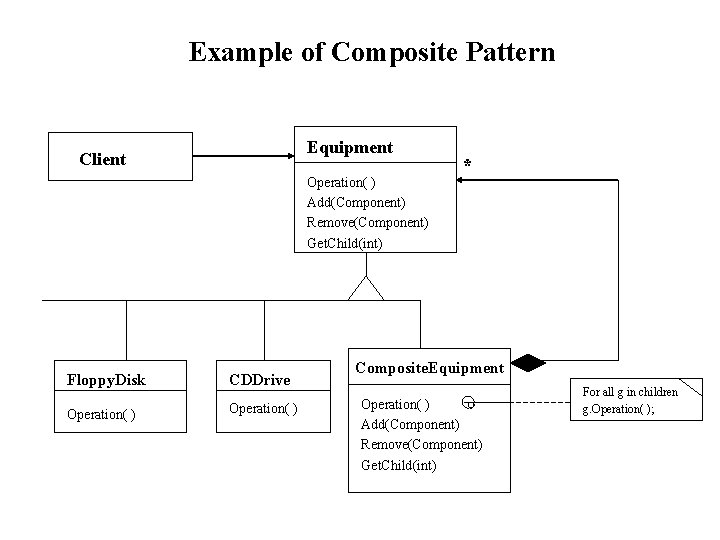
Example of Composite Pattern Equipment Client Operation( ) Add(Component) Remove(Component) Get. Child(int) Floppy. Disk CDDrive Operation( ) * Composite. Equipment Operation( ) Add(Component) Remove(Component) Get. Child(int) For all g in children g. Operation( );
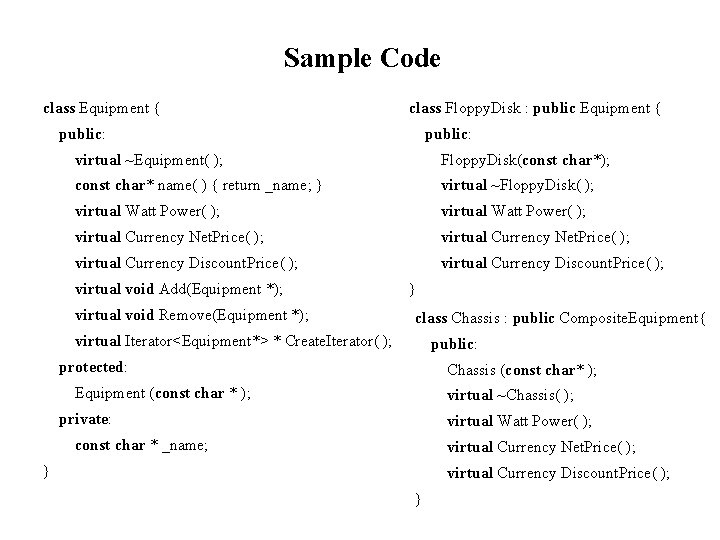
Sample Code class Equipment { class Floppy. Disk : public Equipment { public: virtual ~Equipment( ); Floppy. Disk(const char*); const char* name( ) { return _name; } virtual ~Floppy. Disk( ); virtual Watt Power( ); virtual Currency Net. Price( ); virtual Currency Discount. Price( ); virtual void Add(Equipment *); virtual void Remove(Equipment *); } class Chassis : public Composite. Equipment{ virtual Iterator<Equipment*> * Create. Iterator( ); public: protected: Chassis (const char* ); Equipment (const char * ); virtual ~Chassis( ); private: virtual Watt Power( ); const char * _name; virtual Currency Net. Price( ); } virtual Currency Discount. Price( ); }
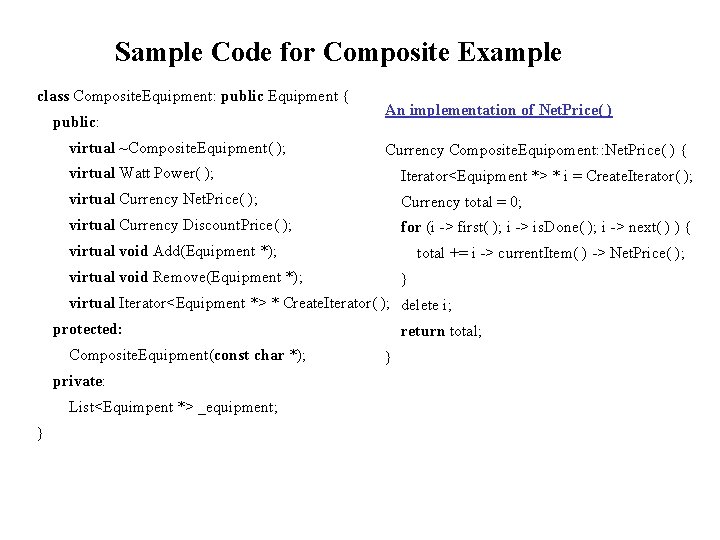
Sample Code for Composite Example class Composite. Equipment: public Equipment { public: virtual ~Composite. Equipment( ); An implementation of Net. Price( ) Currency Composite. Equipoment: : Net. Price( ) { virtual Watt Power( ); Iterator<Equipment *> * i = Create. Iterator( ); virtual Currency Net. Price( ); Currency total = 0; virtual Currency Discount. Price( ); for (i -> first( ); i -> is. Done( ); i -> next( ) ) { virtual void Add(Equipment *); total += i -> current. Item( ) -> Net. Price( ); virtual void Remove(Equipment *); } virtual Iterator<Equipment *> * Create. Iterator( ); delete i; protected: return total; Composite. Equipment(const char *); private: List<Equimpent *> _equipment; } }
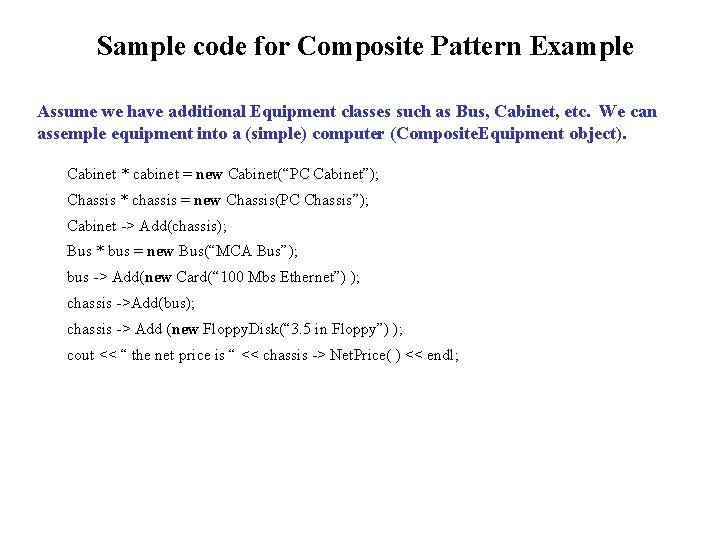
Sample code for Composite Pattern Example Assume we have additional Equipment classes such as Bus, Cabinet, etc. We can assemple equipment into a (simple) computer (Composite. Equipment object). Cabinet * cabinet = new Cabinet(“PC Cabinet”); Chassis * chassis = new Chassis(PC Chassis”); Cabinet -> Add(chassis); Bus * bus = new Bus(“MCA Bus”); bus -> Add(new Card(“ 100 Mbs Ethernet”) ); chassis ->Add(bus); chassis -> Add (new Floppy. Disk(“ 3. 5 in Floppy”) ); cout << “ the net price is “ << chassis -> Net. Price( ) << endl;
- Slides: 29