
Using Data to Transform Community Correction Interventions Mike

- Slides: 43
Using Data to Transform Community Correction Interventions Mike Randle Vice President of Summit County Programs Derek Ault Lead Research Specialist Oriana House, Inc.
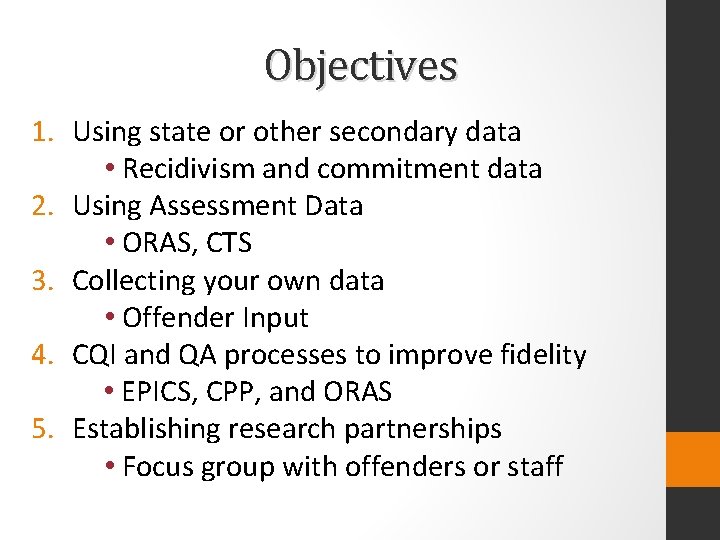
Objectives 1. Using state or other secondary data • Recidivism and commitment data 2. Using Assessment Data • ORAS, CTS 3. Collecting your own data • Offender Input 4. CQI and QA processes to improve fidelity • EPICS, CPP, and ORAS 5. Establishing research partnerships • Focus group with offenders or staff
USING STATE OR OTHER SECONDARY DATA Problem 1
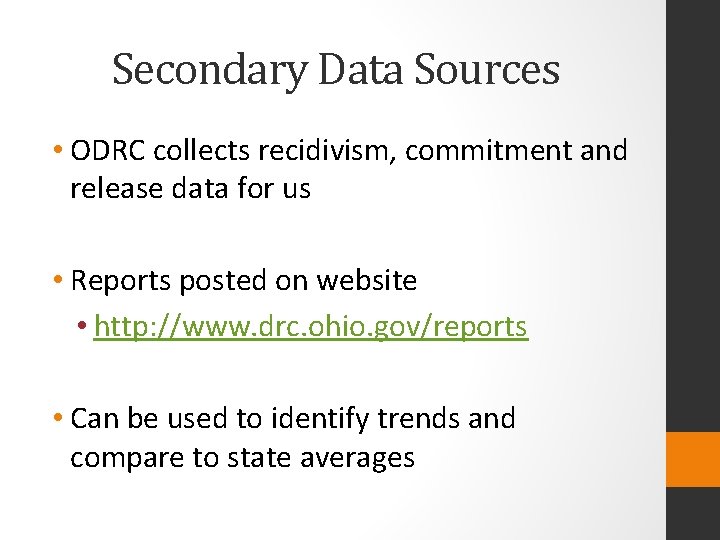
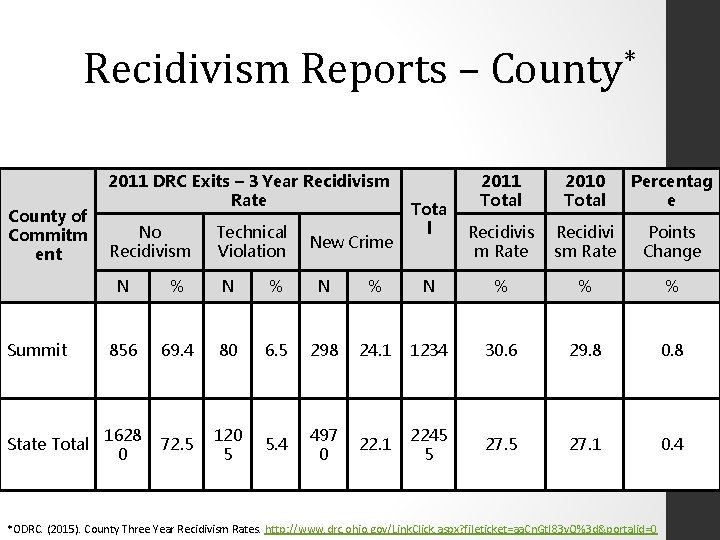
Secondary Data Sources • ODRC collects recidivism, commitment and release data for us • Reports posted on website • http: //www. drc. ohio. gov/reports • Can be used to identify trends and compare to state averages
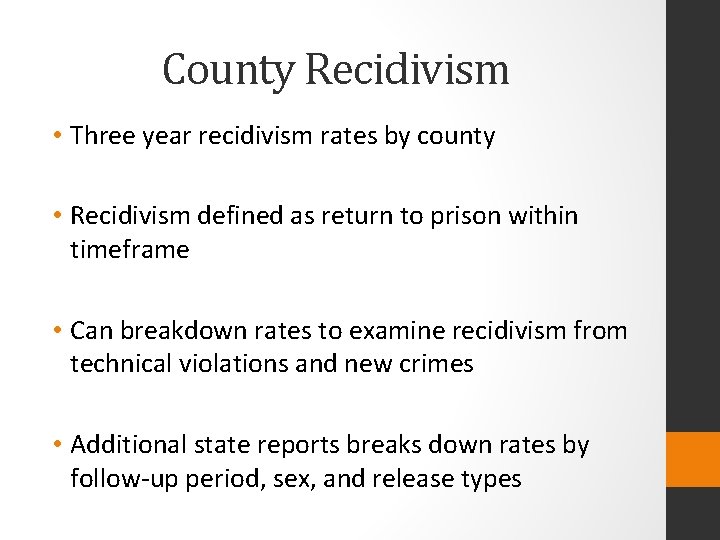
County Recidivism • Three year recidivism rates by county • Recidivism defined as return to prison within timeframe • Can breakdown rates to examine recidivism from technical violations and new crimes • Additional state reports breaks down rates by follow-up period, sex, and release types
Recidivism Reports – County* County of Commitm ent 2011 DRC Exits – 3 Year Recidivism Rate No Recidivism Technical Violation New Crime Tota l 2011 Total 2010 Total Percentag e Recidivis m Rate Recidivi sm Rate Points Change N % N % % % Summit 856 69. 4 80 6. 5 298 24. 1 1234 30. 6 29. 8 0. 8 State Total 1628 0 72. 5 120 5 5. 4 497 0 22. 1 2245 5 27. 1 0. 4 *ODRC. (2015). County Three Year Recidivism Rates. http: //www. drc. ohio. gov/Link. Click. aspx? fileticket=aa. Cn. Gt. I 83 v. Q%3 d&portalid=0
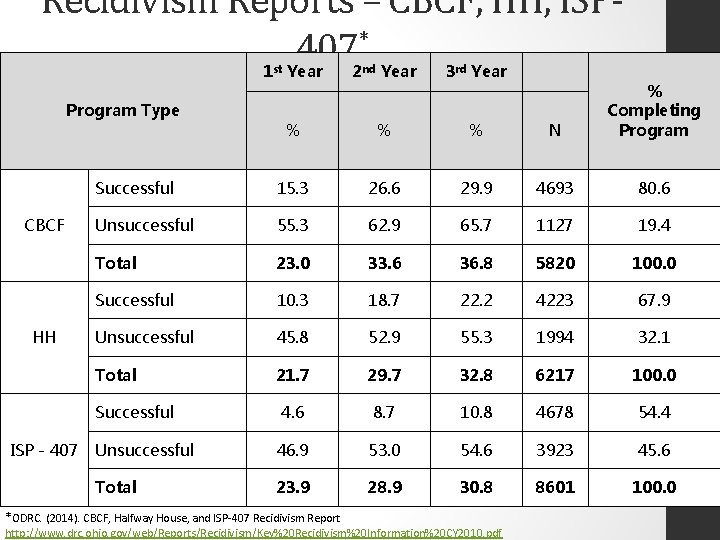
CBCF, HH, ISP-407 Recidivism • Includes all programs that receive funding from the ODRC • CY 2010 Cohort (1, 2, and 3 year recidivism rates) CY 2011 Cohort (1 and 2 year recidivism rates) CY 2012 Cohort (1 year recidivism rate) • Recidivism defined as, “failed supervision or community placement resulting in placement in Ohio’s prisons”
Recidivism Reports – CBCF, HH, ISP 407* 1 st Year 2 nd Year 3 rd Year % % % N % Completing Program Successful 15. 3 26. 6 29. 9 4693 80. 6 Unsuccessful 55. 3 62. 9 65. 7 1127 19. 4 Total 23. 0 33. 6 36. 8 5820 100. 0 Successful 10. 3 18. 7 22. 2 4223 67. 9 Unsuccessful 45. 8 52. 9 55. 3 1994 32. 1 Total 21. 7 29. 7 32. 8 6217 100. 0 Successful 4. 6 8. 7 10. 8 4678 54. 4 Unsuccessful 46. 9 53. 0 54. 6 3923 45. 6 Total 23. 9 28. 9 30. 8 8601 100. 0 Program Type CBCF HH ISP - 407 *ODRC. (2014). CBCF, Halfway House, and ISP-407 Recidivism Report http: //www. drc. ohio. gov/web/Reports/Recidivism/Key%20 Recidivism%20 Information%20 CY 2010. pdf
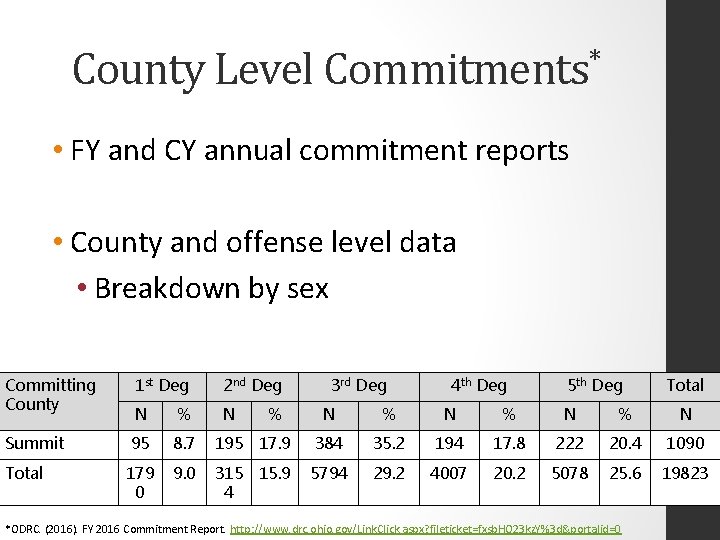
County Level Commitments* • FY and CY annual commitment reports • County and offense level data • Breakdown by sex Committing County 1 st Deg 2 nd Deg N % N Summit 95 8. 7 Total 179 0 9. 0 % 3 rd Deg 4 th Deg 5 th Deg Total N % N % N 195 17. 9 384 35. 2 194 17. 8 222 20. 4 1090 315 15. 9 4 5794 29. 2 4007 20. 2 5078 25. 6 19823 *ODRC. (2016). FY 2016 Commitment Report. http: //www. drc. ohio. gov/Link. Click. aspx? fileticket=fxsb. HO 23 kz. Y%3 d&portalid=0
Application of Secondary Data
USING CLIENT/OFFENDER ASSESSMENT DATA Problem 2
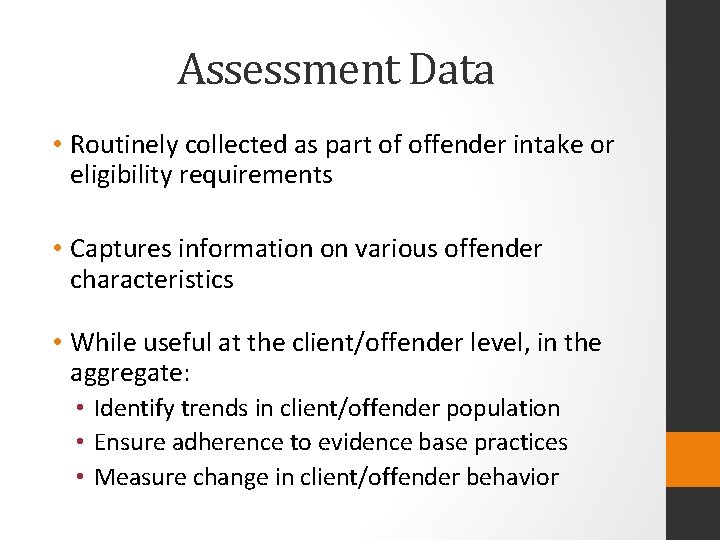
Assessment Data • Routinely collected as part of offender intake or eligibility requirements • Captures information on various offender characteristics • While useful at the client/offender level, in the aggregate: • Identify trends in client/offender population • Ensure adherence to evidence base practices • Measure change in client/offender behavior
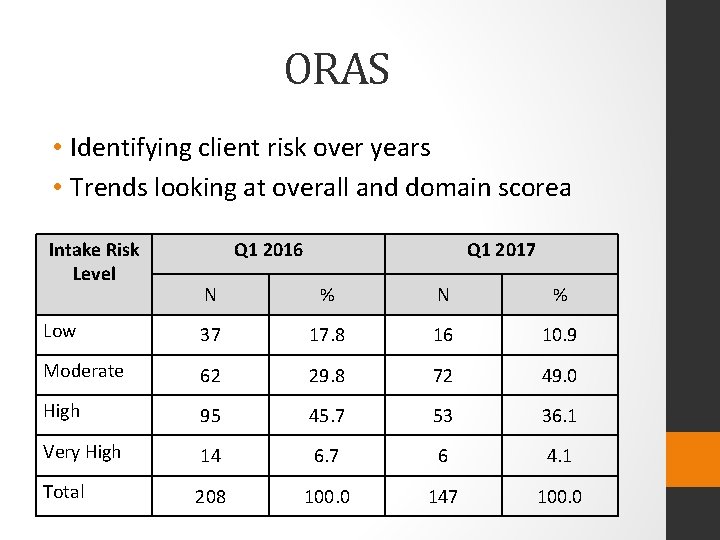
ORAS • Identifying client risk over years • Trends looking at overall and domain scorea Intake Risk Level Q 1 2016 Q 1 2017 N % Low 37 17. 8 16 10. 9 Moderate 62 29. 8 72 49. 0 High 95 45. 7 53 36. 1 Very High 14 6. 7 6 4. 1 Total 208 100. 0 147 100. 0
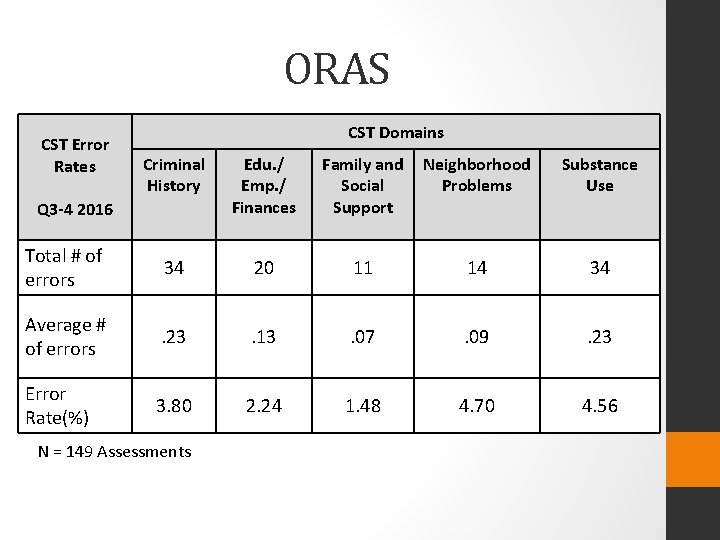
ORAS CST Error Rates CST Domains Criminal History Edu. / Emp. / Finances Family and Social Support Neighborhood Problems Substance Use Total # of errors 34 20 11 14 34 Average # of errors . 23 . 13 . 07 . 09 . 23 Error Rate(%) 3. 80 2. 24 1. 48 4. 70 4. 56 Q 3 -4 2016 N = 149 Assessments
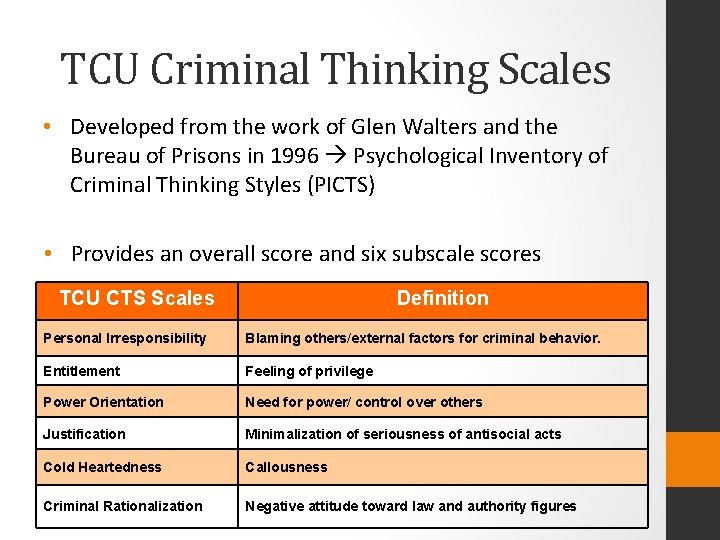
TCU Criminal Thinking Scales • Developed from the work of Glen Walters and the Bureau of Prisons in 1996 Psychological Inventory of Criminal Thinking Styles (PICTS) • Provides an overall score and six subscale scores TCU CTS Scales Definition Personal Irresponsibility Blaming others/external factors for criminal behavior. Entitlement Feeling of privilege Power Orientation Need for power/ control over others Justification Minimalization of seriousness of antisocial acts Cold Heartedness Callousness Criminal Rationalization Negative attitude toward law and authority figures
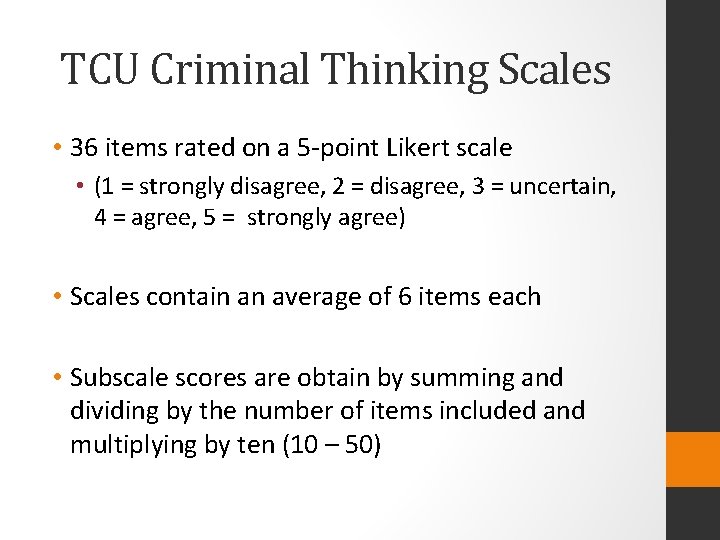
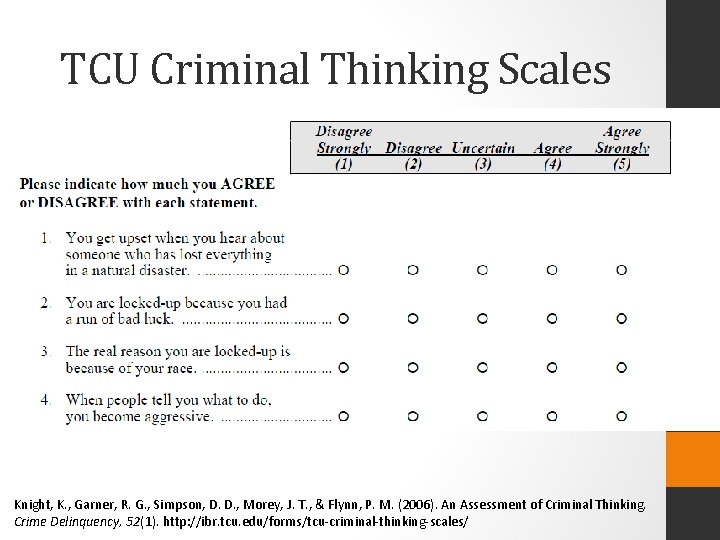
TCU Criminal Thinking Scales • 36 items rated on a 5 -point Likert scale • (1 = strongly disagree, 2 = disagree, 3 = uncertain, 4 = agree, 5 = strongly agree) • Scales contain an average of 6 items each • Subscale scores are obtain by summing and dividing by the number of items included and multiplying by ten (10 – 50)
TCU Criminal Thinking Scales Knight, K. , Garner, R. G. , Simpson, D. D. , Morey, J. T. , & Flynn, P. M. (2006). An Assessment of Criminal Thinking. Crime Delinquency, 52(1). http: //ibr. tcu. edu/forms/tcu-criminal-thinking-scales/
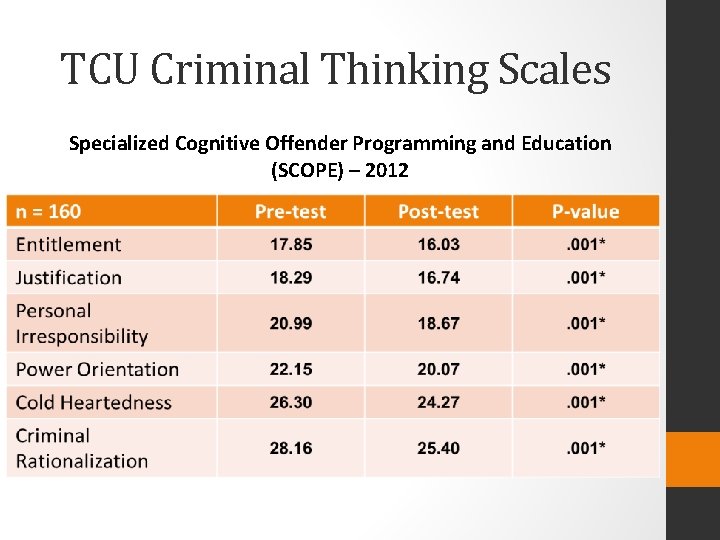
TCU Criminal Thinking Scales Specialized Cognitive Offender Programming and Education (SCOPE) – 2012
Application of Assessment Data
COLLECTING OUR OWN DATA Problem 3
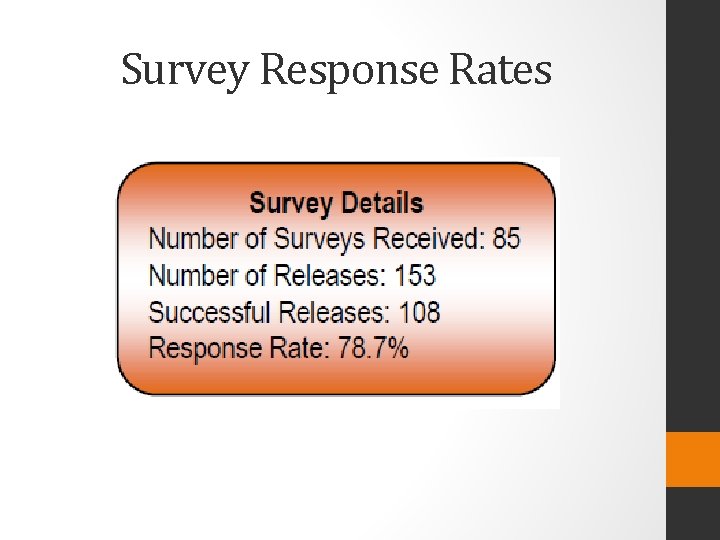
Survey Data • Easy method to collect client/offender satisfaction • Identify population of focus • Establishing timelines • What to ask
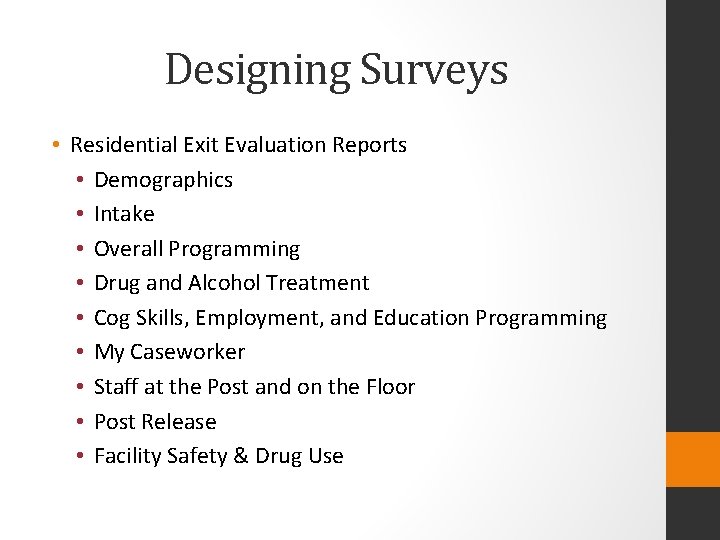
Designing Surveys • Residential Exit Evaluation Reports • Demographics • Intake • Overall Programming • Drug and Alcohol Treatment • Cog Skills, Employment, and Education Programming • My Caseworker • Staff at the Post and on the Floor • Post Release • Facility Safety & Drug Use
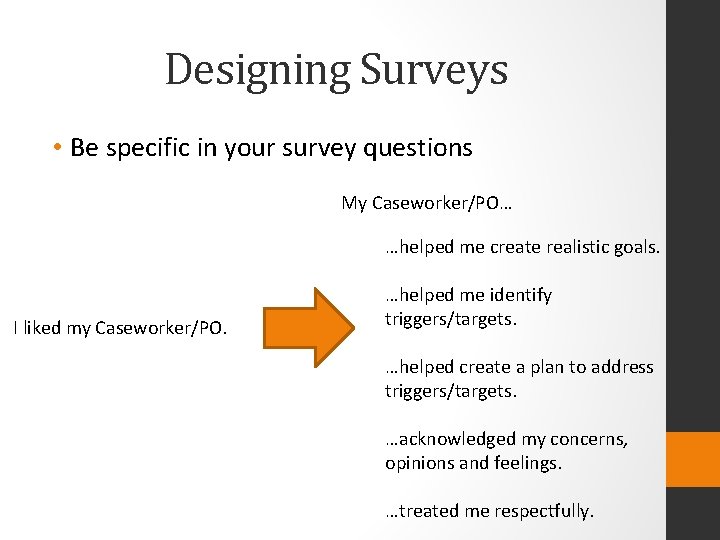
Designing Surveys • Be specific in your survey questions My Caseworker/PO… …helped me create realistic goals. I liked my Caseworker/PO. …helped me identify triggers/targets. …helped create a plan to address triggers/targets. …acknowledged my concerns, opinions and feelings. …treated me respectfully.
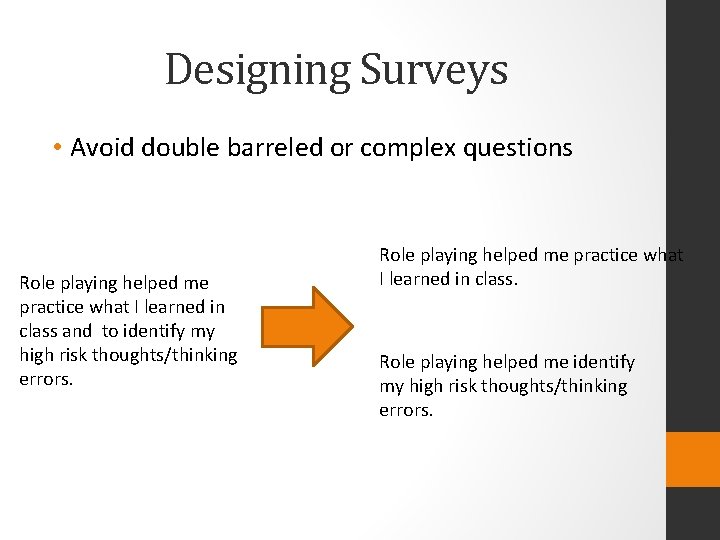
Designing Surveys • Avoid double barreled or complex questions Role playing helped me practice what I learned in class and to identify my high risk thoughts/thinking errors. Role playing helped me practice what I learned in class. Role playing helped me identify my high risk thoughts/thinking errors.
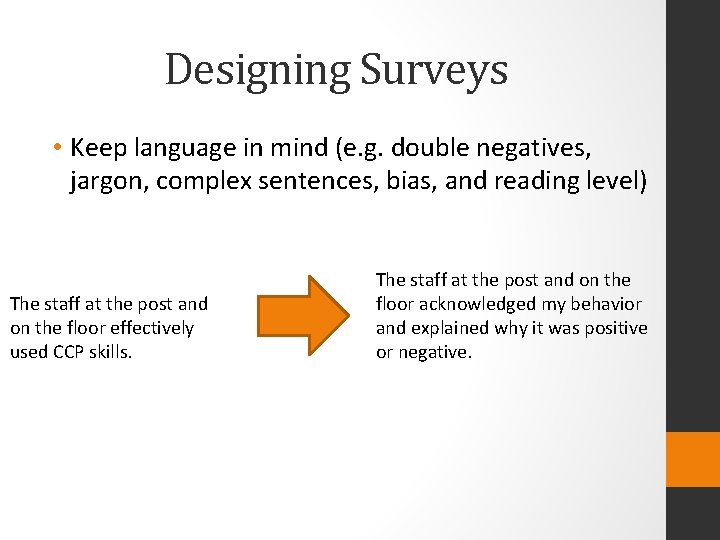
Designing Surveys • Keep language in mind (e. g. double negatives, jargon, complex sentences, bias, and reading level) The staff at the post and on the floor effectively used CCP skills. The staff at the post and on the floor acknowledged my behavior and explained why it was positive or negative.
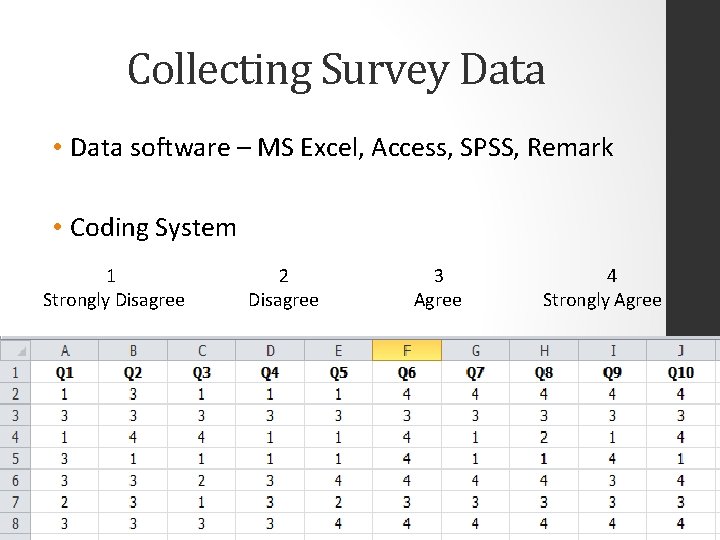
Collecting Survey Data • Data software – MS Excel, Access, SPSS, Remark • Coding System 1 Strongly Disagree 2 Disagree 3 Agree 4 Strongly Agree
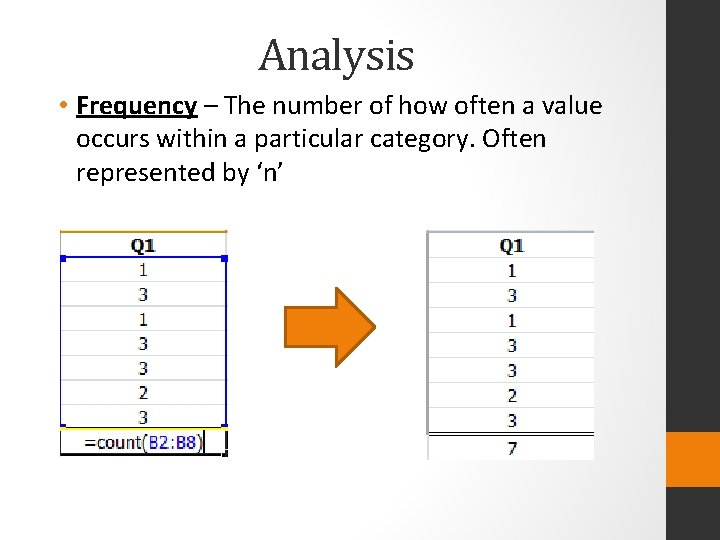
Analysis • Frequency – The number of how often a value occurs within a particular category. Often represented by ‘n’
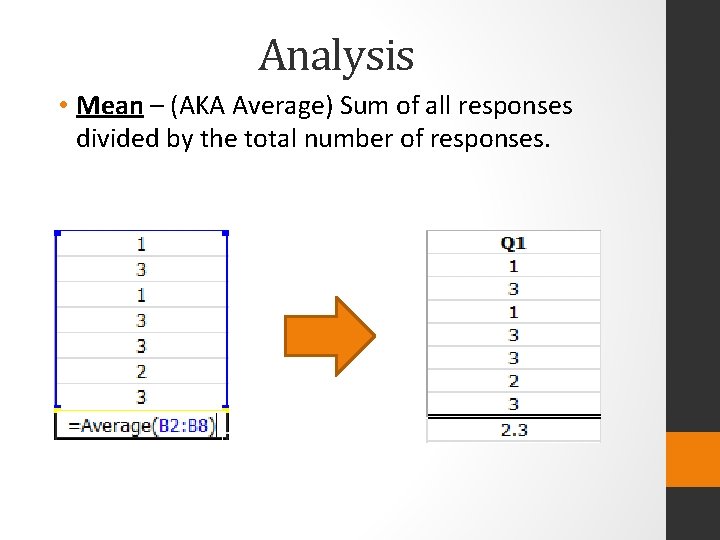
Analysis • Mean – (AKA Average) Sum of all responses divided by the total number of responses.
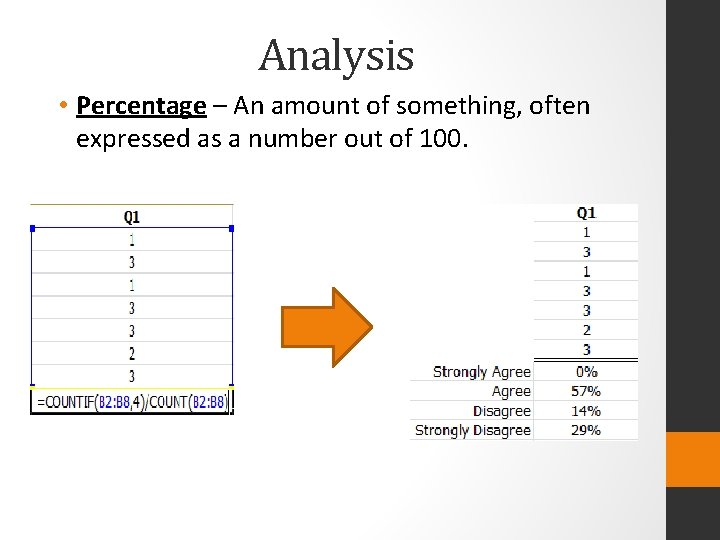
Analysis • Percentage – An amount of something, often expressed as a number out of 100.
Survey Response Rates
Application of Satisfaction Data
QA / CQI PROCESSES TO ENSURE FIDELITY Problem 4
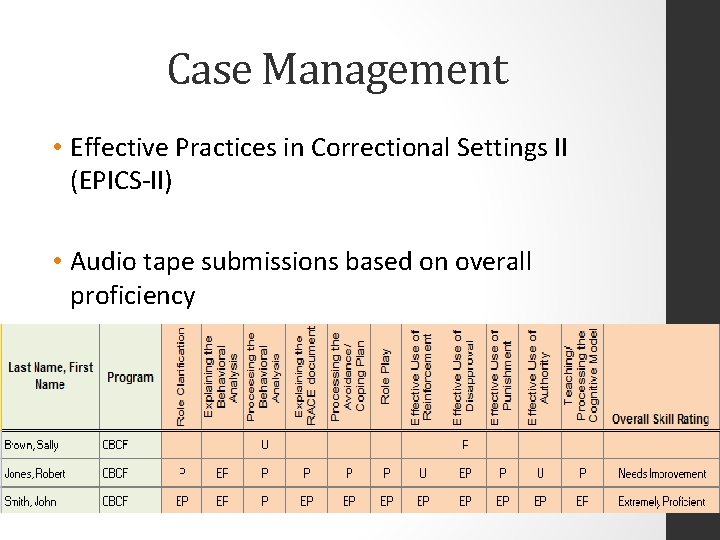
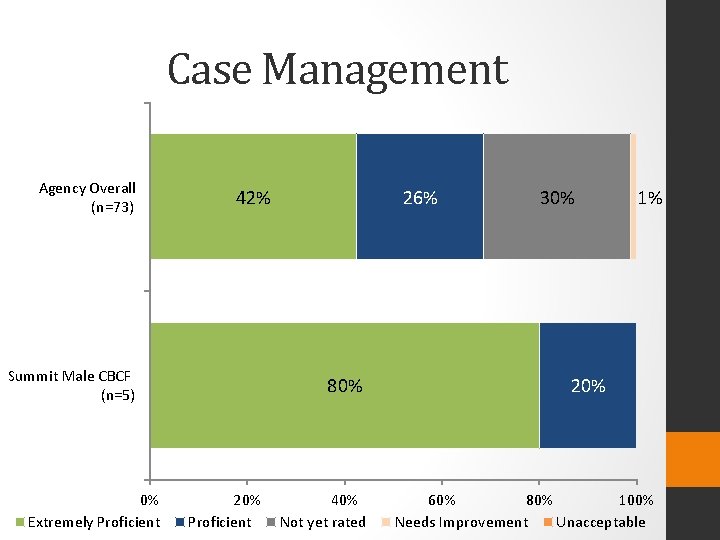
Case Management • Effective Practices in Correctional Settings II (EPICS-II) • Audio tape submissions based on overall proficiency
Case Management Agency Overall (n=73) 42% Summit Male CBCF (n=5) 0% Extremely Proficient 26% 80% 20% Proficient 40% Not yet rated 30% 1% 20% 60% 80% 100% Needs Improvement Unacceptable
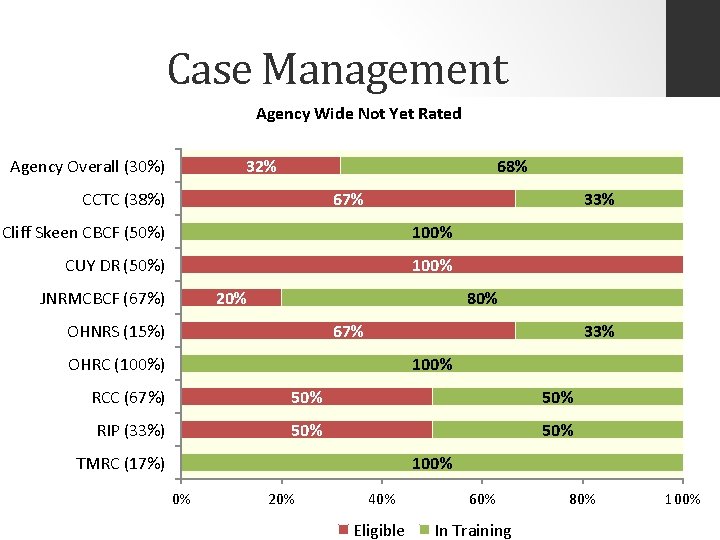
Case Management Agency Wide Not Yet Rated Agency Overall (30%) 32% 68% CCTC (38%) 67% 33% Cliff Skeen CBCF (50%) 100% CUY DR (50%) 100% JNRMCBCF (67%) 20% 80% OHNRS (15%) 67% 33% OHRC (100%) 100% RCC (67%) 50% RIP (33%) 50% TMRC (17%) 100% 0% 20% 40% Eligible 60% In Training 80% 100%
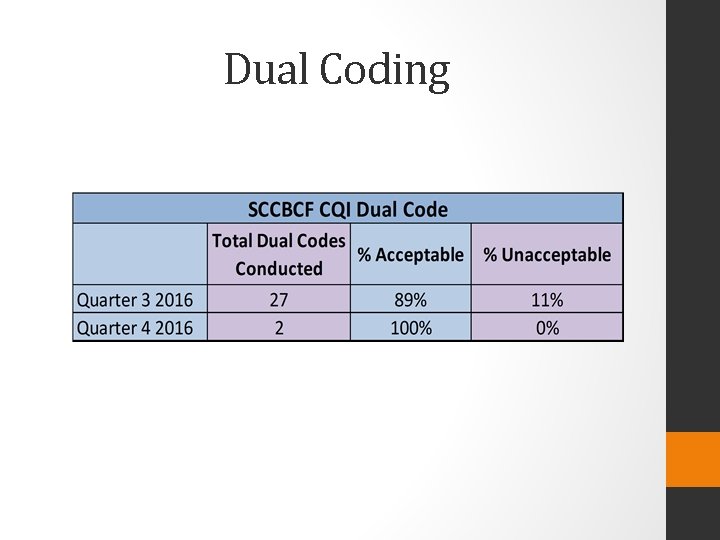
Dual Coding
Additional QA and CQI Processes • Core Correctional Practices (CCP) • Frontline staff • ORAS administration • Caseworkers & Intake Specialists • Group observation • Cog Skill Specialists • Education and Employment Specialists
Application of QA/CQI data
ESTABLISHING RESEARCH PARTNERSHIPS Problem 5
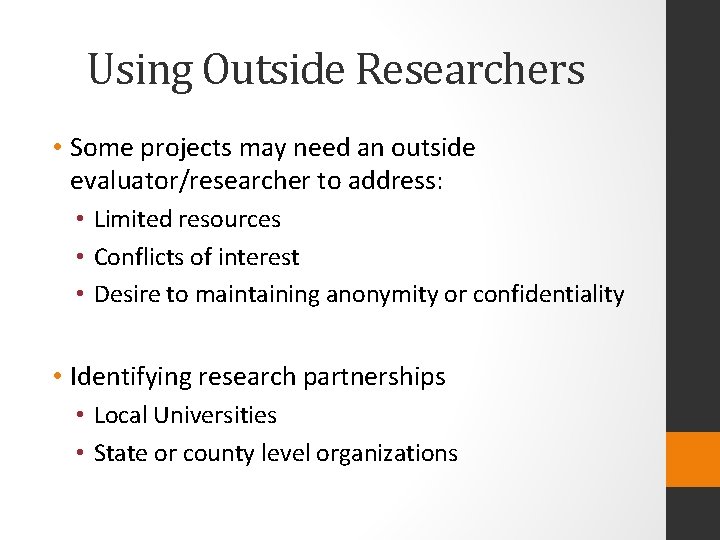
Using Outside Researchers • Some projects may need an outside evaluator/researcher to address: • Limited resources • Conflicts of interest • Desire to maintaining anonymity or confidentiality • Identifying research partnerships • Local Universities • State or county level organizations
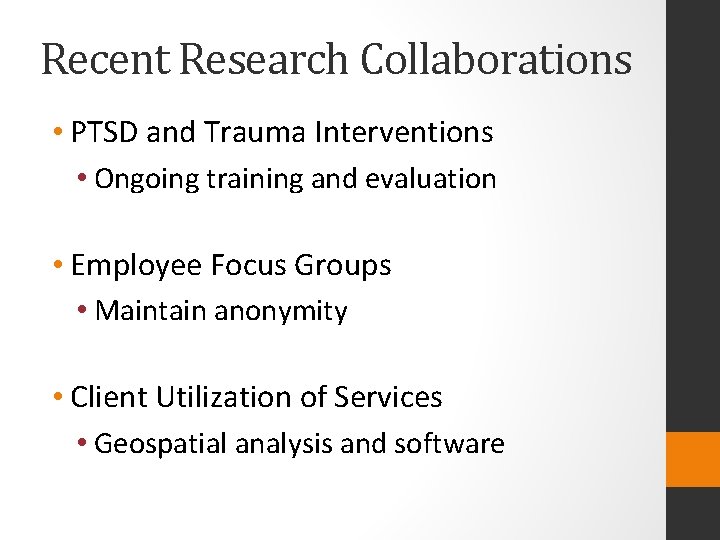
Recent Research Collaborations • PTSD and Trauma Interventions • Ongoing training and evaluation • Employee Focus Groups • Maintain anonymity • Client Utilization of Services • Geospatial analysis and software
Discussion Steps to identifying local research partnerships
Questions?