
USING DATA TO IDENTIFY PRIORITY POPULATIONS Dr Lisa





- Slides: 45
USING DATA TO IDENTIFY PRIORITY POPULATIONS Dr. Lisa Simon, Associate Medical Officer of Health Emily House, Research Analyst June 28, 2019 SMDHU. ORG 1
OBJECTIVES SMDHU. ORG 2
OBJECTIVES By the end of this session, participants will be able to: 1) Understand how to apply a health equity lens to assessing and reporting on local population health data 2) Understand the key components of a framework to assist in identifying local priority populations 3) Provide an example of applying this priority population framework in a local public health context SMDHU. ORG 3
BACKGROUND SMDHU. ORG 4
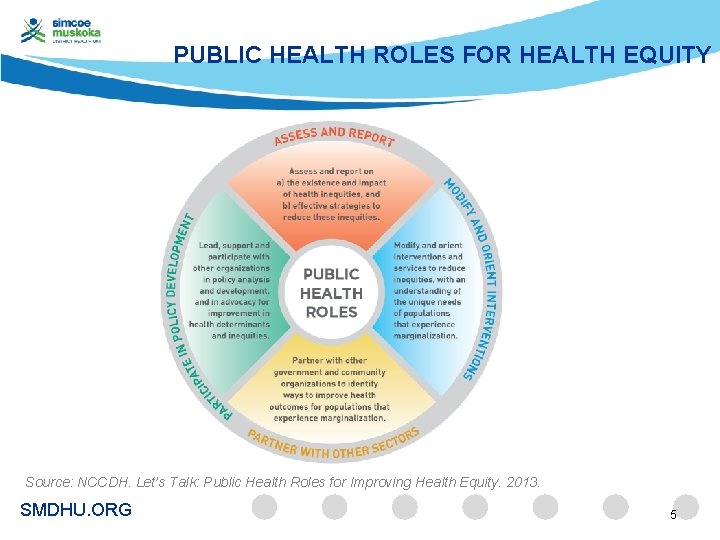
PUBLIC HEALTH ROLES FOR HEALTH EQUITY Source: NCCDH. Let’s Talk: Public Health Roles for Improving Health Equity. 2013. SMDHU. ORG 5
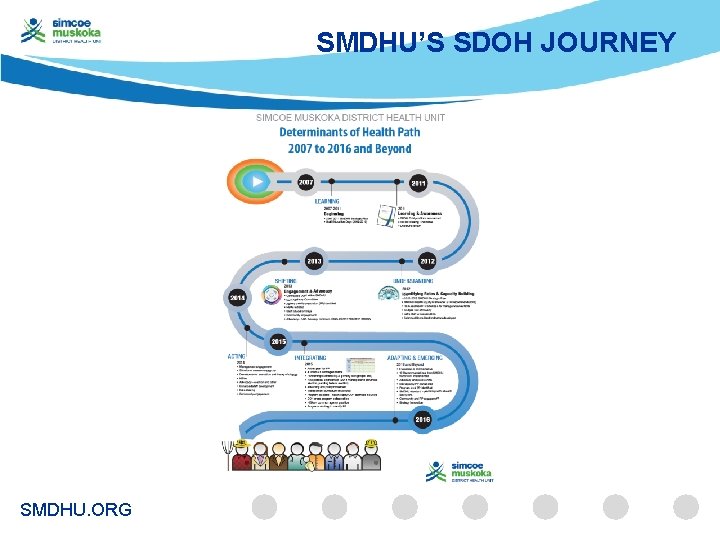
SMDHU’S SDOH JOURNEY SMDHU. ORG
WHAT ARE PRIORITY POPULATIONS? • OPHS Health Equity Guideline 1 defines priority populations as: • “those that are experiencing and/or at increased risk of poor health outcomes due to the burden of disease and/or factors for disease; the determinants of health, including the social determinants of health; and/or the intersection between them. They are identified by using local, provincial, and/or federal data sources; emerging trends and local context; community assessments; surveillance; and epidemiological and other research studies. ” • Health inequities are health differences that are systematic, socially produced, and considered unfair 1 • Social positions that can impact opportunities for health and well-being include: • • Ability Age Culture Ethnicity • • Family Status Gender Language Race • • Religion Sex Social class Socioeconomic status 1 Ontario Government. Ministry of Health and Long-Term Care. Health Equity Guideline. 2018. Available from: http: //www. health. gov. on. ca/en/programs/publichealth/oph_standards / SMDHU. ORG 7
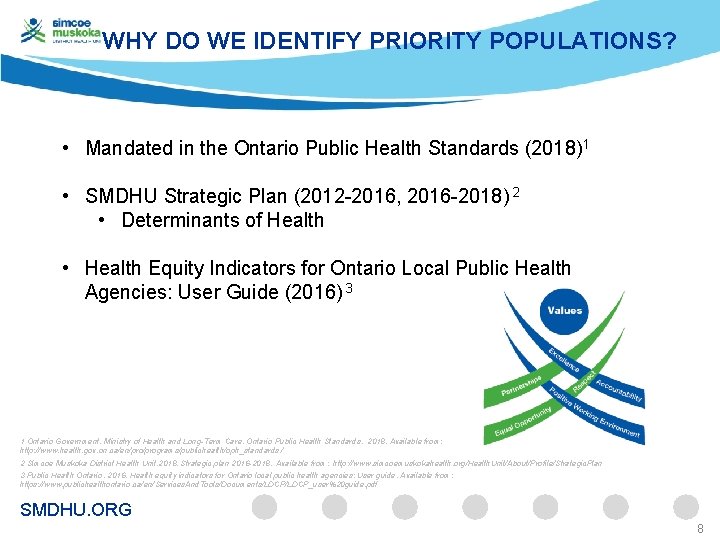
WHY DO WE IDENTIFY PRIORITY POPULATIONS? • Mandated in the Ontario Public Health Standards (2018)1 • SMDHU Strategic Plan (2012 -2016, 2016 -2018) 2 • Determinants of Health • Health Equity Indicators for Ontario Local Public Health Agencies: User Guide (2016) 3 1 Ontario Government. Ministry of Health and Long-Term Care. Ontario Public Health Standards. 2018. Available from: http: //www. health. gov. on. ca/en/programs/publichealth/oph_standards / 2 Simcoe Muskoka District Health Unit. 2018. Strategic plan 2016 -2018. Available from: http: //www. simcoemuskokahealth. org/Health. Unit/About/Profile/Strategic. Plan 3 Public Health Ontario. 2016. Health equity indicators for Ontario local public health agencies: User guide. Available from: https: //www. publichealthontario. ca/en/Services. And. Tools/Documents/LDCP_user%20 guide. pdf SMDHU. ORG 8
OBJECTIVE #1: APPLY A HEALTH EQUITY LENS TO ASSESSING AND REPORTING ON LOCAL POPULATION HEALTH DATA SMDHU. ORG 9
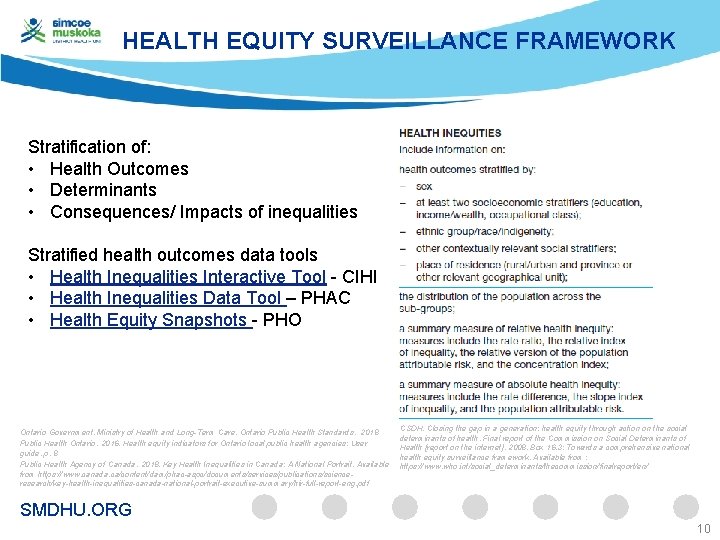
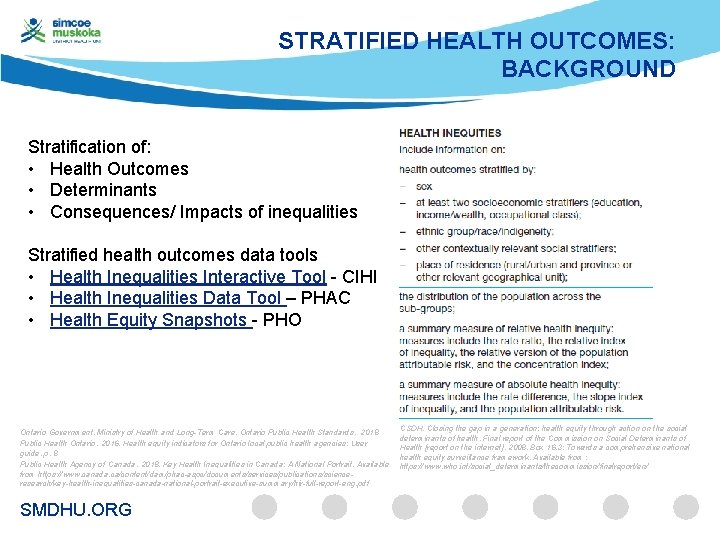
HEALTH EQUITY SURVEILLANCE FRAMEWORK Stratification of: • Health Outcomes • Determinants • Consequences/ Impacts of inequalities Stratified health outcomes data tools • Health Inequalities Interactive Tool - CIHI • Health Inequalities Data Tool – PHAC • Health Equity Snapshots - PHO Ontario Government. Ministry of Health and Long-Term Care. Ontario Public Health Standards. 2018 Public Health Ontario. 2016. Health equity indicators for Ontario local public health agencies: User guide. p. 8 Public Health Agency of Canada. 2018. Key Health Inequalities in Canada: A National Portrait. Available from https: //www. canada. ca/content/dam/phac-aspc/documents/services/publications/scienceresearch/key-health-inequalities-canada-national-portrait-executive-summary/hir-full-report-eng. pdf CSDH. Closing the gap in a generation: health equity through action on the social determinants of health. Final report of the Commission on Social Determinants of Health [report on the internet]. 2008. Box 16. 3: Towards a comprehensive national health equity surveillance framework. Available from : https: //www. who. int/social_determinants/thecommission/finalreport/en/ SMDHU. ORG 10
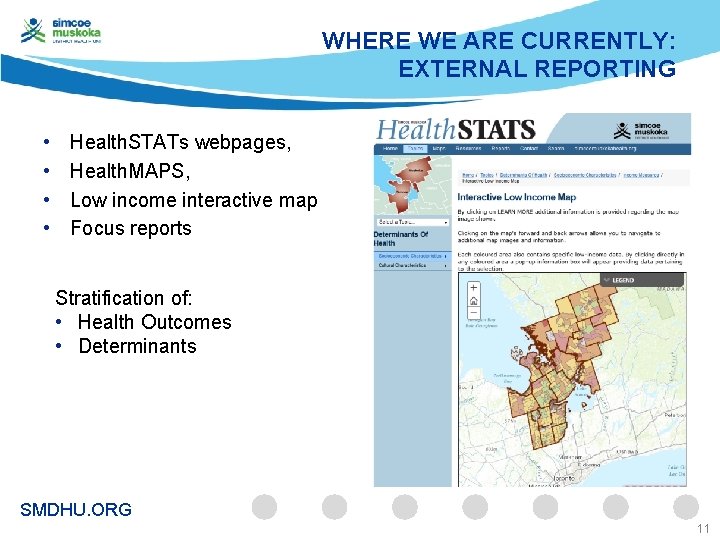
WHERE WE ARE CURRENTLY: EXTERNAL REPORTING • • Health. STATs webpages, Health. MAPS, Low income interactive map Focus reports Stratification of: • Health Outcomes • Determinants SMDHU. ORG 11
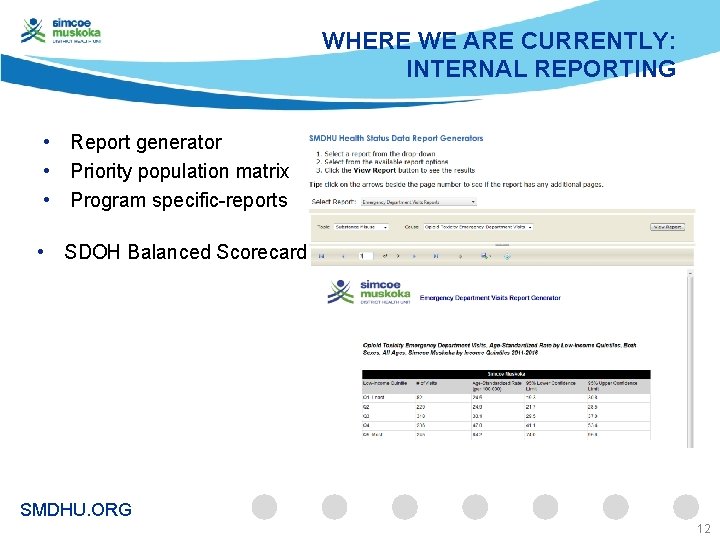
WHERE WE ARE CURRENTLY: INTERNAL REPORTING • Report generator • Priority population matrix • Program specific-reports • SDOH Balanced Scorecard SMDHU. ORG 12
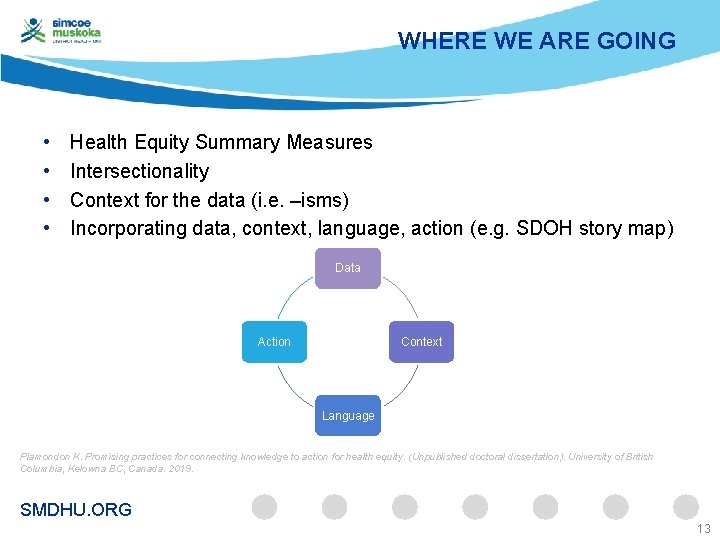
WHERE WE ARE GOING • • Health Equity Summary Measures Intersectionality Context for the data (i. e. –isms) Incorporating data, context, language, action (e. g. SDOH story map) Data Action Context Language Plamondon K. Promising practices for connecting knowledge to action for health equity. (Unpublished doctoral dissertation). University of British Columbia, Kelowna BC, Canada. 2019. SMDHU. ORG 13
OBJECTIVE #2: KEY COMPONENTS OF A FRAMEWORK TO ASSIST IN IDENTIFYING LOCAL PRIORITY POPULATIONS SMDHU. ORG 14
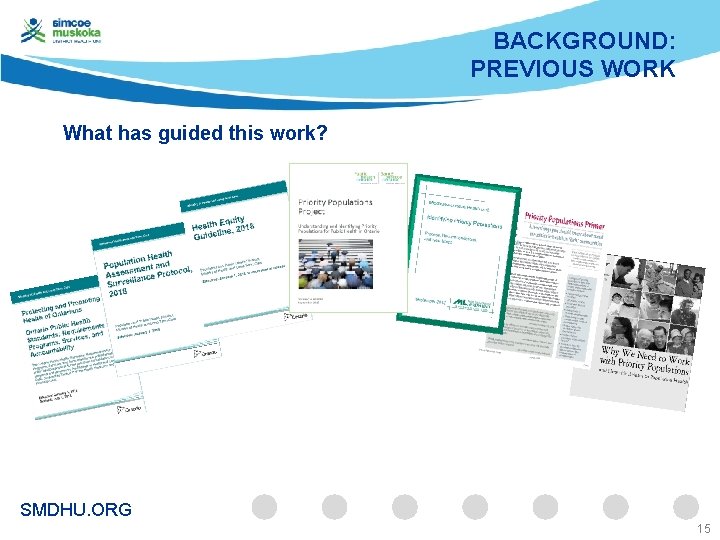
BACKGROUND: PREVIOUS WORK What has guided this work? SMDHU. ORG 15
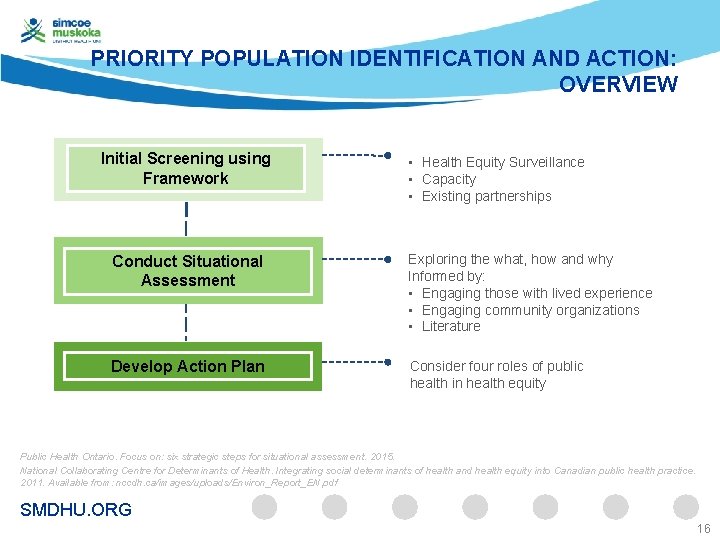
PRIORITY POPULATION IDENTIFICATION AND ACTION: OVERVIEW Initial Screening using Framework • Health Equity Surveillance • Capacity • Existing partnerships Conduct Situational Assessment Exploring the what, how and why Informed by: • Engaging those with lived experience • Engaging community organizations • Literature Develop Action Plan Consider four roles of public health in health equity Public Health Ontario. Focus on: six strategic steps for situational assessment. 2015. National Collaborating Centre for Determinants of Health. Integrating social determinants of health and health equity into Canadian public health practice. 2011. Available from: nccdh. ca/images/uploads/Environ_Report_EN. pdf SMDHU. ORG 16
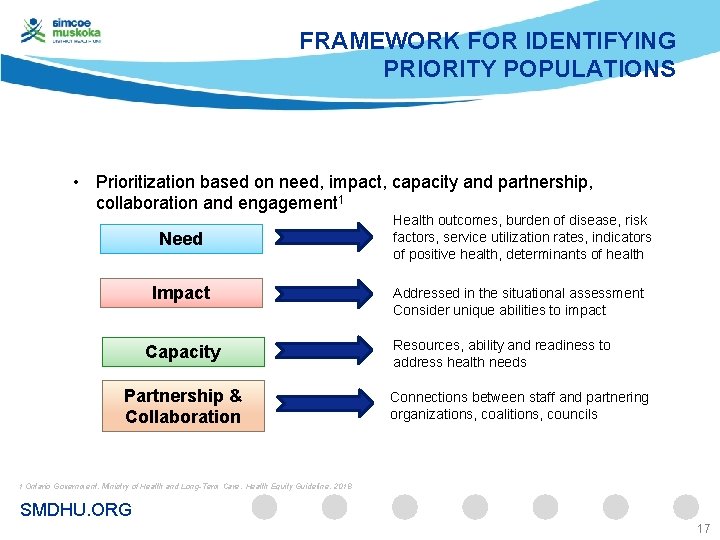
FRAMEWORK FOR IDENTIFYING PRIORITY POPULATIONS • Prioritization based on need, impact, capacity and partnership, collaboration and engagement 1 Need Impact Capacity Partnership & Collaboration Health outcomes, burden of disease, risk factors, service utilization rates, indicators of positive health, determinants of health Addressed in the situational assessment Consider unique abilities to impact Resources, ability and readiness to address health needs Connections between staff and partnering organizations, coalitions, councils 1 Ontario Government. Ministry of Health and Long-Term Care. Health Equity Guideline. 2018 SMDHU. ORG 17
FRAMEWORK: MATRIX SMDHU. ORG 18
MATRIX: POPULATIONS SMDHU. ORG 19
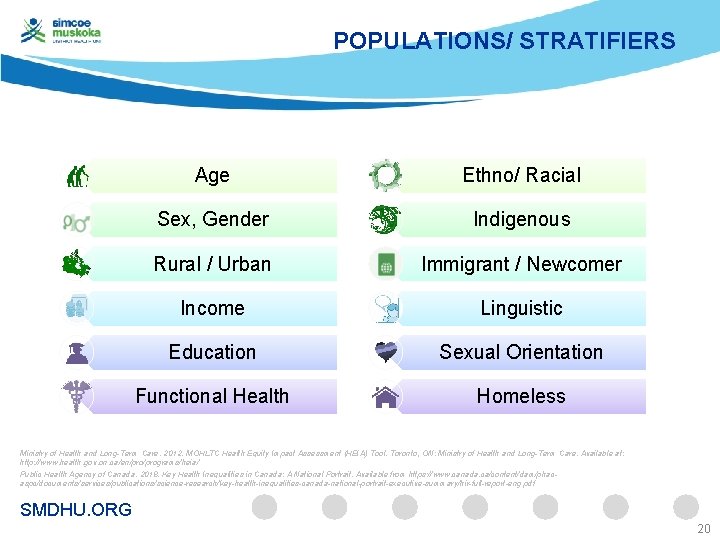
POPULATIONS/ STRATIFIERS Age Ethno/ Racial Sex, Gender Indigenous Rural / Urban Immigrant / Newcomer Income Linguistic Education Sexual Orientation Functional Health Homeless Ministry of Health and Long-Term Care. 2012. MOHLTC Health Equity Impact Assessment (HEIA) Tool. Toronto, ON: Ministry of Health and Long-Term Care. Available at: http: //www. health. gov. on. ca/en/programs/heia/ Public Health Agency of Canada. 2018. Key Health Inequalities in Canada: A National Portrait. Available from https: //www. canada. ca/content/dam/phacaspc/documents/services/publications/science-research/key-health-inequalities-canada-national-portrait-executive-summary/hir-full-report-eng. pdf SMDHU. ORG 20
FRAMEWORK: MATRIX SMDHU. ORG 21
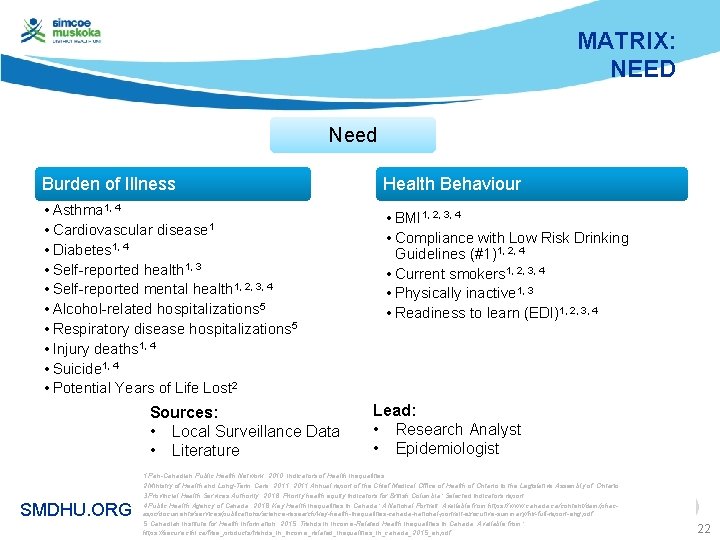
MATRIX: NEED Need Burden of Illness Health Behaviour • Asthma 1, 4 • Cardiovascular disease 1 • Diabetes 1, 4 • Self-reported health 1, 3 • Self-reported mental health 1, 2, 3, 4 • Alcohol-related hospitalizations 5 • Respiratory disease hospitalizations 5 • Injury deaths 1, 4 • Suicide 1, 4 • Potential Years of Life Lost 2 • BMI 1, 2, 3, 4 • Compliance with Low Risk Drinking Guidelines (#1)1, 2, 4 • Current smokers 1, 2, 3, 4 • Physically inactive 1, 3 • Readiness to learn (EDI)1, 2, 3, 4 Sources: • Local Surveillance Data • Literature SMDHU. ORG Lead: • Research Analyst • Epidemiologist 1 Pan-Canadian Public Health Network. 2010. Indicators of Health Inequalities. 2 Ministry of Health and Long-Term Care. 2011 Annual report of the Chief Medical Office of Health of Ontario to the Legislative Assembly of Ontario 3 Provincial Health Services Authority. 2016. Priority health equity indicators for British Columbia: Selected indicators report. 4 Public Health Agency of Canada. 2018. Key Health Inequalities in Canada: A National Portrait. Available from https: //www. canada. ca/content/dam/phacaspc/documents/services/publications/science-research/key-health-inequalities-canada-national-portrait-executive-summary/hir-full-report-eng. pdf 5. Canadian Institute for Health Information. 2015. Trends in Income-Related Health Inequalities in Canada. Available from: https: //secure. cihi. ca/free_products/trends_in_income_related_inequalities_in_canada_2015_en. pdf 22
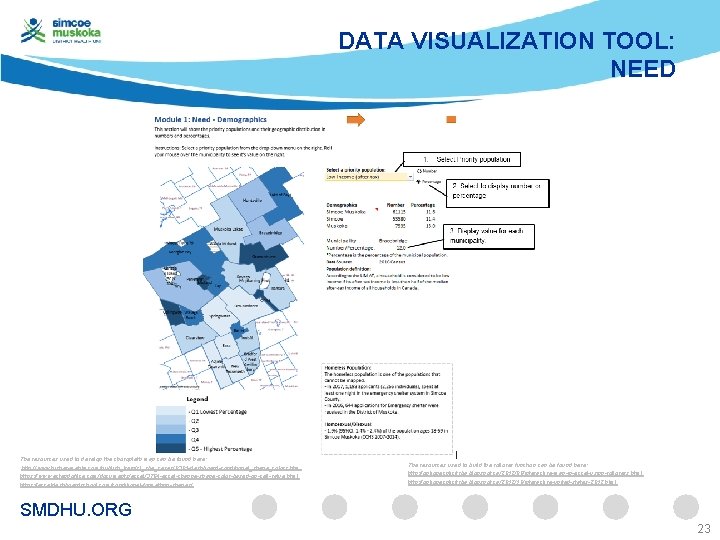
DATA VISUALIZATION TOOL: NEED The resources used to develop the choropleth map can be found here: http: //www. tushar-mehta. com/publish_train/xl_vba_cases/0301 -dashboard-conditional_shape_colors. htm https: //www. extendoffice. com/documents/excel/3764 -excel-change-shape-color-based-on-cell-value. html https: //exceldashboardschool. com/conditional-formatting-shapes/ The resources used to build the rollover function can be found here: http: //optionexplicitvba. blogspot. ca/2012/08/interactive-map-in-excel-using-rollovers. html http: //optionexplicitvba. blogspot. ca/2012/10/interactive-united-states-2012. html SMDHU. ORG 23
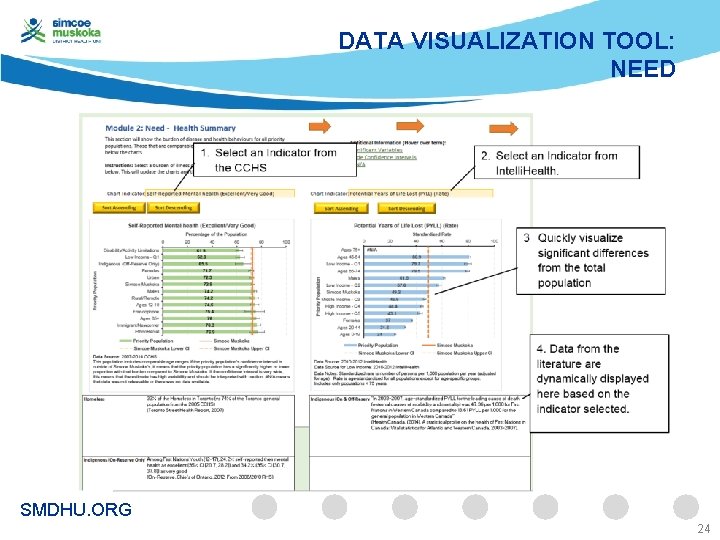
DATA VISUALIZATION TOOL: NEED SMDHU. ORG 24
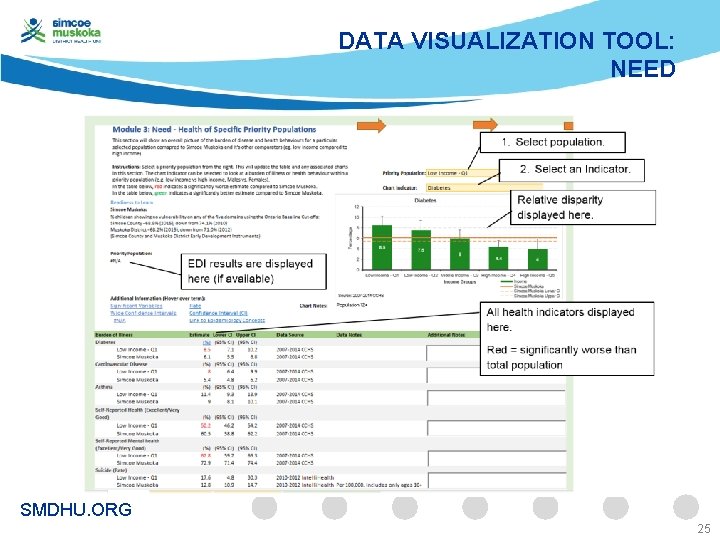
DATA VISUALIZATION TOOL: NEED SMDHU. ORG 25
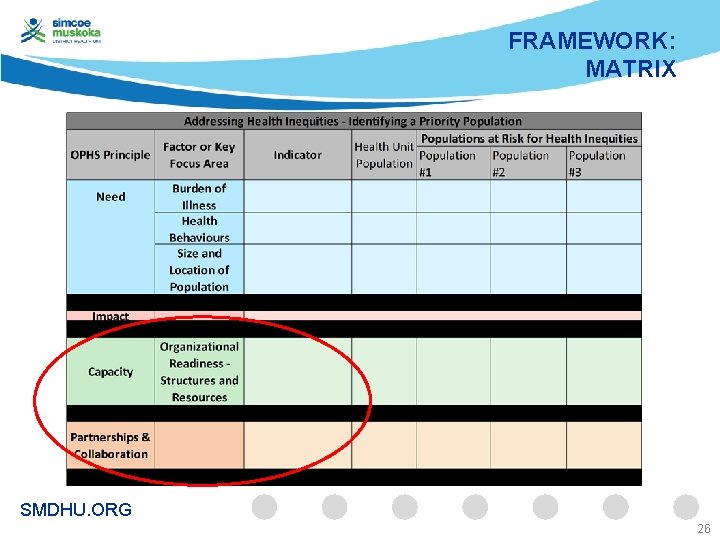
FRAMEWORK: MATRIX SMDHU. ORG 26
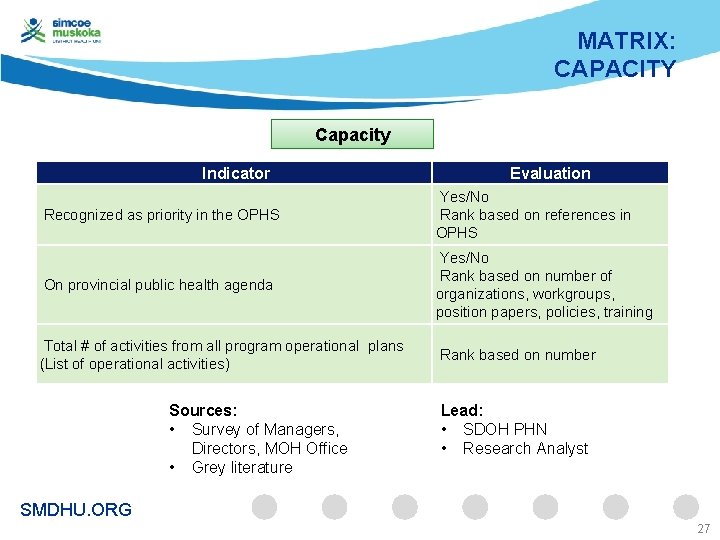
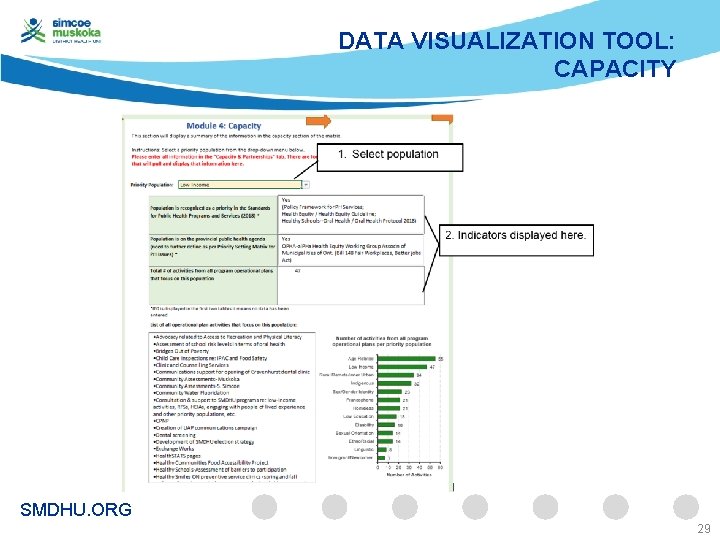
MATRIX: CAPACITY Capacity Indicator Evaluation Recognized as priority in the OPHS Yes/No Rank based on references in OPHS On provincial public health agenda Yes/No Rank based on number of organizations, workgroups, position papers, policies, training Total # of activities from all program operational plans (List of operational activities) Rank based on number Sources: • Survey of Managers, Directors, MOH Office • Grey literature Lead: • SDOH PHN • Research Analyst SMDHU. ORG 27
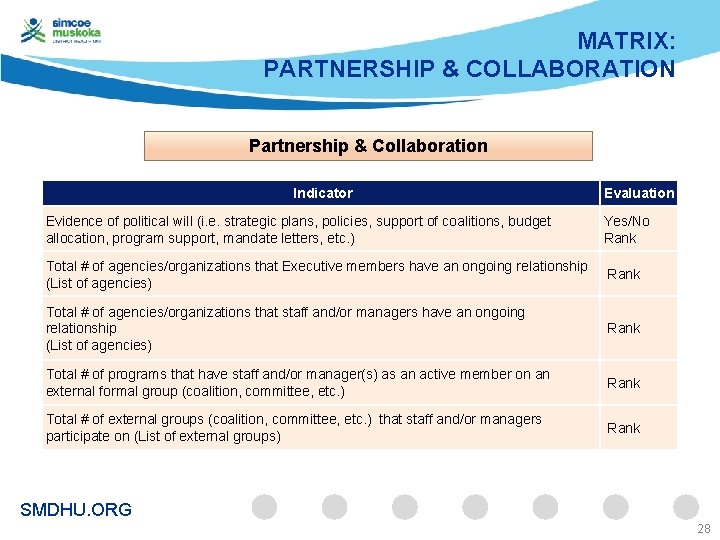
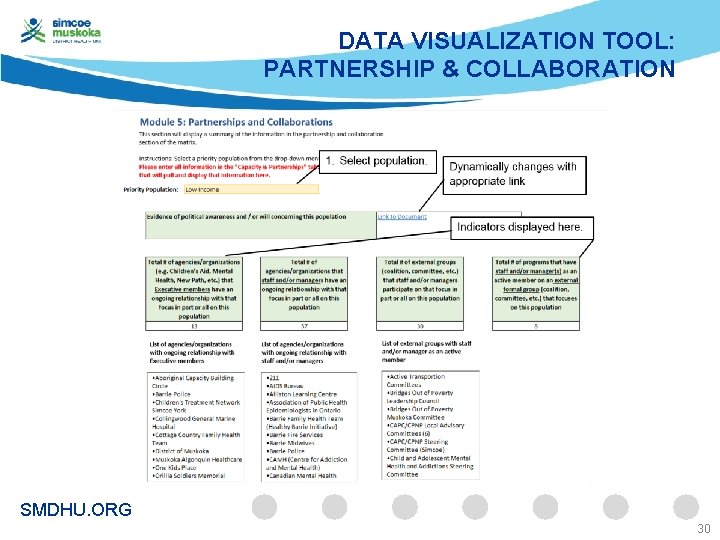
MATRIX: PARTNERSHIP & COLLABORATION Partnership & Collaboration Indicator Evaluation Evidence of political will (i. e. strategic plans, policies, support of coalitions, budget allocation, program support, mandate letters, etc. ) Yes/No Rank Total # of agencies/organizations that Executive members have an ongoing relationship (List of agencies) Rank Total # of agencies/organizations that staff and/or managers have an ongoing relationship (List of agencies) Rank Total # of programs that have staff and/or manager(s) as an active member on an external formal group (coalition, committee, etc. ) Rank Total # of external groups (coalition, committee, etc. ) that staff and/or managers participate on (List of external groups) Rank SMDHU. ORG 28
DATA VISUALIZATION TOOL: CAPACITY SMDHU. ORG 29
DATA VISUALIZATION TOOL: PARTNERSHIP & COLLABORATION SMDHU. ORG 30
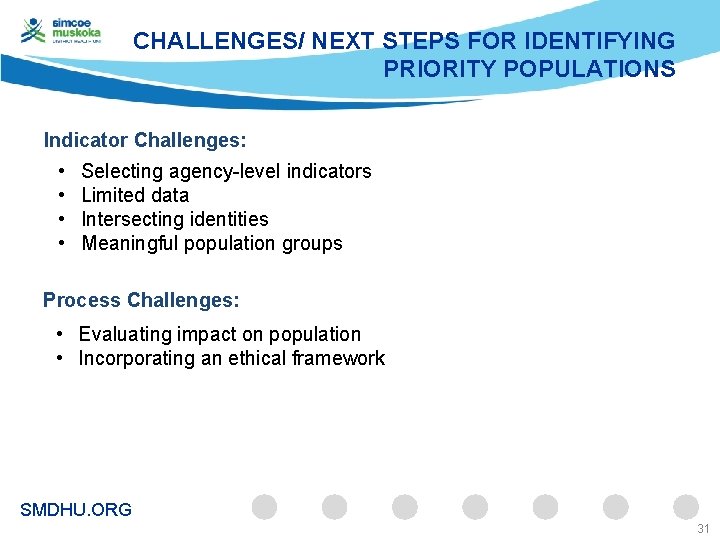
CHALLENGES/ NEXT STEPS FOR IDENTIFYING PRIORITY POPULATIONS Indicator Challenges: • • Selecting agency-level indicators Limited data Intersecting identities Meaningful population groups Process Challenges: • Evaluating impact on population • Incorporating an ethical framework SMDHU. ORG 31
OBJECTIVE #3 - EXAMPLE OF APPLYING THIS PRIORITY POPULATION FRAMEWORK IN A LOCAL PUBLIC HEALTH CONTEXT SMDHU. ORG 32
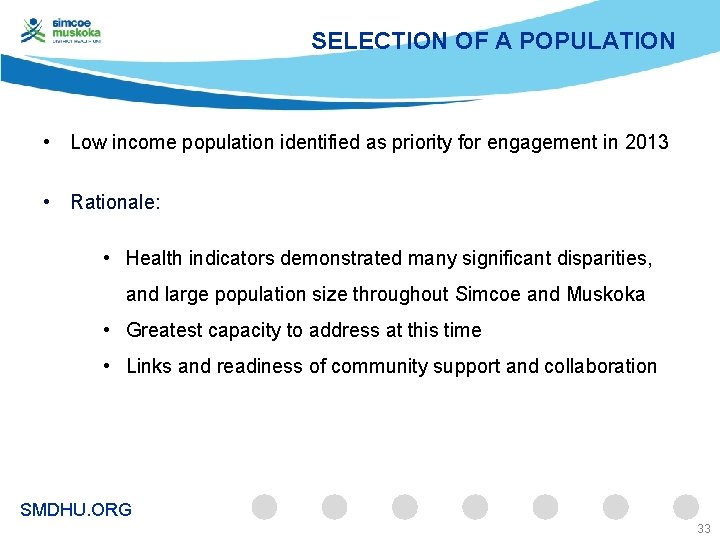
SELECTION OF A POPULATION • Low income population identified as priority for engagement in 2013 • Rationale: • Health indicators demonstrated many significant disparities, and large population size throughout Simcoe and Muskoka • Greatest capacity to address at this time • Links and readiness of community support and collaboration SMDHU. ORG 33
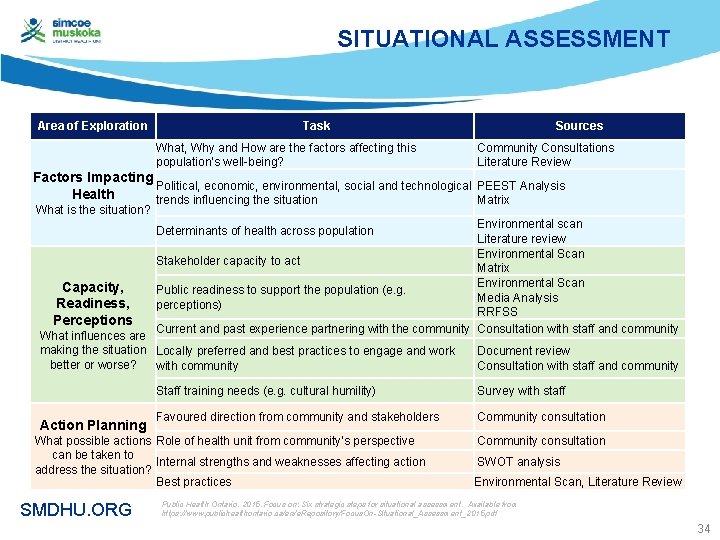
SITUATIONAL ASSESSMENT Area of Exploration Task What, Why and How are the factors affecting this population’s well-being? Sources Community Consultations Literature Review Factors Impacting Political, economic, environmental, social and technological PEEST Analysis Health trends influencing the situation Matrix What is the situation? Environmental scan Literature review Environmental Scan Stakeholder capacity to act Matrix Environmental Scan Public readiness to support the population (e. g. Media Analysis perceptions) RRFSS Current and past experience partnering with the community Consultation with staff and community Determinants of health across population Capacity, Readiness, Perceptions What influences are making the situation Locally preferred and best practices to engage and work better or worse? with community Action Planning Staff training needs (e. g. cultural humility) Survey with staff Favoured direction from community and stakeholders Community consultation What possible actions Role of health unit from community’s perspective can be taken to Internal strengths and weaknesses affecting action address the situation? Best practices SMDHU. ORG Document review Consultation with staff and community Community consultation SWOT analysis Environmental Scan, Literature Review Public Health Ontario. 2015. Focus on: Six strategic steps for situational assessment. Available from https: //www. publichealthontario. ca/en/e. Repository/Focus. On-Situational_Assessment_2015. pdf 34
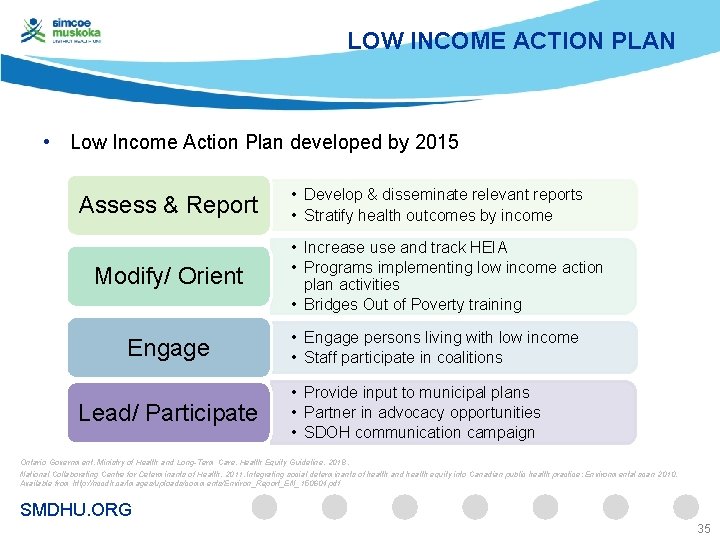
LOW INCOME ACTION PLAN • Low Income Action Plan developed by 2015 Assess & Report Modify/ Orient Engage Lead/ Participate • Develop & disseminate relevant reports • Stratify health outcomes by income • Increase use and track HEIA • Programs implementing low income action plan activities • Bridges Out of Poverty training • Engage persons living with low income • Staff participate in coalitions • Provide input to municipal plans • Partner in advocacy opportunities • SDOH communication campaign Ontario Government. Ministry of Health and Long-Term Care. Health Equity Guideline. 2018. National Collaborating Centre for Determinants of Health. 2011. Integrating social determinants of health and health equity into Canadian public health practice: Environmental scan 2010. Available from http: //nccdh. ca/images/uploads/comments/Environ_Report_EN_150604. pdf SMDHU. ORG 35
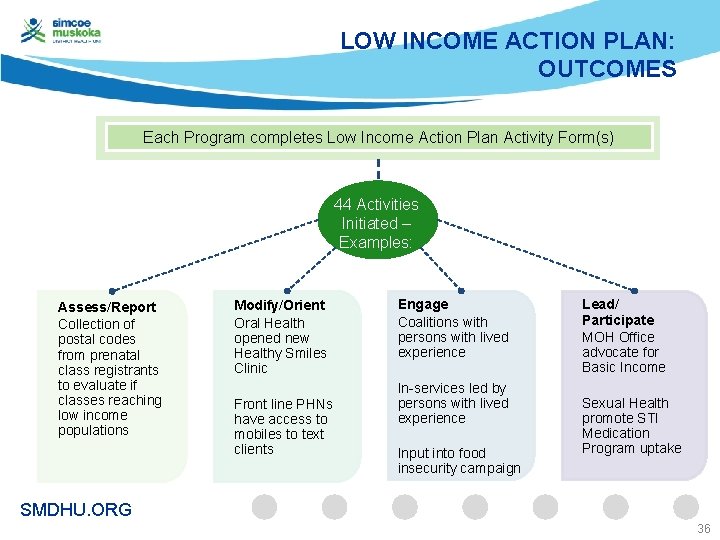
LOW INCOME ACTION PLAN: OUTCOMES Each Program completes Low Income Action Plan Activity Form(s) 44 Activities Initiated – Examples: Assess/Report Collection of postal codes from prenatal class registrants to evaluate if classes reaching low income populations Modify/Orient Oral Health opened new Healthy Smiles Clinic Front line PHNs have access to mobiles to text clients Engage Coalitions with persons with lived experience In-services led by persons with lived experience Input into food insecurity campaign Lead/ Participate MOH Office advocate for Basic Income Sexual Health promote STI Medication Program uptake SMDHU. ORG 36
QUESTIONS? Thank you! Questions? Lisa Simon, AMOH Lisa. simon@smdhu. org Thank you: Megan Williams (Manager, Health Promotion and Communications) Carol Yandreski (SDOH PHN, Health Promotion and Communications) Brenda Guarda (Manager, Population Health Assessment Surveillance and Evaluation) Ainslie Butler (Epidemiologist, Population Health Assessment Surveillance and Evaluation) SMDHU. ORG 37
APPENDIX A: HEALTH EQUITY SURVEILLANCE SMDHU. ORG 38
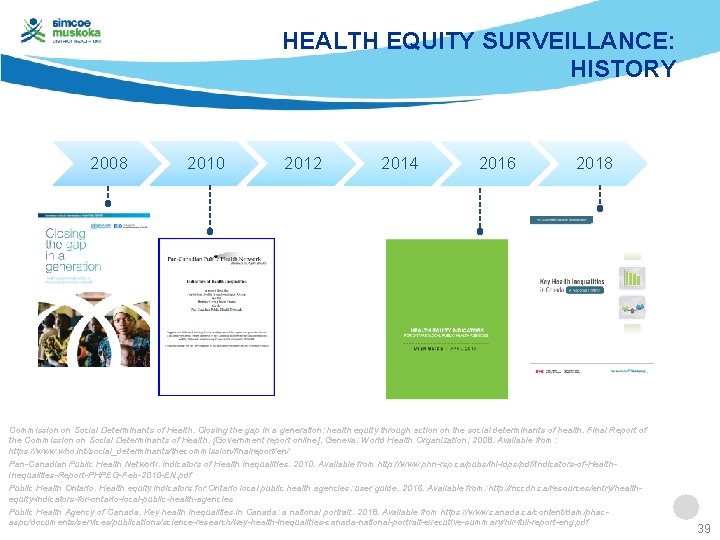
HEALTH EQUITY SURVEILLANCE: HISTORY 2008 2010 2012 2014 2016 2018 Commission on Social Determinants of Health. Closing the gap in a generation: health equity through action on the social determinants of health. Final Report of the Commission on Social Determinants of Health. [Government report online]. Geneva: World Health Organization; 2008. Available from: https: //www. who. int/social_determinants/thecommission/finalreport/en/ Pan-Canadian Public Health Network. Indicators of Health Inequalities. 2010. Available from http: //www. phn-rsp. ca/pubs/ihi-idps/pdf/Indicators-of-Health. Inequalities-Report-PHPEG-Feb-2010 -EN. pdf Public Health Ontario. Health equity indicators for Ontario local public health agencies: user guide. 2016. Available from: http: //nccdh. ca/resources/entry/healthequity-indicators-for-ontario-local-public-health-agencies Public Health Agency of Canada. Key health inequalities in Canada: a national portrait. 2018. Available from https: //www. canada. ca/content/dam/phacaspc/documents/services/publications/science-research/key-health-inequalities-canada-national-portrait-executive-summary/hir-full-report-eng. pdf SMDHU. ORG 39
STRATIFIED HEALTH OUTCOMES: BACKGROUND Stratification of: • Health Outcomes • Determinants • Consequences/ Impacts of inequalities Stratified health outcomes data tools • Health Inequalities Interactive Tool - CIHI • Health Inequalities Data Tool – PHAC • Health Equity Snapshots - PHO Ontario Government. Ministry of Health and Long-Term Care. Ontario Public Health Standards. 2018 Public Health Ontario. 2016. Health equity indicators for Ontario local public health agencies: User guide. p. 8 Public Health Agency of Canada. 2018. Key Health Inequalities in Canada: A National Portrait. Available from https: //www. canada. ca/content/dam/phac-aspc/documents/services/publications/scienceresearch/key-health-inequalities-canada-national-portrait-executive-summary/hir-full-report-eng. pdf SMDHU. ORG CSDH. Closing the gap in a generation: health equity through action on the social determinants of health. Final report of the Commission on Social Determinants of Health [report on the internet]. 2008. Box 16. 3: Towards a comprehensive national health equity surveillance framework. Available from : https: //www. who. int/social_determinants/thecommission/finalreport/en/
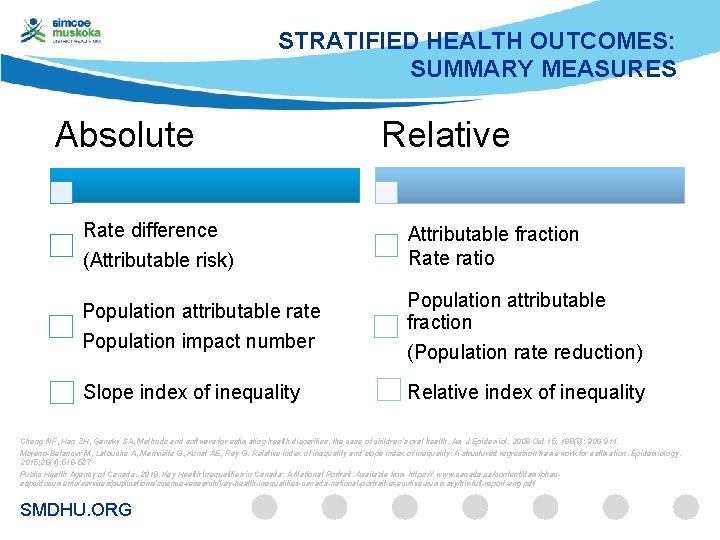
STRATIFIED HEALTH OUTCOMES: SUMMARY MEASURES Absolute Relative Rate difference (Attributable risk) Attributable fraction Rate ratio Population attributable rate Population impact number Population attributable fraction (Population rate reduction) Slope index of inequality Relative index of inequality Cheng NF, Han ZH, Gansky SA. Methods and software for estimating health disparities: the case of children’s oral health. Am J Epidemiol. 2008 Oct 15; 168(8): 906 -914. Moreno-Betancur M, Latouche A, Menvielle G, Kunst AE, Rey G. Relative index of inequality and slope index of inequality: A structured regression framework for estimation. Epidemiology. 2015; 26(4): 518 -527 Public Health Agency of Canada. 2018. Key Health Inequalities in Canada: A National Portrait. Available from https: // www. canada. ca/content/dam/phacaspc/documents/services/publications/science-research/key-health-inequalities-canada-national-portrait-executive-summary/hir-full-report-eng. pdf SMDHU. ORG
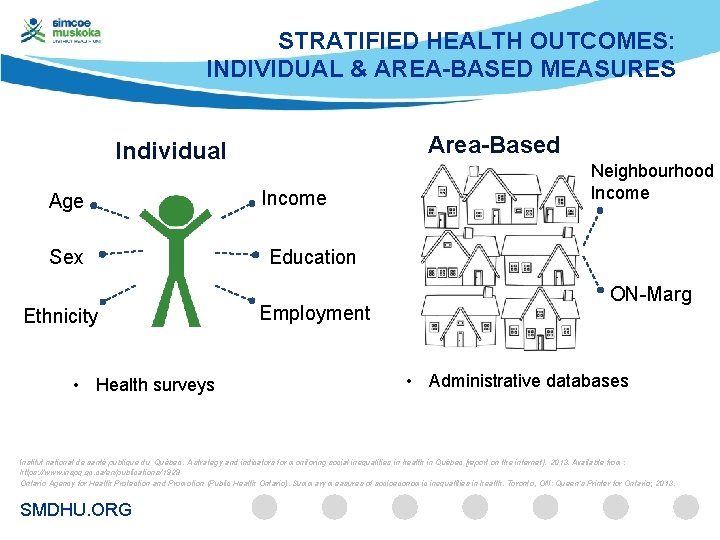
STRATIFIED HEALTH OUTCOMES: INDIVIDUAL & AREA-BASED MEASURES Area-Based Individual Age Sex Ethnicity • Health surveys Income Neighbourhood Income Education Employment ON-Marg • Administrative databases Institut national de santé publique du Québec. A strategy and indicators for monitoring social inequalities in health in Québec [report on the internet]. 2013. Available from: https: //www. inspq. qc. ca/en/publications/1929 Ontario Agency for Health Protection and Promotion (Public Health Ontario). Summary measures of socioeconomic inequalities in health. Toronto, ON: Queen’s Printer for Ontario; 2013. SMDHU. ORG
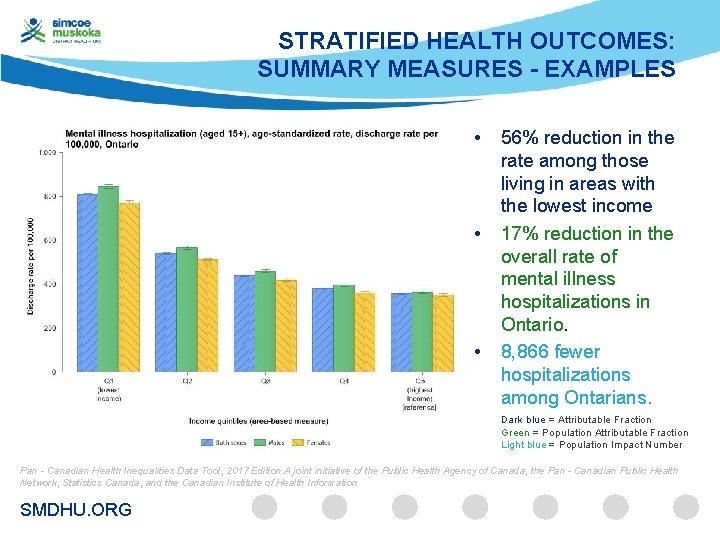
STRATIFIED HEALTH OUTCOMES: SUMMARY MEASURES - EXAMPLES • • • 56% reduction in the rate among those living in areas with the lowest income 17% reduction in the overall rate of mental illness hospitalizations in Ontario. 8, 866 fewer hospitalizations among Ontarians. Dark blue = Attributable Fraction Green = Population Attributable Fraction Light blue = Population Impact Number Pan - Canadian Health Inequalities Data Tool, 2017 Edition. A joint initiative of the Public Health Agency of Canada, the Pan - Canadian Public Health Network, Statistics Canada, and the Canadian Institute of Health Information SMDHU. ORG
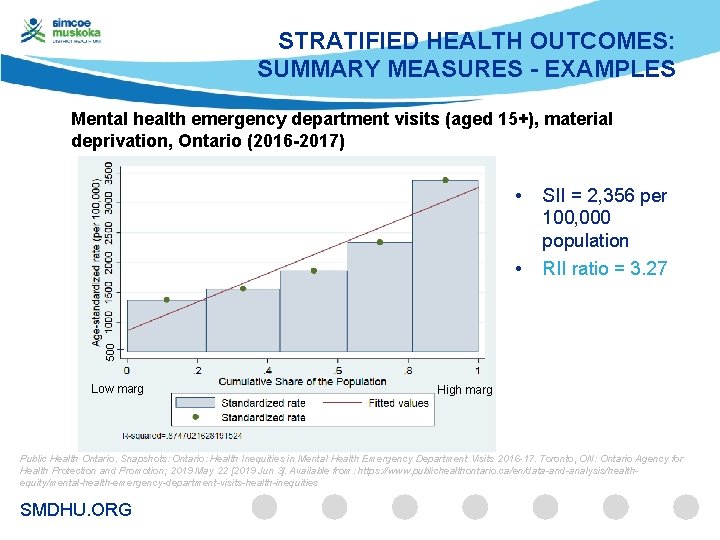
STRATIFIED HEALTH OUTCOMES: SUMMARY MEASURES - EXAMPLES Mental health emergency department visits (aged 15+), material deprivation, Ontario (2016 -2017) • 500 • SII = 2, 356 per 100, 000 population RII ratio = 3. 27 Low marg High marg Public Health Ontario. Snapshots: Ontario: Health Inequities in Mental Health Emergency Department Visits 2016 -17. Toronto, ON: Ontario Agency for Health Protection and Promotion; 2019 May 22 [2019 Jun 3]. Available from: https: //www. publichealthontario. ca/en/data-and-analysis/healthequity/mental-health-emergency-department-visits-health-inequities SMDHU. ORG
STRATIFIED HEALTH OUTCOMES: SUMMARY MEASURES - TIPS #1 Check the methodology #2 Attributable fraction is only used when lower prevalence is good Public Health Ontario. Snapshots: Health Inequities in Mental Health Emergency Department Visits 2016 -17. Toronto, ON: Ontario Agency for Health Protection and Promotion; 2019 May 22 [2019 Jun 18]. Available from: https: //www. publichealthontario. ca/en/data-and-analysis/health-equity/mental-health-emergency-department-visits -health-inequities Pan - Canadian Health Inequalities Data Tool, 2017 Edition. A joint initiative of the Public Health Agency of Canada, the Pan - Canadian Public Health Network, Statistics Canada, and the Canadian Institute of Health Information SMDHU. ORG