
Using Data Analytics to Develop a Web Resource
Using Data Analytics to Develop a Web Resource to Access Trends in Information Technology Careers Lawrence Robcke, Dhairya Harsh Parikh, Yvonne Gil, Jingxiang Huang, Charles C. Tappert, Krishna Bathula, Jane Schmidt, Seidenberg School of Computer Science and Information Systems, Pace University Pleasantville, NY 10570, USA Email: {lrobcke, dp 08607 n, yd 54321 n, jh 82802 n, ctappert, kbathula, jschmidt} @pace. edu
Data Analytics Research Presentation Layout • Abstract • Introduction • Literature Review • Methodology • Preliminary Findings and Results • Conclusion • References • Appendix A & B
Abstract This paper describes the development of an online resource to assist the Career Services Office of the Seidenberg School of CSIS with graduating students’ career job searches in technology. A practical automated tool was created for Pace Career Services to help students get the best job positions in Software Engineering, Data Science, and Cybersecurity. This will include specific job titles such as Cyber Security Risk Analyst, Information Security Engineer, IT Security Consultant, Cyber Security Incident Responder, and others that require an extended period of job experience, certifications and college degrees. The development of this tool illustrates the phases of web development using Python codes and modules that will scrape major job search platforms and return keyword data on relevant job queries. The projected data output will produce information concerning job trends in Information Technology and attempt to provide relevant data to the career servicing office so potential graduates can finetune resumes for job search purposes.
Introduction • The research is based on the successful placing of students in a desired technical career. • Most students who have obtained a bachelor’s degree including beginner certification, focus on entry level technological fields that provides the needed job experience. • If the goal is to achieve an intense technological career, then the requirements for skill sets will demand a masters or doctorate degree. • The efforts to create a resource for job searches will use a basic computer interface that will allow students to enter his or her skills and receive the output information regarding available employment.

US Bureau of Labor Statistics
Literature Review • The university has a project plan, which has been assigned to the research team responsible for expanding the idea of developing a code that will produce part of the scraping method used on job search websites, such as Indeed, Git. Hub, and Monster. • At some point, we all experience a moment where college students realized the difficulties of finding a job, which involves a new career, job search goals, or a job were promotion a benefit opportunity exist. • In any given situation data analytics is a crucial element, a big part of the daily lives for career services staff and university undergraduates and graduates. • The purpose of web mining is to find and extract the potential useful model and the hidden information from the web documents and web activities.
Methodology • The web scraping research analysis assists students at Pace University to obtain the most desirable courses available to assist them and the Career Service Center to build an effective resume for job searches. • This research will analyze potential position titles and opportunities of availability with employers who need individuals with a specific skill sets in comparison to the types of jobs currently available in the market. • The main research goal is to create or improve the code that will be utilize to scrape website for job search and potentially provide an easy to use web interface for staff to assist in gathering the necessary key words for a student resume.
Preliminary Findings and Results • The tasks of data projections consist of textual and numeric variables, primary and secondary values, which are used in statistical analysis. • Upon researching the most sought-after skills, badges an certifications, the developed prototype showcases real-time analytics for highly valued skills in the technology industry. • Currently, career centers don’t have time to go over this vital information, one job role at a time, in order to guide the students in the right direction. Various websites give out this information to the applicants, but it comes with its own price, and it’s not something that everyone can afford. • The tool results in an output that can be used immediately. This research acts as a guide for recruiters to write more precise job descriptions.
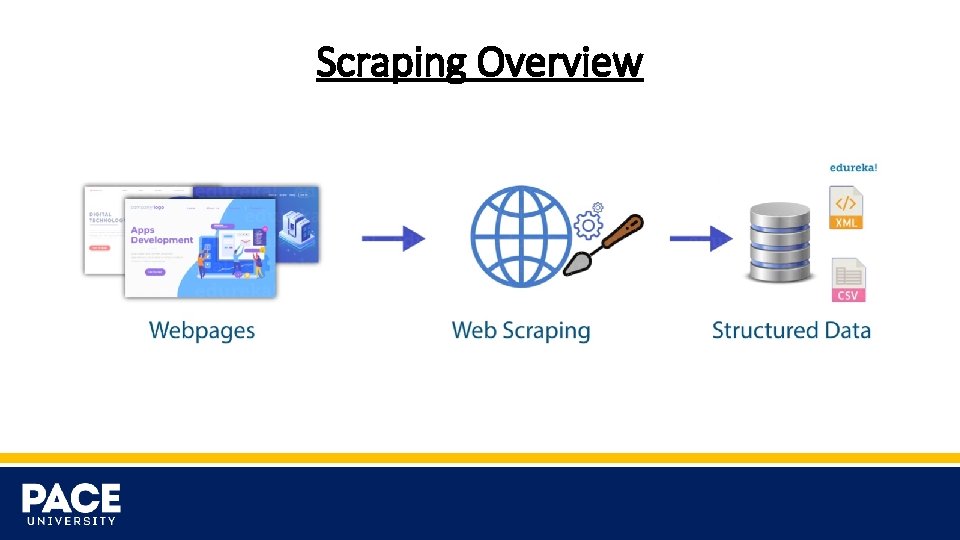
Scraping Overview
So, what exactly is Web Scraping? • Web scraping is an automated method used to extract large amounts of data from websites. • The data on the websites are unstructured. • Web scraping helps collect these unstructured data and store it in a structured form. • There are different ways to scrape websites such as online Services, APIs or writing your own code. • When you run the code for web scraping, a request is sent to the URL that you have mentioned. As a response to the request, the server sends the data and allows you to read the HTML or XML page. The code then, parses the HTML or XML page, finds the data and extracts it.
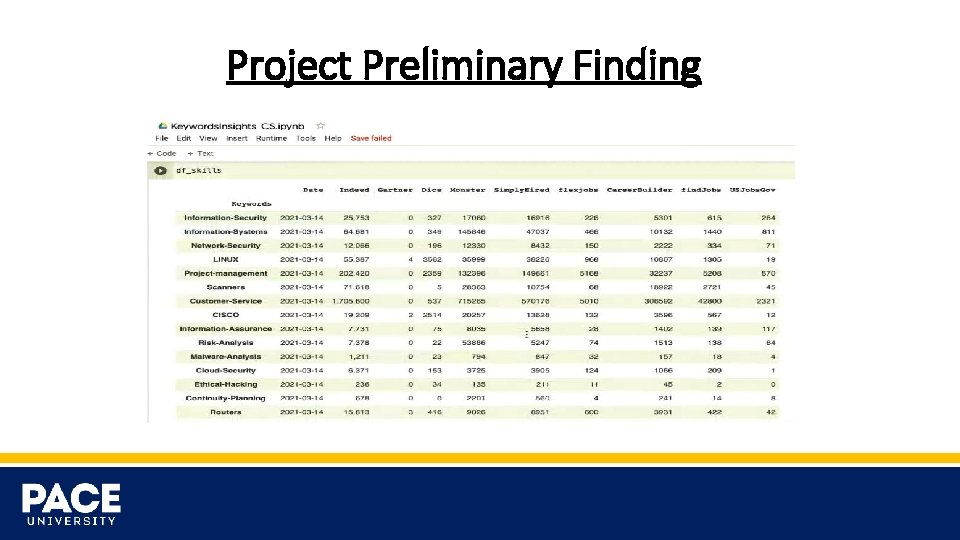
Project Preliminary Finding
Is It “Legal” to Scrape a site? • Discussing whether web scraping is legal or not, some websites allow web scraping, and some don’t. To understand whether a website allows web scraping or not, you can look at the website’s “robots. txt” file. • You must also review and understand the “Terms Of Use” or “Terms of Agreement” most information for allowed activity on the site is found here. • The factors of web scraping considered by the court as illegal are an act of hacking or violating the terms and agreement of a websites contract. • While there are numerous technologies tools used to preform data or web scraping the legality of Web Scraping is still a “grey area” in the legal field when discussing this, we must define legality as compliance with local, state and federal applicable laws and legal doctrines.
Conclusion The research in this project is mainly focused on: • Web Scraping Tools: optimum method to extract precise job information from popular job websites in real time. • Data Analysis: Data mining from the filtered job keywords to provide analysis of job skills requirement matchup to different job position in the job market. • Pace University career services: To achieve the ultimate working efficiencies when apply this application to the University career service, the project has aimed to work compatibly with the career service website.
Future Work • Possible web Interface. • User input fields for job search and key words. • Expand usage to students
![Reference • [1] U. S. B. of Labor Statistics. (2019) Projected percent change, by](http://slidetodoc.com/presentation_image_h2/b7183a01f20c657d2f2f3e78e6356995/image-15.jpg "Reference • [1] U. S. B. of Labor Statistics. (2019) Projected percent change, by")
Reference • [1] U. S. B. of Labor Statistics. (2019) Projected percent change, by selected occupational groups, 2019 -29. [Online]. Available: https: //www. bls. gov/emp • [2] S. Zhong, “Information intelligent system based on web data mining, ” in 2008 International Symposium on Electronic Commerce and Security. IEEE, 2008, pp. 514– 517. • [3] M. J. Berry and G. S. Linoff, Data mining techniques: for marketing, sales, and customer relationship management. John Wiley and Sons, 2004. • [4] A. I. Ali and F. Kohun, “The use of web log analysis in academic journals–case study, ” Issues in Information Systems, vol. 11, no. 1, pp. 612– 619, 2010. • [5] A. Jain, L. Montoya, A. Hossain, E. Cardona, O. De. Fran, P. Gurung, J. Shmidt, C. Tappert, and A. Leider, “Using data analytics to extract top keywords and trends in information technologies. ” • [6] J. Snell and N. Menaldo, “Web scraping in an era of big data 2. 0, ” Bloomberg Law News, 2016. • [7] V. Krotov and L. Silva, “Legality and ethics of web scraping, ” 2018. • [8] M. Mancosu and F. Vegetti, “What you can scrape and what is right to scrape: A proposal for a tool to collect public facebook data, ” Social Media+ Society, vol. 6, no. 3, p. 2056305120940703. • [9] J. Snell and N. Menaldo, “Web scraping in an era of big data 2. 0, ” Bloomberg Law News, 2016. • [12] L. A. Mc. Farland, S. Reeves, W. B. Porr, and R. E. Ployhart, “Impact of the covid-19 pandemic on job search behavior: An event transition perspective. ” Journal of Applied Psychology, 2020. • [13] D. Borup and E. C. M. Sch¨utte, “In search of a job: Forecasting employment growth using google trends, ” Journal of Business & Economic Statistics, pp. 1– 15, 2020.
- Slides: 15