
Using critical thinking to escape ideology Part I


- Slides: 24
Using critical thinking to escape ideology
Part I: Revision of literary theories
Feminism • Is the author male or female? Is the text narrated by a male or a female? What types of roles do women have in the text? Are the female characters the protagonists or secondary and minor characters? Do any stereotypical characterizations of women appear? What are the attitudes toward women held by the male characters? What is the author's attitude toward women in society? How does the author's culture influence her or his attitude? Is feminine imagery used? If so, what is the significance of such imagery? Do the female characters speak differently from the male characters? By asking any or ail of these questions of a text, we can begin our journey in feminist criticism while simultaneously helping ourselves to better understand the world in which we live.
• Feminist criticism is concerned with ". . . the ways in which literature (and other cultural productions) reinforce or undermine the economic, political, social, and psychological oppression of women" (Tyson). Feminism
Critical Race Studies • Critical Race Theory, or CRT, is a theoretical and interpretive mode that examines the appearance of race and racism across dominant cultural modes of expression. In adopting this approach, CRT scholars attempt to understand how victims of systemic racism are affected by cultural perceptions of race and how they are able to represent themselves to counter prejudice.
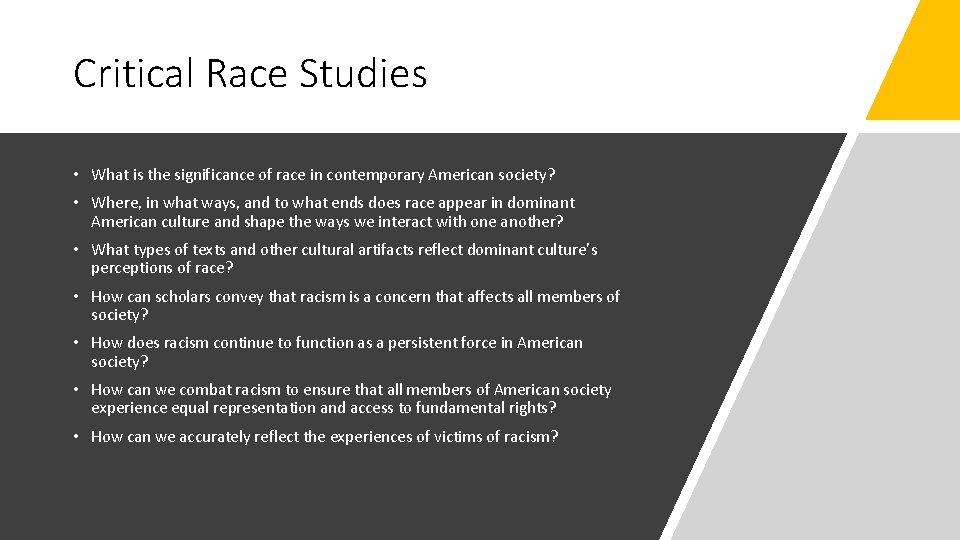
Critical Race Studies • What is the significance of race in contemporary American society? • Where, in what ways, and to what ends does race appear in dominant American culture and shape the ways we interact with one another? • What types of texts and other cultural artifacts reflect dominant culture’s perceptions of race? • How can scholars convey that racism is a concern that affects all members of society? • How does racism continue to function as a persistent force in American society? • How can we combat racism to ensure that all members of American society experience equal representation and access to fundamental rights? • How can we accurately reflect the experiences of victims of racism?
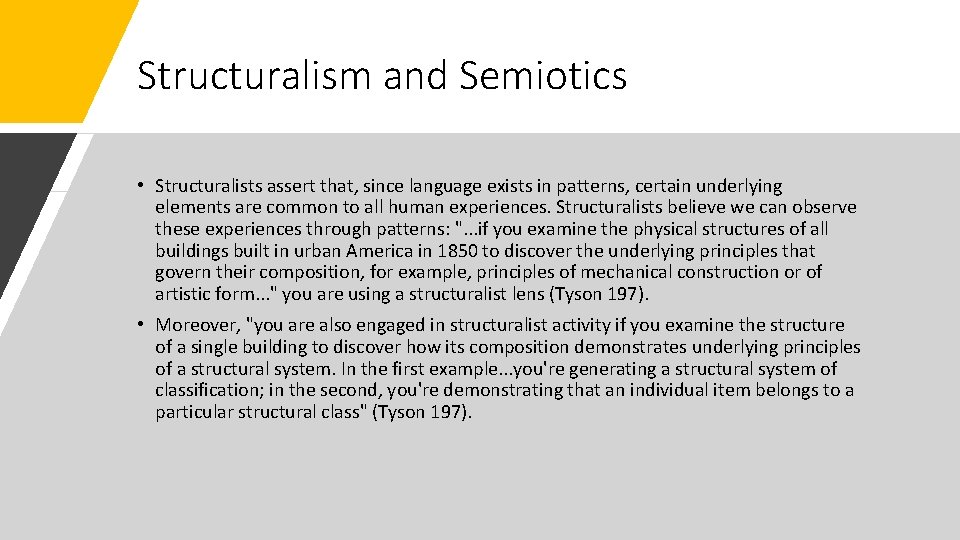
Structuralism and Semiotics • Structuralists assert that, since language exists in patterns, certain underlying elements are common to all human experiences. Structuralists believe we can observe these experiences through patterns: ". . . if you examine the physical structures of all buildings built in urban America in 1850 to discover the underlying principles that govern their composition, for example, principles of mechanical construction or of artistic form. . . " you are using a structuralist lens (Tyson 197). • Moreover, "you are also engaged in structuralist activity if you examine the structure of a single building to discover how its composition demonstrates underlying principles of a structural system. In the first example. . . you're generating a structural system of classification; in the second, you're demonstrating that an individual item belongs to a particular structural class" (Tyson 197).
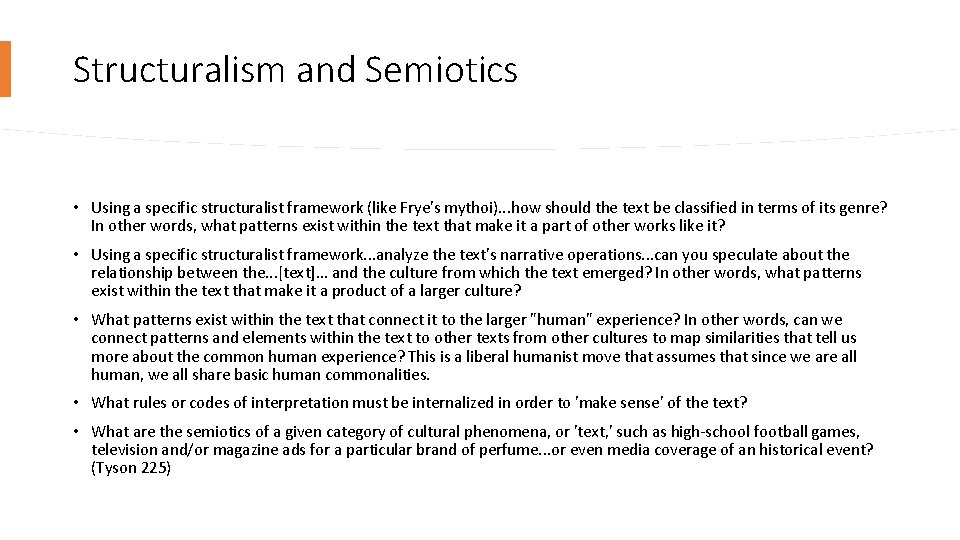
Structuralism and Semiotics • Using a specific structuralist framework (like Frye's mythoi). . . how should the text be classified in terms of its genre? In other words, what patterns exist within the text that make it a part of other works like it? • Using a specific structuralist framework. . . analyze the text's narrative operations. . . can you speculate about the relationship between the. . . [text]. . . and the culture from which the text emerged? In other words, what patterns exist within the text that make it a product of a larger culture? • What patterns exist within the text that connect it to the larger "human" experience? In other words, can we connect patterns and elements within the text to other texts from other cultures to map similarities that tell us more about the common human experience? This is a liberal humanist move that assumes that since we are all human, we all share basic human commonalities. • What rules or codes of interpretation must be internalized in order to 'make sense' of the text? • What are the semiotics of a given category of cultural phenomena, or 'text, ' such as high-school football games, television and/or magazine ads for a particular brand of perfume. . . or even media coverage of an historical event? (Tyson 225)
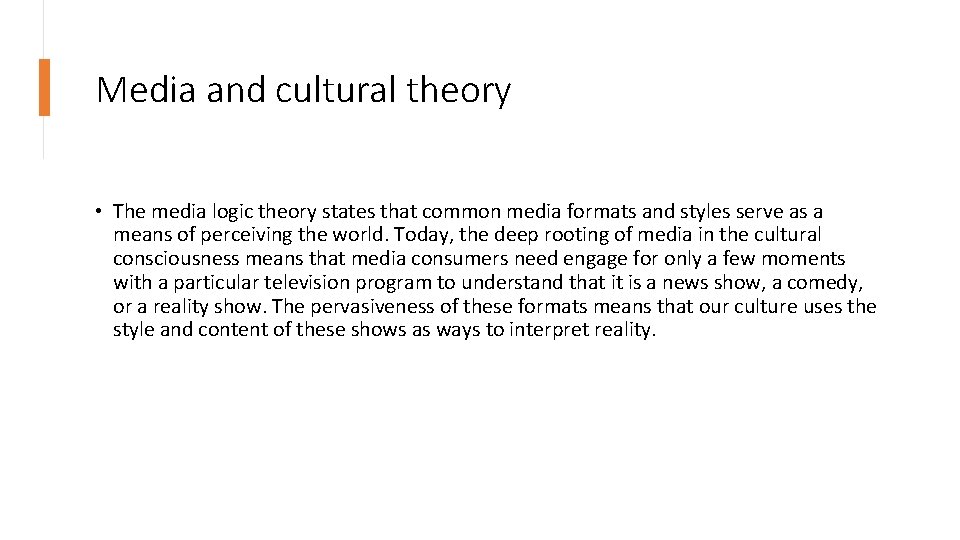
Media and cultural theory • The media logic theory states that common media formats and styles serve as a means of perceiving the world. Today, the deep rooting of media in the cultural consciousness means that media consumers need engage for only a few moments with a particular television program to understand that it is a news show, a comedy, or a reality show. The pervasiveness of these formats means that our culture uses the style and content of these shows as ways to interpret reality.
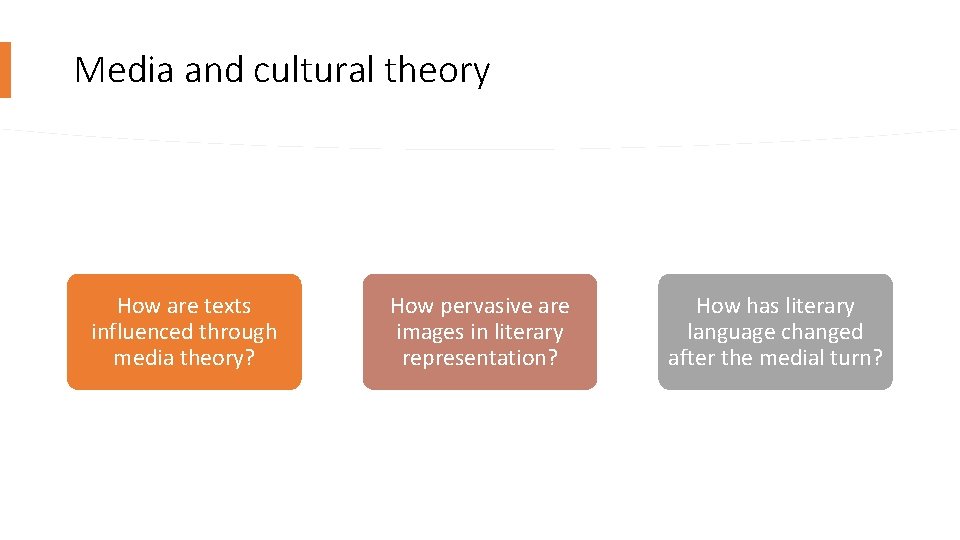
Media and cultural theory How are texts influenced through media theory? How pervasive are images in literary representation? How has literary language changed after the medial turn?
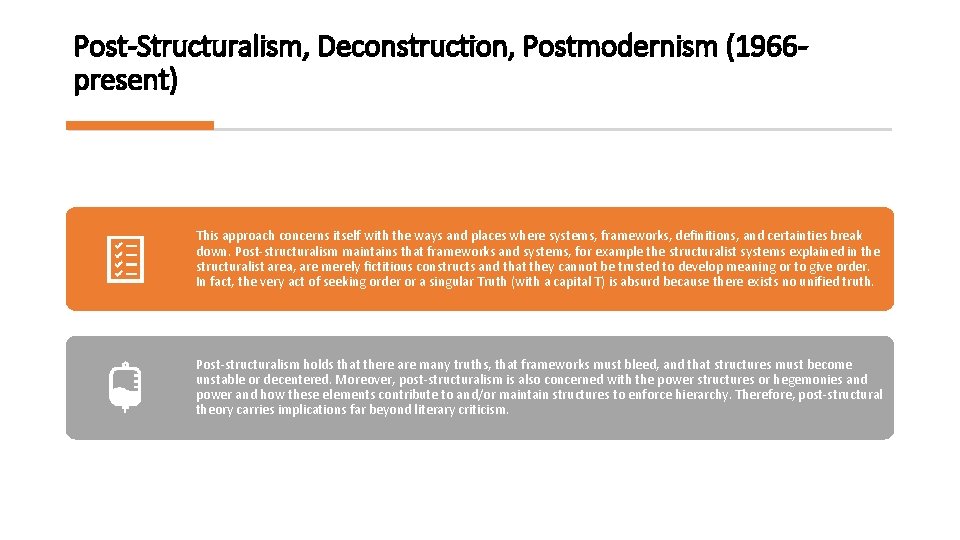
Post-Structuralism, Deconstruction, Postmodernism (1966 present) This approach concerns itself with the ways and places where systems, frameworks, definitions, and certainties break down. Post-structuralism maintains that frameworks and systems, for example the structuralist systems explained in the structuralist area, are merely fictitious constructs and that they cannot be trusted to develop meaning or to give order. In fact, the very act of seeking order or a singular Truth (with a capital T) is absurd because there exists no unified truth. Post-structuralism holds that there are many truths, that frameworks must bleed, and that structures must become unstable or decentered. Moreover, post-structuralism is also concerned with the power structures or hegemonies and power and how these elements contribute to and/or maintain structures to enforce hierarchy. Therefore, post-structural theory carries implications far beyond literary criticism.
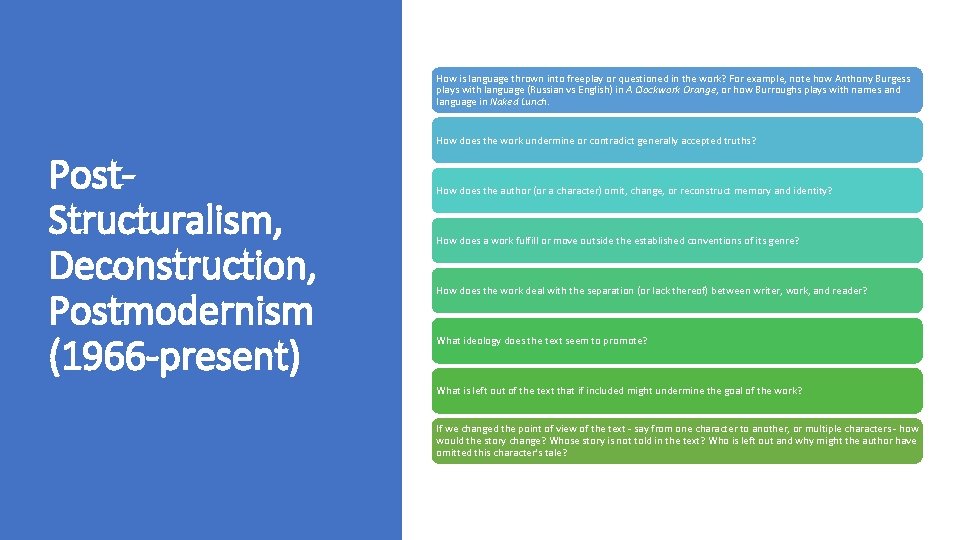
How is language thrown into freeplay or questioned in the work? For example, note how Anthony Burgess plays with language (Russian vs English) in A Clockwork Orange, or how Burroughs plays with names and language in Naked Lunch. How does the work undermine or contradict generally accepted truths? Post. Structuralism, Deconstruction, Postmodernism (1966 -present) How does the author (or a character) omit, change, or reconstruct memory and identity? How does a work fulfill or move outside the established conventions of its genre? How does the work deal with the separation (or lack thereof) between writer, work, and reader? What ideology does the text seem to promote? What is left out of the text that if included might undermine the goal of the work? If we changed the point of view of the text - say from one character to another, or multiple characters - how would the story change? Whose story is not told in the text? Who is left out and why might the author have omitted this character's tale?
Psychoanalysis • some critics believe that we can ". . . read psychoanalytically. . . to see which concepts are operating in the text in such a way as to enrich our understanding of the work and, if we plan to write a paper about it, to yield a meaningful, coherent psychoanalytic interpretation" (Tyson 29). Tyson provides some insightful and applicable questions to help guide our understanding of psychoanalytic criticism.
• How do the operations of repression structure or inform the work? • Are there any Oedipal dynamics - or any other family dynamics - at work here? Psychoanalysis • How can characters' behavior, narrative events, and/or images be explained in terms of psychoanalytic concepts of any kind (for example, fear or fascination with death, sexuality - which includes love and romance as well as sexual behavior - as a primary indicator of psychological identity or the operations of ego-id-superego)? • What does the work suggest about the psychological being of its author? • What might a given interpretation of a literary work suggest about the psychological motives of the reader? • Are there prominent words in the piece that could have different or hidden meanings? Could there be a subconscious reason for the author using these "problem words"?
New Historicism • This school, influenced by structuralist and post-structuralist theories, seeks to reconnect a work with the time period in which it was produced and identify it with the cultural and political movements of the time (Michel Foucault's concept of épistème). New Historicism assumes that every work is a product of the historic moment that created it. Specifically, New Historicism is ". . . a practice that has developed out of contemporary theory, particularly the structuralist realization that all human systems are symbolic and subject to the rules of language, and the deconstructive realization that there is no way of positioning oneself as an observer outside the closed circle of textuality" (Richter 1205).
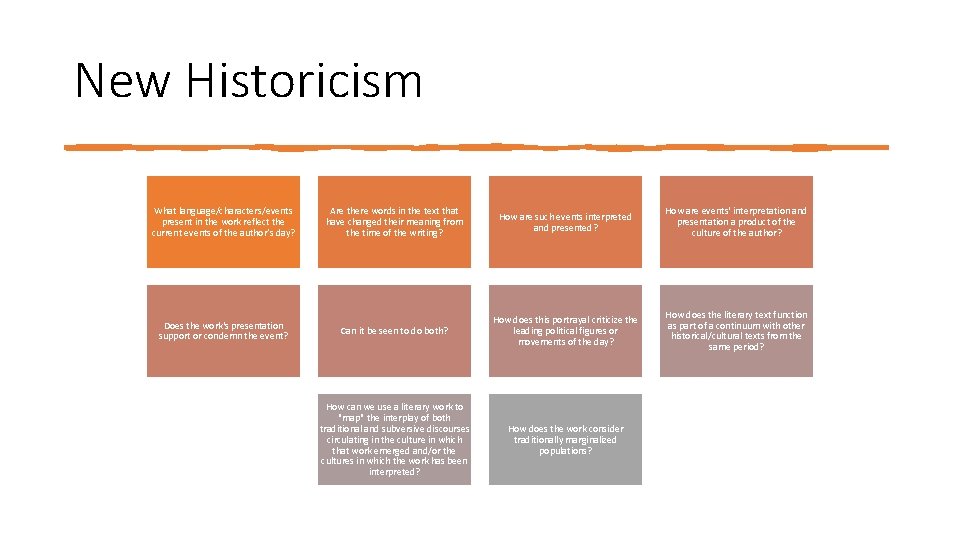
New Historicism What language/characters/events present in the work reflect the current events of the author’s day? Does the work's presentation support or condemn the event? Are there words in the text that have changed their meaning from the time of the writing? How are such events interpreted and presented? How are events' interpretation and presentation a product of the culture of the author? Can it be seen to do both? How does this portrayal criticize the leading political figures or movements of the day? How does the literary text function as part of a continuum with other historical/cultural texts from the same period? How can we use a literary work to "map" the interplay of both traditional and subversive discourses circulating in the culture in which that work emerged and/or the cultures in which the work has been interpreted? How does the work consider traditionally marginalized populations?
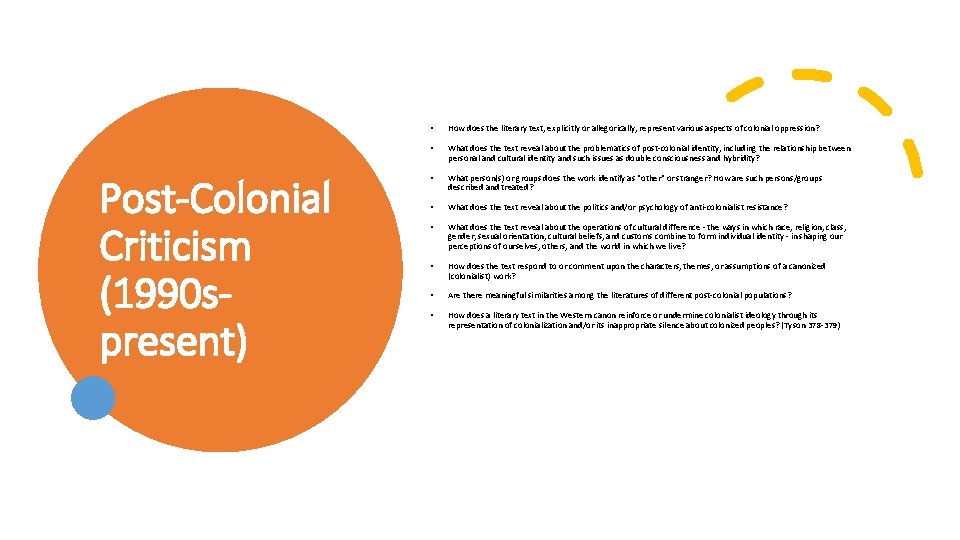
Post-Colonial Criticism (1990 s-present) • Post-colonial criticism is similar to cultural studies, but it assumes a unique perspective on literature and politics that warrants a separate discussion. Specifically, post-colonial critics are concerned with literature produced by colonial powers and works produced by those who were/are colonized. Post-colonial theory looks at issues of power, economics, politics, religion, and culture and how these elements work in relation to colonial hegemony (Western colonizers controlling the colonized). • Therefore, a post-colonial critic might be interested in works such as Daniel Defoe's Robinson Crusoe where colonial ". . . ideology [is] manifest in Crusoe's colonialist attitude toward the land upon which he's shipwrecked and toward the black man he 'colonizes' and names Friday" (Tyson 377). In addition, post-colonial theory might point out that ". . . despite Heart of Darkness's (Joseph Conrad) obvious anti-colonist agenda, the novel points to the colonized population as the standard of savagery to which Europeans are contrasted" (Tyson 375). Post-colonial criticism also takes the form of literature composed by authors that critique Euro-centric hegemony.
Post-Colonial Criticism (1990 spresent) • How does the literary text, explicitly or allegorically, represent various aspects of colonial oppression? • What does the text reveal about the problematics of post-colonial identity, including the relationship between personal and cultural identity and such issues as double consciousness and hybridity? • What person(s) or groups does the work identify as "other" or stranger? How are such persons/groups described and treated? • What does the text reveal about the politics and/or psychology of anti-colonialist resistance? • What does the text reveal about the operations of cultural difference - the ways in which race, religion, class, gender, sexual orientation, cultural beliefs, and customs combine to form individual identity - in shaping our perceptions of ourselves, others, and the world in which we live? • How does the text respond to or comment upon the characters, themes, or assumptions of a canonized (colonialist) work? • Are there meaningful similarities among the literatures of different post-colonial populations? • How does a literary text in the Western canon reinforce or undermine colonialist ideology through its representation of colonialization and/or its inappropriate silence about colonized peoples? (Tyson 378 -379)
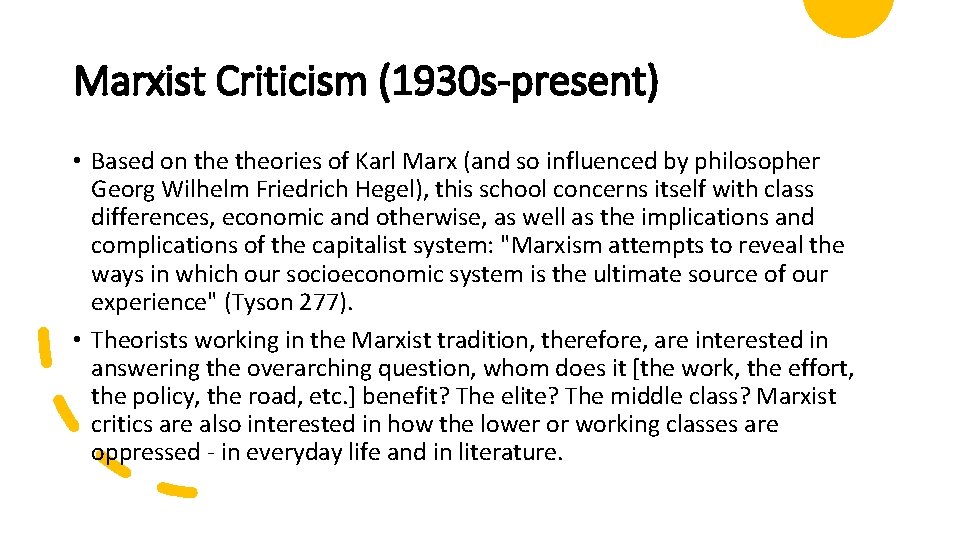
Marxist Criticism (1930 s-present) • Based on theories of Karl Marx (and so influenced by philosopher Georg Wilhelm Friedrich Hegel), this school concerns itself with class differences, economic and otherwise, as well as the implications and complications of the capitalist system: "Marxism attempts to reveal the ways in which our socioeconomic system is the ultimate source of our experience" (Tyson 277). • Theorists working in the Marxist tradition, therefore, are interested in answering the overarching question, whom does it [the work, the effort, the policy, the road, etc. ] benefit? The elite? The middle class? Marxist critics are also interested in how the lower or working classes are oppressed - in everyday life and in literature.
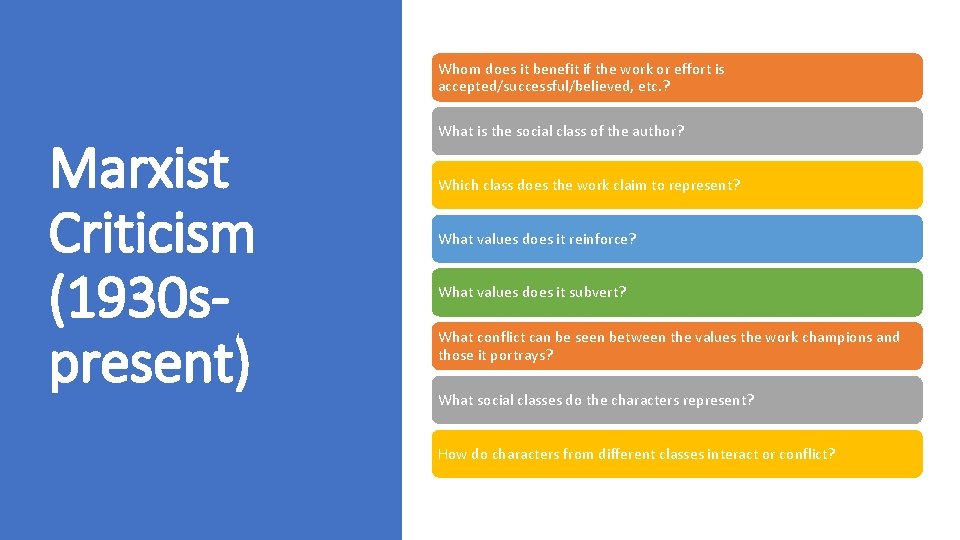
Whom does it benefit if the work or effort is accepted/successful/believed, etc. ? Marxist Criticism (1930 spresent) What is the social class of the author? Which class does the work claim to represent? What values does it reinforce? What values does it subvert? What conflict can be seen between the values the work champions and those it portrays? What social classes do the characters represent? How do characters from different classes interact or conflict?
Literary terms https: //owl. purdue. edu/owl/subject_specific_writing/writin g_in_literature/literary_terms/index. html
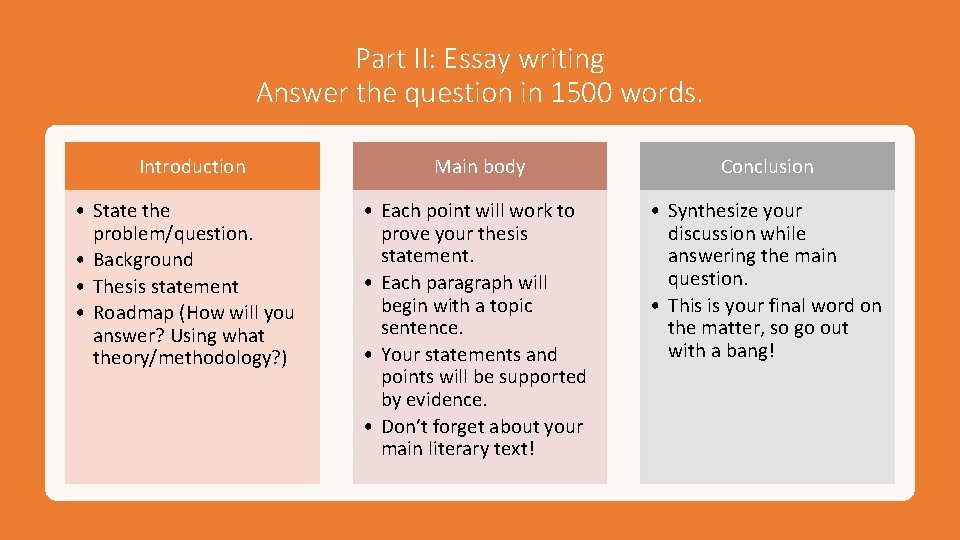
Part II: Essay writing Answer the question in 1500 words. Introduction • State the problem/question. • Background • Thesis statement • Roadmap (How will you answer? Using what theory/methodology? ) Main body Conclusion • Each point will work to prove your thesis statement. • Each paragraph will begin with a topic sentence. • Your statements and points will be supported by evidence. • Don’t forget about your main literary text! • Synthesize your discussion while answering the main question. • This is your final word on the matter, so go out with a bang!
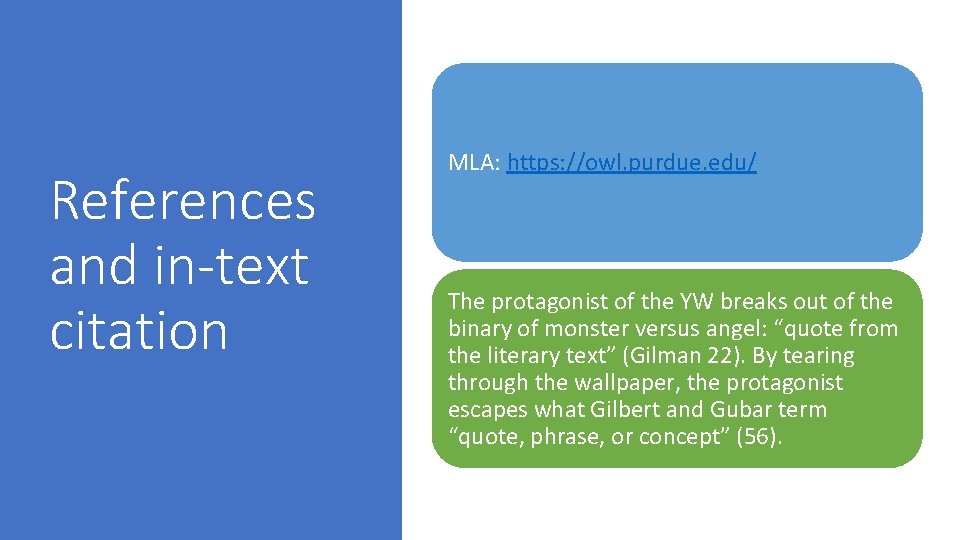
References and in-text citation MLA: https: //owl. purdue. edu/ The protagonist of the YW breaks out of the binary of monster versus angel: “quote from the literary text” (Gilman 22). By tearing through the wallpaper, the protagonist escapes what Gilbert and Gubar term “quote, phrase, or concept” (56).
You might need to rewrite your introduction or edit after you are done with your essay. DO NOT leave your bibliography for the last minute. https: //www. zotero. org/ Tips Read the entire essay a day or two after you have completed it OUT LOUD. Proof-read.