
Using Cooperative Learning to Encourage Higher Order Thinking


- Slides: 17
Using Cooperative Learning to Encourage Higher Order Thinking Dunklin R-V School District New Teacher Orientation August 15, 2007
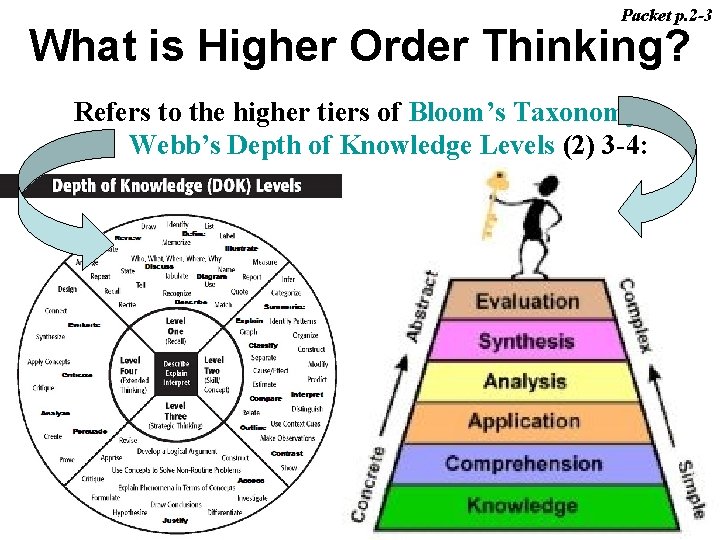
Packet p. 2 -3 What is Higher Order Thinking? Refers to the higher tiers of Bloom’s Taxonomy & Webb’s Depth of Knowledge Levels (2) 3 -4:
Packet p. 6 What is Cooperative Learning? • Key Concepts – Teams (2 -4; heterogeneous, homogeneous, random) – Will (Teambuilding & Classbuilding) – Management (signals, roles, modeling) – Skills (social, listening, conflict resolution, tutoring) – PIES – Co-op Strategies/Structures (Kagan, Slavin, Johnson & Johnson)
Packet p. 7 Using Questions • Pairs: Rally Coach • Teams: Fan-N-Pick, Cubing, Numbered Heads Together
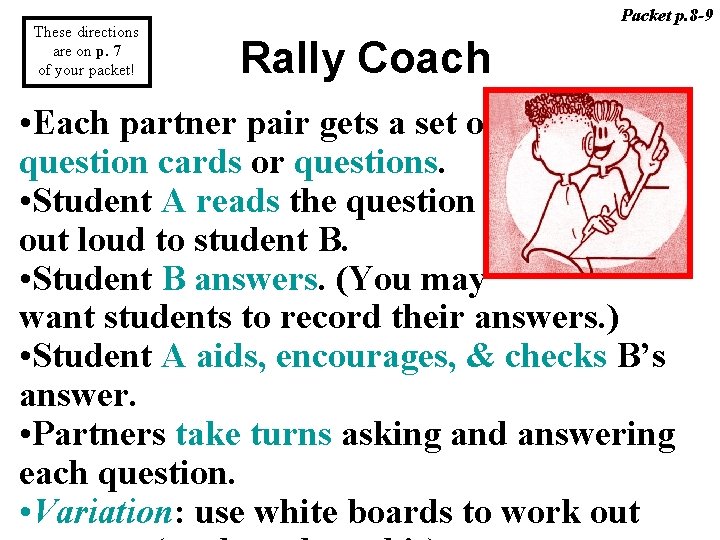
These directions are on p. 7 of your packet! Packet p. 8 -9 Rally Coach • Each partner pair gets a set of question cards or questions. • Student A reads the question out loud to student B. • Student B answers. (You may want students to record their answers. ) • Student A aids, encourages, & checks B’s answer. • Partners take turns asking and answering each question. • Variation: use white boards to work out
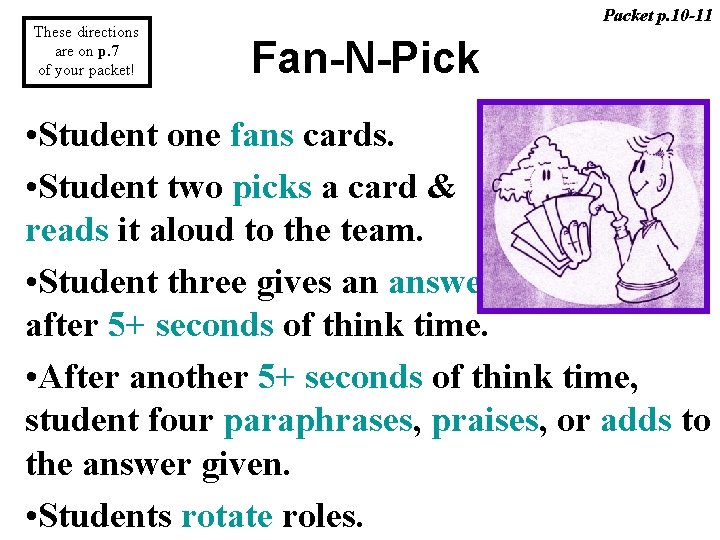
These directions are on p. 7 of your packet! Packet p. 10 -11 Fan-N-Pick • Student one fans cards. • Student two picks a card & reads it aloud to the team. • Student three gives an answer after 5+ seconds of think time. • After another 5+ seconds of think time, student four paraphrases, praises, or adds to the answer given. • Students rotate roles.
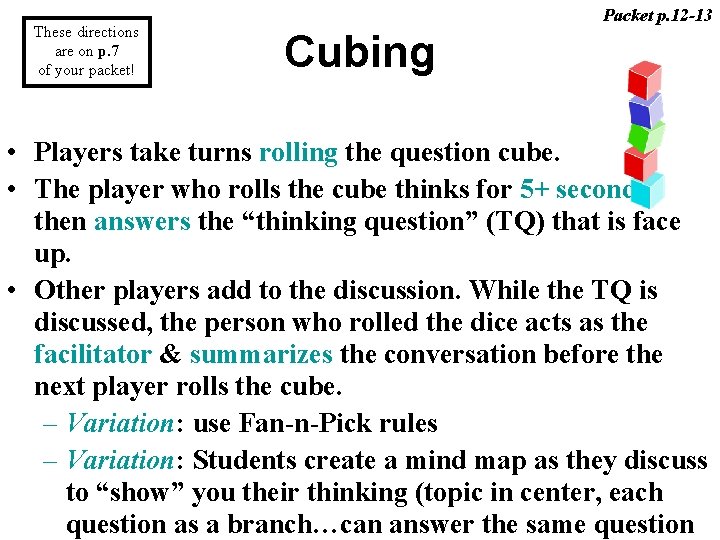
These directions are on p. 7 of your packet! Packet p. 12 -13 Cubing • Players take turns rolling the question cube. • The player who rolls the cube thinks for 5+ seconds, then answers the “thinking question” (TQ) that is face up. • Other players add to the discussion. While the TQ is discussed, the person who rolled the dice acts as the facilitator & summarizes the conversation before the next player rolls the cube. – Variation: use Fan-n-Pick rules – Variation: Students create a mind map as they discuss to “show” you their thinking (topic in center, each question as a branch…can answer the same question
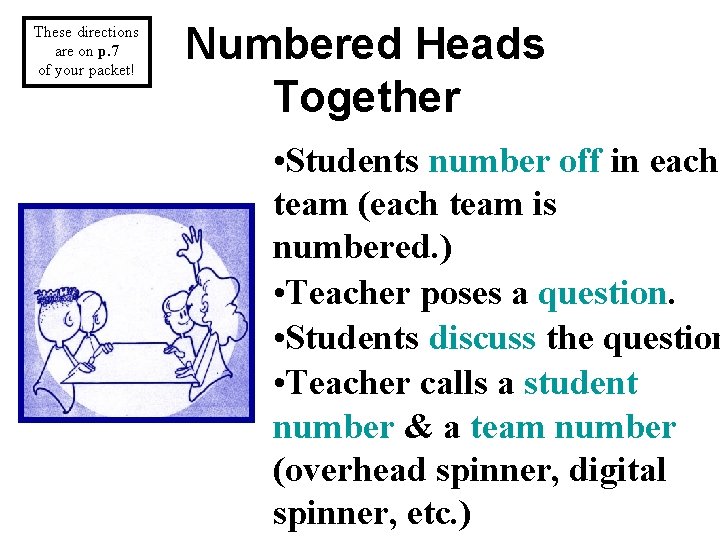
These directions are on p. 7 of your packet! Numbered Heads Together • Students number off in each team (each team is numbered. ) • Teacher poses a question. • Students discuss the question • Teacher calls a student number & a team number (overhead spinner, digital spinner, etc. )
Question 1 Which of Abraham Lincoln’s character traits is the most admirable? Why?
Question 2 You have been granted one day to go back in history to become Abraham Lincoln. What would you do differently (besides NOT going to Ford’s theater)?
Question 3 How might the world be different today if Abraham Lincoln had never lived?
Directions on p. 7. Good way to ensure Individual Accountability after a Co-op structure. Packet p. 14 -15 Journal Writing • Students pick one question card & make a journal entry or use the question as the prompt for an essay or creative writing assignment. • Students share their writing with a partner or in turn with teammates. (When students get acquainted with good higher order thinking questions, they can begin to make their own questions using “Question-Starters. ”)
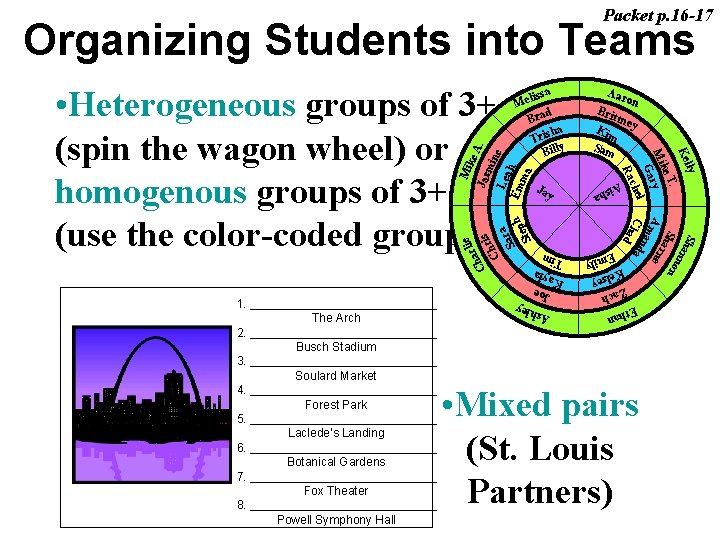
Packet p. 16 -17 Organizing Students into Teams Ja Ais Em an Eth h Zac sey Kel ily Joe Kay la Tim ie arl h C ris Ch ra Sa h p Ste Sh a nn on Sh ar Am ne an Ch da ad ley Ash 1. ______________ The Arch 2. ______________ Busch Stadium 3. ______________ Soulard Market 4. ______________ Forest Park 5. ______________ Laclede’s Landing 6. ______________ Botanical Gardens 7. ______________ Fox Theater 8. ______________ Powell Symphony Hall y ha Jas Mi ke A. min Lea e Em h ma ttne Kim y Sam Bri lly Ke T. ke Mi ry Ga l che Ra • Heterogeneous groups of 3+ (spin the wagon wheel) or homogenous groups of 3+ (use the color-coded groups) Aar on issa Mel d Bra ha Tris y Bill • Mixed pairs (St. Louis Partners)
Ticket to Leave • Look at your graphic organizer on p. 1 • Identify one cooperative learning structure you will try in your classroom—put a star next to it • On a slip of paper, tell me 1. The content area topic you will you use it to teach/reinforce, and
Thanks! Good luck! Call or email if you
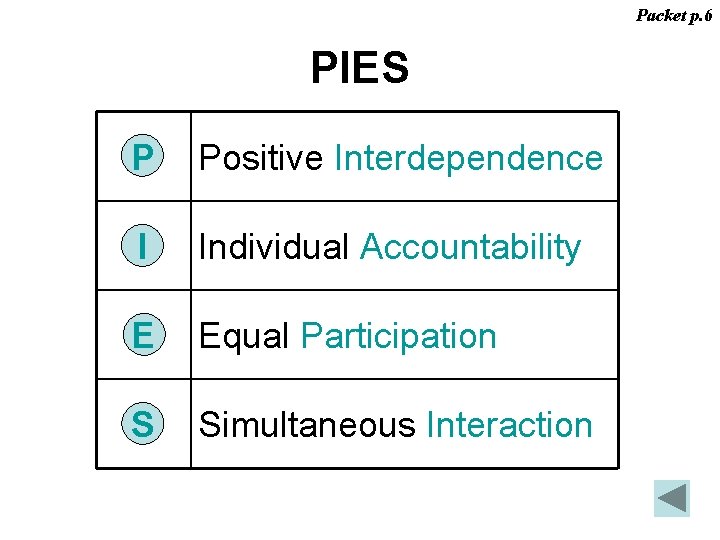
Packet p. 6 PIES P Positive Interdependence I Individual Accountability E Equal Participation S Simultaneous Interaction