
Using Conceptual Frameworks of Earth Systems to Frame


- Slides: 19
Using Conceptual Frameworks of Earth Systems to Frame Future Directions in Systems Thinking Research HANNA H H. S CHERER , AGRICULTURAL, LEADERS HI P, & COMMU NITY EDUCATION, VIRGINIA TECH LISA G ILB ERT , GEOSCIENCES & MARINE SCIENCE, WI LLI AMS-MY STIC
Ice Breaker At your table group: 1. Introduce yourself (name and institution) 2. How do you engage in systems thinking as a professional (scientist)? 3. In what ways do you teach it?
Conceptual Frameworks of Earth Systems A Synthesis of Literature Addressing Student Learning of Complex Earth Systems HANNA H H. S CHERER , AGRICULTURAL, LEADERS HI P, & COMMU NITY EDUCATION, VIRGINIA TECH LAUR EN HOLDER & BRUCE HERBERT , GEOLOG Y AND GEOPHYS ICS , TEXAS A & M UNIVERSITY
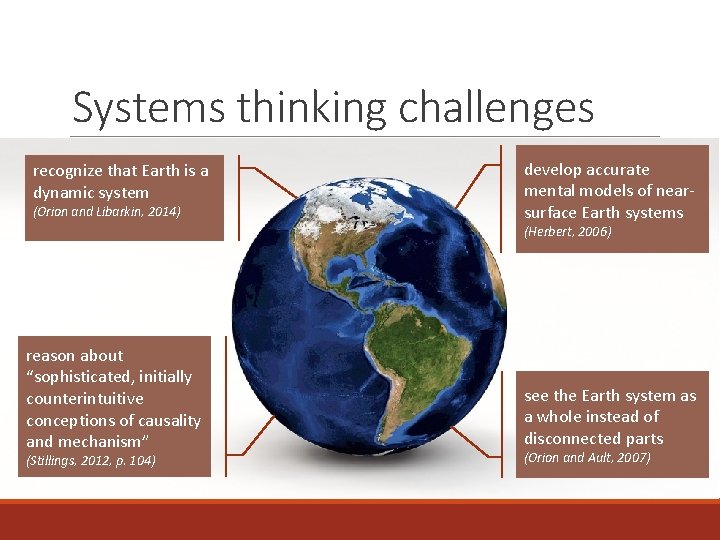
Systems thinking challenges recognize that Earth is a dynamic system (Orion and Libarkin, 2014) develop accurate mental models of nearsurface Earth systems (Herbert, 2006) reason about “sophisticated, initially counterintuitive conceptions of causality and mechanism” (Stillings, 2012, p. 104) see the Earth system as a whole instead of disconnected parts (Orion and Ault, 2007)
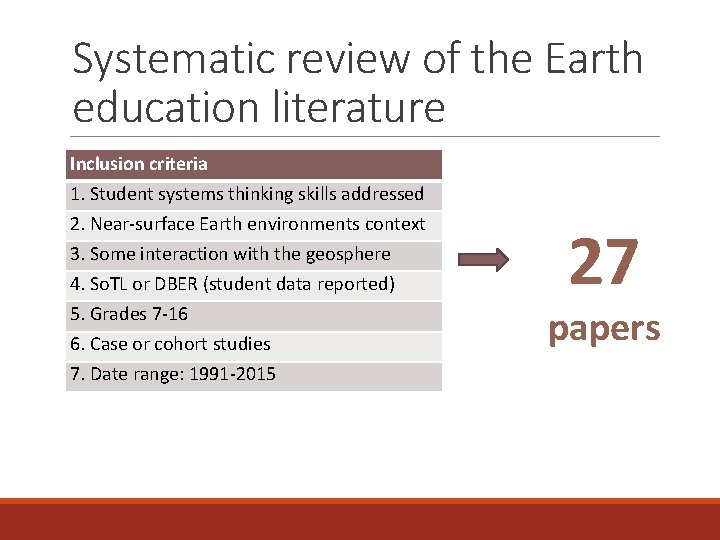
Systematic review of the Earth education literature Inclusion criteria 1. Student systems thinking skills addressed 2. Near-surface Earth environments context 3. Some interaction with the geosphere 4. So. TL or DBER (student data reported) 5. Grades 7 -16 6. Case or cohort studies 7. Date range: 1991 -2015 27 papers
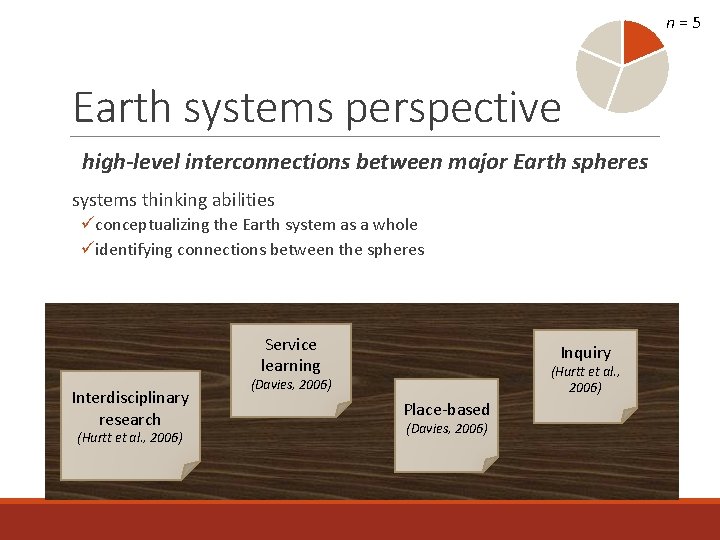
n=5 Earth systems perspective high-level interconnections between major Earth spheres systems thinking abilities üconceptualizing the Earth system as a whole üidentifying connections between the spheres Service learning Interdisciplinary research (Hurtt et al. , 2006) Inquiry (Hurtt et al. , 2006) (Davies, 2006) Place-based (Davies, 2006)
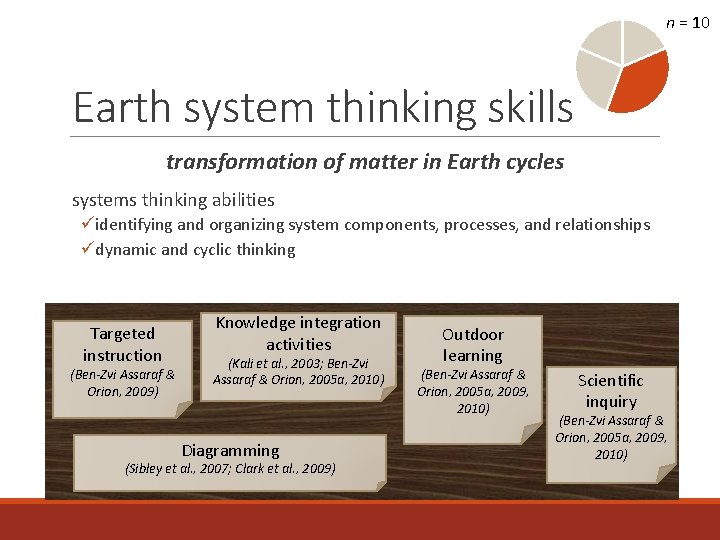
n = 10 Earth system thinking skills transformation of matter in Earth cycles systems thinking abilities üidentifying and organizing system components, processes, and relationships üdynamic and cyclic thinking Targeted instruction (Ben-Zvi Assaraf & Orion, 2009) Knowledge integration activities (Kali et al. , 2003; Ben-Zvi Assaraf & Orion, 2005 a, 2010) Diagramming (Sibley et al. , 2007; Clark et al. , 2009) Outdoor learning (Ben-Zvi Assaraf & Orion, 2005 a, 2009, 2010) Scientific inquiry (Ben-Zvi Assaraf & Orion, 2005 a, 2009, 2010)
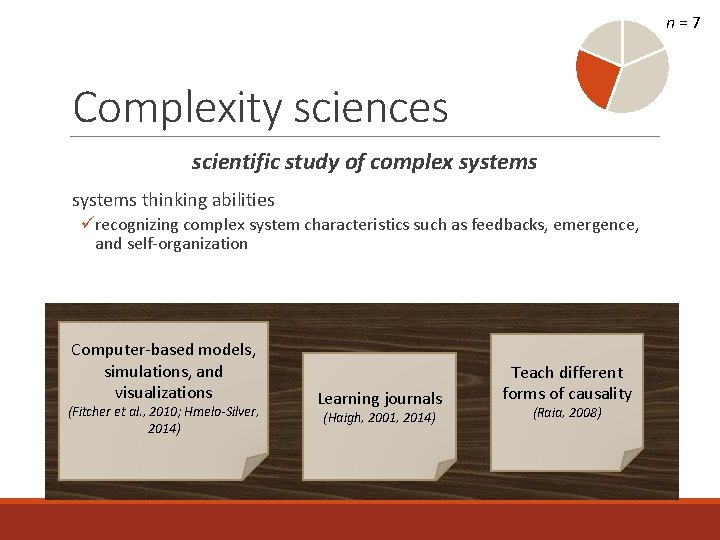
n=7 Complexity sciences scientific study of complex systems thinking abilities ürecognizing complex system characteristics such as feedbacks, emergence, and self-organization Computer-based models, simulations, and visualizations (Fitcher et al. , 2010; Hmelo-Silver, 2014) Learning journals (Haigh, 2001, 2014) Teach different forms of causality (Raia, 2008)
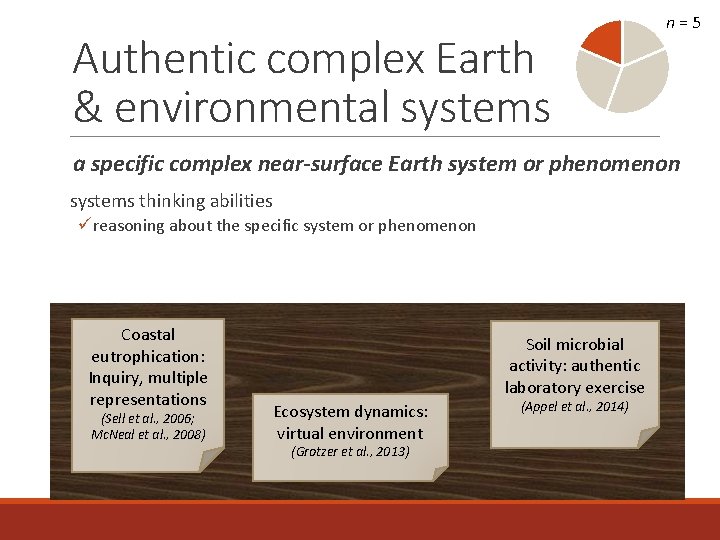
Authentic complex Earth & environmental systems n=5 a specific complex near-surface Earth system or phenomenon systems thinking abilities üreasoning about the specific system or phenomenon Coastal eutrophication: Inquiry, multiple representations (Sell et al. , 2006; Mc. Neal et al. , 2008) Soil microbial activity: authentic laboratory exercise Ecosystem dynamics: virtual environment (Grotzer et al. , 2013) (Appel et al. , 2014)
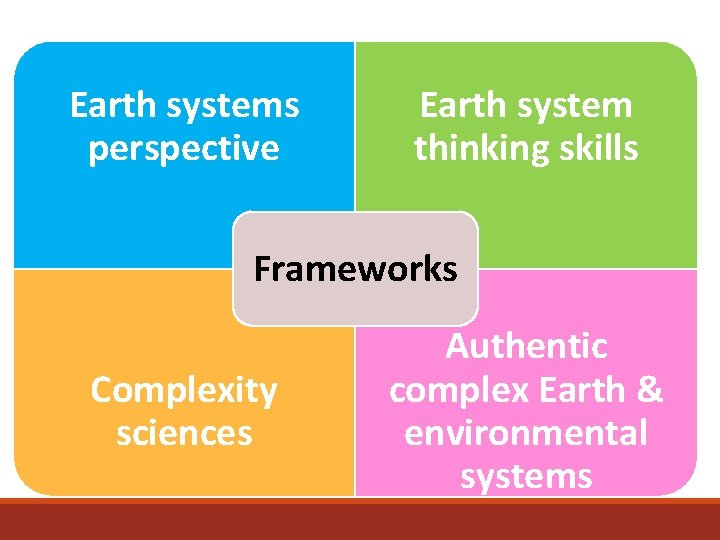
Earth systems perspective Earth system thinking skills Frameworks Complexity sciences Authentic complex Earth & environmental systems
Small group reflection At your table group, discuss: 1. Why might it be important to think about different ways to frame systems thinking? 2. What are your realizations about how to teach systems thinking? 3. What is the utility of the frameworks?
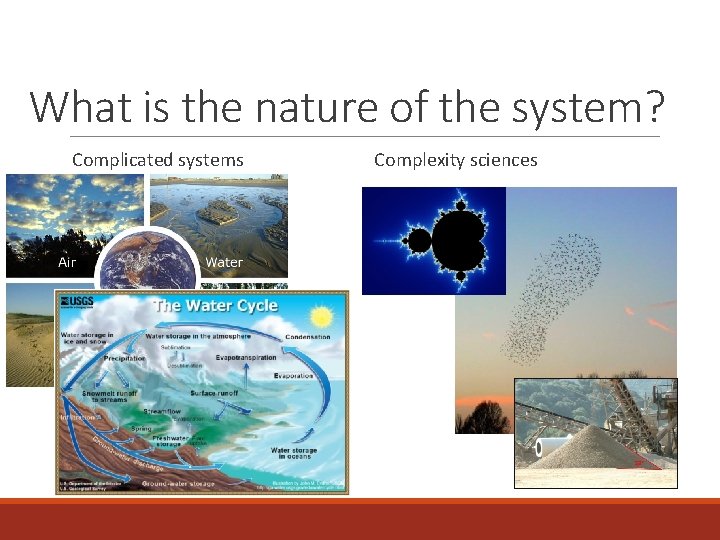
What is the nature of the system? Complicated systems Complexity sciences
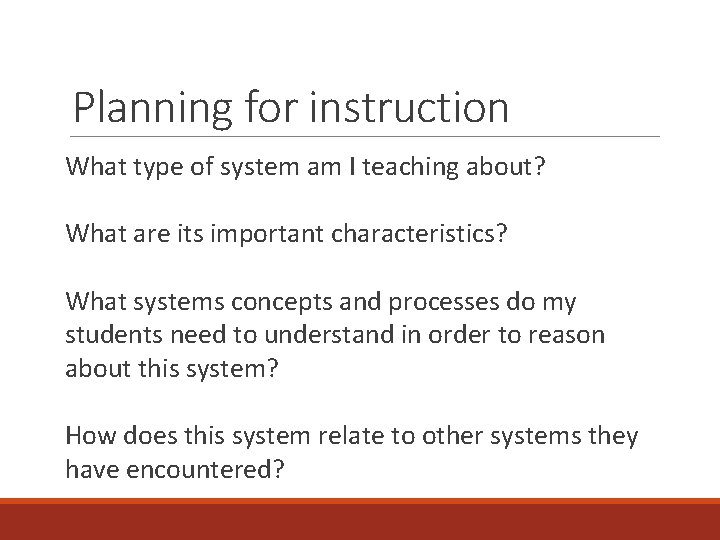
Planning for instruction What type of system am I teaching about? What are its important characteristics? What systems concepts and processes do my students need to understand in order to reason about this system? How does this system relate to other systems they have encountered?
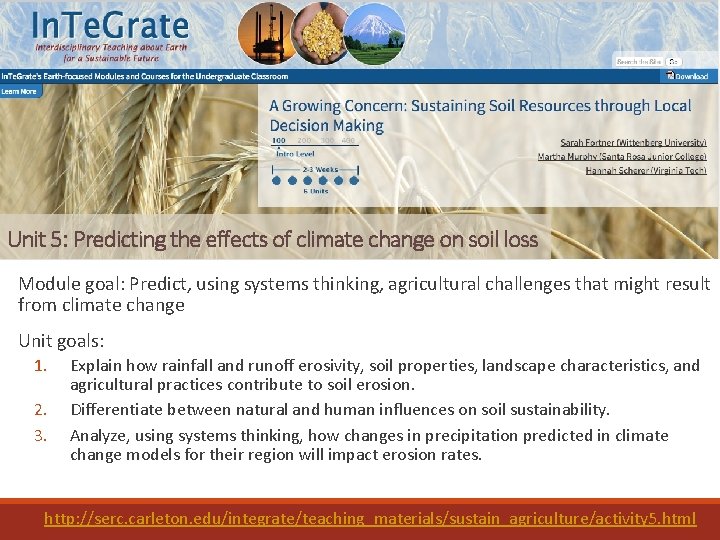
Unit 5: Predicting the effects of climate change on soil loss Module goal: Predict, using systems thinking, agricultural challenges that might result from climate change Unit goals: 1. 2. 3. Explain how rainfall and runoff erosivity, soil properties, landscape characteristics, and agricultural practices contribute to soil erosion. Differentiate between natural and human influences on soil sustainability. Analyze, using systems thinking, how changes in precipitation predicted in climate change models for their region will impact erosion rates. http: //serc. carleton. edu/integrate/teaching_materials/sustain_agriculture/activity 5. html
Authentic complex Earth and environmental systems Unit 5: Predicting the effects of climate change on soil loss Module goal: Predict, using systems thinking, agricultural challenges that might result from climate change Unit goals: 1. 2. 3. Explain how rainfall and runoff erosivity, soil properties, landscape characteristics, and agricultural practices contribute to soil erosion. Differentiate between natural and human influences on soil sustainability. Analyze, using systems thinking, how changes in precipitation predicted in climate change models for their region will impact erosion rates. http: //serc. carleton. edu/integrate/teaching_materials/sustain_agriculture/activity 5. html
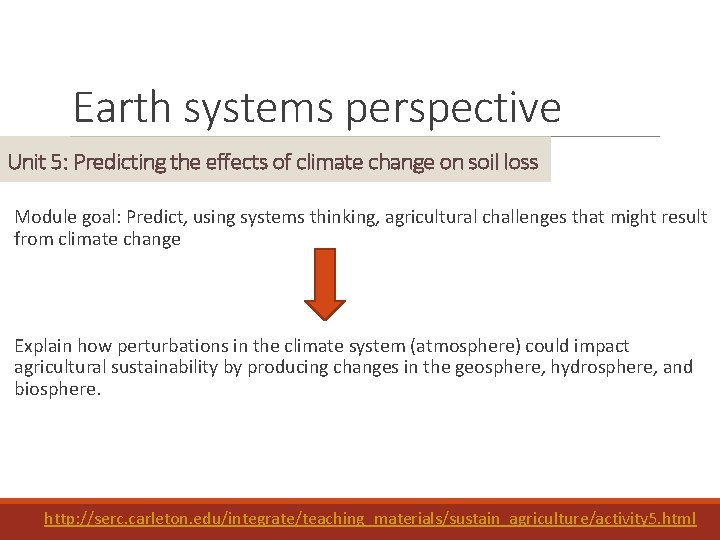
Earth systems perspective Unit 5: Predicting the effects of climate change on soil loss Module goal: Predict, using systems thinking, agricultural challenges that might result from climate change Explain how perturbations in the climate system (atmosphere) could impact agricultural sustainability by producing changes in the geosphere, hydrosphere, and biosphere. http: //serc. carleton. edu/integrate/teaching_materials/sustain_agriculture/activity 5. html
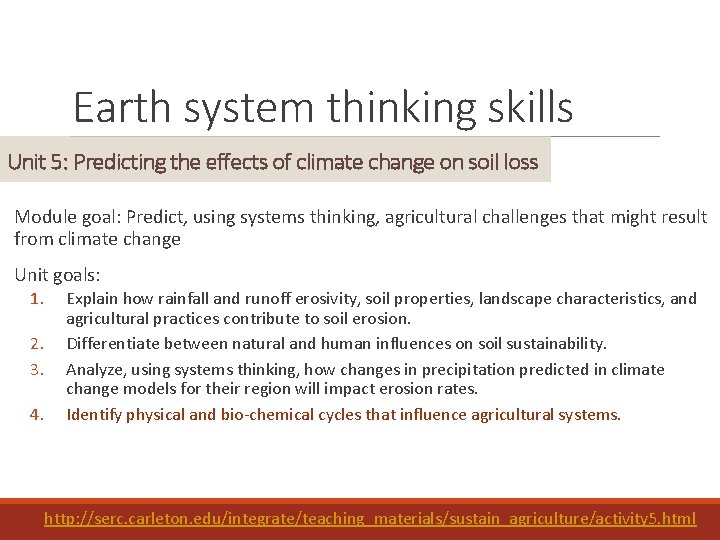
Earth system thinking skills Unit 5: Predicting the effects of climate change on soil loss Module goal: Predict, using systems thinking, agricultural challenges that might result from climate change Unit goals: 1. 2. 3. 4. Explain how rainfall and runoff erosivity, soil properties, landscape characteristics, and agricultural practices contribute to soil erosion. Differentiate between natural and human influences on soil sustainability. Analyze, using systems thinking, how changes in precipitation predicted in climate change models for their region will impact erosion rates. Identify physical and bio-chemical cycles that influence agricultural systems. http: //serc. carleton. edu/integrate/teaching_materials/sustain_agriculture/activity 5. html
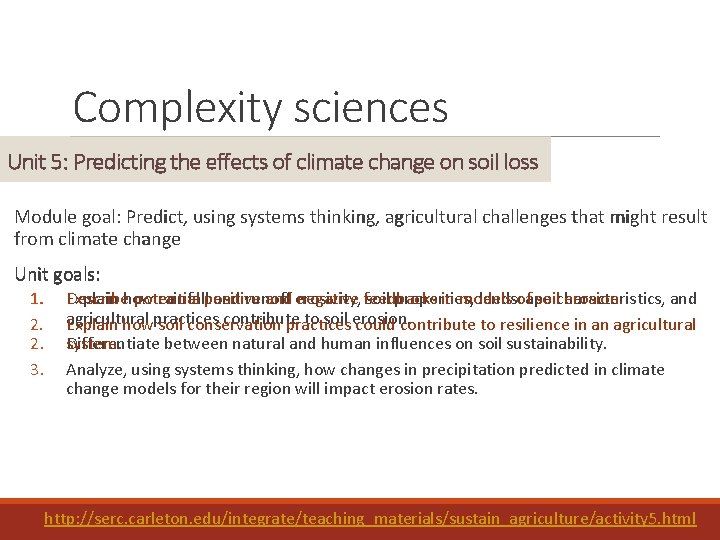
Complexity sciences Unit 5: Predicting the effects of climate change on soil loss Module goal: Predict, using systems thinking, agricultural challenges that might result from climate change Unit goals: 1. 2. 2. 3. Describe potential and erosivity, negative feedbacks in models of soilcharacteristics, erosion. Explain how rainfallpositive and runoff soil properties, landscape and agricultural contribute to soil erosion. Explain howpractices soil conservation practices could contribute to resilience in an agricultural system. Differentiate between natural and human influences on soil sustainability. Analyze, using systems thinking, how changes in precipitation predicted in climate change models for their region will impact erosion rates. http: //serc. carleton. edu/integrate/teaching_materials/sustain_agriculture/activity 5. html
Break until 10: 15