
Using Computational Toxicology to Enable RiskBased Chemical Safety
Using Computational Toxicology to Enable Risk-Based Chemical Safety Decision Making Richard Judson U. S. EPA, National Center for Computational Toxicology Office of Research and Development CSS Communities of Practice November 17 2016 Office of Research and Development The views expressed in this presentation are those of the author and do not necessarily reflect the views or policies of the U. S. EPA
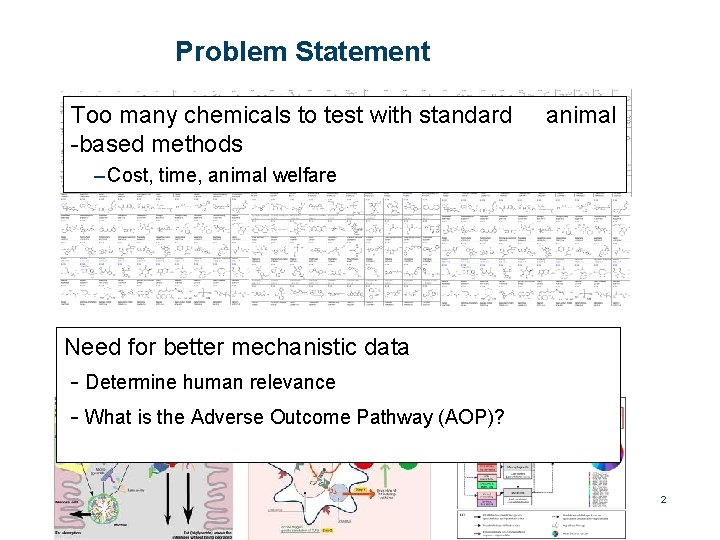
Problem Statement Too many chemicals to test with standard animal -based methods – Cost, time, animal welfare Need for better mechanistic data - Determine human relevance - What is the Adverse Outcome Pathway (AOP)? Office of Research and Development National Center for Computational Toxicology 2
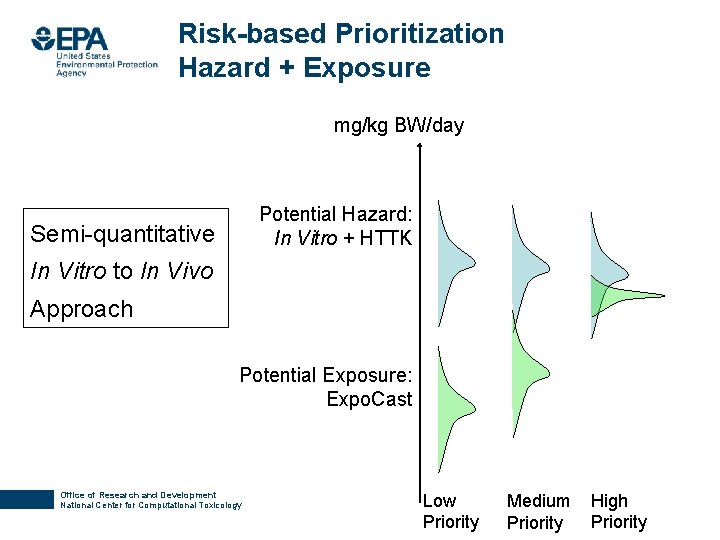
Risk-based Prioritization Hazard + Exposure mg/kg BW/day Potential Hazard: In Vitro + HTTK Semi-quantitative In Vitro to In Vivo Approach Potential Exposure: Expo. Cast Office of Research and Development National Center for Computational Toxicology Low Priority Medium Priority High Priority
Computational Toxicology • Identify biological pathways of toxicity (AOPs) • Develop high-throughput in vitro assays – Test “Human Exposure Universe” chemicals in the assays • Develop models that link in vitro to in vivo hazard – Use pharmacokinetic models to predict activating doses • Develop exposure models • Add uncertainty estimates • Create high-throughput risk assessments Office of Research and Development National Center for Computational Toxicology
Zebrafish and Developmental Toxicology • Goal: Use zebrafish as an in vivo model of vertebrate developmental toxicity • Build in vitro to in vivo models using ~700 human assays • ~1000 Chemicals – pharmaceuticals, pesticides, industrial chemicals, personal care product chemicals and food ingredients Office of Research and Development National Center for Computational Toxicology 5 Padilla et al. , 2015, 2016, in preparation
Zebrafish Imaging and scoring Office of Research and Development National Center for Computational Toxicology 6 Deal et al. J Applied Tox. 2016
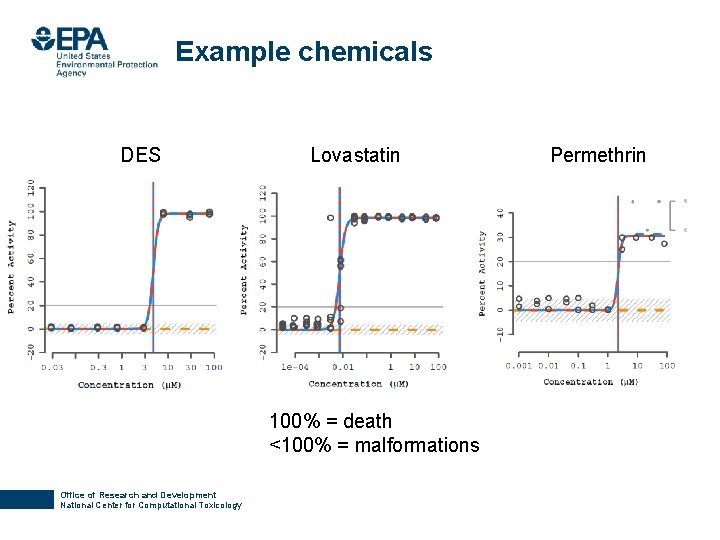
Example chemicals DES Lovastatin Permethrin 7 100% = death <100% = malformations Office of Research and Development National Center for Computational Toxicology
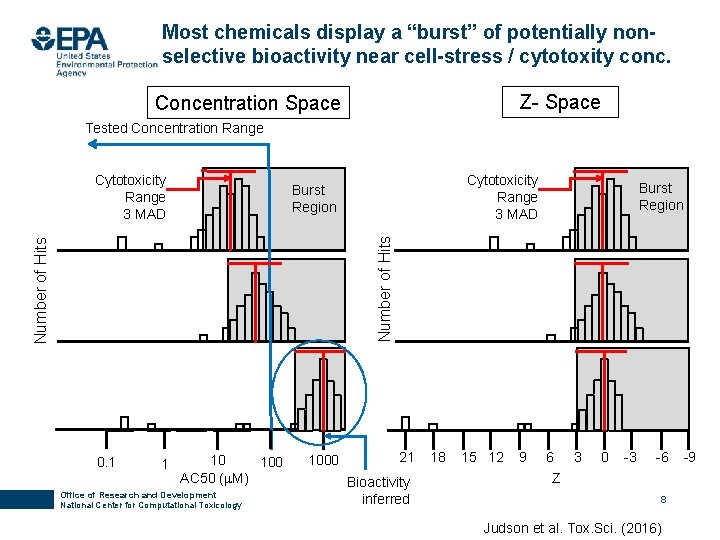
Most chemicals display a “burst” of potentially nonselective bioactivity near cell-stress / cytotoxity conc. Z- Space Concentration Space Tested Concentration Range Cytotoxicity Range 3 MAD Burst Region Number of Hits Burst Region 0. 1 1 10 100 AC 50 (m. M) Office of Research and Development National Center for Computational Toxicology 1000 21 18 15 12 9 6 3 0 -3 -6 -9 Z Bioactivity 8 inferred Judson et al. Tox. Sci. (2016)
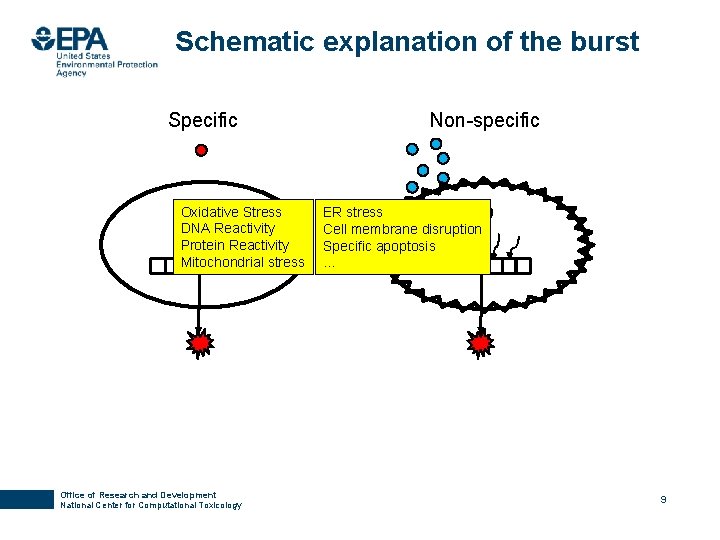
Schematic explanation of the burst Specific Oxidative Stress DNA Reactivity Protein Reactivity Mitochondrial stress Office of Research and Development National Center for Computational Toxicology Non-specific ER stress Cell membrane disruption Specific apoptosis … 9
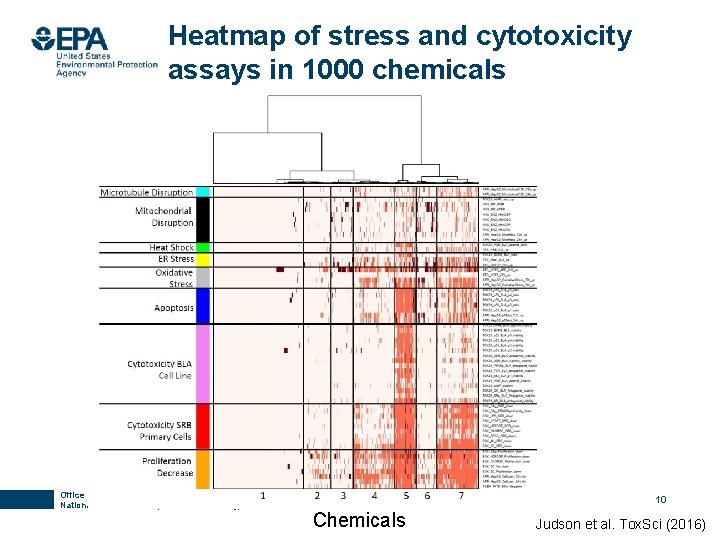
Heatmap of stress and cytotoxicity assays in 1000 chemicals Office of Research and Development National Center for Computational Toxicology 10 Chemicals Judson et al. Tox. Sci (2016)
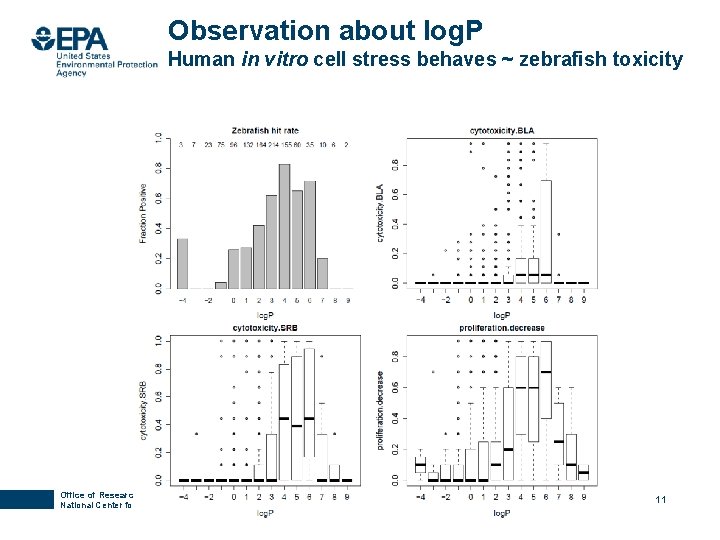
Observation about log. P Human in vitro cell stress behaves ~ zebrafish toxicity Office of Research and Development National Center for Computational Toxicology 11
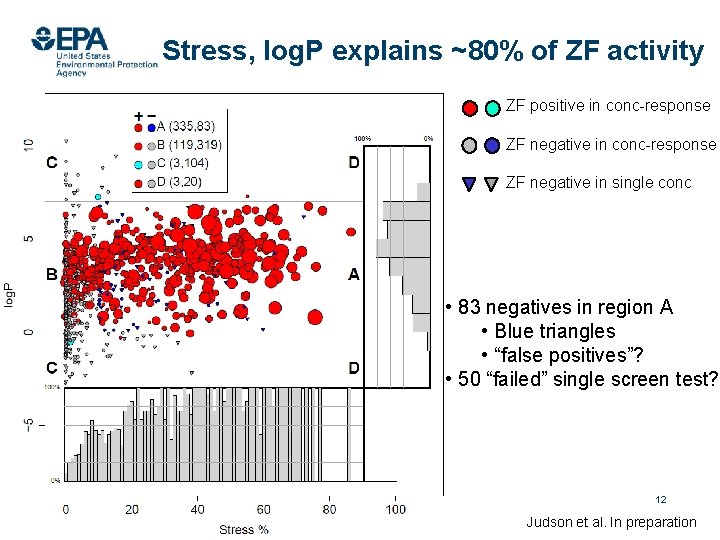
Stress, log. P explains ~80% of ZF activity ZF positive in conc-response ZF negative in single conc • 83 negatives in region A • Blue triangles • “false positives”? • 50 “failed” single screen test? Office of Research and Development National Center for Computational Toxicology 12 Judson et al. In preparation
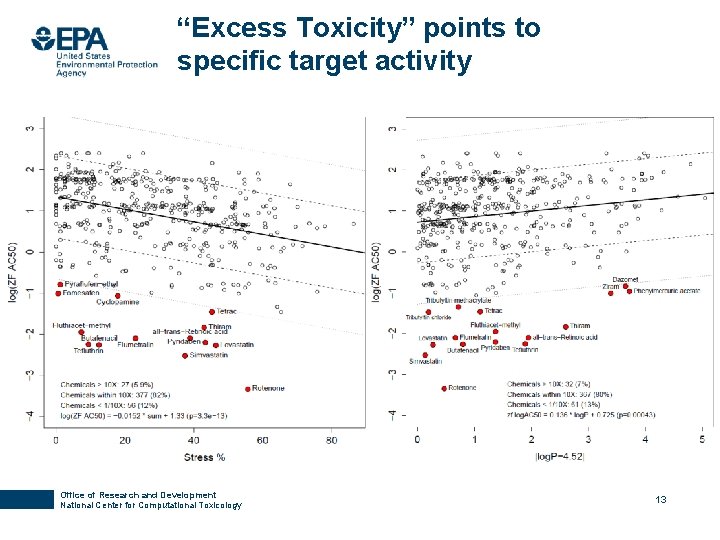
“Excess Toxicity” points to specific target activity Office of Research and Development National Center for Computational Toxicology 13
Chemicals with excess toxicity tend to fall in a few target MOA classes • ACHE • Ion channel blockers • HMGCR • Mitochondrial disruptors • PPO inhibitors (disrupts plant cell membranes) • Chemicals reacting with protein SH groups • Thyroid hormone receptor blockers • Some of these classes are over-represented in overall hit predictivity and in excess potency for hits Office of Research and Development National Center for Computational Toxicology 14
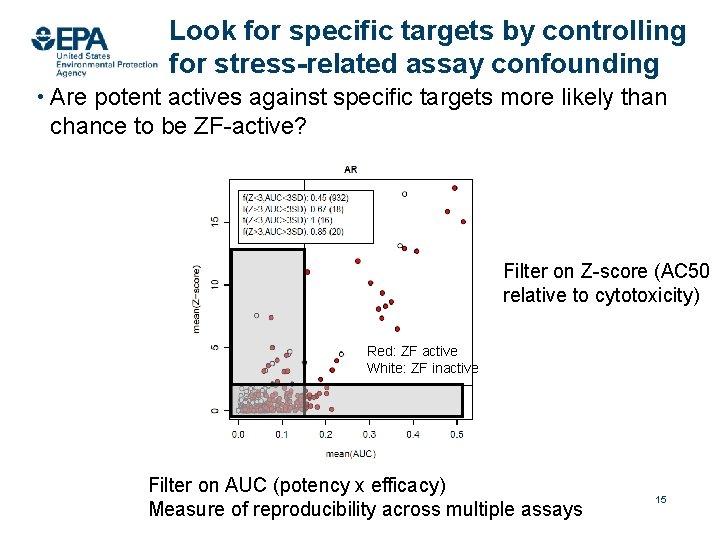
Look for specific targets by controlling for stress-related assay confounding • Are potent actives against specific targets more likely than chance to be ZF-active? Filter on Z-score (AC 50 relative to cytotoxicity) Red: ZF active White: ZF inactive Filter on AUC (potency x efficacy) Measure of reproducibility across multiple assays Office of Research and Development National Center for Computational Toxicology 15
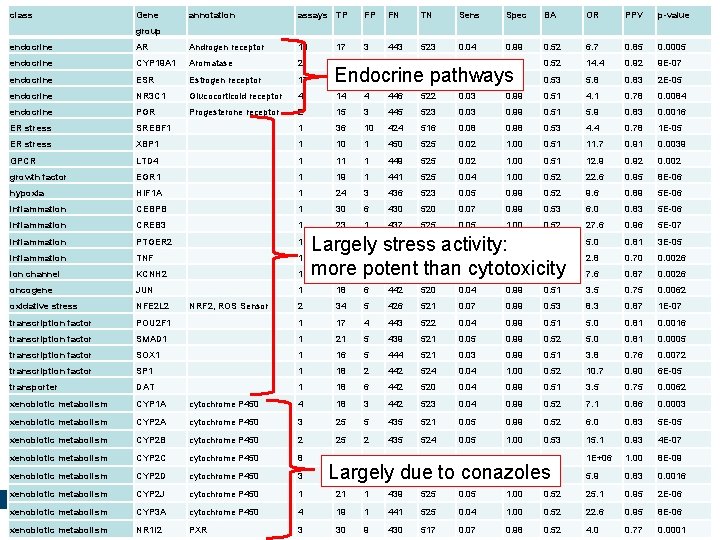
class Gene annotation assays TP FP FN TN Sens Spec BA OR PPV p-value group endocrine AR Androgen receptor 11 17 3 443 523 0. 04 0. 99 0. 52 6. 7 0. 85 0. 0005 endocrine CYP 19 A 1 Aromatase 2 24 2 436 524 0. 05 1. 00 14. 4 0. 92 9 E-07 endocrine ESR Estrogen receptor 17 Endocrine pathways 29 6 431 520 0. 06 0. 99 0. 52 0. 53 5. 8 0. 83 2 E-05 endocrine NR 3 C 1 Glucocorticoid receptor 4 14 4 446 522 0. 03 0. 99 0. 51 4. 1 0. 78 0. 0084 endocrine PGR Progesterone receptor 2 15 3 445 523 0. 03 0. 99 0. 51 5. 9 0. 83 0. 0016 ER stress SREBF 1 1 36 10 424 516 0. 08 0. 98 0. 53 4. 4 0. 78 1 E-05 ER stress XBP 1 1 10 1 450 525 0. 02 1. 00 0. 51 11. 7 0. 91 0. 0039 GPCR LTD 4 1 11 1 449 525 0. 02 1. 00 0. 51 12. 9 0. 92 0. 002 growth factor EGR 1 1 19 1 441 525 0. 04 1. 00 0. 52 22. 6 0. 95 8 E-06 hypoxia HIF 1 A 1 24 3 436 523 0. 05 0. 99 0. 52 9. 6 0. 89 5 E-06 inflammation CEBPB 1 30 6 430 520 0. 07 0. 99 0. 53 6. 0 0. 83 5 E-06 inflammation CREB 3 1 23 1 437 525 0. 05 1. 00 0. 52 27. 6 0. 96 5 E-07 inflammation PTGER 2 1 5. 0 0. 81 3 E-05 inflammation TNF 1 2. 8 0. 70 0. 0026 ion channel KCNH 2 1 7. 6 0. 87 0. 0026 oncogene JUN 1 18 6 442 520 0. 04 0. 99 0. 51 3. 5 0. 75 0. 0062 oxidative stress NFE 2 L 2 NRF 2, ROS Sensor 2 34 5 426 521 0. 07 0. 99 0. 53 8. 3 0. 87 1 E-07 transcription factor POU 2 F 1 1 17 4 443 522 0. 04 0. 99 0. 51 5. 0 0. 81 0. 0016 transcription factor SMAD 1 1 21 5 439 521 0. 05 0. 99 0. 52 5. 0 0. 81 0. 0005 transcription factor SOX 1 1 16 5 444 521 0. 03 0. 99 0. 51 3. 8 0. 76 0. 0072 transcription factor SP 1 1 18 2 442 524 0. 04 1. 00 0. 52 10. 7 0. 90 6 E-05 transporter DAT 1 18 6 442 520 0. 04 0. 99 0. 51 3. 5 0. 75 0. 0062 xenobiotic metabolism CYP 1 A cytochrome P 450 4 18 3 442 523 0. 04 0. 99 0. 52 7. 1 0. 86 0. 0003 xenobiotic metabolism CYP 2 A cytochrome P 450 3 25 5 435 521 0. 05 0. 99 0. 52 6. 0 0. 83 5 E-05 xenobiotic metabolism CYP 2 B cytochrome P 450 2 25 2 435 524 0. 05 1. 00 0. 53 15. 1 0. 93 4 E-07 xenobiotic metabolism CYP 2 C cytochrome P 450 8 24 0 436 526 0. 05 1. 00 0. 53 1 E+06 1. 00 8 E-09 xenobiotic metabolism CYP 2 D cytochrome P 450 3 5. 9 0. 83 0. 0016 xenobiotic metabolism cytochrome P 450 Office of Research. CYP 2 J and Development National Center for Computational Toxicology xenobiotic metabolism CYP 3 A cytochrome P 450 1 21 1 439 525 0. 05 1. 00 0. 52 25. 1 0. 95 4 19 1 441 525 0. 04 1. 00 0. 52 22. 6 0. 95 8 E-06 xenobiotic metabolism 3 30 9 430 517 0. 07 0. 98 0. 52 4. 0 0. 77 0. 0001 NR 1 I 2 PXR 29 7 431 519 0. 06 0. 99 0. 52 Largely stress activity: 30 13 430 513 0. 07 0. 98 0. 52 more potent than cytotoxicity 13 2 447 524 0. 03 1. 00 0. 51 Largely due to conazoles 15 3 445 523 0. 03 0. 99 0. 51 2 E-06 16
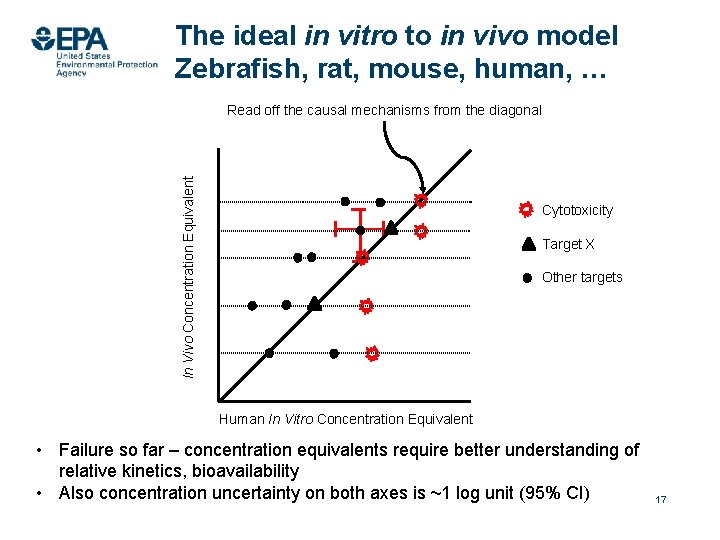
The ideal in vitro to in vivo model Zebrafish, rat, mouse, human, … In Vivo Concentration Equivalent Read off the causal mechanisms from the diagonal Cytotoxicity Target X Other targets Human In Vitro Concentration Equivalent • Failure so far – concentration equivalents require better understanding of relative kinetics, bioavailability Office of Research and Development • Also concentration uncertainty on both axes is ~1 log unit (95% CI) National Center for Computational Toxicology 17
Modeling with Uncertainty • Our first goal is prediction – What is the highest safe dose of a chemical? – What types of harm would a chemical cause above that dose? • Predictions are based on models – Computational, statistical, “mental”, in vitro, in vivo • All models are based on data • Data is always subject to noise, variability • Therefore, all predictions are subject to uncertainty • Our second goal is estimating prediction uncertainty Office of Research and Development National Center for Computational Toxicology 18 Watt, Kapraun et al. In preparation
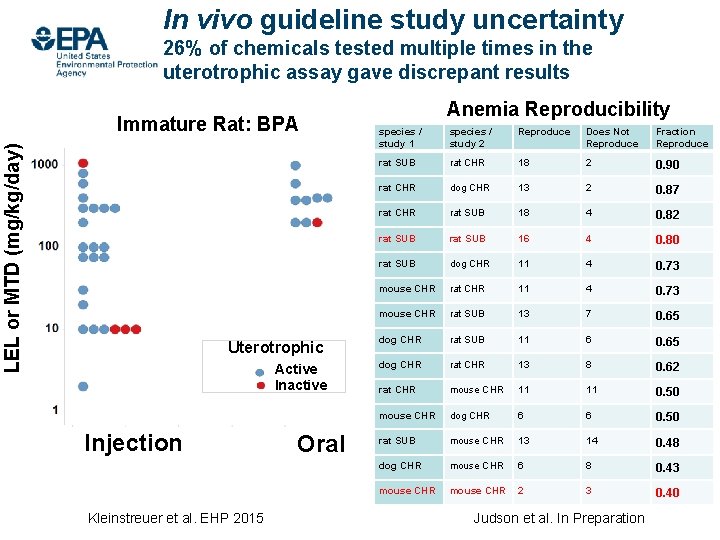
In vivo guideline study uncertainty 26% of chemicals tested multiple times in the uterotrophic assay gave discrepant results LEL or MTD (mg/kg/day) Immature Rat: BPA Uterotrophic Active Inactive Injection Office of Research and Development National Center for Computational Toxicology Kleinstreuer et al. EHP 2015 Oral Anemia Reproducibility species / study 1 species / study 2 Reproduce Does Not Reproduce Fraction Reproduce rat SUB rat CHR 18 2 0. 90 rat CHR dog CHR 13 2 0. 87 rat CHR rat SUB 18 4 0. 82 rat SUB 16 4 0. 80 rat SUB dog CHR 11 4 0. 73 mouse CHR rat SUB 13 7 0. 65 dog CHR rat SUB 11 6 0. 65 dog CHR rat CHR 13 8 0. 62 rat CHR mouse CHR 11 11 0. 50 mouse CHR dog CHR 6 6 0. 50 rat SUB mouse CHR 13 14 0. 48 dog CHR mouse CHR 6 8 0. 43 mouse CHR 2 3 0. 40 Judson et al. In Preparation
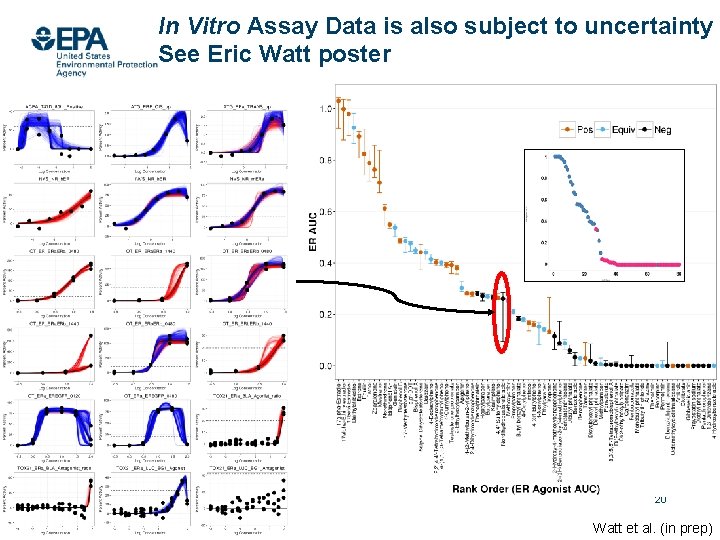
In Vitro Assay Data is also subject to uncertainty See Eric Watt poster Office of Research and Development National Center for Computational Toxicology 20 Watt et al. (in prep)
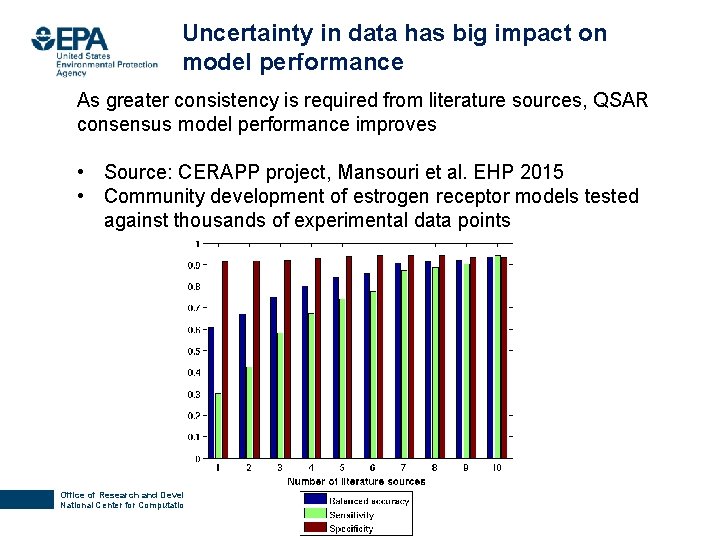
Uncertainty in data has big impact on model performance As greater consistency is required from literature sources, QSAR consensus model performance improves • Source: CERAPP project, Mansouri et al. EHP 2015 • Community development of estrogen receptor models tested against thousands of experimental data points Office of Research and Development National Center for Computational Toxicology
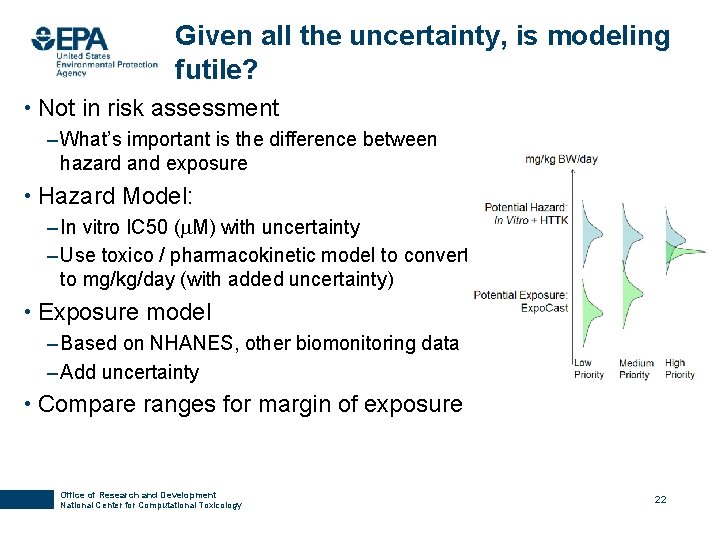
Given all the uncertainty, is modeling futile? • Not in risk assessment – What’s important is the difference between hazard and exposure • Hazard Model: – In vitro IC 50 (m. M) with uncertainty – Use toxico / pharmacokinetic model to convert to mg/kg/day (with added uncertainty) • Exposure model – Based on NHANES, other biomonitoring data – Add uncertainty • Compare ranges for margin of exposure Office of Research and Development National Center for Computational Toxicology 22
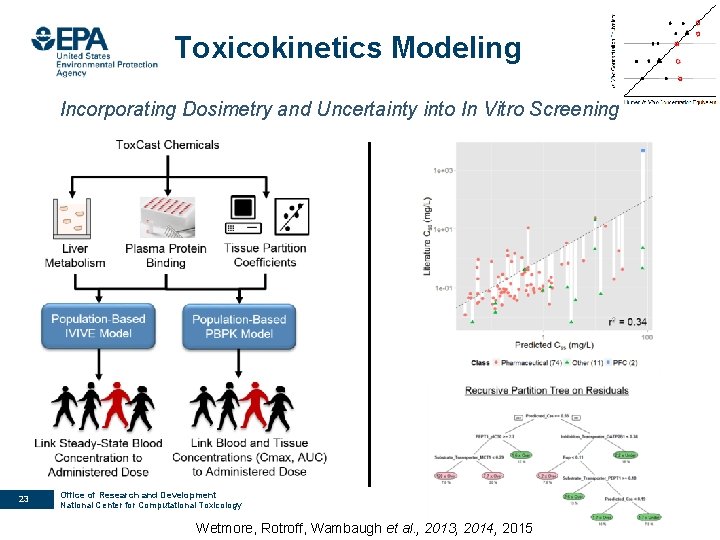
Toxicokinetics Modeling Incorporating Dosimetry and Uncertainty into In Vitro Screening 23 Office of Research and Development National Center for Computational Toxicology Wetmore, Rotroff, Wambaugh et al. , 2013, 2014, 2015
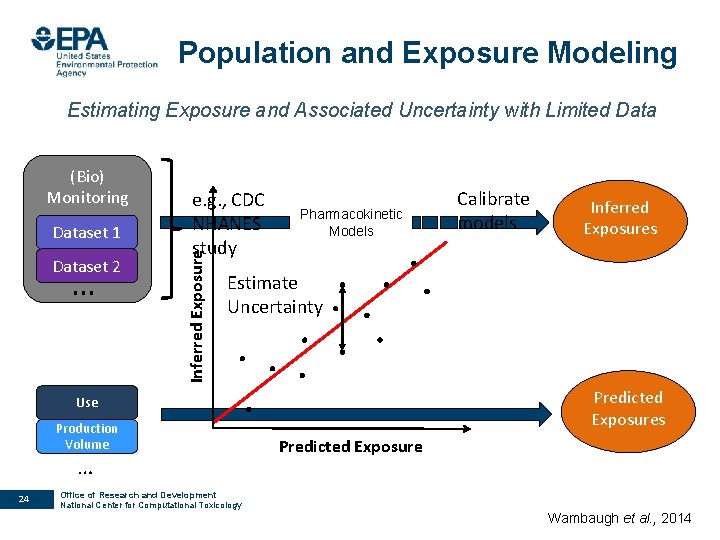
Population and Exposure Modeling Estimating Exposure and Associated Uncertainty with Limited Dataset 1 Dataset 2 … e. g. , CDC NHANES study Inferred Exposure (Bio) Monitoring Pharmacokinetic Models Inferred Exposures Estimate Uncertainty Predicted Exposures Use Production Volume … 24 Calibrate models Predicted Exposure Office of Research and Development National Center for Computational Toxicology Wambaugh et al. , 2014
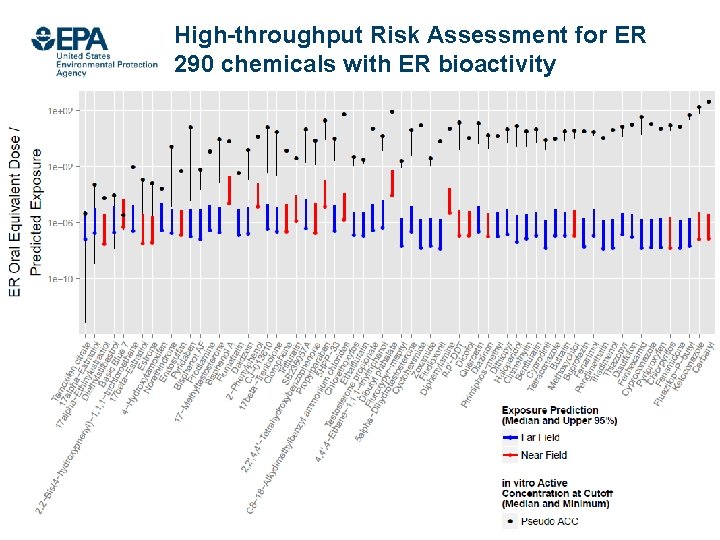
High-throughput Risk Assessment for ER 290 chemicals with ER bioactivity Office of Research and Development National Center for Computational Toxicology 25

Retrofitting Assays for Metabolic Competence – Extracellular Approach Alginate Immobilization of Metabolic Enzymes (AIME) Prototype Lids De. Groot et al. 2016 SOT poster #3757 26 Office of Research and Development Amount of XME Activity in Microspheres Small Molecule Inhibition of XME Activity
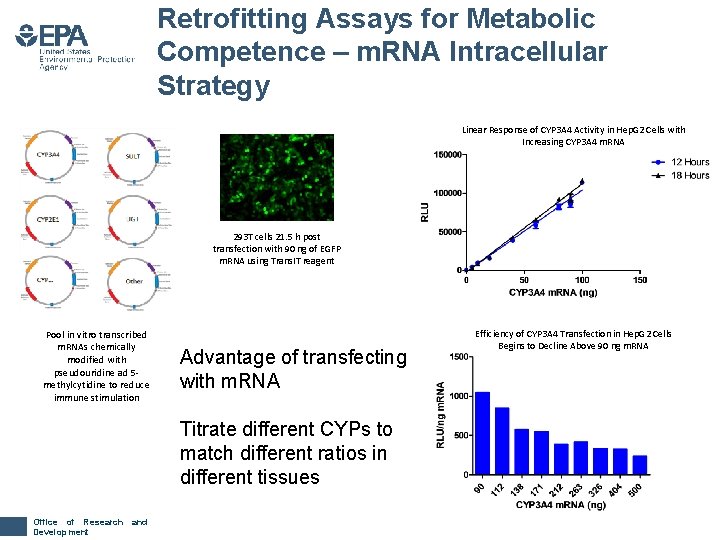
Retrofitting Assays for Metabolic Competence – m. RNA Intracellular Strategy Linear Response of CYP 3 A 4 Activity in Hep. G 2 Cells with Increasing CYP 3 A 4 m. RNA 293 T cells 21. 5 h post transfection with 90 ng of EGFP m. RNA using Trans. IT reagent Pool in vitro transcribed m. RNAs chemically modified with pseudouridine ad 5 methylcytidine to reduce immune stimulation Advantage of transfecting with m. RNA Titrate different CYPs to match different ratios in different tissues 27 Office of Research and Development Efficiency of CYP 3 A 4 Transfection in Hep. G 2 Cells Begins to Decline Above 90 ng m. RNA
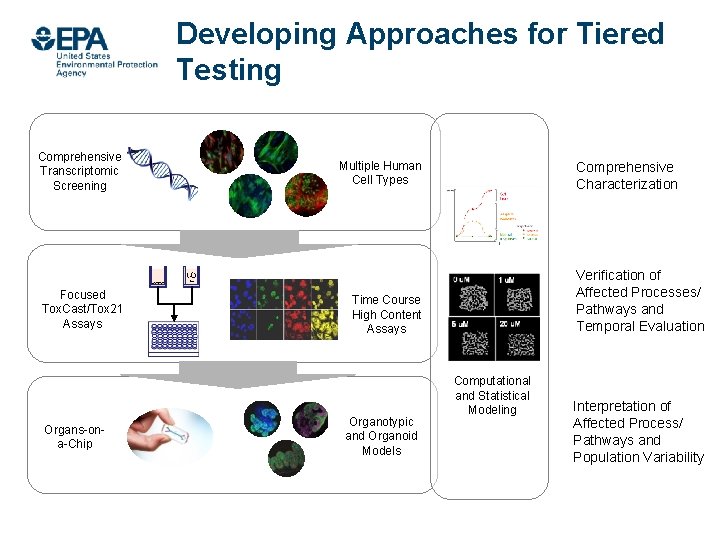
Developing Approaches for Tiered Testing Comprehensive Transcriptomic Screening Focused Tox. Cast/Tox 21 Assays Organs-ona-Chip 28 Office of Research and Development National Center for Computational Toxicology Multiple Human Cell Types Comprehensive Characterization Verification of Affected Processes/ Pathways and Temporal Evaluation Time Course High Content Assays Organotypic and Organoid Models Computational and Statistical Modeling Interpretation of Affected Process/ Pathways and Population Variability
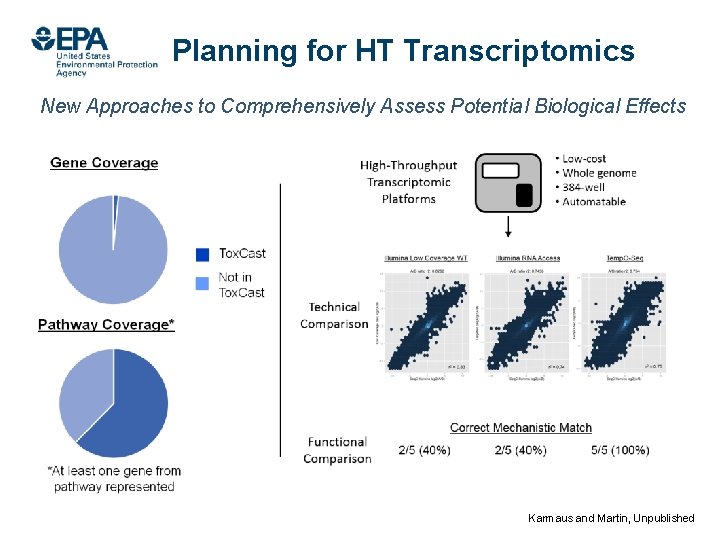
Planning for HT Transcriptomics New Approaches to Comprehensively Assess Potential Biological Effects 29 Office of Research and Development National Center for Computational Toxicology Karmaus and Martin, Unpublished
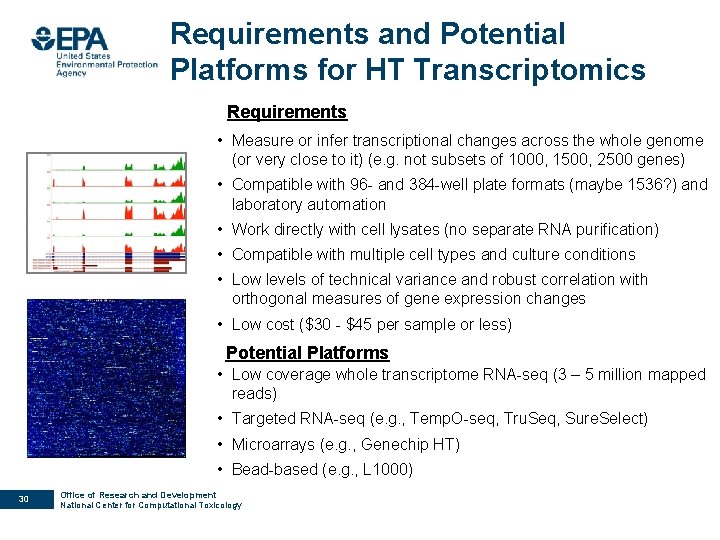
Requirements and Potential Platforms for HT Transcriptomics Requirements • Measure or infer transcriptional changes across the whole genome (or very close to it) (e. g. not subsets of 1000, 1500, 2500 genes) • Compatible with 96 - and 384 -well plate formats (maybe 1536? ) and laboratory automation • Work directly with cell lysates (no separate RNA purification) • Compatible with multiple cell types and culture conditions • Low levels of technical variance and robust correlation with orthogonal measures of gene expression changes • Low cost ($30 - $45 per sample or less) Potential Platforms • Low coverage whole transcriptome RNA-seq (3 – 5 million mapped reads) • Targeted RNA-seq (e. g. , Temp. O-seq, Tru. Seq, Sure. Select) • Microarrays (e. g. , Genechip HT) • Bead-based (e. g. , L 1000) 30 Office of Research and Development National Center for Computational Toxicology
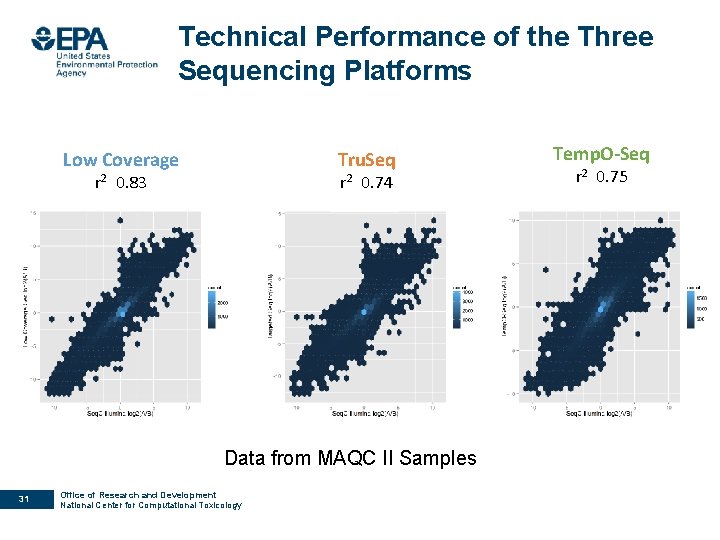
Technical Performance of the Three Sequencing Platforms Low Coverage Tru. Seq r 2 0. 83 r 2 0. 74 Data from MAQC II Samples 31 Office of Research and Development National Center for Computational Toxicology Temp. O-Seq r 2 0. 75
HT Transcriptomics Next Steps • Perform pilot study (Summer) to validate workflow and refine experimental design • Initiate large scale screen (Fall/Winter) • Cell type: MCF 7 • Compounds: 1, 000 (Tox. Cast Phase I/II) • Time Point: Single • Concentration Response: 8 (? ) • Perform secondary pilot study looking at cell type selection/ pooling strategies (Fall/Winter) • Integrate HT transcriptomic platform with metabolic retrofit solution to allow screening +/- metabolism (FY 17) • Explore partnerships to build community database of common chemical set across multiple cell types/lines Office of Research and Development National Center for Computational Toxicology
Other Ongoing Efforts • Curated chemical structure database of >1 million unique substances • Capability to retrofit high-throughput in vitro assays for metabolic competence • Software infrastructure to manage, use and share big data in toxicology • Methods to quantify uncertainty in all quantities • Read-across approaches that quantitatively include uncertainty • Pharmacokinetic models for hundreds of chemicals while understanding which chemical classes are well predicted and which ones have greater uncertainty • High-throughput exposure models for thousands of chemicals with estimates of uncertainty • Non-targeted analytical measurements of chemical constituents in hundreds of consumer products • Framework for streamlined validation of high-throughput in vitro assays 33 Office of Research and Development National Center for Computational Toxicology
Challenges • Technical limitations/obstacles associated with each technology (e. g. , metabolism, volatiles, etc. ) • Moving from an apical to a molecular paradigm and defining adversity • Predicting human safety vs. toxicity • Combining new approaches to have adequate throughput and sufficiently capture higher levels of biological organization • Systematically integrating multiple data streams from the new approaches in a risk-based, weight of evidence assessment • Quantifying and incorporating uncertainty and variability • Dealing with the validation • Defining a fit-for-purpose framework(s) that is time and resource efficient • Performance-based technology standards vs. traditional validation • Role of in vivo rodent studies and understanding their inherent uncertainty 34 • Legal of new methods and assessment products Office of defensibility Research and Development National Center for Computational Toxicology
Acknowledgements Stephanie Padilla Tamara Tal Eric Watt Martin Rusty Thomas Agnes Karmaus Steve Simmons Danica De. Groot Keith Houck John Wambaugh Woody Setzer NCCT Staff Scientists Rusty Thomas Kevin Crofton Keith Houck Ann Richard Judson Tom Knudsen Matt Martin Grace Patlewicz Woody Setzer John Wambaugh Tony Williams Steve Simmons Chris Grulke Jeff Edwards NCCT Contractors Nancy Baker Dayne Filer Parth Kothiya Doris Smith Jamey Vail Sean Watford Indira Thillainadarajah Tommy Cathey NCCT Postdocs Todor Antonijevic Audrey Bone Swapnil Chavan Danica De. Groot Jeremy Fitzpatrick Jason Harris Dustin Kapraun Max Leung Kamel Mansouri Ly. Ly Pham Prachi Pradeep Eric Watt NIH/NCATS Menghang Xia Ruili Huang Anton Simeonov NTP Warren Casey Nicole Kleinstreuer Mike Devito Dan Zang Office of Research and Development National Center for Computational Toxicology https: //www. epa. gov/chemical-research/toxicity-forecasting
- Slides: 35