
Using Communication to Build an Inclusive Classroom Culture
Using Communication to Build an Inclusive Classroom Culture Online Co-Facilitators Komie Bumpers (Instructor of Department of Applied Communication Studies) Britt Peterson (Asst. Professor of Biological Sciences) Ashton Speno (Asst. Professor of Mass Communications)
Using Communication to Build an Inclusive Classroom Culture Online Starting Premise: The first day of a class sets the tone and culture for the rest of the semester. Communication is the foundation for setting culture and thus is the foundation of an inclusive classroom. • Objectives: • To consider the importance of the first day of class and to spark critical thinking about the first day. • To provide practical, tangible resources to “build” your first day of class. • To encourage the re-examination of current practices and how to realign them with inclusivity in mind
IMPACT Community Norms To accomplish our goals for this IMPACT training, it is vital that we create an environment that ensures this training is beneficial. The norms below reflect a collective vision of how we want to be in relation to each other – what every person in our group needs from each other and commits to in order to feel safe, supported, open, productive, trusting, curious, thoughtful, and engaged.
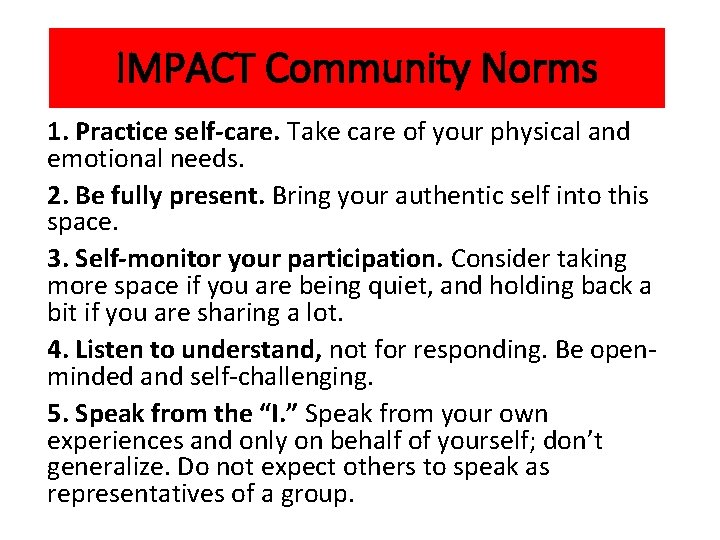
IMPACT Community Norms 1. Practice self-care. Take care of your physical and emotional needs. 2. Be fully present. Bring your authentic self into this space. 3. Self-monitor your participation. Consider taking more space if you are being quiet, and holding back a bit if you are sharing a lot. 4. Listen to understand, not for responding. Be openminded and self-challenging. 5. Speak from the “I. ” Speak from your own experiences and only on behalf of yourself; don’t generalize. Do not expect others to speak as representatives of a group.
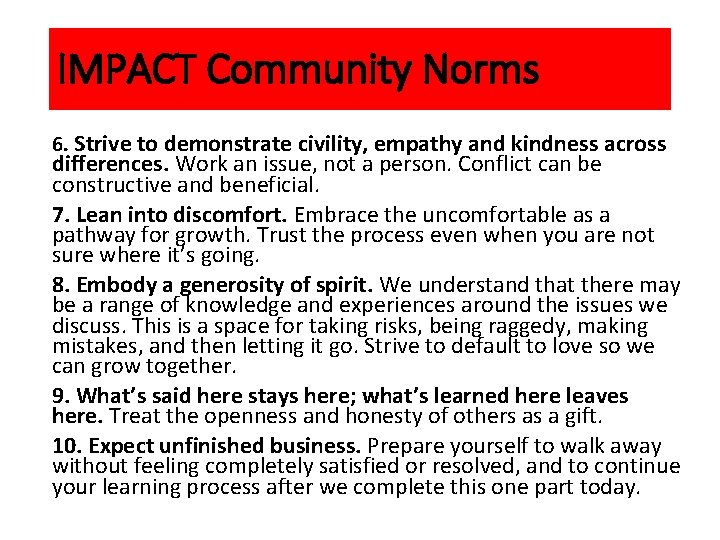
IMPACT Community Norms 6. Strive to demonstrate civility, empathy and kindness across differences. Work an issue, not a person. Conflict can be constructive and beneficial. 7. Lean into discomfort. Embrace the uncomfortable as a pathway for growth. Trust the process even when you are not sure where it’s going. 8. Embody a generosity of spirit. We understand that there may be a range of knowledge and experiences around the issues we discuss. This is a space for taking risks, being raggedy, making mistakes, and then letting it go. Strive to default to love so we can grow together. 9. What’s said here stays here; what’s learned here leaves here. Treat the openness and honesty of others as a gift. 10. Expect unfinished business. Prepare yourself to walk away without feeling completely satisfied or resolved, and to continue your learning process after we complete this one part today.
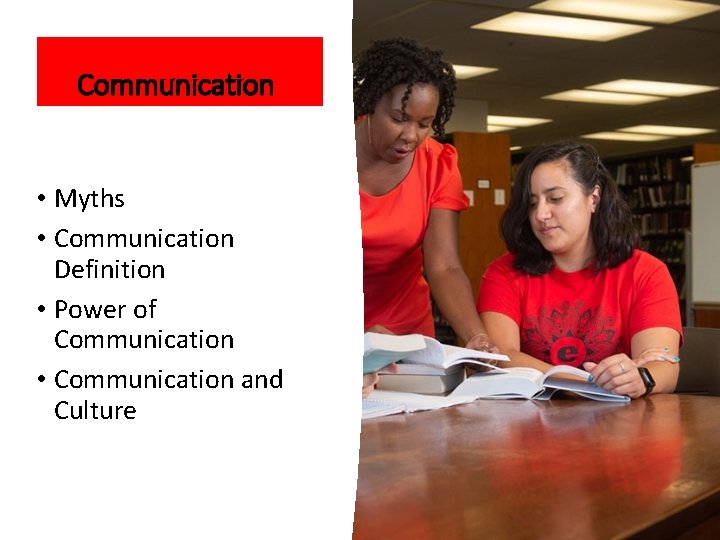
Communication • Myths • Communication Definition • Power of Communication • Communication and Culture
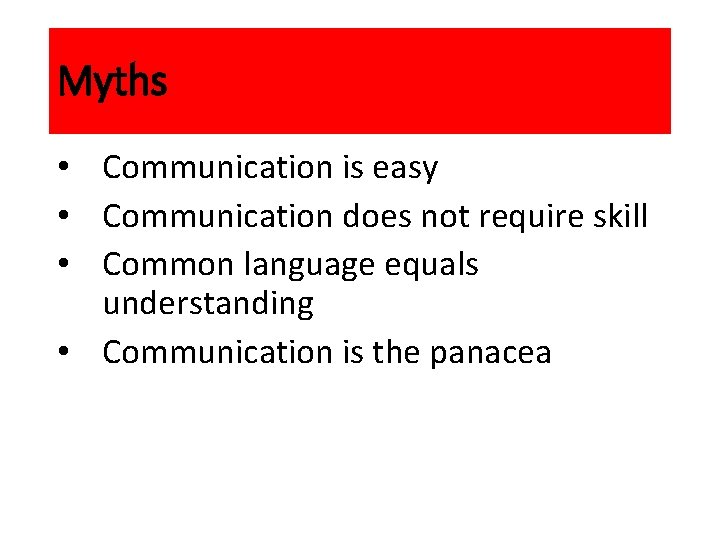
Myths • Communication is easy • Communication does not require skill • Common language equals understanding • Communication is the panacea
Communication “Communication is the continuous, complex, collaborative, process of verbal and nonverbal meaning making thought which we construct the worlds of meaning we inhabit. ” (John Stewart)
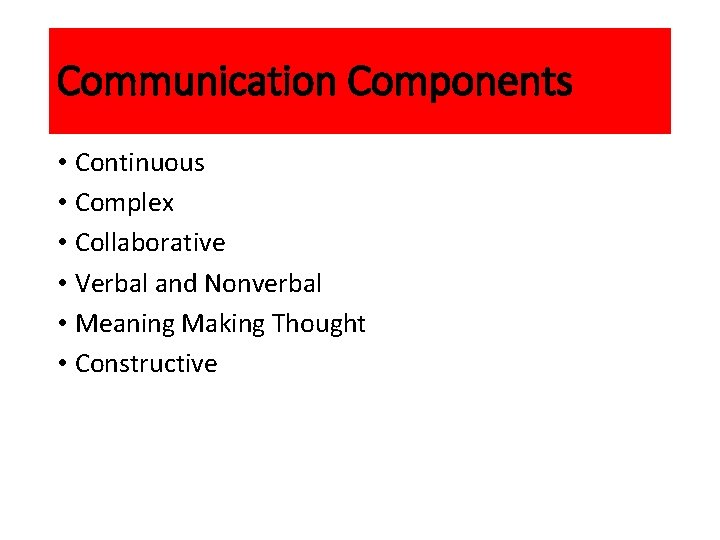
Communication Components • Continuous • Complex • Collaborative • Verbal and Nonverbal • Meaning Making Thought • Constructive
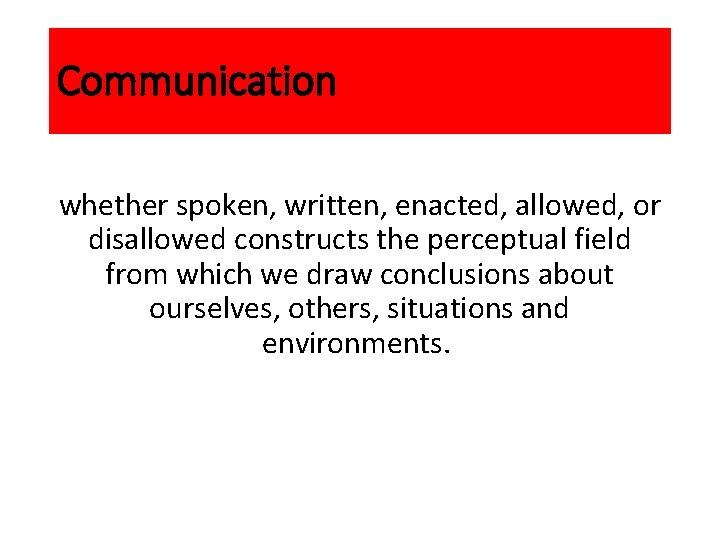
Communication whether spoken, written, enacted, allowed, or disallowed constructs the perceptual field from which we draw conclusions about ourselves, others, situations and environments.
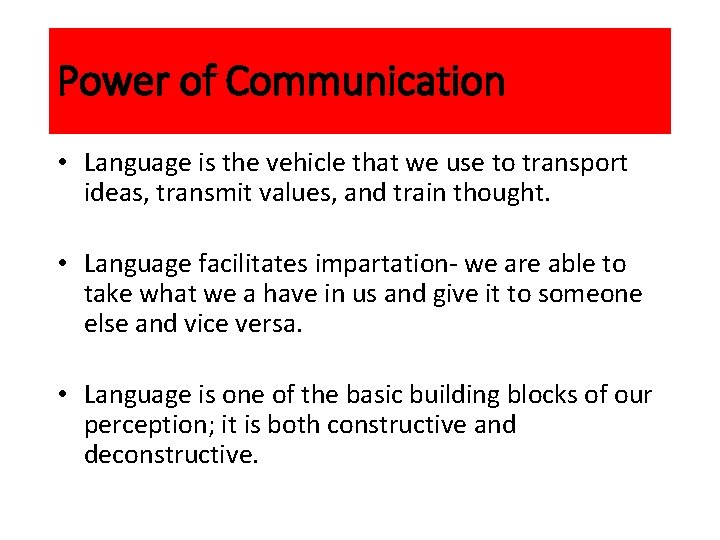
Power of Communication • Language is the vehicle that we use to transport ideas, transmit values, and train thought. • Language facilitates impartation- we are able to take what we a have in us and give it to someone else and vice versa. • Language is one of the basic building blocks of our perception; it is both constructive and deconstructive.
Power of Communication • Communication can be motivating, inspiring, uplifting, but also demeaning, humiliating, dehumanizing. • Every revolution, movement, reformation has had language as both its’ catalyst and perpetuator. • • Hitler Martin Luther King Jr. Make America Great Again Black Lives Matter
Power of Communication • Nonverbal communication includes gestures, appearance, facial expressions, vocalics, spatial messages, silence, and artifactual communication. • Non-verbal communication can express acceptance, affinity, affection, but also rejection, indifference, and aversion. • Nonverbal communication can confirm or disconfirm, include, or exclude.
Communication and Classroom Culture • Culture consists of beliefs, values, norms and social practices. • (Shein, 1984) “Taught to new members as a way to perceive, think, and feel. ” • Communication is the way that we establish and perpetuate culture. • We have some communication strategies to make your online classes inclusive.
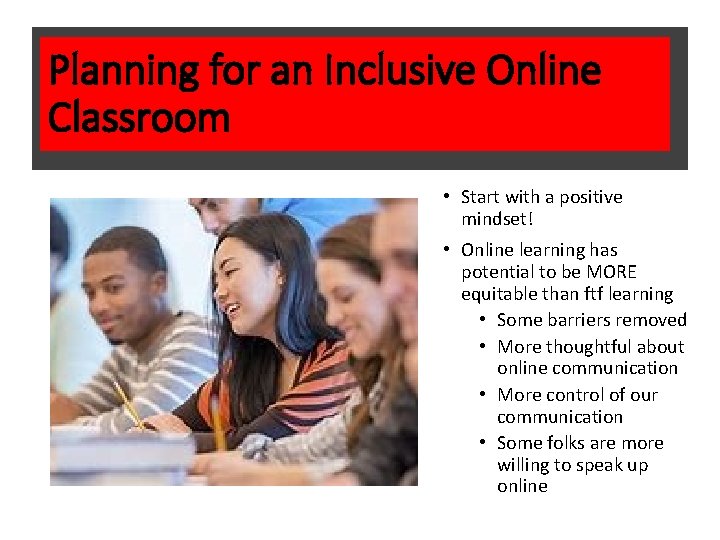
Planning for an Inclusive Online Classroom • Start with a positive mindset! • Online learning has potential to be MORE equitable than ftf learning • Some barriers removed • More thoughtful about online communication • More control of our communication • Some folks are more willing to speak up online
Create Community Norms for your Classroom • Behavioral requirements (http: //crlt. umich. edu/examples-discussion-guidelines) • Participation • Attendance • Conduct • Allow for community editing • Discuss the ramifications for not adhering to norms
Using the syllabus to set the culture • Communicate & empower • Use positive, active language • Create objectives, assessments, and projects with a goal of transparency • Provide information about resources on campus • Consider using our IMPACT syllabus statement
Inclusion, Equity, and Social Justice SIUE is committed to respecting everyone’s dignity at all times. In order to learn, exchange ideas, and support one another, our virtual and physical classrooms must be places where students and teachers feel safe and supported. Systems of oppression permeate our institutions and our classrooms. All students and faculty have the responsibility to co-create a classroom that affirms inclusion, equity, and justice, where racism, sexism, classism, ableism, heterosexism, xenophobia, and other social pathologies are not tolerated. Violations of this policy will be enforced in line with the SIUE Student Conduct Code (https: //www. siue. edu/policies/3 c 1. shtml). The Center for Student Diversity & Inclusion (https: //www. siue. edu/csdi/) is an excellent resource for support and community. If you experience or witness discrimination or harassment, you can reach out to Ms. Jamie Ball, director of the Office of Equal Opportunity, Access and Title IX Coordination (https: //www. siue. edu/eoa/), by e-mail at jball@siue. edu or by calling 618 -650 -2333. You can also report bias incidents using this online form (https: //www. siue. edu/birt).
Virtual Office Hours • Consider having office hours on at least 2 days, during a specified time • Always list your office hours on your syllabus, & also include “& by appointment” • Consider renaming "office hours" "student hours" • Set expectations for office hours • Encourage your students to attend!
Introductions & First-Impressions • Name and rationale • Pronouns • Humanize yourself • • Discuss your interest/expertise in the subject A failure An interest or hobby Share a photo of your family, a pet, a favorite locale
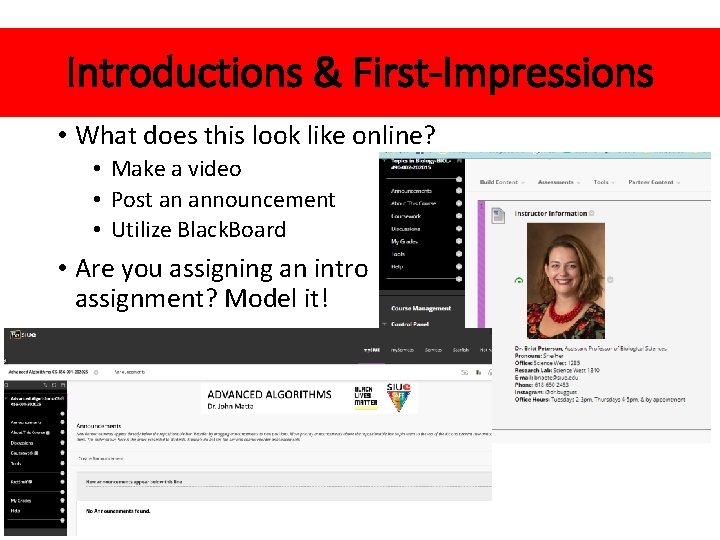
Introductions & First-Impressions • What does this look like online? • Make a video • Post an announcement • Utilize Black. Board • Are you assigning an intro assignment? Model it!
Student Introductions • Let students introduce themselves • Pronunciation, preferred name • Provide an opportunity sharing things that are important to the students • "Share anything that you think could help make this a better learning environment for you. "
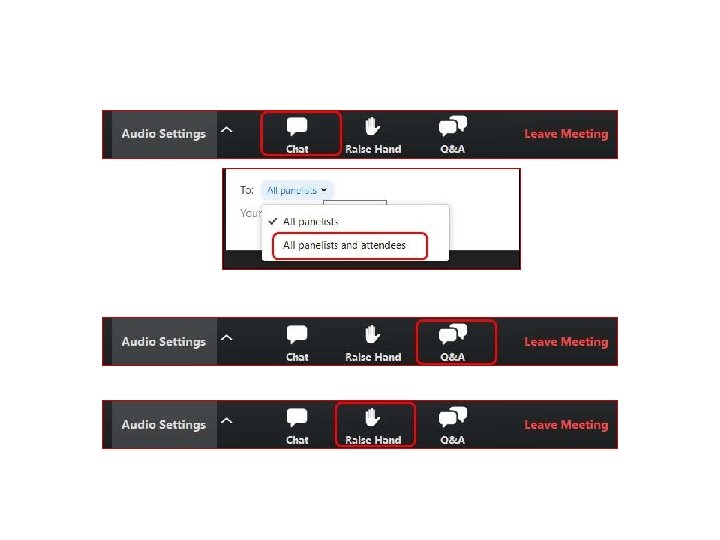
Student Introductions • How does this work online? • Dependent on class size, format, and course content • Synchronous – go around/popcorn, breakout rooms, use Zoom chat feature • Asynchronous – post a video, add to a thread, etc. • An opportunity model how you'll be using technology in the classroom from the first day!
Name-Related Considerations • What if a student's name doesn't match what they prefer to be called? • Formal name change with the university • servicecenter@siue. edu with legal name and preferred name from SIUE email address • Center for Student Diversity & Inclusion • Consider adopting a discussion board format • Include signatures, salutations

Icebreakers—The Why • We all have different reasons for using them 1. A *fun* way to take roll 2. To engage students 3. Start building a community 4. Highlight commonalities, celebrate uniqueness 5. To get the conversation started • No one uses them to be intentionally exclusionary or otherizing, but that can be an unintended impact!
Icebreaker Ideas • Avoid problematic questions • Where are you from? What high school did you go to? Where have you traveled to? • Find similarities/commonalities in the group • Popular TV/movies, Favorite season of the year • Might be useful to make them practical • It may be useful if your icebreaker connects to or is related to the course's content
Icebreaker Ideas • Offer options of questions to answer: • Share your _____ (Favorite movie, Food that reminds you of home/family, A book you read/listened to recently) • Prime the class • What's something that makes you optimistic? - (courtesy of Liz Stygar in Sociology) • What strategies make you a successful student? • What is one habit you're hoping to establish this semester to meet your goals? • Get creative • Craft and share an "I am" poem • Affirmations - "I am ______, and I am a changemaker"
Creating a community & a sense of belonging in the online environment • Some basic considerations: • Be warm/energetic • Be encouraging to students • Interact with each student • Create small groups for students • Call students by their preferred name/pronoun • Be friendly via email
Asynchronous Considerations • Silence communicates – consider consistent and appropriate response times • Depth of response • Consider rubrics that might standardize your responses
Check & Correct Nonverbals When Relevant • Vocalics • Eye-contact • Facial Expressions • Spatial Messages
Avoid Microaggressions • Microaggressions are a subtle form of verbal discrimination that may be conscious or unconscious. It’s saying things that reveal your negative notions about a group of people. • Examples • Take action on microaggressions
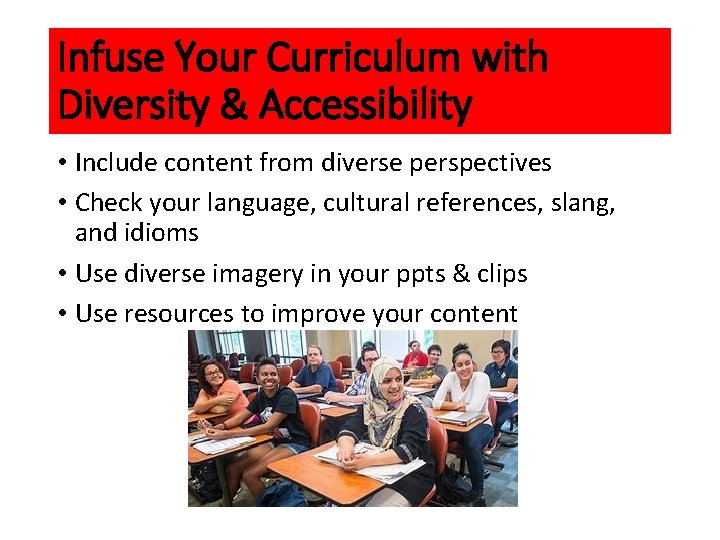
Infuse Your Curriculum with Diversity & Accessibility • Include content from diverse perspectives • Check your language, cultural references, slang, and idioms • Use diverse imagery in your ppts & clips • Use resources to improve your content

What are 3 things you can change to make your classroom more inclusive?
Join us for "Zoom & Groom" next Thursday, 7/30 @ 1: 00! Zoom Meeting ID: 914 8694 3910 Password: 831303 https: //siue. zoom. us/j/91486943910? pwd=NUc 1 e. FN 0 ZFZH c. Gxtb. DZSZz. J 6 STJQQT 09
Questions?
- Slides: 36