
USING COMMON CORE LEARNING STANDARDS AND 21 S
- Slides: 21
USING COMMON CORE LEARNING STANDARDS AND 21 S T CENTURY LEARNING SKILLS N EXTENDED LEARNING PROJECTS OCTOBER 22, 2012 NYSED ESD/SVP CONFERENCE LISA HILEY, PHD -DIRCETOR OF EDUCATION JEANNE FRADELLA- ADMINISTRATOR OF EXTENDED LEARNING MARY FRENZEL- CURRICULUM & INSTRUCTION SPECIALIST
INTRODUCTION AND ORGANIZATIONAL OVERVIEW En. Compass: Resources for Learning MISSION: En. Compass, an organization focused on evidence-based educational services and support, improves academic outcomes for students of all ages who struggle to learn. Non-profit founded in 2006 Provides innovative educational services for struggling learners and their families Committed at all levels of programming to evaluation and continuous improvement that utilization focused and responsive Programs in elementary and secondary schools, as well as off-site tutoring services, serving over 1, 600 students each year. ◦ Academic Support & Tutoring (Secondary) ◦ Extended Learning Programs (Elementary and Secondary) ◦ Summer Learning and Enrichment
ENCOMPASS OST PROGRAM OVERVIEW Programs provide an afterschool learning and enrichment opportunity for in Rochester and surrounding communities. The hallmark of En. Compass OST programs is the combination of targeted tutoring and inquiry-based learning opportunities. § Targeted Academic Tutoring - Youth academic skills, performance and behaviors are supported within the targeted tutoring opportunities provided on a daily basis. Youth work directly with an Academic Coach in small groups to address academic skills and performance specifically in the areas of ELA and math. Individualized learning goals are established for each youth. § Inquiry-Based Learning - opportunities for students to explore, inquire, and discuss topics relating to a chosen inquiry are incorporated on a daily basis. The inquiry-based learning opportunities promote a cohesive learning community fostering social-emotional competencies (e. g. , selfmanagement, peer social skills) as well as academic skill development. Health and wellness components are embedded through health snacks and meals, opportunities for physical activity and/or field trips and regular tracking of wellness through food and physical activity logs. En. Compass is committed to data-driven instruction and programming. Immediate and long-term outcomes are identified. Student and program measures are linked to outcomes and align with program values and essential elements.
CCLS IN PRACTICE FOR OST PROGRAMS Front and Center on the National Stage in Education: § § Common Core State Standards (CCSS) & Curricular Examples Annual Professional Performance Reviews (APPR) Response to Intervention (Rt. I) Student Learning Objectives (SLO) Objectives for Presentation: § Understand origins and implementation of Common Core § Recognize application of Common Core to OST Programs § Identify 2 -3 means to align OST programs with Common Core
COMMON CORE LEARNING STANDARDS The Common Core State Standards Initiative is a state-led effort coordinated by the National Governors Association Center for Best Practices (NGA Center) and the Council of Chief State School Officers (CCSSO). The standards were developed in collaboration with teachers, school administrators, and experts, to provide a clear and consistent framework to prepare our children for college and the workforce. These standards define the knowledge and skills students should have within their K-12 education careers so that they will graduate high school able to succeed in entry-level, creditbearing academic college courses and in workforce training programs.
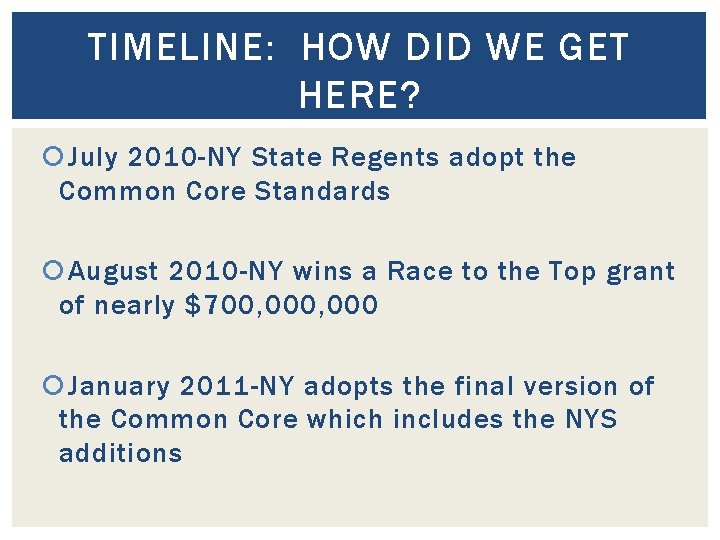
TIMELINE: HOW DID WE GET HERE? July 2010 -NY State Regents adopt the Common Core Standards August 2010 -NY wins a Race to the Top grant of nearly $700, 000 January 2011 -NY adopts the final version of the Common Core which includes the NYS additions
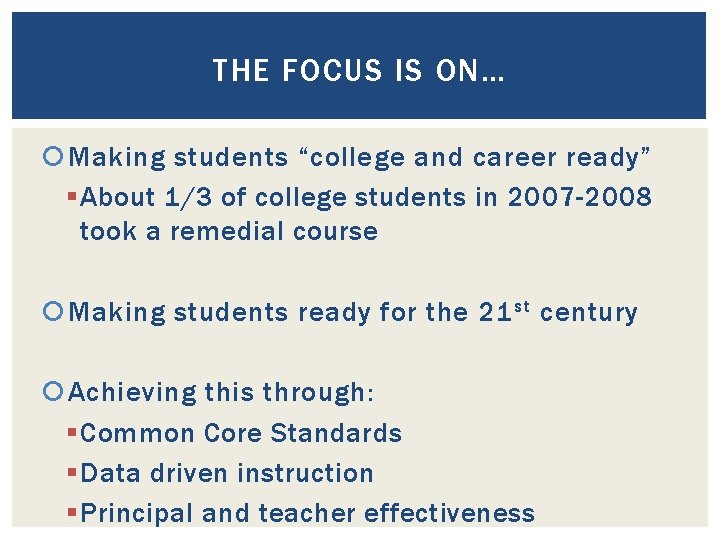
THE FOCUS IS ON… Making students “college and career ready” § About 1/3 of college students in 2007 -2008 took a remedial course Making students ready for the 21 st century Achieving this through: § Common Core Standards § Data driven instruction § Principal and teacher effectiveness
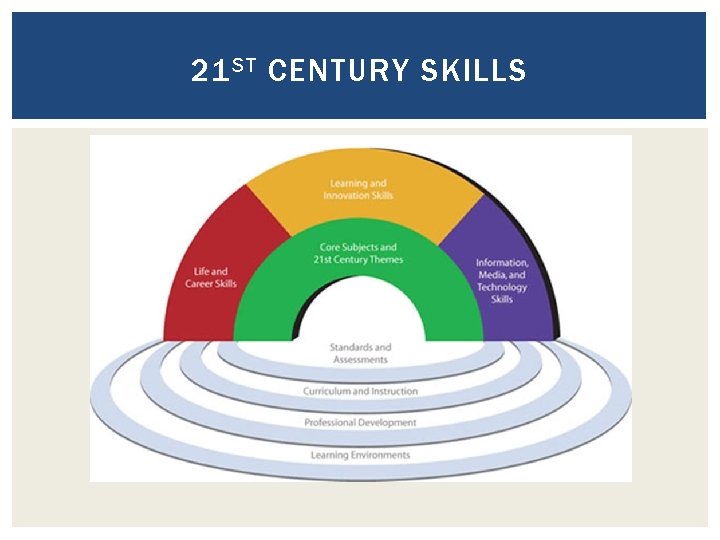
21 ST CENTURY SKILLS
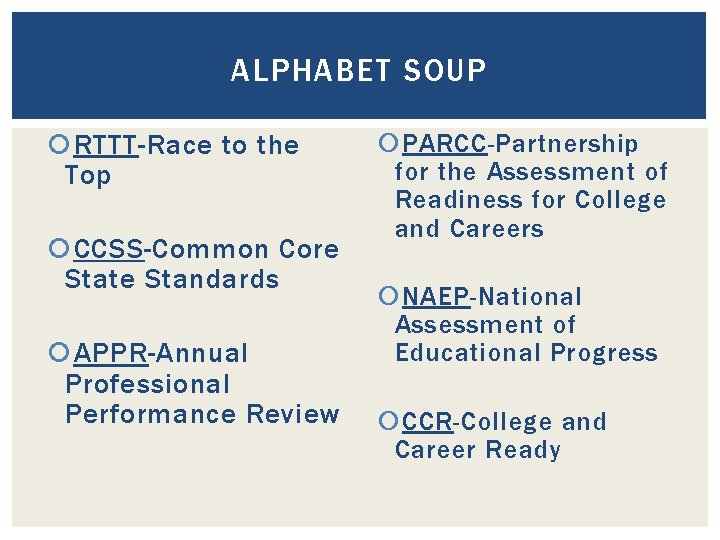
ALPHABET SOUP RTTT-Race to the Top CCSS-Common Core State Standards APPR-Annual Professional Performance Review PARCC-Partnership for the Assessment of Readiness for College and Careers NAEP-National Assessment of Educational Progress CCR-College and Career Ready
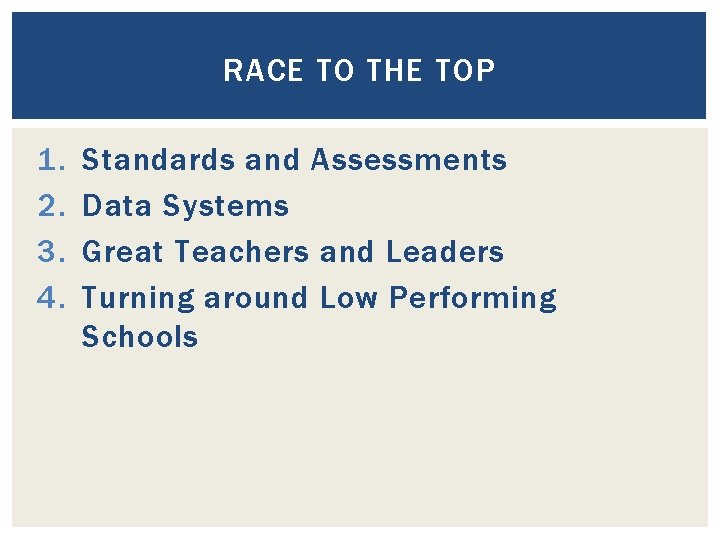
RACE TO THE TOP 1. 2. 3. 4. Standards and Assessments Data Systems Great Teachers and Leaders Turning around Low Performing Schools
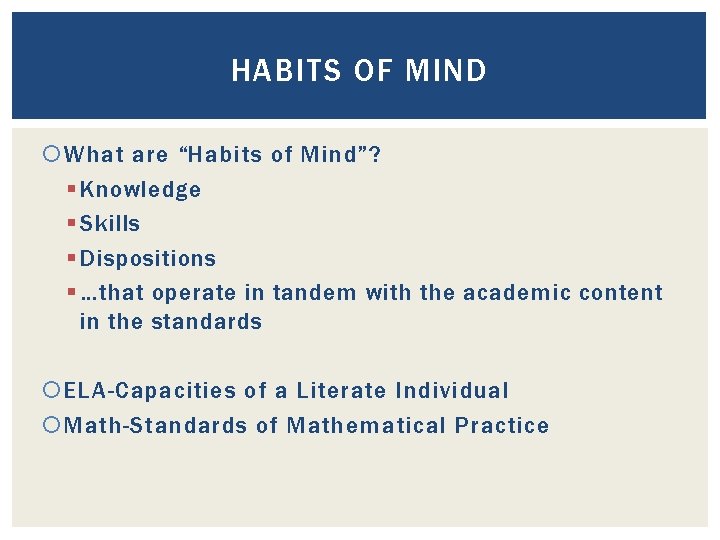
HABITS OF MIND What are “Habits of Mind”? § Knowledge § Skills § Dispositions § …that operate in tandem with the academic content in the standards ELA-Capacities of a Literate Individual Math-Standards of Mathematical Practice
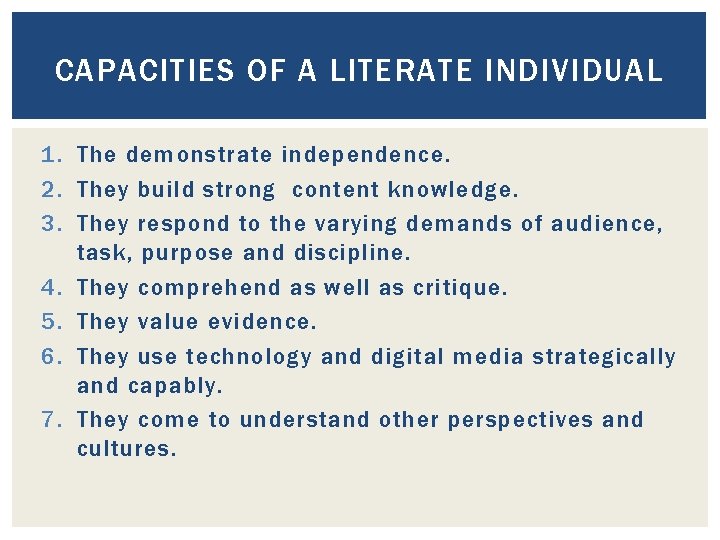
CAPACITIES OF A LITERATE INDIVIDUAL 1. The demonstrate independence. 2. They build strong content knowledge. 3. They respond to the varying demands of audience, task, purpose and discipline. 4. They comprehend as well as critique. 5. They value evidence. 6. They use technology and digital media strategically and capably. 7. They come to understand other perspectives and cultures.
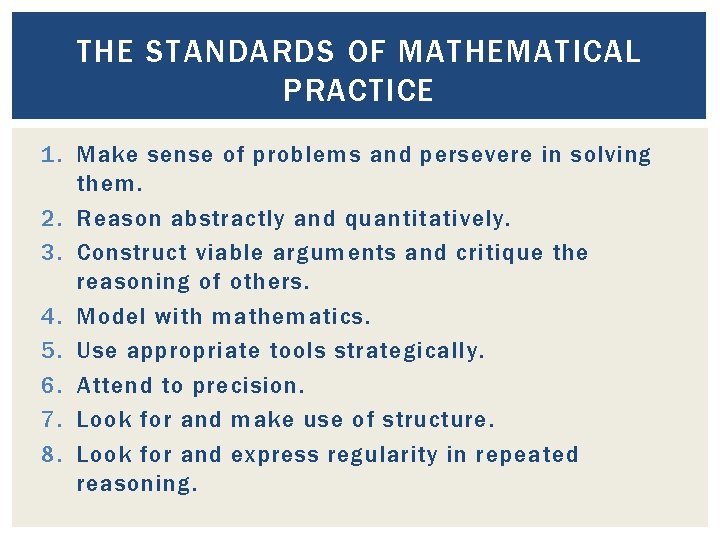
THE STANDARDS OF MATHEMATICAL PRACTICE 1. Make sense of problems and persevere in solving them. 2. Reason abstractly and quantitatively. 3. Construct viable arguments and critique the reasoning of others. 4. Model with mathematics. 5. Use appropriate tools strategically. 6. Attend to precision. 7. Look for and make use of structure. 8. Look for and express regularity in repeated reasoning.
EXTENDED LEARNING TIME-ACADEMIC IMPLICATIONS Time & Support
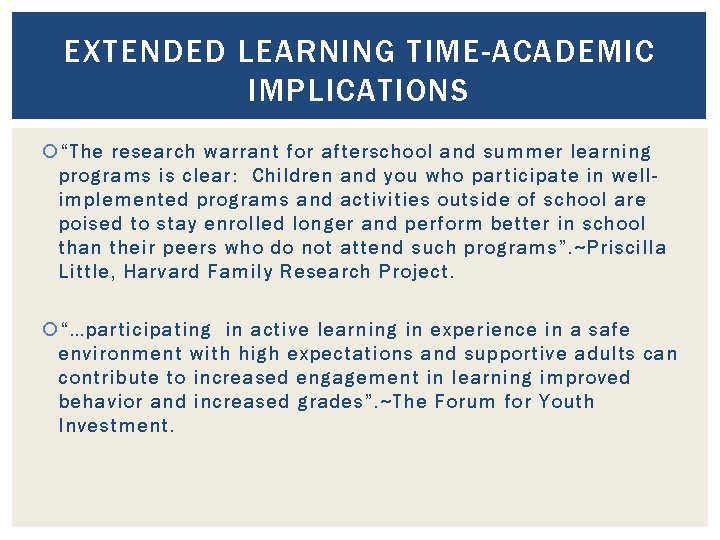
EXTENDED LEARNING TIME-ACADEMIC IMPLICATIONS “The research warrant for afterschool and summer learning programs is clear: Children and you who participate in wellimplemented programs and activities outside of school are poised to stay enrolled longer and perform better in school than their peers who do not attend such programs”. ~Priscilla Little, Harvard Family Research Project. “…participating in active learning in experience in a safe environment with high expectations and supportive adults can contribute to increased engagement in learning improved behavior and increased grades”. ~The Forum for Youth Investment.
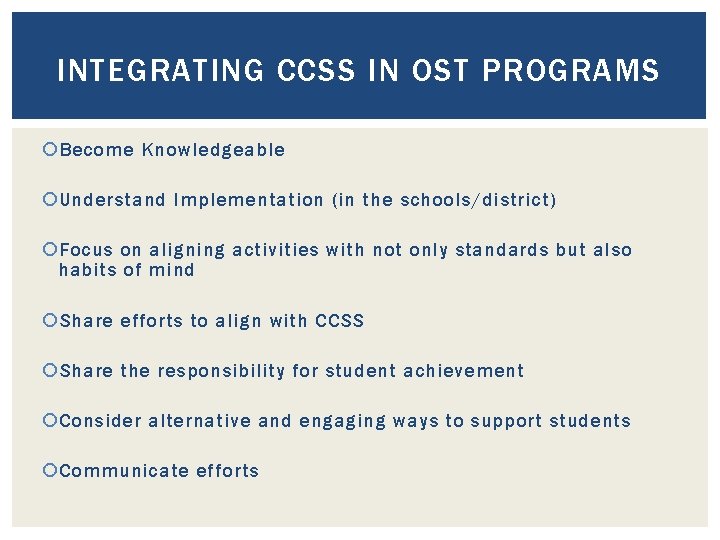
INTEGRATING CCSS IN OST PROGRAMS Become Knowledgeable Understand Implementation (in the schools/district) Focus on aligning activities with not only standards but also habits of mind Share efforts to align with CCSS Share the responsibility for student achievement Consider alternative and engaging ways to support students Communicate efforts
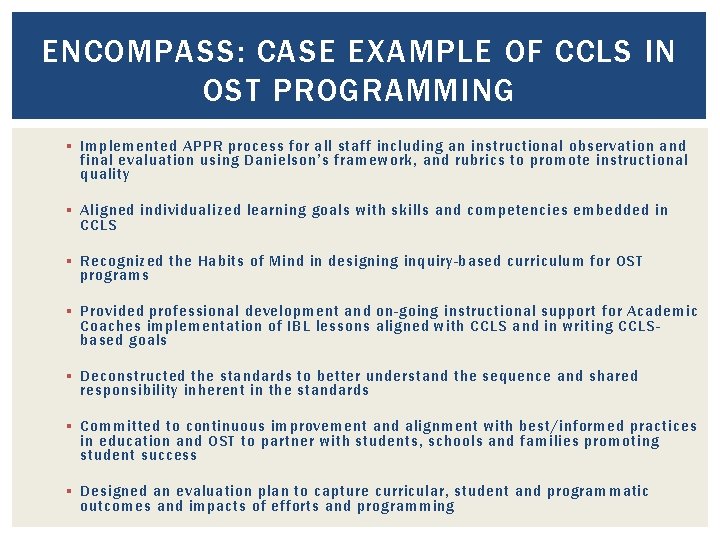
ENCOMPASS: CASE EXAMPLE OF CCLS IN OST PROGRAMMING § Implemented APPR process for all staff including an instructional observation and final evaluation using Danielson’s framework, and rubrics to promote instructional quality § Aligned individualized learning goals with skills and competencies embedded in CCLS § Recognized the Habits of Mind in designing inquiry-based curriculum for OST programs § Provided professional development and on-going instructional support for Academic Coaches implementation of IBL lessons aligned with CCLS and in writing CCLSbased goals § Deconstructed the standards to better understand the sequence and shared responsibility inherent in the standards § Committed to continuous improvement and alignment with best/informed practices in education and OST to partner with students, schools and families promoting student success § Designed an evaluation plan to capture curricular, student and programmatic outcomes and impacts of efforts and programming
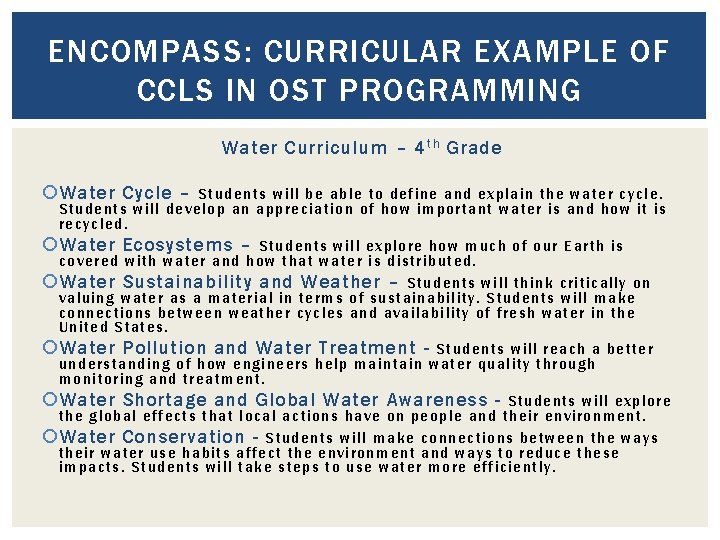
ENCOMPASS: CURRICULAR EXAMPLE OF CCLS IN OST PROGRAMMING Water Curriculum – 4 t h Grade Water Cycle – Student s w ill be able to define and explai n the wa te r c ycl e. S tude nts will develop an appr eciation of how important water is a nd ho w it is recy cl ed. Water Ecosystems – Stu dents will explore how much o f our Ear th i s cov ered with water and how t hat water is distributed. Water Sustainability and Weather – Students will think c ri ti ca ll y on v aluing water as a material in terms of sustainability. Students wi ll make con n ections between weather cycles and availability of fres h wat er in t he U nited States. Water Pollution and Water Treatment - Students will re ac h a b et te r u nde rstand ing of how eng ineers help maintain water quality thr ough mo nitoring a nd treatment. Water Shortage and Global Water Awareness - Student s wil l e xpl or e th e global eff ects that local actions have on people and their envi ro nment. Water Conservation - St u dents will make connections betwee n the ways th eir water use habits affect the environment and ways to reduce the se i mpacts. Students will take steps to use water more efficiently.
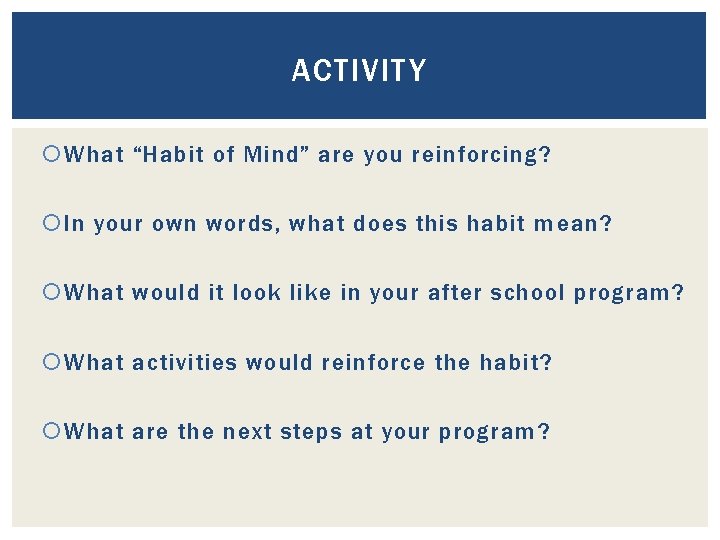
ACTIVITY What “Habit of Mind” are you reinforcing? In your own words, what does this habit mean? What would it look like in your after school program? What activities would reinforce the habit? What are the next steps at your program?
QUESTIONS
CONTACT INFORMATION Lisa Hiley, Ph. D – Director of Education lhiley@encompassresources. org Jeanne Fradella – Administrator of Extended Learning jfradella@encompassresources. org Mary Frenzel – Curriculum and Instructional Specialist mfrenzel@encompassresources. org