
Using commas with relative clauses Relative Clauses A
- Slides: 11
Using commas with relative clauses
Relative Clauses A relative clause is the part of a sentence that joins the main clause with a relative pronoun, such as that, which, who, what, where, when, why and how. For example: The book that I borrowed from the library yesterday is really good.
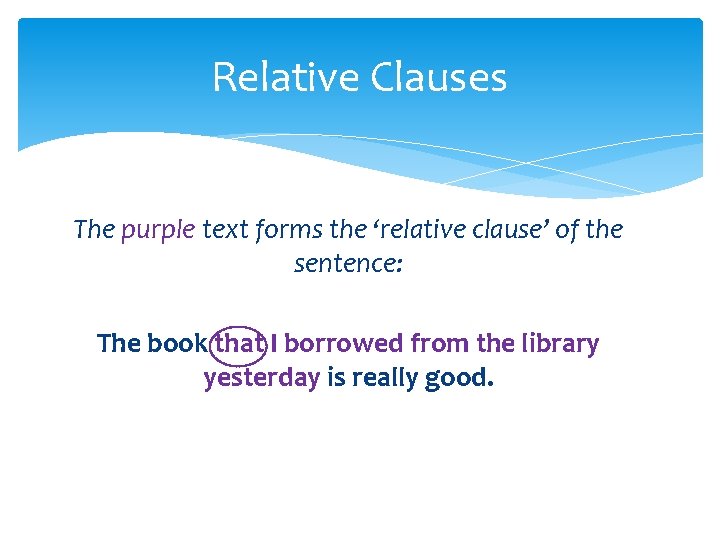
Relative Clauses The purple text forms the ‘relative clause’ of the sentence: The book that I borrowed from the library yesterday is really good.
Relative Clauses When we have relative clauses in a sentence, we have to think about whether or not to use commas. , , , , , , , , , , , , , ,
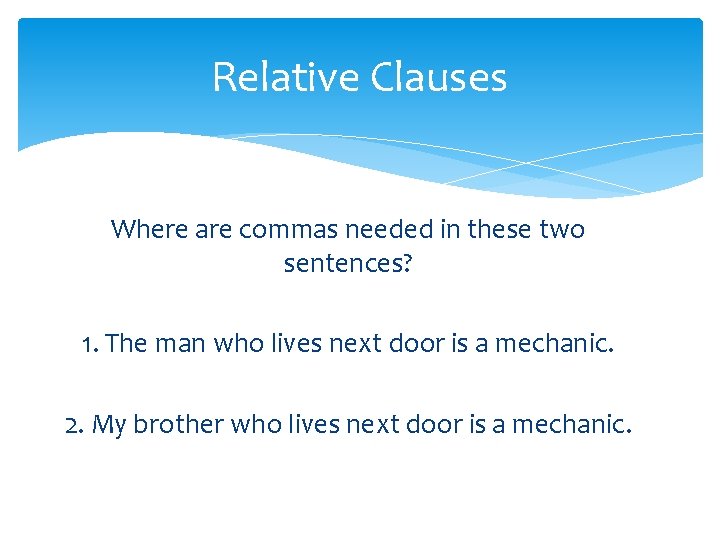
Relative Clauses Where are commas needed in these two sentences? 1. The man who lives next door is a mechanic. 2. My brother who lives next door is a mechanic.
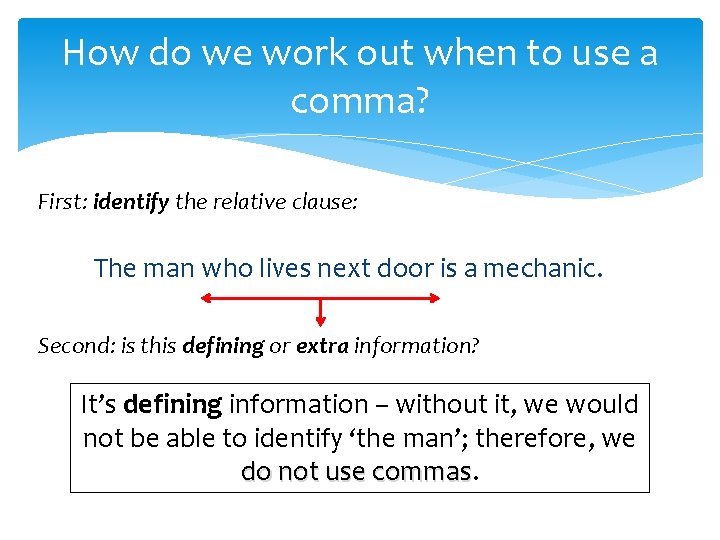
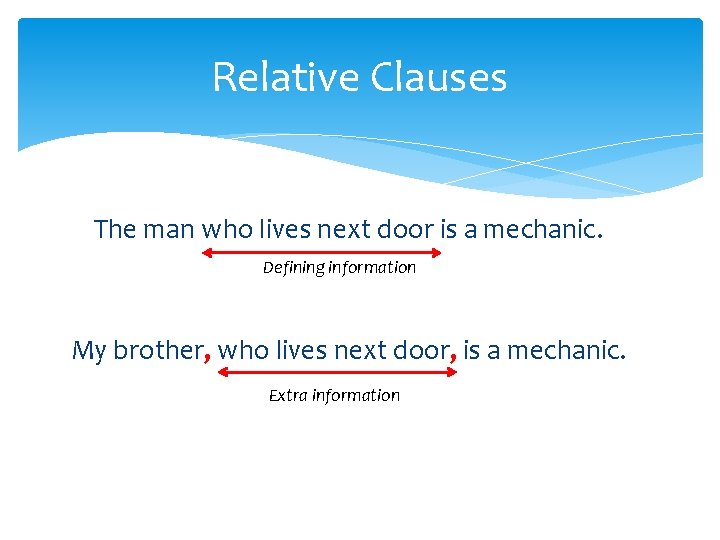
How do we work out when to use a comma? First: identify the relative clause: The man who lives next door is a mechanic. Second: is this defining or extra information? It’s defining information – without it, we would not be able to identify ‘the man’; therefore, we do not use commas
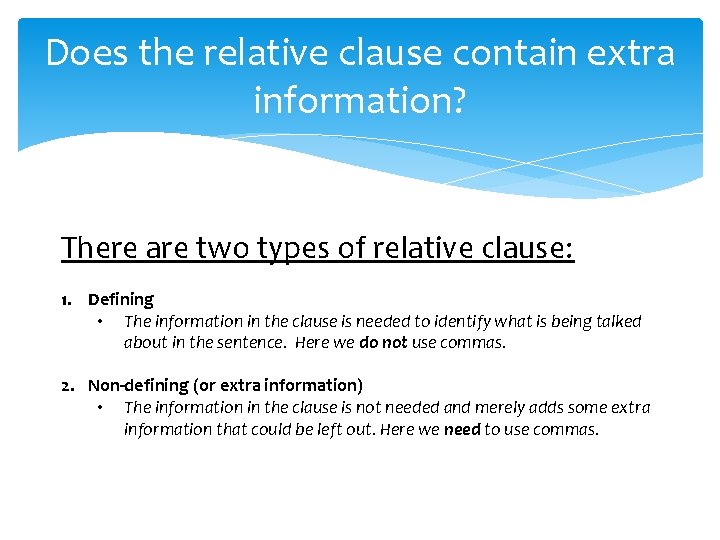
Does the relative clause contain extra information? There are two types of relative clause: 1. Defining • The information in the clause is needed to identify what is being talked about in the sentence. Here we do not use commas. 2. Non-defining (or extra information) • The information in the clause is not needed and merely adds some extra information that could be left out. Here we need to use commas.
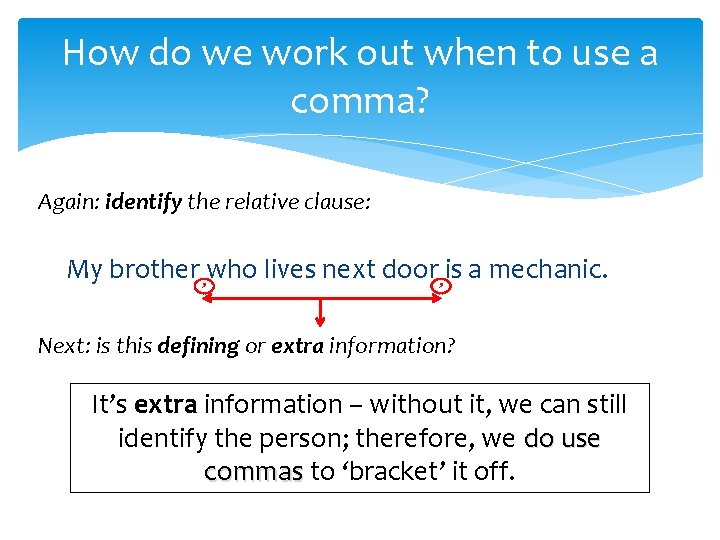
How do we work out when to use a comma? Again: identify the relative clause: My brother , who lives next door, is a mechanic. Next: is this defining or extra information? It’s extra information – without it, we can still identify the person; therefore, we do use commas to ‘bracket’ it off.
Relative Clauses The man who lives next door is a mechanic. Defining information My brother, who lives next door, is a mechanic. Extra information
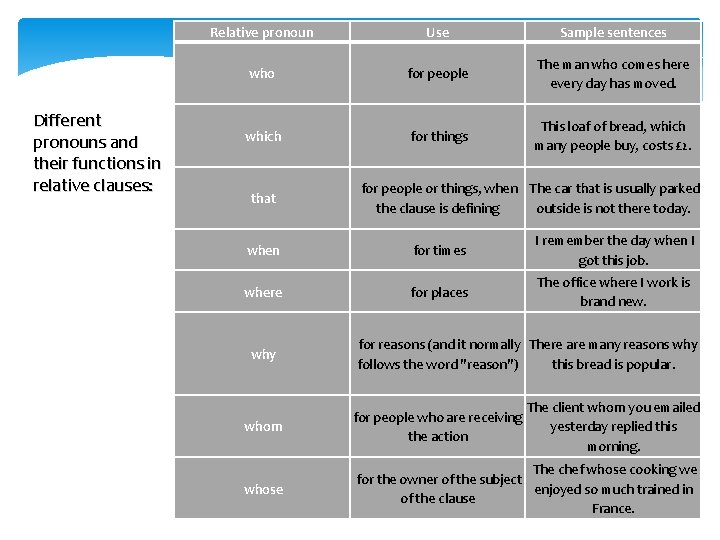
Different pronouns and their functions in relative clauses: Relative pronoun Use Sample sentences who for people The man who comes here every day has moved. which for things This loaf of bread, which many people buy, costs £ 2. that for people or things, when The car that is usually parked the clause is defining outside is not there today. when for times I remember the day when I got this job. where for places The office where I work is brand new. why for reasons (and it normally There are many reasons why follows the word "reason") this bread is popular. The client whom you emailed yesterday replied this morning. whom for people who are receiving the action whose The chef whose cooking we for the owner of the subject enjoyed so much trained in of the clause France.
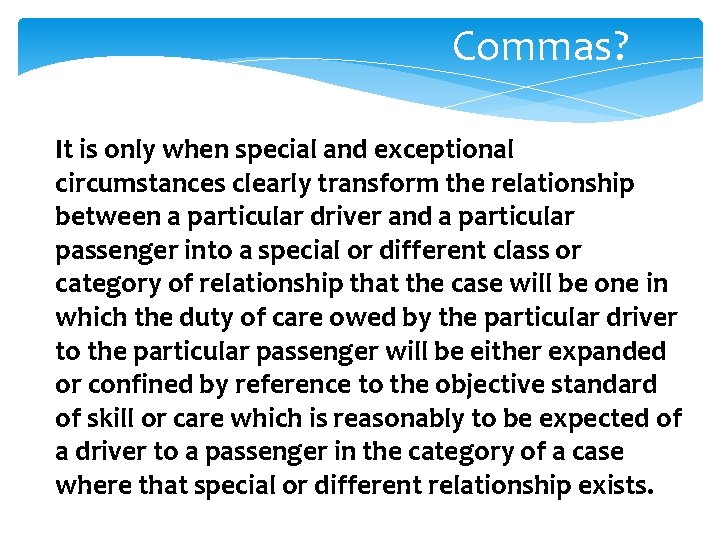
Commas? It is only when special and exceptional circumstances clearly transform the relationship between a particular driver and a particular passenger into a special or different class or category of relationship that the case will be one in which the duty of care owed by the particular driver to the particular passenger will be either expanded or confined by reference to the objective standard of skill or care which is reasonably to be expected of a driver to a passenger in the category of a case where that special or different relationship exists.