
Using Commas Commas should be used 1 To
Using Commas
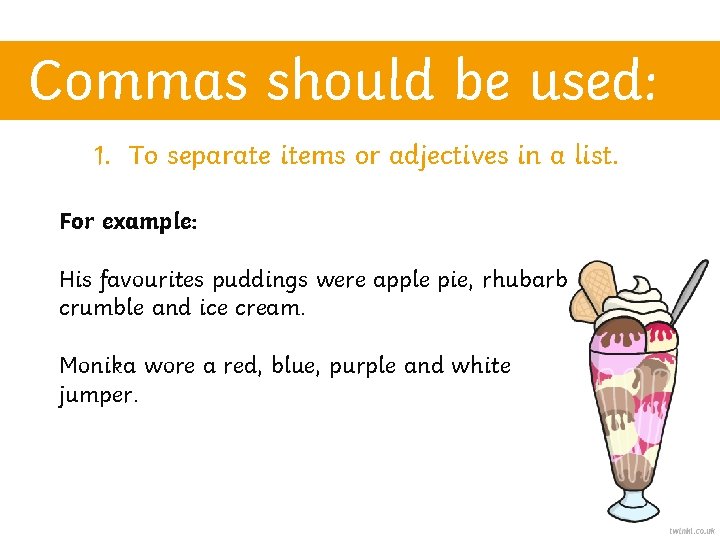
Commas should be used: 1. To separate items or adjectives in a list. For example: His favourites puddings were apple pie, rhubarb crumble and ice cream. Monika wore a red, blue, purple and white jumper.
Note that a comma is not normally used before the final item in a list. It is, however, acceptable to use a comma before the final item if it could otherwise cause confusion. For example: His favourite puddings were apple pie, rhubarb crumble, and jelly and ice cream. The use of the final comma indicates that ‘jelly and ice cream’ is considered a single item.
Commas should be used: 2. To separate a fronted adverbial from the rest of the sentence For example: Given the terrible weather conditions, the crew of the yacht were lucky to complete the race. As the last ray of sun disappeared, Yasmine crept silently out of the house.
Commas should be used: 3. To indicate parenthesis Parenthesis in a sentence adds information and can be removed without changing the meaning. For example: Milan, the cleverest boy in the class, was often late for school. CBBC, which is based in Manchester, is a popular children’s TV channel.
Commas should be used: 4. To separate direct speech from the rest of a sentence For example: “Martina, ” called Mum, “it’s time to leave for school. ” “Stop right there, ” the man commanded. “This is private property. ”
Commas should be used: A comma is not always needed in direct speech if another punctuation mark is used to separate the speech from the rest of the sentence. For example: “Give me the money!” he snarled. “Where have you been? ” asked Dad. NOT “Give me the money!, ” he snarled. “Where have you been? , ” asked Dad.
Commas should be used: 5. To separate main and subordinate clauses For example: While you’re waiting, you can read a magazine. Although I love football, swimming is my favourite sport.
Commas should be used: 6. To separate elements in a sentence that express contrast For example: He thought the building was enormous, but ugly. She enjoyed the music in the show, not the acting.
Commas should be used: 7. To separate dates, years, towns etc. For example: I grew up in Kentish Town, North London. My gran was born on March 25 th, 1942.
Comma splices occur when two independent clauses are joined by a comma. Comma splicing is inaccurate and should be avoided. For example: Julian usually gets on with everybody, he is an understanding person.
Comma splices Instead of a comma splice, the writer could use: a semi colon: Julian usually gets on with everybody; he is an understanding person. or a full stop: Julian usually gets on with everybody. He is an understanding person.

- Slides: 13