
Using cluster analysis to understand complex data sets

- Slides: 25
Using cluster analysis to understand complex data sets: Experience from a national nursing consortium Barbara Williams, Ph. D Center for Health Care Improvement Science Stata Conference July 11 -12, 2019
Overview • • Patient ulcer injuries and falls Nursing care Relationship between injuries, falls, and nursing care Methods Cluster Analysis Implications Discussion © 2019 Virginia Mason Medical Center
Background • Hospitalized patients in the United States experience up to 1 million falls and 2. 5 million hospital-acquired pressure injuries (HAPI) each year. • Falls happen because of general weakness from being in the hospital and dizziness or confusion caused by medications • Pressure injuries (sores) happen if a patient can’t move around and so the skin can break down under constant pressure. • Both adverse outcomes are considered to be preventable with appropriate nursing care. © 2019 Virginia Mason Medical Center
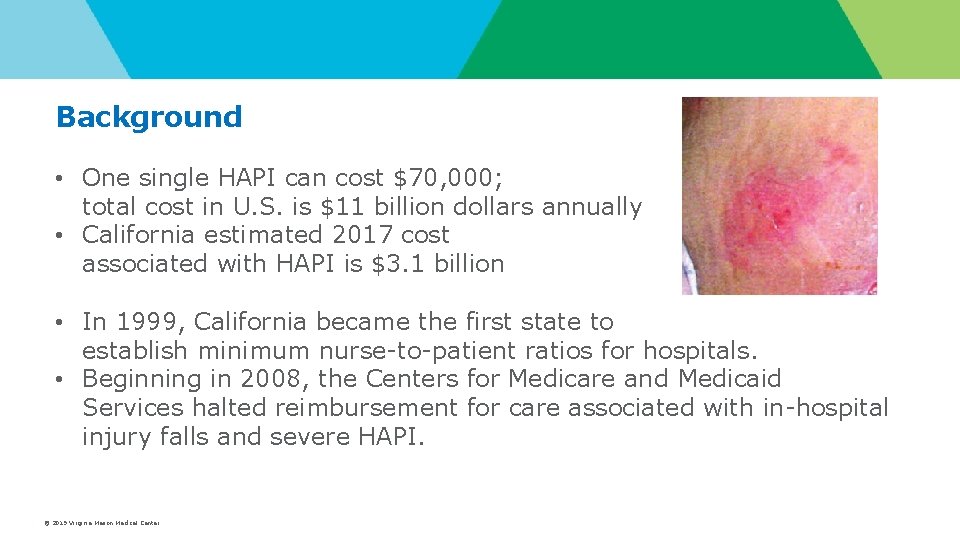
Background • One single HAPI can cost $70, 000; total cost in U. S. is $11 billion dollars annually • California estimated 2017 cost associated with HAPI is $3. 1 billion • In 1999, California became the first state to establish minimum nurse-to-patient ratios for hospitals. • Beginning in 2008, the Centers for Medicare and Medicaid Services halted reimbursement for care associated with in-hospital injury falls and severe HAPI. © 2019 Virginia Mason Medical Center
Are all nurses the same? Traveling Nurses • Hospitals use traveling nurses to fill short-term staffing shortages. • Traveling nurses are employed by staffing agencies rather than hospitals and go where they are needed. • Assignments generally last 13 weeks, with one week of training • Disadvantage: traveling nurses may lack the knowledge and experience necessary for the specific job. For example, working with a particular computer system or hospital-specific procedures. © 2019 Virginia Mason Medical Center
Objective To determine the relationship between the number and types of nurse staffing and two nurse-sensitive adverse hospital outcomes: HAPI and falls. © 2019 Virginia Mason Medical Center
Our data • Hospitals participating in the Collaborative Alliance for Nursing Outcomes (CALNOC) database. • CALNOC is a voluntary consortium of hospitals who supply quarterly data on nurse staffing and outcomes (including HAPI and falls) to a central database. • We included all hospitals with data reported between 2015 and 2016, even if there was never a contract nurse in any of the units. • The final number for our analysis was 605 units in 166 hospitals. © 2019 Virginia Mason Medical Center
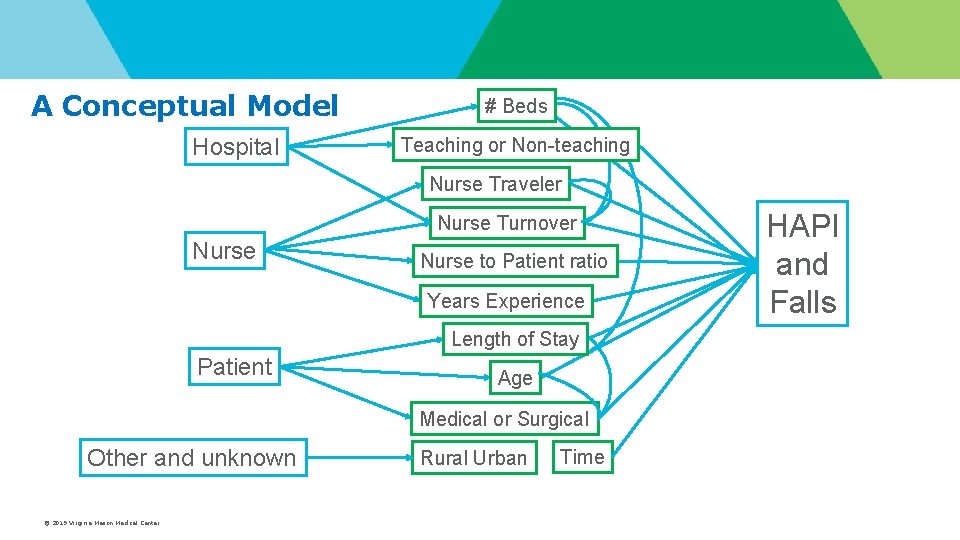
A Conceptual Model Hospital # Beds Teaching or Non-teaching Nurse Traveler Nurse Turnover Nurse to Patient ratio Years Experience Length of Stay Patient Age Medical or Surgical Other and unknown © 2019 Virginia Mason Medical Center Rural Urban Time HAPI and Falls
A Conceptual Model Hospital # Beds Teaching or Non-teaching Nurse Traveler Nurse Turnover Nurse to Patient ratio Years Experience Length of Stay Patient Age Medical or Surgical Other and unknown © 2019 Virginia Mason Medical Center Rural Urban Time HAPI and Falls
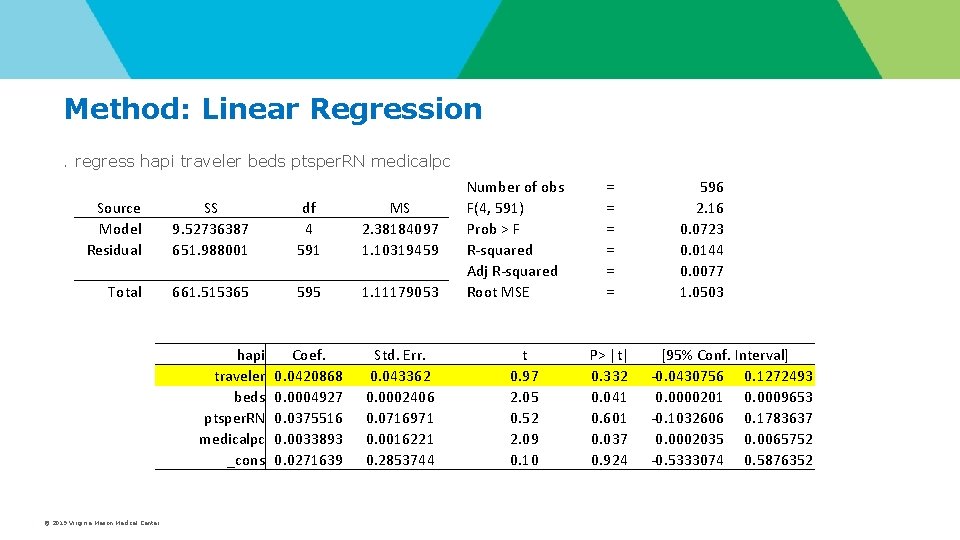
Method: Linear Regression. regress hapi traveler beds ptsper. RN medicalpc Source Model Residual SS 9. 52736387 651. 988001 df 4 591 MS 2. 38184097 1. 10319459 Total 661. 515365 595 1. 11179053 Coef. 0. 0420868 0. 0004927 0. 0375516 0. 0033893 0. 0271639 Std. Err. 0. 043362 0. 0002406 0. 0716971 0. 0016221 0. 2853744 hapi traveler beds ptsper. RN medicalpc _cons © 2019 Virginia Mason Medical Center Number of obs F(4, 591) Prob > F R-squared Adj R-squared Root MSE t 0. 97 2. 05 0. 52 2. 09 0. 10 = = = P> |t| 0. 332 0. 041 0. 601 0. 037 0. 924 596 2. 16 0. 0723 0. 0144 0. 0077 1. 0503 [95% Conf. Interval] -0. 0430756 0. 1272493 0. 0000201 0. 0009653 -0. 1032606 0. 1783637 0. 0002035 0. 0065752 -0. 5333074 0. 5876352
Problems with linear regression models There are several potential problems with using a regression model in this analysis: 1. Requires a pre-defined model of the relationships 2. Assumes that hospital, nurse, and patient characteristics are linear. 3. Does not account for complex interaction effects whereby an unit’s scoring high on two or more qualities, could have a larger impact than the sum of the effects taken separately. © 2019 Virginia Mason Medical Center
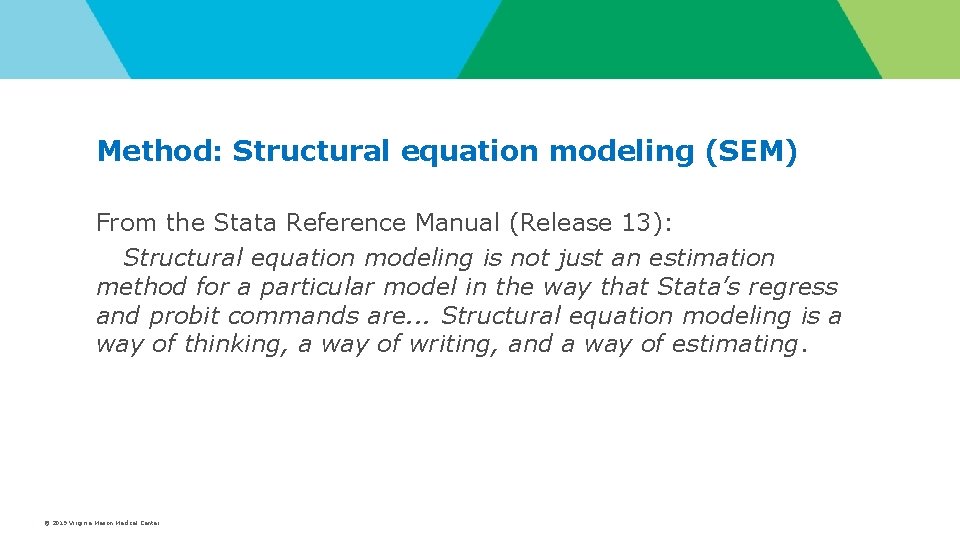
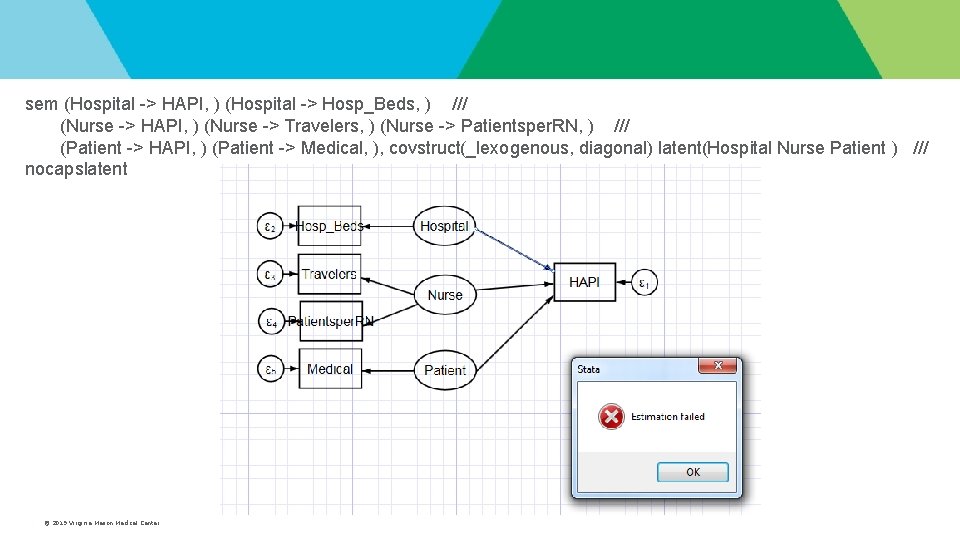
Method: Structural equation modeling (SEM) From the Stata Reference Manual (Release 13): Structural equation modeling is not just an estimation method for a particular model in the way that Stata’s regress and probit commands are. . . Structural equation modeling is a way of thinking, a way of writing, and a way of estimating. © 2019 Virginia Mason Medical Center
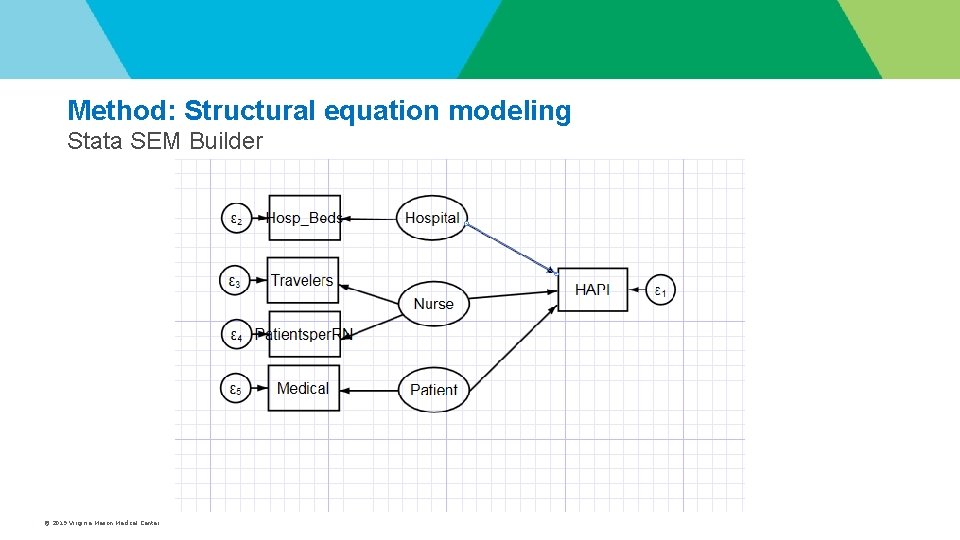
Method: Structural equation modeling Stata SEM Builder © 2019 Virginia Mason Medical Center
sem (Hospital -> HAPI, ) (Hospital -> Hosp_Beds, ) /// (Nurse -> HAPI, ) (Nurse -> Travelers, ) (Nurse -> Patientsper. RN, ) /// (Patient -> HAPI, ) (Patient -> Medical, ), covstruct(_lexogenous, diagonal) latent(Hospital Nurse Patient ) /// nocapslatent © 2019 Virginia Mason Medical Center
Method 4: Cluster Analysis From the Stata Manual: Cluster analysis attempts to determine the natural groupings (or clusters) of observations. . . [There are] examples of the use of cluster analysis, such as in refining or redefining diagnostic categories in psychiatry, detecting similarities in artifacts by archaeologists to study the spatial distribution of artifact types, discovering hierarchical relationships in taxonomy, and identifying sets of similar cities so that one city from each class can be sampled in a market research task. © 2019 Virginia Mason Medical Center
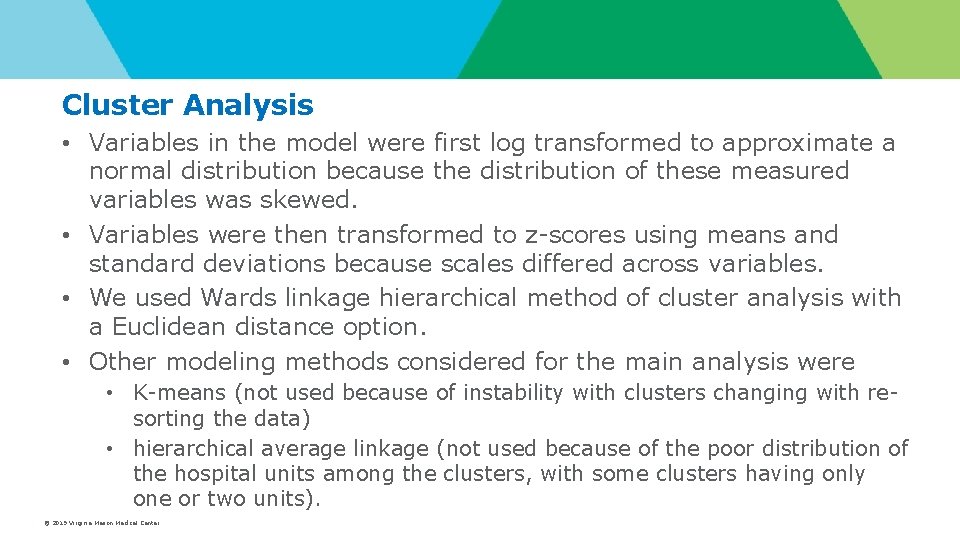
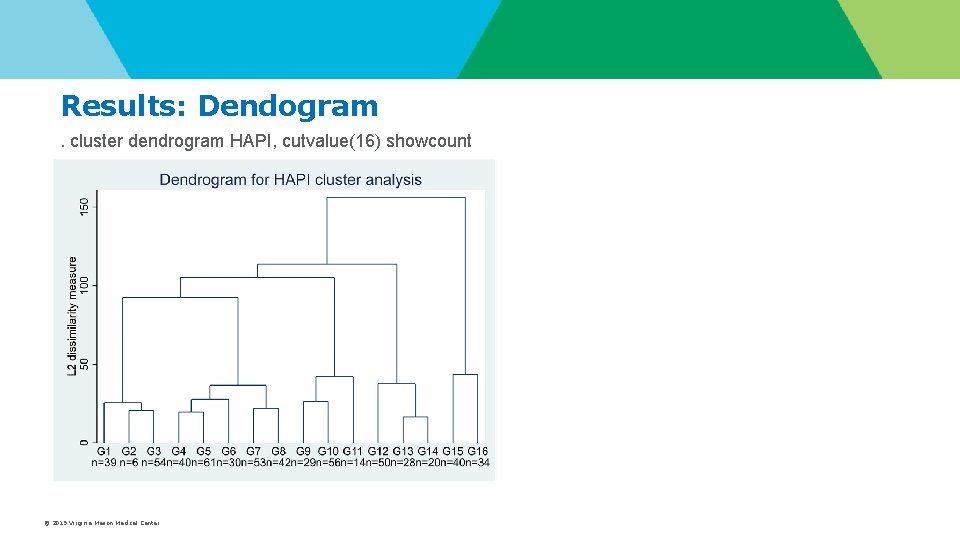
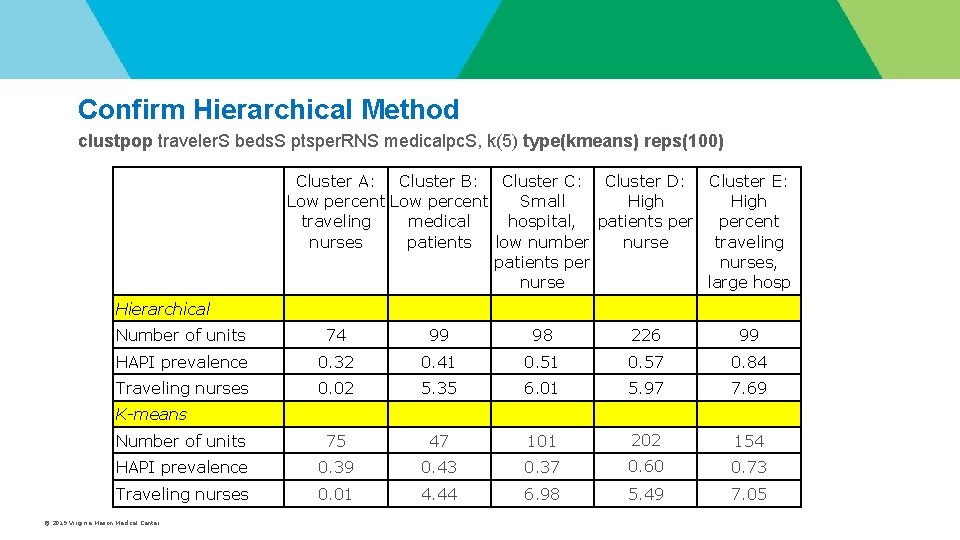
Cluster Analysis • Variables in the model were first log transformed to approximate a normal distribution because the distribution of these measured variables was skewed. • Variables were then transformed to z-scores using means and standard deviations because scales differed across variables. • We used Wards linkage hierarchical method of cluster analysis with a Euclidean distance option. • Other modeling methods considered for the main analysis were • K-means (not used because of instability with clusters changing with resorting the data) • hierarchical average linkage (not used because of the poor distribution of the hospital units among the clusters, with some clusters having only one or two units). © 2019 Virginia Mason Medical Center
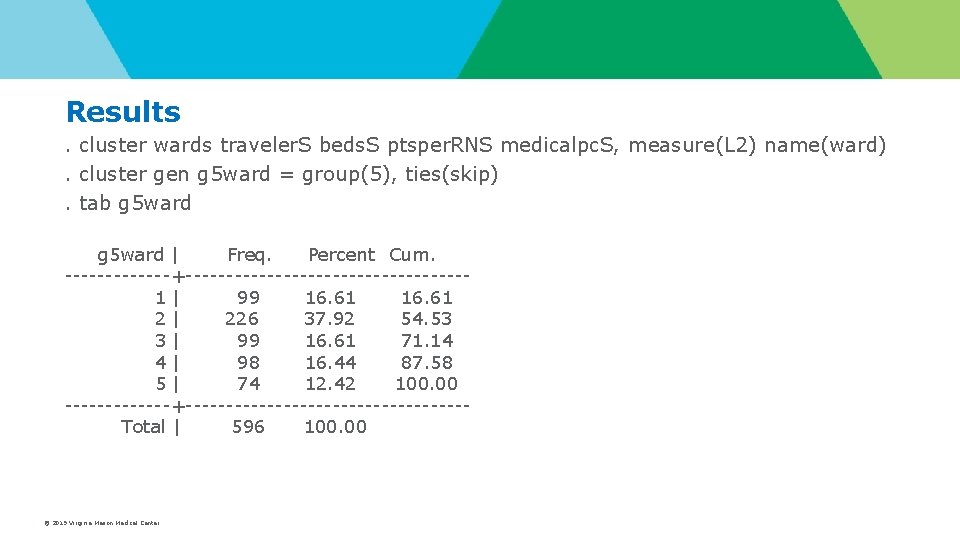
Results. cluster wards traveler. S beds. S ptsper. RNS medicalpc. S, measure(L 2) name(ward). cluster gen g 5 ward = group(5), ties(skip). tab g 5 ward | Freq. Percent Cum. -------+----------------- 1 | 99 16. 61 2 | 226 37. 92 54. 53 3 | 99 16. 61 71. 14 4 | 98 16. 44 87. 58 5 | 74 12. 42 100. 00 -------+----------------- Total | 596 100. 00 © 2019 Virginia Mason Medical Center
Results: Dendogram. cluster dendrogram HAPI, cutvalue(16) showcount © 2019 Virginia Mason Medical Center
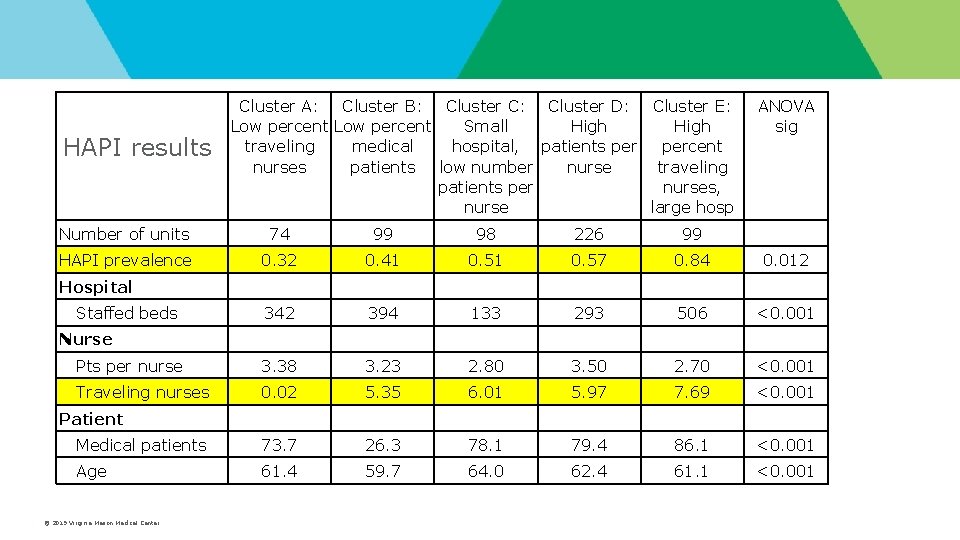
HAPI results Cluster A: Cluster B: Cluster C: Cluster D: Cluster E: Low percent Small High traveling medical hospital, patients percent nurses patients low number nurse traveling patients per nurses, nurse large hosp Number of units 74 99 98 226 99 HAPI prevalence 0. 32 0. 41 0. 57 0. 84 Hospital Staffed beds Nurse 342 394 133 293 ANOVA sig 0. 012 506 <0. 001 Pts per nurse 3. 38 3. 23 2. 80 3. 50 2. 70 <0. 001 Traveling nurses 0. 02 5. 35 6. 01 5. 97 7. 69 <0. 001 Patient Medical patients 73. 7 26. 3 78. 1 79. 4 86. 1 <0. 001 Age 61. 4 59. 7 64. 0 62. 4 61. 1 <0. 001 © 2019 Virginia Mason Medical Center
Confirm Hierarchical Method clustpop traveler. S beds. S ptsper. RNS medicalpc. S, k(5) type(kmeans) reps(100) Cluster A: Cluster B: Cluster C: Cluster D: Cluster E: Low percent Small High traveling medical hospital, patients percent nurses patients low number nurse traveling patients per nurses, nurse large hosp Hierarchical Number of units 74 99 98 226 99 HAPI prevalence 0. 32 0. 41 0. 57 0. 84 Traveling nurses 0. 02 5. 35 6. 01 5. 97 7. 69 Number of units 75 47 101 202 154 HAPI prevalence 0. 39 0. 43 0. 37 0. 60 0. 73 Traveling nurses 0. 01 4. 44 6. 98 5. 49 7. 05 K-means © 2019 Virginia Mason Medical Center
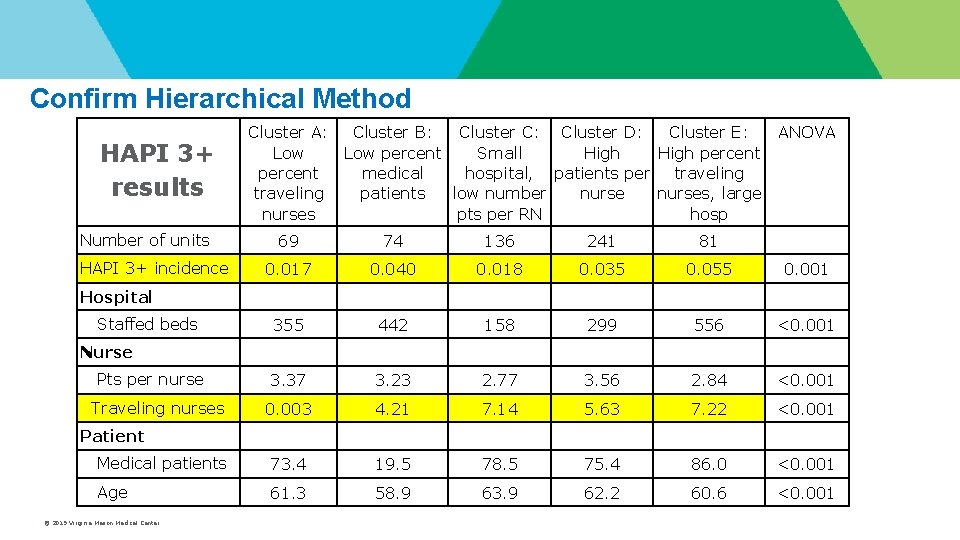
Confirm Hierarchical Method HAPI 3+ results Cluster A: Cluster B: Cluster C: Cluster D: Cluster E: ANOVA Low percent Small High percent medical hospital, patients per traveling patients low number nurses, large nurses pts per RN hosp Number of units HAPI 3+ incidence Hospital 136 241 81 0. 017 0. 040 0. 018 0. 035 0. 055 355 Pts per nurse Traveling nurses Patient 74 Staffed beds Nurse 69 442 158 299 0. 001 556 <0. 001 3. 37 3. 23 2. 77 3. 56 2. 84 <0. 001 0. 003 4. 21 7. 14 5. 63 7. 22 <0. 001 Medical patients 73. 4 19. 5 78. 5 75. 4 86. 0 <0. 001 Age 61. 3 58. 9 63. 9 62. 2 60. 6 <0. 001 © 2019 Virginia Mason Medical Center
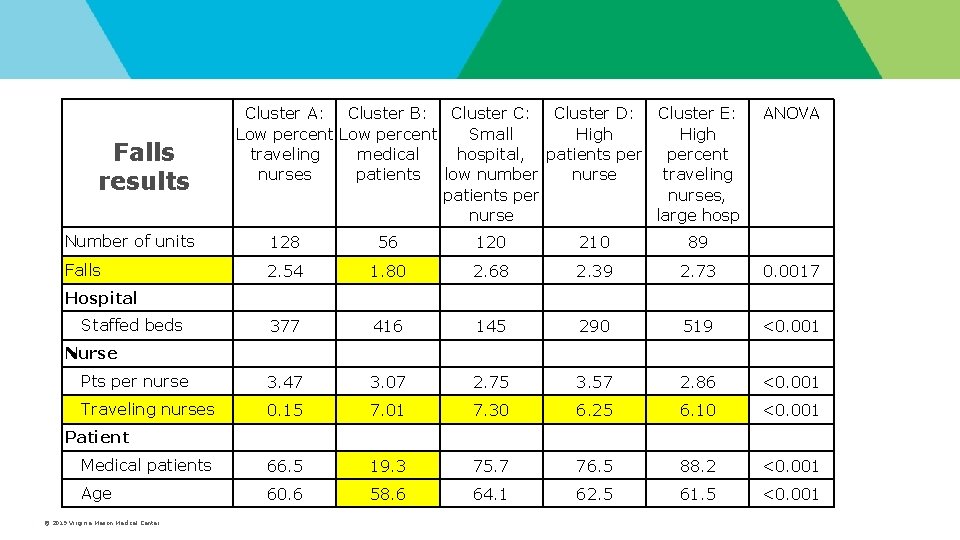
Falls results Cluster A: Cluster B: Cluster C: Cluster D: Cluster E: Low percent Small High traveling medical hospital, patients percent nurses patients low number nurse traveling patients per nurses, nurse large hosp Number of units 128 56 120 210 89 Falls 2. 54 1. 80 2. 68 2. 39 2. 73 Hospital Staffed beds Nurse 377 416 145 290 ANOVA 0. 0017 519 <0. 001 Pts per nurse 3. 47 3. 07 2. 75 3. 57 2. 86 <0. 001 Traveling nurses 0. 15 7. 01 7. 30 6. 25 6. 10 <0. 001 Patient Medical patients 66. 5 19. 3 75. 7 76. 5 88. 2 <0. 001 Age 60. 6 58. 6 64. 1 62. 5 61. 5 <0. 001 © 2019 Virginia Mason Medical Center
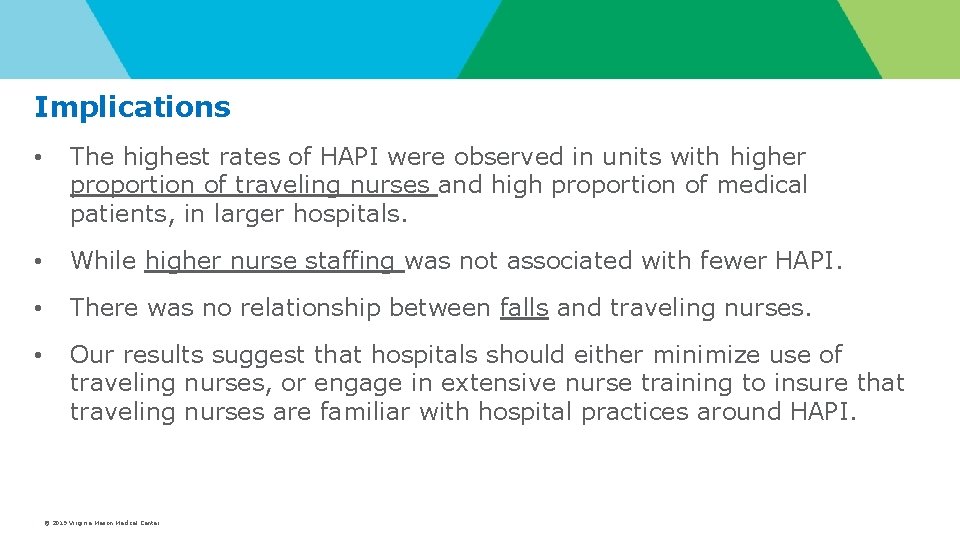
Implications • The highest rates of HAPI were observed in units with higher proportion of traveling nurses and high proportion of medical patients, in larger hospitals. • While higher nurse staffing was not associated with fewer HAPI. • There was no relationship between falls and traveling nurses. • Our results suggest that hospitals should either minimize use of traveling nurses, or engage in extensive nurse training to insure that traveling nurses are familiar with hospital practices around HAPI. © 2019 Virginia Mason Medical Center
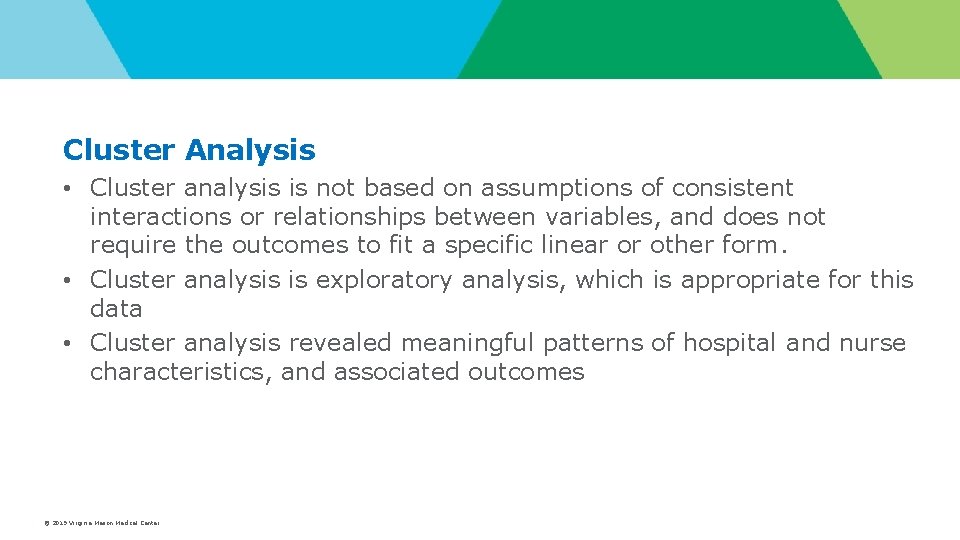
Cluster Analysis • Cluster analysis is not based on assumptions of consistent interactions or relationships between variables, and does not require the outcomes to fit a specific linear or other form. • Cluster analysis is exploratory analysis, which is appropriate for this data • Cluster analysis revealed meaningful patterns of hospital and nurse characteristics, and associated outcomes © 2019 Virginia Mason Medical Center
Discussion • Any recommendations to strengthen this analysis? • What are the limitations in using this method? • What other statistical methods could be used with this data? © 2019 Virginia Mason Medical Center