
USING CASAS TEST RESULTS TO DESIGN INSTRUCTION FOR


- Slides: 54
USING CASAS TEST RESULTS TO DESIGN INSTRUCTION FOR ADULTS WITH LEARNING DISABILITIES CASAS National Summer Institute Wednesday, June 16, 2004 Nancie Payne, M. S. Payne & Associates, Inc.
GOALS & OBJECTIVES • Enhance learning for students who have Learning Disabilities & Related Special Needs – CASAS competency student information – Diagnostic-prescriptive teaching – Practical, hands-on accommodations
DIAGNOSTICPRESCRIPTIVE TEACHING METHOD • What Does that Mean?
DIAGNOSTIC-PRESCRIPTIVE METHODS MEANS… • Effective use of assessment data in instruction that is based on Observations, Informal & Formal Data to create a Learner-Centered Instructional Approach…
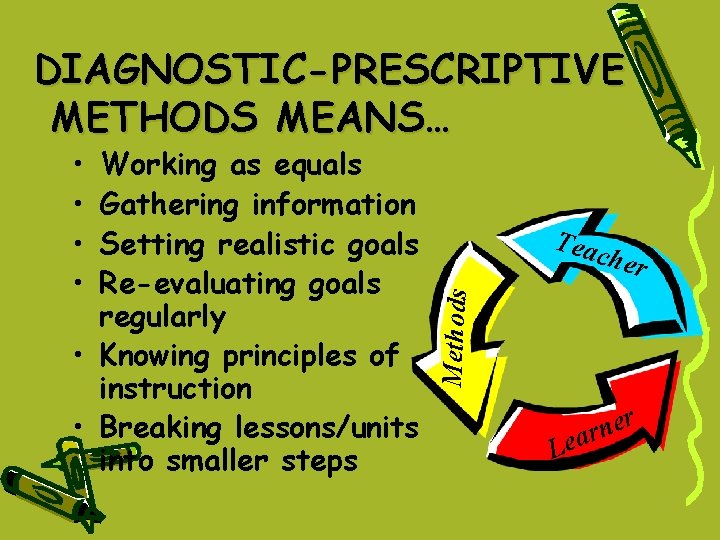
DIAGNOSTIC-PRESCRIPTIVE METHODS MEANS… Working as equals Gathering information Setting realistic goals Re-evaluating goals regularly • Knowing principles of instruction • Breaking lessons/units into smaller steps Teac her Methods • • Le r e n ar
DIAGNOSTIC-PRESCRIPTIVE METHODS MEANS… • Evaluating & re-evaluating • Exploring student-centered learning methods • Modifying instruction when needed • Being organized & focused • Maintaining flexibility
DIAGNOSTIC-PRESCRIPTIVE METHODS MEANS… • • • Establish classroom routines Have a relationship with the learner Promote consistency Hold high expectations & standards Expect that all learners will succeed Reward – reward!!
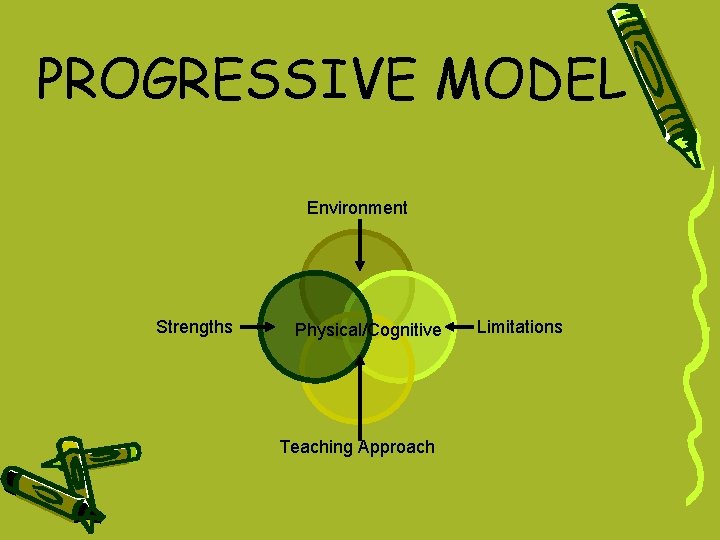
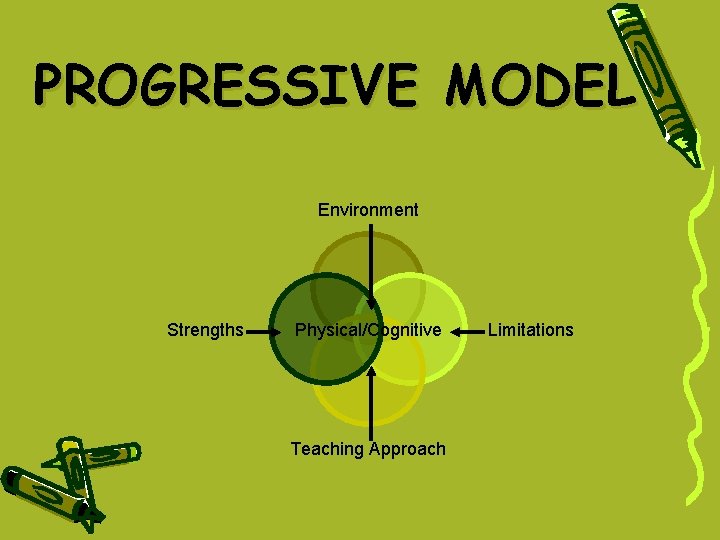
PROGRESSIVE MODEL Environment Strengths Physical/Cognitive Teaching Approach Limitations
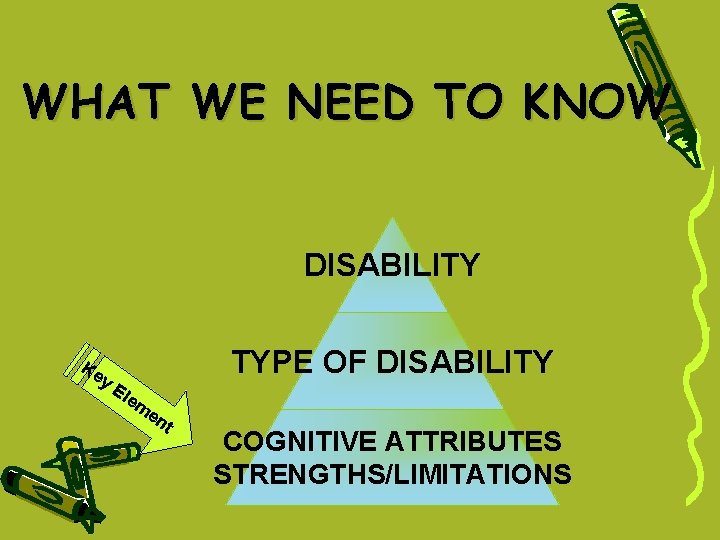
WHAT WE NEED TO KNOW DISABILITY TYPE OF DISABILITY Ke y. E lem en t COGNITIVE ATTRIBUTES STRENGTHS/LIMITATIONS
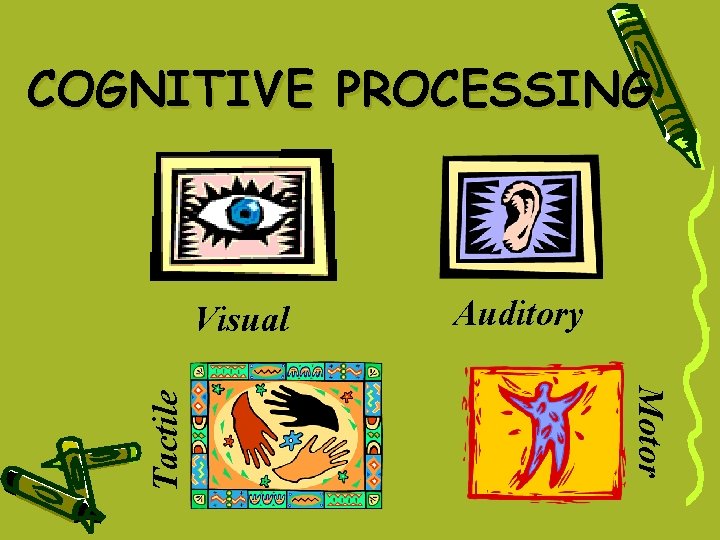
COGNITIVE PROCESSING Auditory Motor Tactile Visual
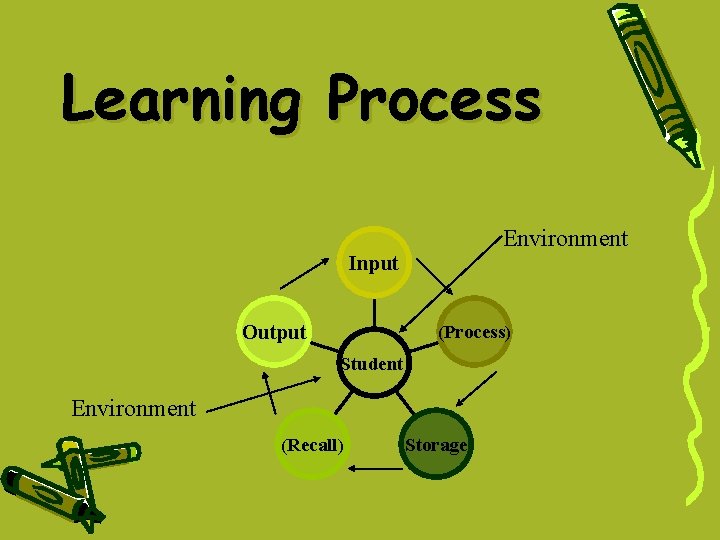
Learning Process Environment Input Output (Process) Student Environment (Recall) Storage
Strengths & Limitations • Strengths – What student does or can do really well (CASAS Competencies) – Successes or potential successes • Limitations – Activities the disability prevents student from accomplishing even though he/she has or can acquire the knowledge, skills & abilities
STRENGTHS = Processing Style • Learning Styles Checklist • Learning Styles on the Web – – – www. ldrc. ca/projects/aware/index. php www. engr. ncsu. edu/learningstyles/ilsweb. html www. clat. psu. edu/gems/other/LSI. htm http: //ttc. coe. uga. edu/surveys www. crc 4 mse. org/ILS/self_test. html
DIAGNOSTIC-PRESCRIPTIVE MEANS GATHERING INFORMATION • Background – Hobbies, Interests, Family, Education, Talents • Current Situation – Food, Housing, Heat, Electricity
DIAGNOSTIC-PRESCRIPTIVE MEANS GATHERING INFORMATION • Health/Medical – Illnesses, Allergies, Vision, Hearing, Injuries, Meds • Self-assessment – Life Skills, Learning Style, Reading, Writing, Math • Limitations – Attention, Time Orientation, Sequencing, Spatial, Memory, Motor-visual, Expressive, Receptive
DIAGNOSTIC-PRESCRIPTIVE MEANS GATHERING INFORMATION • Social-Emotional – Appearance, Attitude, Conversation Skills, Anxiety, Self-esteem • Study Methods – Structure, Organization, Schedule, Establish Goals • Goals – Expectations of Program, You, Student
Critical Aspects of the Learning Environment • Observe – Structure of Environment – Distracting • Visually • Auditorially – Workspaces or Stations – Observe How Others Respond to the Environment
SURVEY YOUR ENVIRONMENT… • Think about your learning environment – – Note what is good – Note what needs to be changed
TASK ANALYSIS FOR THE LESSON • Identification of Specific Tasks or Functions • Components of Good Task Analysis: – – – Specify the Task Identify the Outcome Identify in Sequence Discrete Steps Identify Mini Sub-Steps Repeat for each task within the lesson
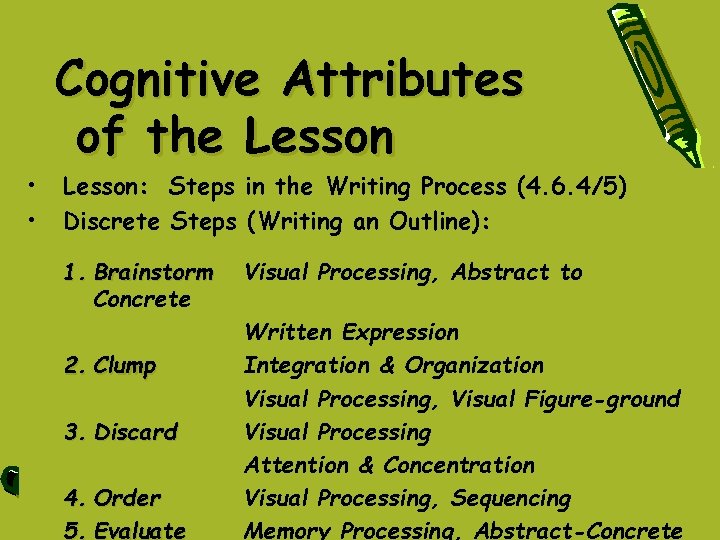
Example • Lesson: Steps in the Writing Process (4. 6. 4/5) • Tasks: Choose a Topic Write an Outline Prepare a Draft… • Discrete Steps (Writing an Outline): 1. Brainstorm 2. Clump 3. Discard 4. Order 5. Evaluate
Lesson Analysis Practice Identify basic steps for the competency: Filling out a form for enrollment (0. 2. 2)
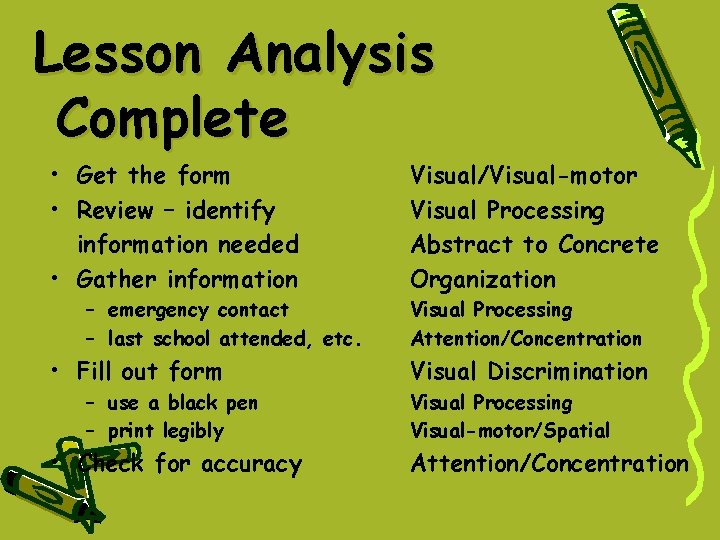
Lesson Analysis Complete • Get the form • Review – identify information needed • Gather up all information – emergency contact – last school attended, etc. • Fill out form – use a black pen – print legibly • Check for accuracy
Cognitive Attributes • Relates to learning functions • The types of cognition to perform a task • Learning characteristics to complete task
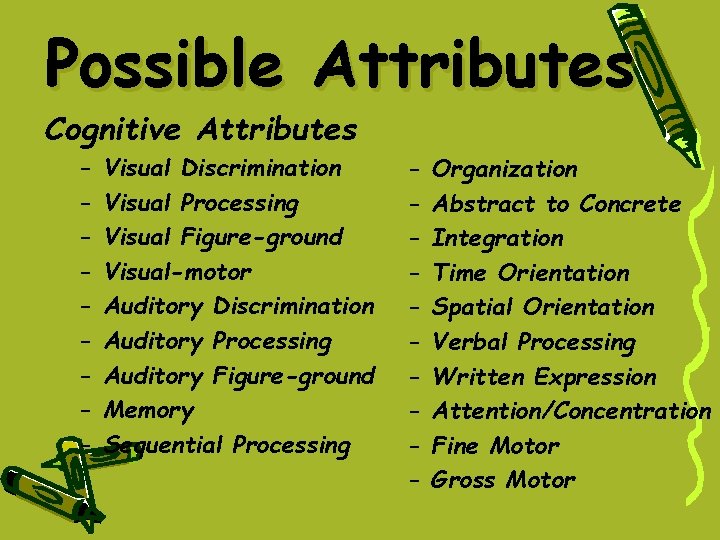
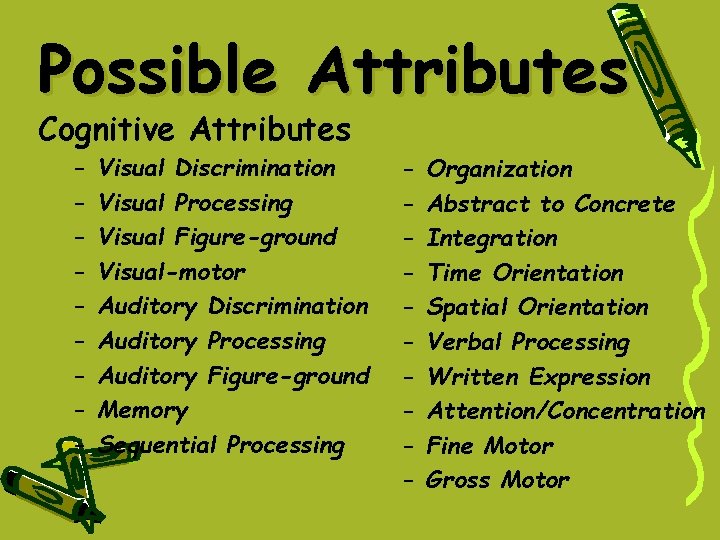
Possible Attributes Cognitive Attributes – – – – – Visual Discrimination Visual Processing Visual Figure-ground Visual-motor Auditory Discrimination Auditory Processing Auditory Figure-ground Memory Sequential Processing – – – – – Organization Abstract to Concrete Integration Time Orientation Spatial Orientation Verbal Processing Written Expression Attention/Concentration Fine Motor Gross Motor
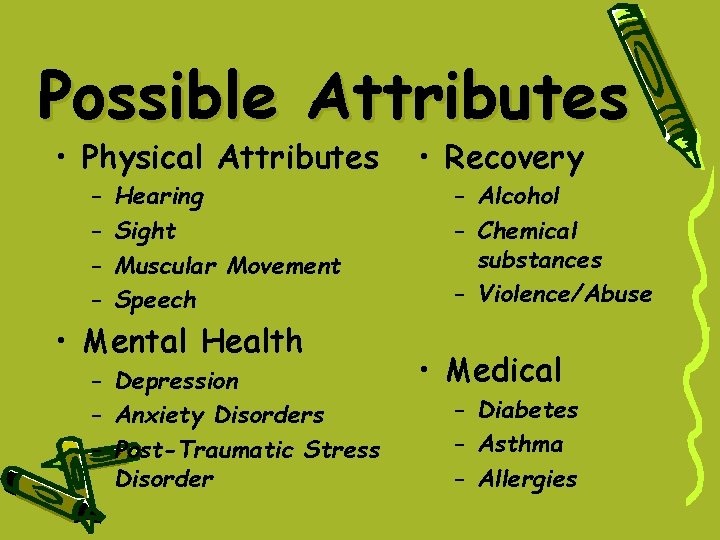
Possible Attributes • Physical Attributes – – Hearing Sight Muscular Movement Speech • Mental Health – Depression – Anxiety Disorders – Post-Traumatic Stress Disorder • Recovery – Alcohol – Chemical substances – Violence/Abuse • Medical – Diabetes – Asthma – Allergies
• • Cognitive Attributes of the Lesson: Steps in the Writing Process (4. 6. 4/5) Discrete Steps (Writing an Outline): 1. Brainstorm Concrete 2. Clump 3. Discard 4. Order 5. Evaluate Visual Processing, Abstract to Written Expression Integration & Organization Visual Processing, Visual Figure-ground Visual Processing Attention & Concentration Visual Processing, Sequencing Memory Processing, Abstract-Concrete
COGNITIVE ANALYSIS PRACTICE • Identify the cognitive attributes of each step in the task analysis completed for: Filling out a form for enrollment (0. 2. 2)
Possible Attributes Cognitive Attributes – – – – – Visual Discrimination Visual Processing Visual Figure-ground Visual-motor Auditory Discrimination Auditory Processing Auditory Figure-ground Memory Sequential Processing – – – – – Organization Abstract to Concrete Integration Time Orientation Spatial Orientation Verbal Processing Written Expression Attention/Concentration Fine Motor Gross Motor
Lesson Analysis Complete • Get the form • Review – identify information needed • Gather information – emergency contact – last school attended, etc. • Fill out form – use a black pen – print legibly • Check for accuracy Visual/Visual-motor Visual Processing Abstract to Concrete Organization Visual Processing Attention/Concentration Visual Discrimination Visual Processing Visual-motor/Spatial Attention/Concentration
Accommodations • Change to Existing Environment, Structure or Protocol • Allows Alternatives to Compensate for Limitations Created by the Person’s Disability
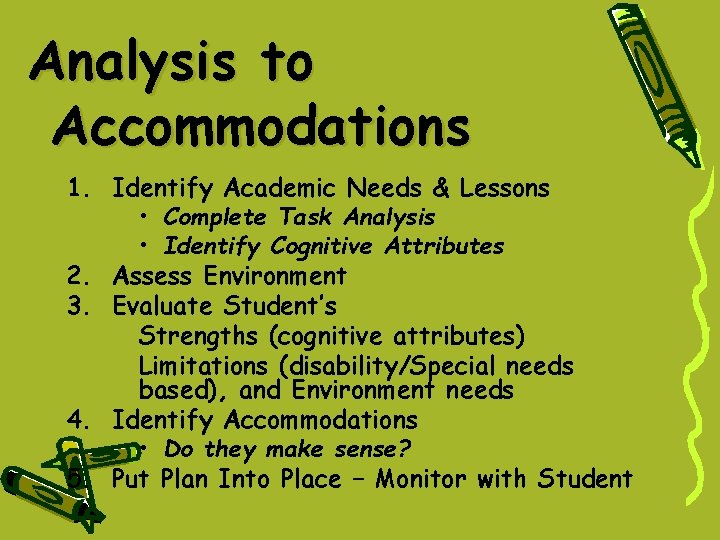
Analysis to Accommodations 1. Identify Academic Needs & Lessons • Complete Task Analysis • Identify Cognitive Attributes 2. Assess Environment 3. Evaluate Student’s Strengths (cognitive attributes) Limitations (disability/Special needs based), and Environment needs 4. Identify Accommodations • Do they make sense? 5. Put Plan Into Place – Monitor with Student
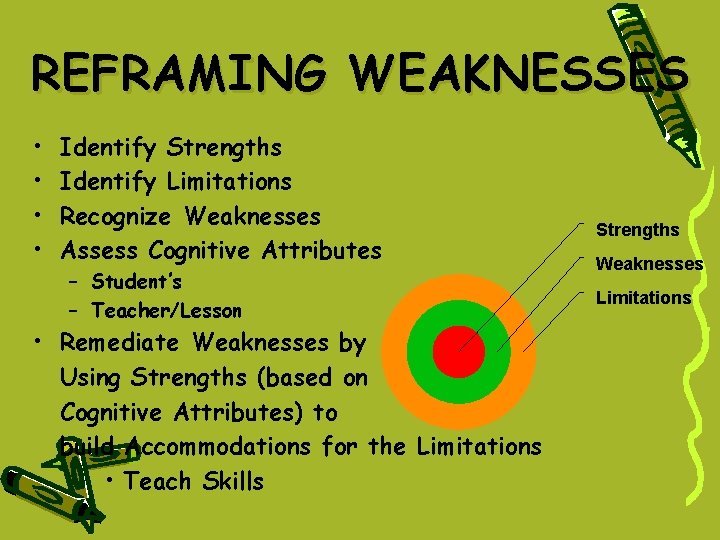
REFRAMING WEAKNESSES • • Identify Strengths Identify Limitations Recognize Weaknesses Assess Cognitive Attributes – Student’s – Teacher/Lesson • Remediate Weaknesses by Using Strengths (based on Cognitive Attributes) to build Accommodations for the Limitations • Teach Skills Strengths Weaknesses Limitations
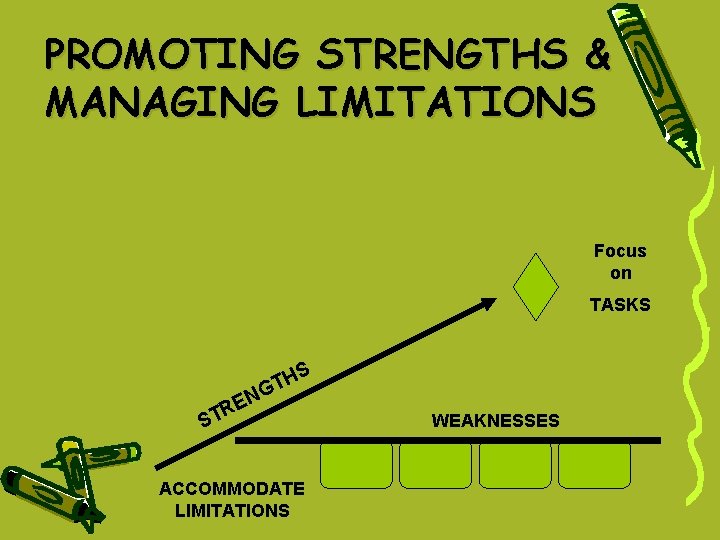
PROMOTING STRENGTHS & MANAGING LIMITATIONS Focus on TASKS S S E TR H GT N ACCOMMODATE LIMITATIONS WEAKNESSES
PROGRESSIVE MODEL Environment Strengths Physical/Cognitive Teaching Approach Limitations
Types of Instructional Approaches • Basic Skill Review • Content • Strategy Instruction
Strategy Instruction Model for Adults • • • Describe Model Self-Instruct Practice and Critique Implement (Learning Strategies for Adults Compensations for Learning Disabilities. Toronto: Wall & Emerson, Inc. )
Student-centered Approaches • Visual – – – – – Posters Movies/videos Interactive CD or video Non-glare paper Drawing (Icon based) Outlines Tinted/colored transparencies Large print Multi-color print Mental movie
Student-centered Approaches • Auditory – Talking word processors/calculators – Self-talk (who, what, where, when, and why) – E-Text – Debate/discussing – Role playing – Songs, Chants, and Alarms – Audio mind-movie
Student-centered Approaches • Tactile-Kinesthetic – – – – Keyboards (Alternative) Walking, rocking, pacing, and swinging Drama and acting Tracing patterns/shapes and/or letters Act out vocabulary Building Dancing
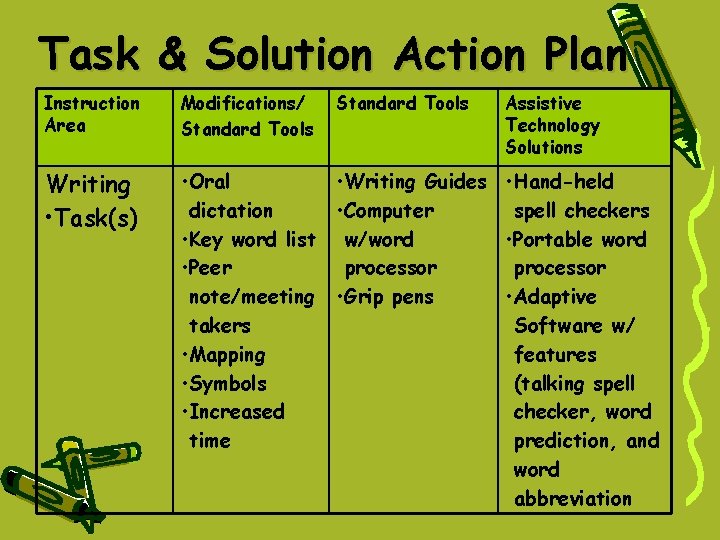
Task & Solution Action Plan Instruction Area Modifications/ Standard Tools Assistive Technology Solutions Writing • Task(s) • Oral • Writing Guides • Hand-held dictation • Computer spell checkers • Key word list w/word • Portable word • Peer processor note/meeting • Grip pens • Adaptive takers Software w/ • Mapping features • Symbols (talking spell • Increased checker, word time prediction, and word abbreviation
READING • • Lighting, Sound & Temperature Placement of Reading Materials Font, Size, & Back/Fore-ground Color Movement Highlighters Pictures/Symbols Screen Readers OCR Scanning Programs
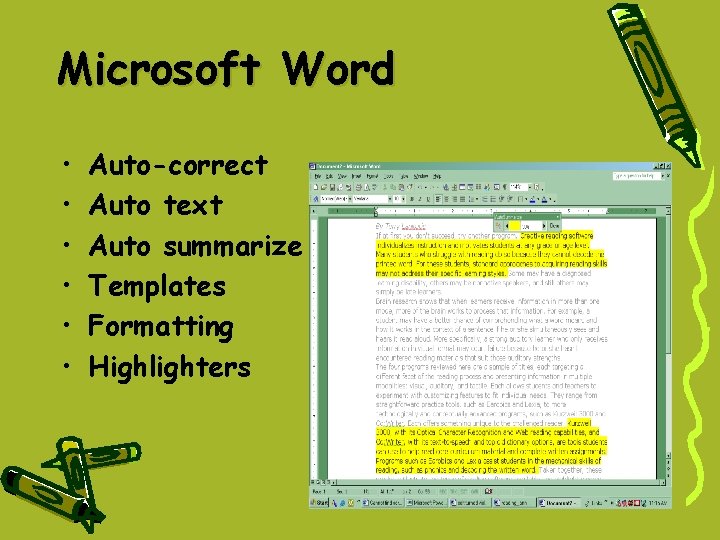
Microsoft Word • • • Auto-correct Auto text Auto summarize Templates Formatting Highlighters
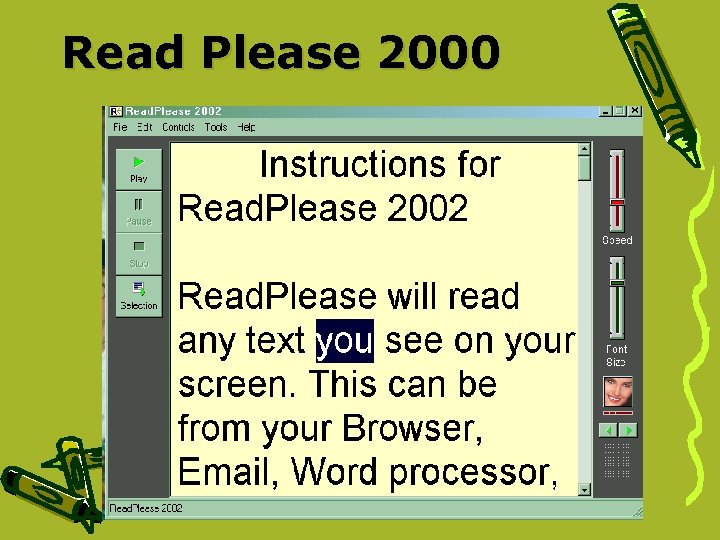
Read Please 2000
WRITING • • Environment & Ergonomic Sitting Posture Color, Graph & Lined Paper Graphic Organizers Small Sentences Talking Word Processors Word Abbreviation & Prediction Voice Recognition Systems Spelling on Screen Key-boards • Dictation
Electronic Text & Disabilities Issues Saving Money for the Regents • The estimated cost of using e-text is approximately $15. 00 per book, compared to a cost of $125. 00 per book using audio taping.
Read & Write www. texthelp. com • Tool for people with reading and writing difficulties • Word Prediction • Speaking Spell Checker • Homophone Support • Scanning • Scientific Calculator • Pronunciation Tutor • Voice Recognition
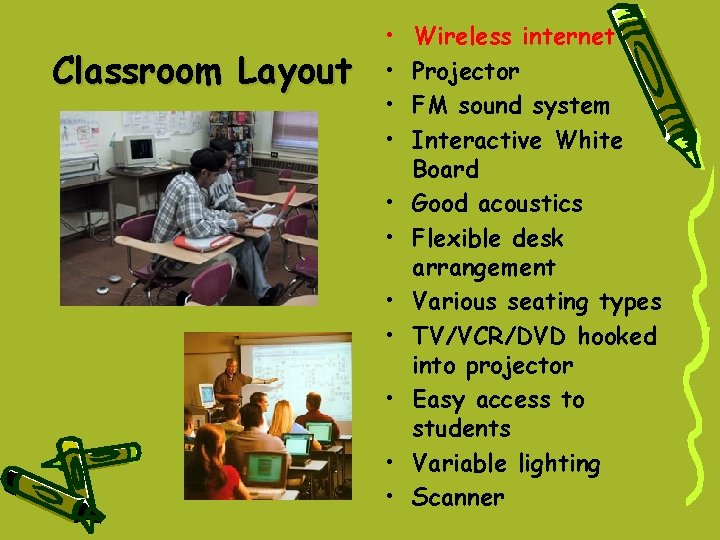
Classroom Layout • • • Wireless internet Projector FM sound system Interactive White Board Good acoustics Flexible desk arrangement Various seating types TV/VCR/DVD hooked into projector Easy access to students Variable lighting Scanner
General Educational Development (GED) • Accommodations – Audiocassette edition (tone indexed w/large -print reference copy & extra time) – Use of a scribe – Calculator – Supervised breaks – Private room – Other accommodations as warranted by candidate’s need
MONITORING IS CRITICAL • Completes needed learner information – Which learning characteristics work well – Rate & speed of learning – Controlling & adjusting the “flood” of “stuff” • Evaluating progress involves – Knowing learner’s understanding of process – Having learner talk through process as performing – Observing learner’s sophistication when performing – Ability to generalize and apply/implement in other settings
MONITORING • What are some ways you monitor learner progress & gains?
FEEDBACK • Essential to learner progress – Encourages mastery – Promotes ability & independence – Provide model for self-directed learning & monitoring – Is motivating – Builds confidence & self-esteem
FEEDBACK • Share some methods you use to give feedback to learners…
EFFECTIVE USE OF ASSESSMENT RESULTS IN INSTRUCTIONAL PRACTICES – Assess specific needs & strengths – Establish realistic, meaningful goals that build on each other – Break goals into achievable lessons & units – Analyze skills & tasks needed to accomplish each lesson & unit – Use & adjust learner-centered methods & approaches to instruction & learning – Apply accommodations where needed – Monitor progress and gains – Give feedback
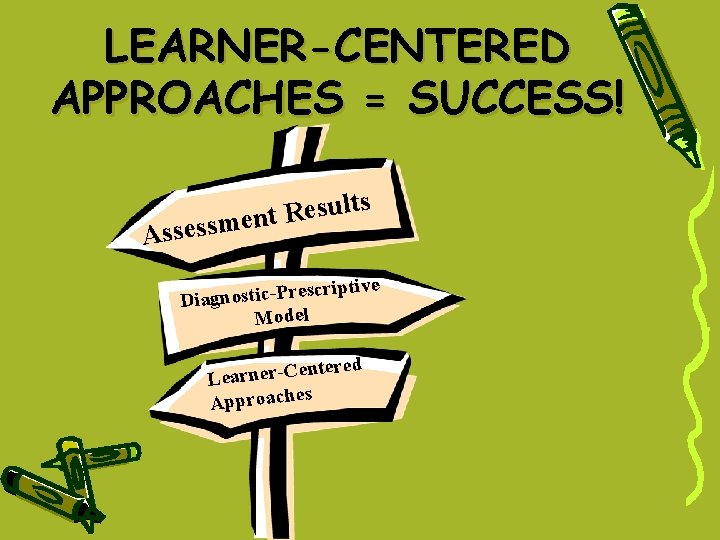
LEARNER-CENTERED APPROACHES = SUCCESS! s t l u s e R t n e m s s e Ass Diagnostic-Prescriptive Diagnostic Model tered n e C r e n r a Le Approaches