
Using Business Analytics to impact the claims process
Using Business Analytics to impact the claims process – recoveries, litigation and claims estimates Athens 2 nd November 2011 David Hartley, ACII Director of Insurance Solutions, SAS HQ Copyright © 2010 SAS Institute Inc. All rights reserved.
Agenda § Introduction § Recovery Optimization § Litigation Management § Claims Estimates § Other Areas § Conclusions and Next Steps 2 Copyright © 2010, SAS Institute Inc. All rights reserved.
Background – Pressure on Claims Departments § Insurers have over the last decade cut costs across the business – reducing number of staff, reducing agents commissions, outsourcing, increasing overall productivity etc. with an effort to reduce the Operating Costs § Recruiting and retaining experienced claims staff has become a serious issue globally § ‘Claims leakage’ has risen as a key issue that insurers need to address – board room discussions 3 Copyright © 2010, SAS Institute Inc. All rights reserved.
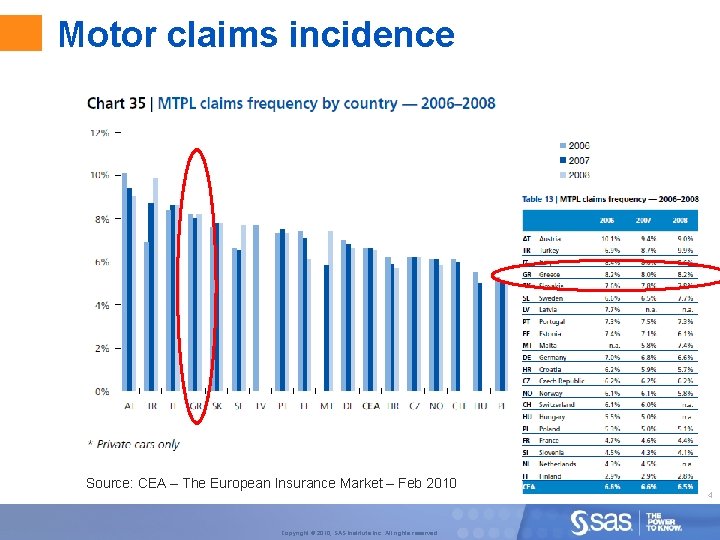
Motor claims incidence Source: CEA – The European Insurance Market – Feb 2010 Copyright © 2010, SAS Institute Inc. All rights reserved. 4

“FCCI Insurance Group anticipates a 1 to 1. 5 percentage point improvement in their combined ratio by using business analytics. ” 5 Copyright © 2010, SAS Institute Inc. All rights reserved.
Business Analytics § Complement existing processes (not replace) § Using historical data to ensure that no opportunities to more effectively manage claims leakage are missed § Can also significantly improve overall claims efficiency – ensuring that ‘Straight Through Processing’ can be applied to those claims which really warrant it Definition – Using existing data to predict the future outcome for an individual claim or claimant 6 Copyright © 2010, SAS Institute Inc. All rights reserved.
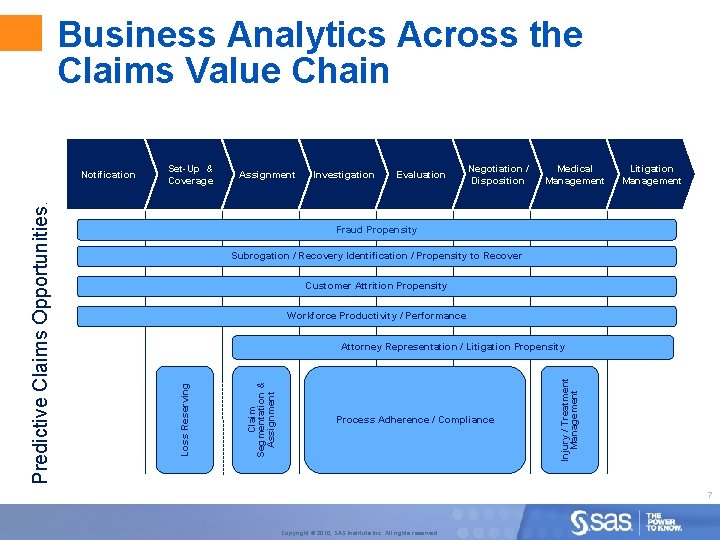
Business Analytics Across the Claims Value Chain Set-Up & Coverage Assignment Investigation Evaluation Negotiation / Disposition Medical Management Litigation Management Fraud Propensity Subrogation / Recovery Identification / Propensity to Recover Customer Attrition Propensity Workforce Productivity / Performance Process Adherence / Compliance Injury / Treatment Management Claim Segmentation & Assignment Attorney Representation / Litigation Propensity Loss Reserving Predictive Claims Opportunities. Notification 7 Copyright © 2010, SAS Institute Inc. All rights reserved.
Agenda § Introduction § Recovery Optimization § Litigation Management § Claims Estimates § Other Areas § Conclusions and Next Steps 8 Copyright © 2010, SAS Institute Inc. All rights reserved.
Industry Issue – Claims Recoveries § In many countries where there is the ability to ‘recover’ claims costs from another insurer then ensuring that no opportunities to recover are missed is a significant issue § Figures on claims recovery leakage are hard to come by § Will vary by country, insurer, LOB and claims handler § But global view suggests that it is in the order of 15+% 9 Copyright © 2010, SAS Institute Inc. All rights reserved.

Proposed Solution § Running predictive analytics alongside the insurers existing claims process will help reduce the number of claims that should have been recovered but weren't § The analytics can be fully integrated with the existing claims management system to make this seamless within the claims management operational system § High probability score = high likelihood of recovery § Low probability score = low chance of recovery and another insurer may look to recover from you 10 Copyright © 2010, SAS Institute Inc. All rights reserved.

Recovery Optimization Case Study § Major European P&C Insurer § Well established Recoveries Process § Deployed SAS analytics both at § FNOL § Retrospective (one off) § Recoveries at FNOL increased from 23% to 27% across total motor book (personal and commercial lines) § Analytics now an integrated part of their process 11 Copyright © 2010, SAS Institute Inc. All rights reserved.
Sample Business Case § € 500 m in motor claims net provision per annum § And that they are currently recovering at 23% § And that we can increase this to 27% § Then this would be worth in the region of an additional € 20 m per annum § In addition we will also provide a retrospective model that should allow you to go back over the last 2 years of claims history giving the potential for an additional € 40 m recovery 12 Copyright © 2010, SAS Institute Inc. All rights reserved.
SAS Solution for Recoveries § SAS predictive analytics § SAS intellectual property to build ‘starter’ § Recovery at FNOL Model § Retrospective Recovery Model § Implementation resources (SAS or partner) 13 Copyright © 2010, SAS Institute Inc. All rights reserved.
So what would this look like? § An analytical process running at FNOL to complement existing manual process § Run an analytical model overnight (batch process) which for each claim will output a score (from 0. 0 to 1. 0) indicating likelihood of being able to make a recovery § Agree threshold for recoveries § Include into existing process § And retrospective modelling as an initial additional win 14 Copyright © 2010, SAS Institute Inc. All rights reserved.
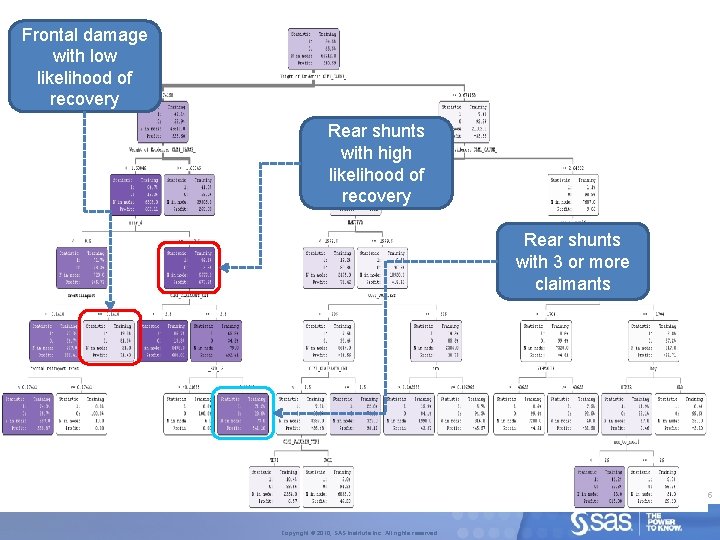
Frontal damage with low likelihood of recovery Rear shunts with high likelihood of recovery Rear shunts with 3 or more claimants 15 Copyright © 2010, SAS Institute Inc. All rights reserved.

Agenda § Introduction § Recovery Optimization § Litigation Management § Claims Estimates § Other Areas § Conclusions and Next Steps 16 Copyright © 2010, SAS Institute Inc. All rights reserved.
Industry Issue – Litigation Management § Globally claims are rising – often mainly because of the increase of litigation claims § Growing issue from ‘compensation culture’ in many countries “The desire of individuals to sue somebody, having suffered as a result of something which could have been avoided if the sued body had done their job properly. ” 17 Copyright © 2010, SAS Institute Inc. All rights reserved.

A global spread? 18 Copyright © 2010, SAS Institute Inc. All rights reserved.

PI Motor claims cost are rising……. Av Claims Payment £ Claims Inflation 2007 -8 Bodily Injury 3, 512 16. 2% Theft 1, 981 -7. 8% Prop damage 1, 588 9. 9% Accidental Damage 1, 388 -2. 5% Windscreen Only 129 2. 0% Total 2, 182 Source: Association of British Insurers Source: CEA – The European Insurance Market – Feb 2010 19 Copyright © 2010, SAS Institute Inc. All rights reserved.
Using Business Analytics § Analytics can help determine which claims are likely to result in litigation early within the claims process – even at FNOL § This allows the assignment of such claims to more senior claims handlers § And can allows more speedy resolution § Significantly reducing overall cost of such claims 20 Copyright © 2010, SAS Institute Inc. All rights reserved.
Agenda § Introduction § Recovery Optimization § Litigation Management § Claims Estimates § Other Areas § Conclusions Next Steps 21 Copyright © 2010, SAS Institute Inc. All rights reserved.
Industry Issue – Claims Estimates § Many insurers are very inaccurate at estimating the claims loss reserve both at FNOL and subsequently in the process as they move to settlement § This can often be a manual process and poorly managed § Provides inaccurate estimates of open claims reserves meaning significant revisions later in the process § Similar business analytics techniques can also be used to better estimate IBNR 22 Copyright © 2010, SAS Institute Inc. All rights reserved.

Claims Estimates § By comparing a loss with similar claims; and as more information comes in on the claim, analytics can automatically update the loss reserve through to eventual settlement. § Far more accurate – based on historic information projecting forward § Better reserving 23 Copyright © 2010, SAS Institute Inc. All rights reserved.
Agenda § Introduction § Recovery Optimization § Litigation Management § Claims Estimates § Other Areas § Conclusions and Next Steps 24 Copyright © 2010, SAS Institute Inc. All rights reserved.
Additional applications within claims § Fraud Detection and Prevention The SAS® Fraud Framework for Insurance is an industry leading analytical fraud detection suite presenting a unique hybrid of business rules, predictive analytics and social network analysis techniques to identify likely fraud. § Settlement Optimization Whilst ‘straight through processing’ is the norm for many insurers, settling a claim on the spot can be costly if an insurer overpays, so by using analytics an insurer can optimize the limits for instant payouts. 25 Copyright © 2010, SAS Institute Inc. All rights reserved.
Additional applications within claims § Contribution Optimization By using analytics, insurers can identify claims where there is a potential additional insurance contract covering the same loss – allowing for the insurer to agree a contribution from this other policy provider. § Activity Optimization Experience claims handlers are much in demand by every insurer. Claims are usually assigned to an adjuster at FNOL using business rules based on limited data. This unscientific approach often results in high reassignment rates that affect loss adjustment expenses, claim duration, settlement amount and the customer claims experience. Using analytics , claims can be scored, prioritized and assigned to the most appropriate adjuster based on experience and loss type. 26 Copyright © 2010, SAS Institute Inc. All rights reserved.
Agenda § Introduction § Recovery Optimization § Litigation Management § Claims Estimates § Other Areas § Conclusions and Next Steps 27 Copyright © 2010, SAS Institute Inc. All rights reserved.
Key Benefits § Enhance (or optimise) existing claims management system and processes NOT replace it § Used on both personal and commercial lines § Add an automated process to existing manual ensuring that few opportunities to reduce claims leakage are missed § Models can be enhanced and updated as required § Significant positive ROI – direct impact onto Combined Ratio 28 Copyright © 2010, SAS Institute Inc. All rights reserved.
Next Steps? Arrange a workshop to § Review applicability to your company § Examine which techniques would make sense to start work with § Outline high level business case § Explore potential roadmap 29 Copyright © 2010, SAS Institute Inc. All rights reserved.

Copyright © 2010 SAS Institute Inc. All rights reserved.
- Slides: 30