
Using Battery Modeling as a Sizing Tool IEEE
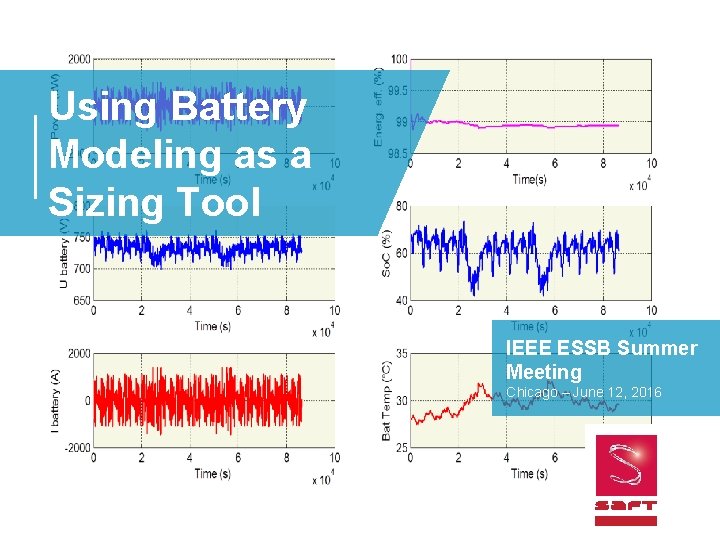
Using Battery Modeling as a Sizing Tool IEEE ESSB Summer Meeting Chicago – June 12, 2016
IEEE battery sizing – Sizing standards • IEEE Std 485 -2010 for vented and valve-regulated lead-acid • IEEE Std 1115 -2014 for nickel-cadmium – Both use modified Hoxie method • Hoxie, E. A. , “Some discharge characteristics of lead-acid batteries, ” AIEE Transactions (Applications and Industry), vol. 73, no. 1, pp. 17 – 22, Mar. 1954. • Divide duty cycle into successive periods with constant load • Size by section with progressively more periods 2 o Section 1 with first period only o Section 2 with first two periods o Etc. Using Battery Modeling as a Sizing Tool

IEEE cell sizing worksheet (IEEE 1115) 3 Using Battery Modeling as a Sizing Tool
Limitations for the IEEE method – Cumbersome for numerous load steps – No consideration for temperature changes during operation • Ambient changes during prolonged duty cycles • I 2 R heating effects – No consideration for ramping loads – No consideration (yet) for new technologies 4 Using Battery Modeling as a Sizing Tool
Battery modeling – an alternative approach – Various platforms depending on need. Examples: – COMSOL Multiphysics • ‘Micro’ modeling e. g. electronic & ionic charge transfer • Useful for cell design – Matlab-Simulink • ‘Macro’ modeling of electrical and thermal characteristics • Scalable to battery level for interactions with dc system • Models for advanced technologies may include battery-management algorithms 5 Using Battery Modeling as a Sizing Tool

Saft Li-ion Matlab-Simulink models – Models run same algorithms as battery management systems – Exactly mimic real battery behavior, including contactor management – Include aging inputs and outputs 6 Using Battery Modeling as a Sizing Tool
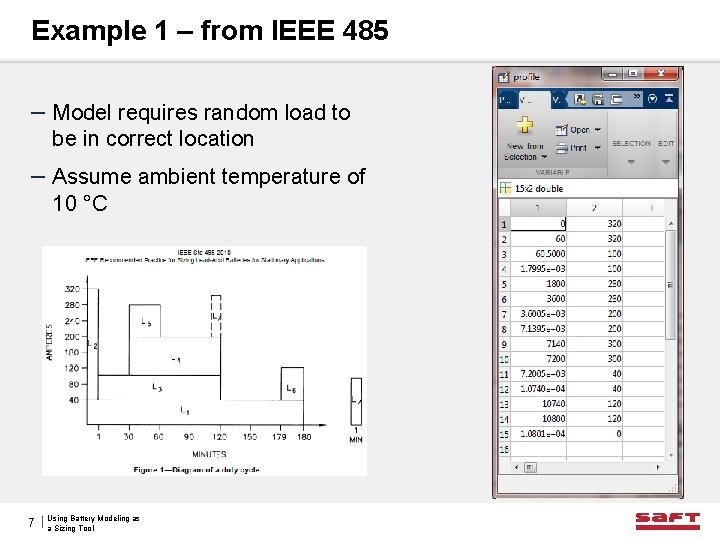
Example 1 – from IEEE 485 – Model requires random load to be in correct location – Assume ambient temperature of 10 °C 7 Using Battery Modeling as a Sizing Tool
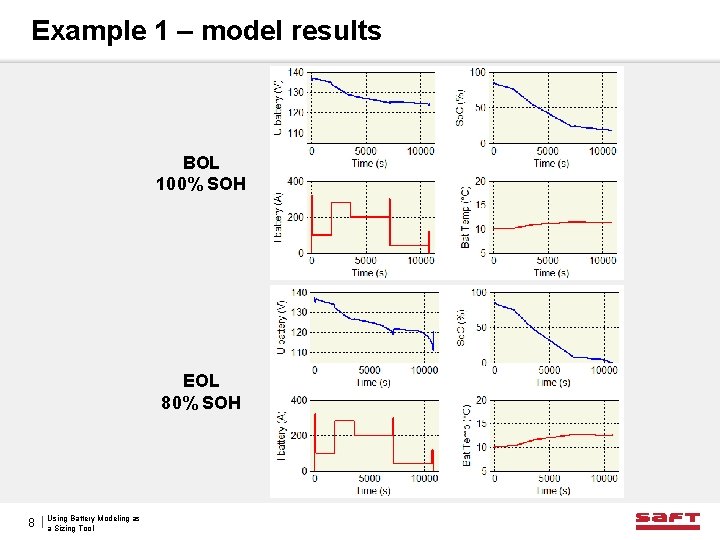
Example 1 – model results BOL 100% SOH EOL 80% SOH 8 Using Battery Modeling as a Sizing Tool
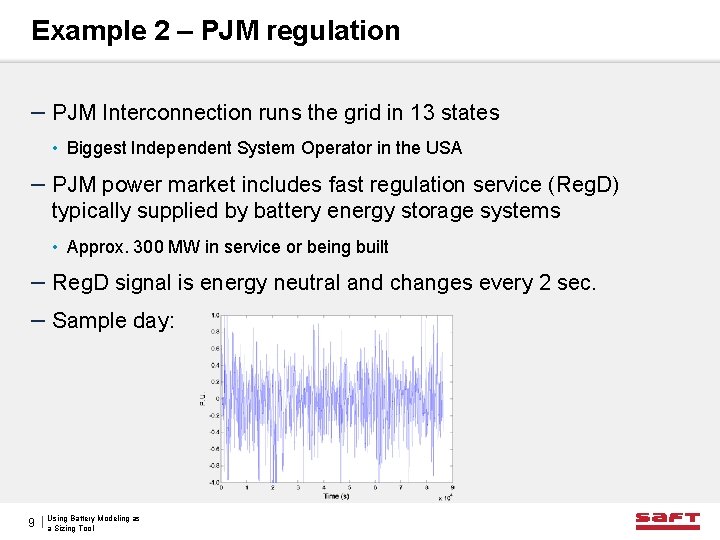
Example 2 – PJM regulation – PJM Interconnection runs the grid in 13 states • Biggest Independent System Operator in the USA – PJM power market includes fast regulation service (Reg. D) typically supplied by battery energy storage systems • Approx. 300 MW in service or being built – Reg. D signal is energy neutral and changes every 2 sec. – Sample day: 9 Using Battery Modeling as a Sizing Tool
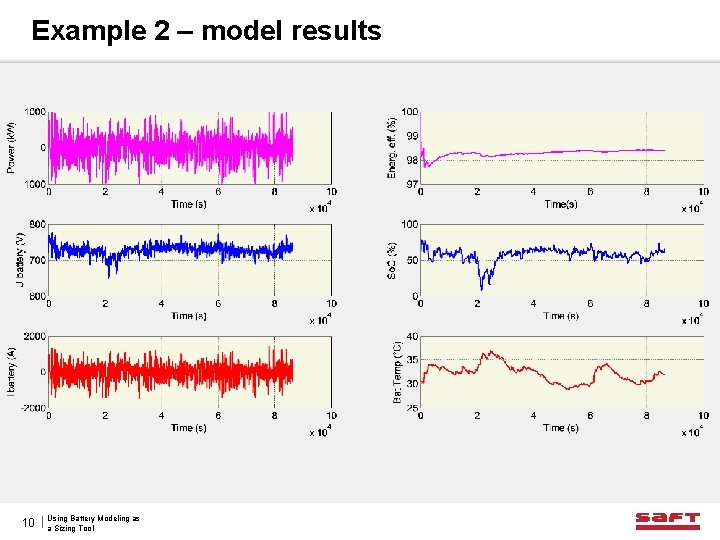
Example 2 – model results 10 Using Battery Modeling as a Sizing Tool
So is modeling the future of battery sizing? – For Saft, the answer is ‘yes’ • But not every battery manufacturer has a model • Most are less sophisticated – Tabular discharge data does not exist for Saft Li-ion cells • The model is the source of all performance characteristics 11 Using Battery Modeling as a Sizing Tool
Where do we go with sizing standards? – The IEEE sizing standards have their origins in the time before computer-driven modeling • Needed to avoid use of different sizing methods for the same project • Continue to be vital for the nuclear industry – Why do we need sizing standards if models exist? – Is validation an issue? • How is ‘trust the model’ different from ‘trust the tabular discharge data’? – Food for thought… 12 Using Battery Modeling as a Sizing Tool
Questions? Thoughts? jim. mcdowall@saftbatteries. com 13 Using Battery Modeling as a Sizing Tool
‘Bonus’ material – cycle counting – Question • How many cycles? • …of what depth? – Answers are important for folks who want to compare cycle count with published cycle-life curves – The following slides show the Saft method • Others may follow a slightly different approach 14 Using Battery Modeling as a Sizing Tool
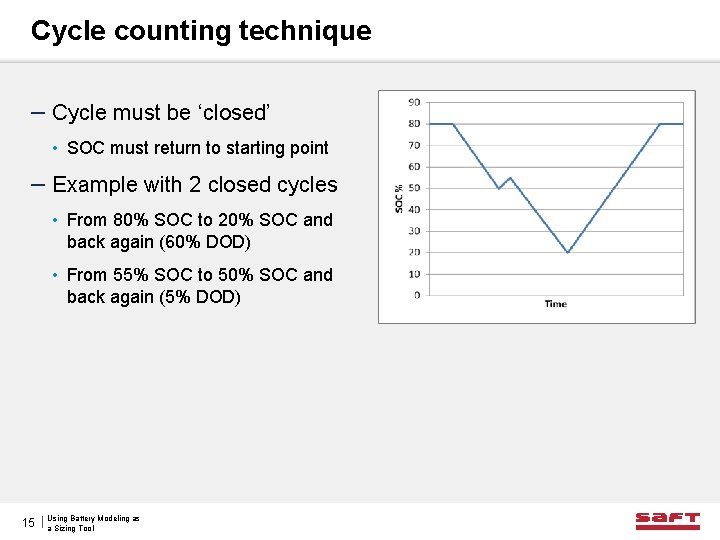
Cycle counting technique – Cycle must be ‘closed’ • SOC must return to starting point – Example with 2 closed cycles • From 80% SOC to 20% SOC and back again (60% DOD) • From 55% SOC to 50% SOC and back again (5% DOD) 15 Using Battery Modeling as a Sizing Tool
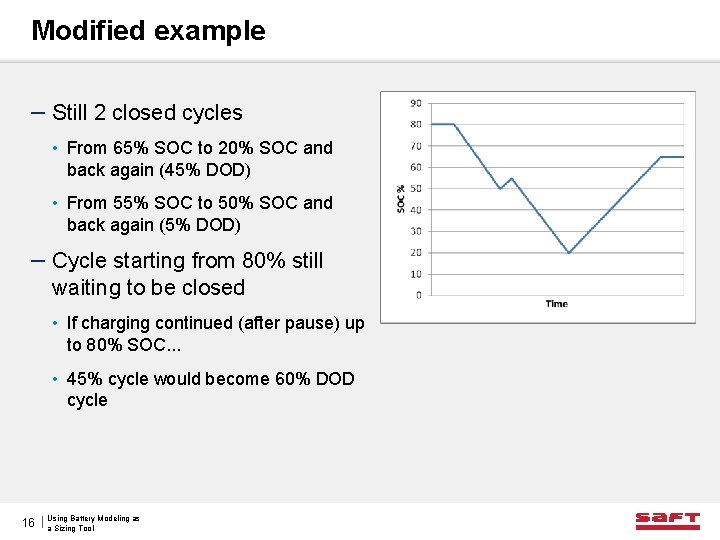
Modified example – Still 2 closed cycles • From 65% SOC to 20% SOC and back again (45% DOD) • From 55% SOC to 50% SOC and back again (5% DOD) – Cycle starting from 80% still waiting to be closed • If charging continued (after pause) up to 80% SOC. . . • 45% cycle would become 60% DOD cycle 16 Using Battery Modeling as a Sizing Tool
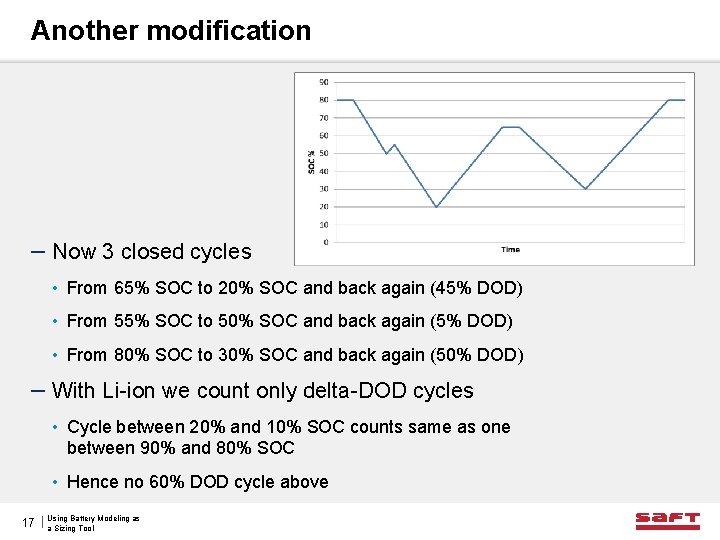
Another modification – Now 3 closed cycles • From 65% SOC to 20% SOC and back again (45% DOD) • From 55% SOC to 50% SOC and back again (5% DOD) • From 80% SOC to 30% SOC and back again (50% DOD) – With Li-ion we count only delta-DOD cycles • Cycle between 20% and 10% SOC counts same as one between 90% and 80% SOC • Hence no 60% DOD cycle above 17 Using Battery Modeling as a Sizing Tool
- Slides: 17