
Using Authentic Materials to Design Classroom Activities CLIC



- Slides: 18
Using Authentic Materials to Design Classroom Activities CLIC Summer Workshop for L 2 Teachers August 12 13, 2016 Aymara Boggiano
Outline Authentic Materials • Concept – Types Selecting & Preparing Authentic Materials • Distinguishing Scripted From Unscripted Materials • Retake on Authentic Materials: Corpora • Preparing Materials Using Authentic Materials to create classroom activities • 3 Examples 2
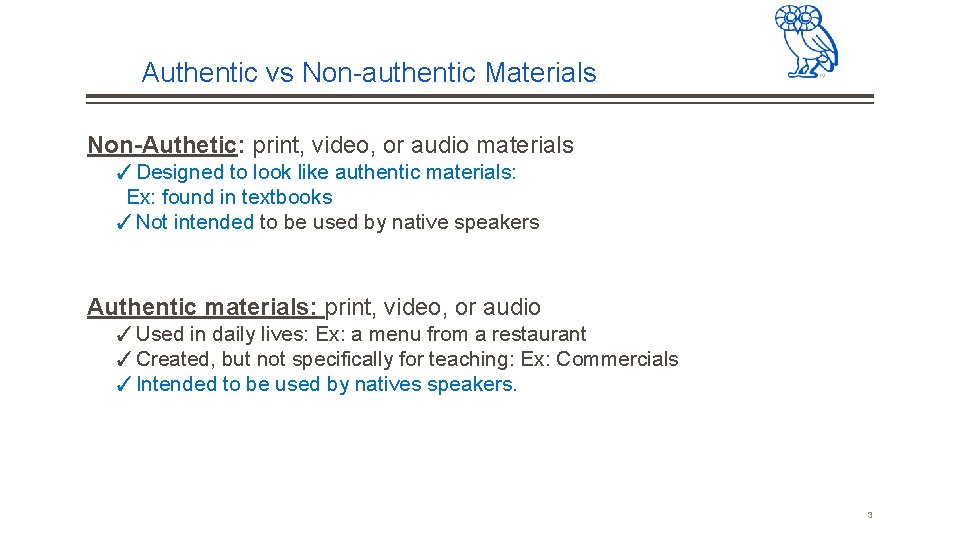
Authentic vs Non authentic Materials Non-Authetic: print, video, or audio materials ✓Designed to look like authentic materials: Ex: found in textbooks ✓Not intended to be used by native speakers Authentic materials: print, video, or audio ✓Used in daily lives: Ex: a menu from a restaurant ✓Created, but not specifically for teaching: Ex: Commercials ✓Intended to be used by natives speakers. 3
Importance of using Authentic Materials ✓Exposes learner to same language as a native speaker ✓Gives learner opportunity to observe and analyze vocabulary, grammar, pragmatic and cultural aspects of the language. ✓ Gives authenticity to: ▪learner’s interpretation of language ▪tasks conducive to language learning ✓Offers immediate proof that the language is used for real life by real people. ✓Has a positive effect on student's motivation 4
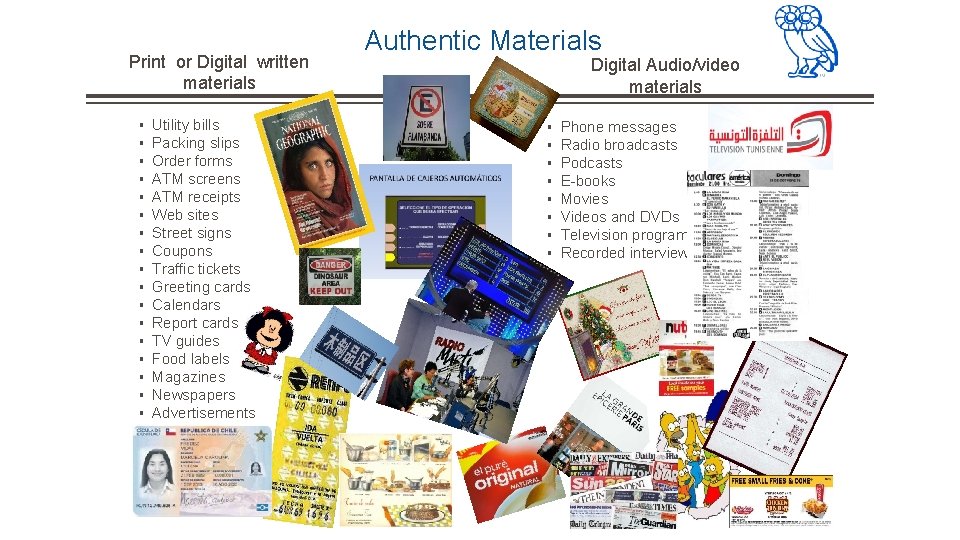
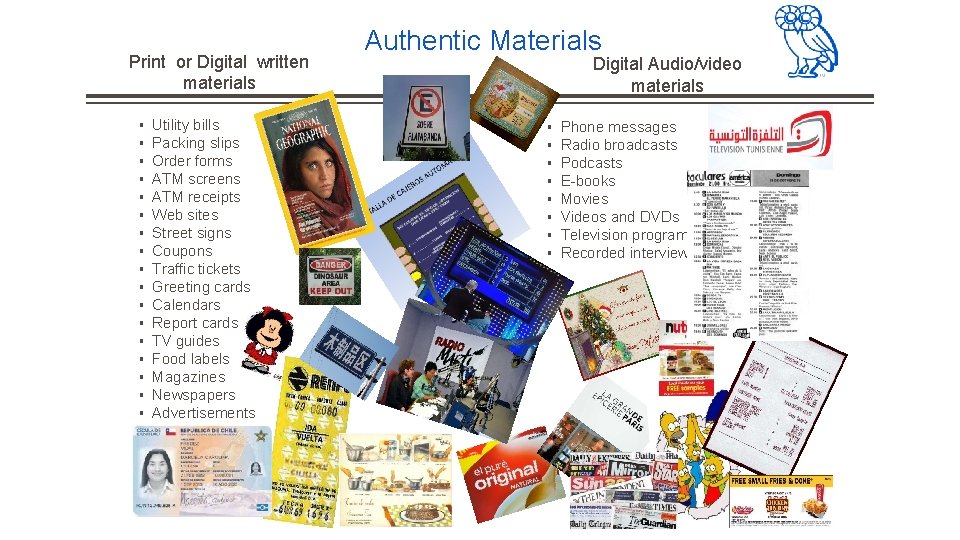
Print or Digital written materials ▪ ▪ ▪ ▪ ▪ Utility bills Packing slips Order forms ATM screens ATM receipts Web sites Street signs Coupons Traffic tickets Greeting cards Calendars Report cards TV guides Food labels Magazines Newspapers Advertisements Authentic Materials Digital Audio/video materials ▪ ▪ ▪ ▪ Phone messages Radio broadcasts Podcasts E books Movies Videos and DVDs Television programs Recorded interviews 5
Authentic Materials ▪ Have you ever collected these type of materials? ▪ Make a list of as many examples as you can that you have collected ▪ Write a check mark next to the ones you have actually used in a lesson plan ▪ Share the information with a partner Use Handout 1 6
On our list of Authentic Materials, are there any that can be used to teach Communicative Practices? Use Handout 1 7
Print or Digital written materials ▪ ▪ ▪ ▪ ▪ Utility bills Packing slips Order forms ATM screens ATM receipts Web sites Street signs Coupons Traffic tickets Greeting cards Calendars Report cards TV guides Food labels Magazines Newspapers Advertisements Authentic Materials Digital Audio/video materials ▪ ▪ ▪ ▪ Phone messages Radio broadcasts Podcasts E books Movies Videos and DVDs Television programs Recorded interviews 8
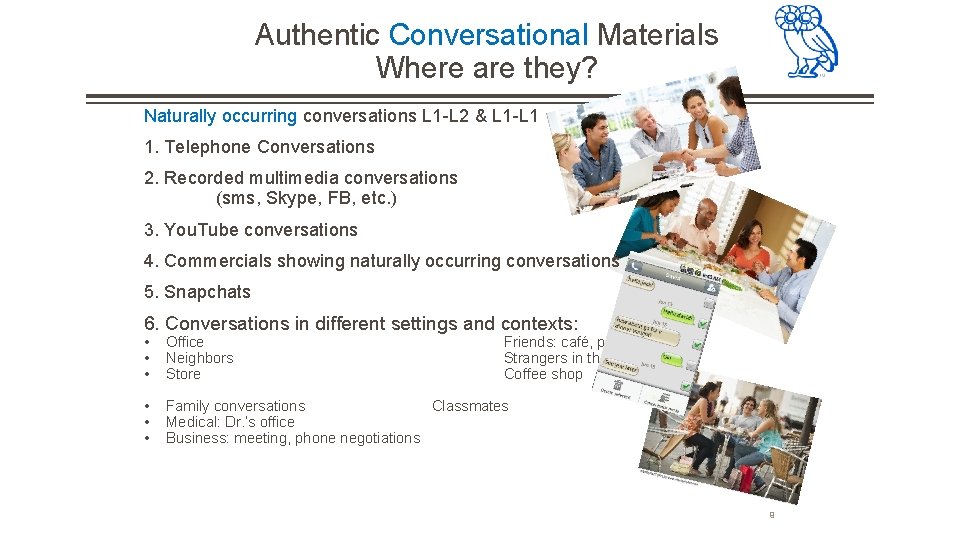
Authentic Conversational Materials Where are they? Naturally occurring conversations L 1 L 2 & L 1 1. Telephone Conversations 2. Recorded multimedia conversations (sms, Skype, FB, etc. ) 3. You. Tube conversations 4. Commercials showing naturally occurring conversations 5. Snapchats 6. Conversations in different settings and contexts: • • • Office Neighbors Store • • • Family conversations Classmates Medical: Dr. ’s office Business: meeting, phone negotiations Friends: café, party Strangers in the street Coffee shop 9
Scripted and Unscripted Conversation Would you say these conversations are scripted or unscripted? • Conversation 1: Meeting • Conversation 2: Two college friends • Conversation 3 Travel Agency • Conversation 4 Two Friends Use Handout 1 10
What is wrong? ▪ Which one would you eliminate? ▪ Which one would you keep? Why? ▪ Natural/Unnatural ▪ Fluency/speed of delivery ▪ Ennunciation ▪ Accent ▪ Exchange of information without social interaction ▪ Affective component ▪ Interlocutors making connections ▪ Expressions of Interactivity: reactive tokens, particles Use Handout 11
Creating Authentic Conversational Materials to teach Communicative Practices ▪ Use the web: ▪ Commercials ▪ Real conversations – You. Tube Podcasts ▪ Snapchat ▪ TV programs – reality shows – game shows ▪ Collect your own Corpora of Video and/or Audio recordings of conversations ▪ Use materials from students assignments: (get permission) ▪ Recorded student’s conversations with native speakers ▪ Recorded Videoconferences with native speakers (New pen pal) ▪ Recorded conversations during study abroad programs (Naoko Osaki) ▪ Between friends or conversation partners abroad ▪ With families in home stays Problems? ▪ Use a Corpus: Collection of authentic language data (Handout 4) ▪ http: //clicmaterialsld. blogs. rice. edu/ 12
Using a Corpus ▪Corpus: Collection of authentic language data (Handout 4) ▪ http: //clicmaterialsld. blogs. rice. edu/ Conversations student w/ native speakers Conversation by native speakers Business recordings: Business meetings Student’s conversations with business executives Medical: Interviews with healthcare professionals Doctor patient mock interviews by native speakers Real Doctor Patient Conversations: 14 recorded in a local physician’s office 7 recorded in China 13
Preparing Conversational Materials for use in the classroom 1. Choose appropriate useful recordings 2. Choose a section that display the content to be learned (less is more) 3. Transcribe: a. Direct transcription (Vocab/Grammar/Syntax) b. One shows non verbal features using notations ▪ Useful notations: [ ] Overlapping turns Handout 2 Use ELAN (The language Archive) Software to reduce speed, pause a recording https: //tla. mpi. nl/tools/tla tools/elan/download/ 14
Using Authentic Materials Handout 2 A commercial from Venezuela: Mercantil Móvil Empresas Handout 2. 1 An Interview from Mexico: El Rol del abogado Handout 2. 2 A Documentary from Chile: Conversaciones en un Taxi 15
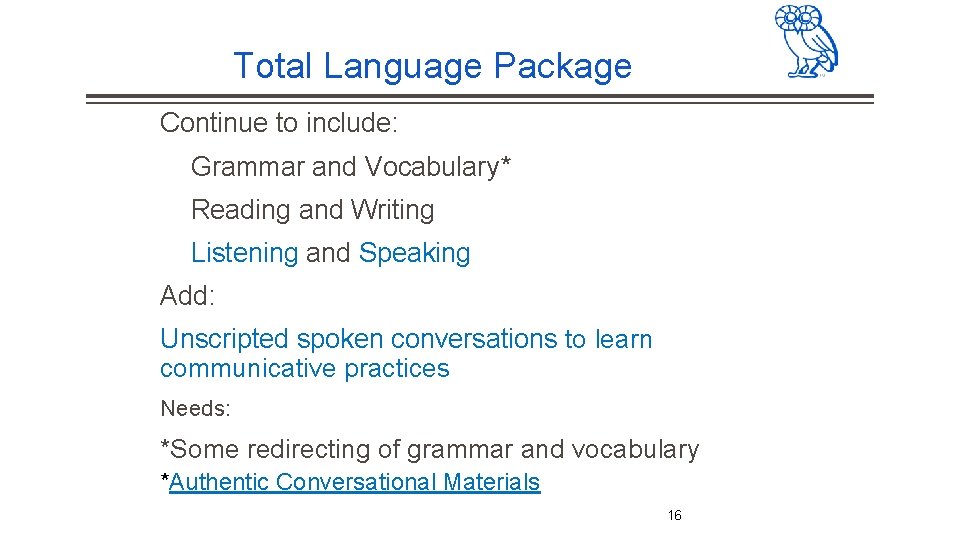
Total Language Package Continue to include: Grammar and Vocabulary* Reading and Writing Listening and Speaking Add: Unscripted spoken conversations to learn communicative practices Needs: *Some redirecting of grammar and vocabulary *Authentic Conversational Materials 16
Thank you! Any questions or comments aymara. boggiano@rice. edu
References BARRAJA ROHAN, A. M. (2011). “USING CONVERSATION ANALYSIS IN THE SECOND LANGUAGE CLASSROOM TO TEACH INTERACTIONAL COMPETENCE”. LANGUAGE TEACHING RESEARCH, 15(4), 479– 507. BETZ, E. , & HUTH, T. (2014). BEYOND GRAMMAR: TEACHING INTERACTIONAL IN THE GERMAN LANGUAGE CLASSROOM. DIE UNTERRICHTSPRAXIS/TEACHING GERMAN, 47, 140– 163. CESTERO, ANA M. (2005). CONVERSACIONES Y LA ENSEÑANZA DE LENGUAS EXTRANJERAS. MADRID: ARCO LIBROS 2. JACOBSON, E. , DEGENER, S. , & PURCELL GATES, V. (2003) CREATING AUTHENTIC MATERIALS AND ACTIVITIES FOR THE ADULT LITERACY CLASSROOM: A HANDBOOK FOR PRACTITIONERS. NCSALL TEACHING AND TRAINING MATERIALS. BOSTON, MA: NCSALL AT WORLD EDUCATION. 3. PURCELL GATES, V. , DEGENER, S. , JA COBSON, E. , & SOLER, M. (2001) TAKING LITERACY SKILLS HOME. FOCUS ON BASICS, 4 (D), 19 22 4. WRIGLEY, H. (2003). A CONVERSATION WITH FOB: WHAT WORKS FOR ESL STUDENTS FOCUS ON BASICS, 6 (C), 14 17 Berardo, Sacha (2006) Use of authentic materials in the teaching of reading. The Reading Matrix Vol. 6 No. 2