
Using Assessment Data to Enhance Learning Teaching Language






- Slides: 65
Using Assessment Data to Enhance Learning & Teaching Language Learning Support Section, EDB 22 nd Nov, 2007
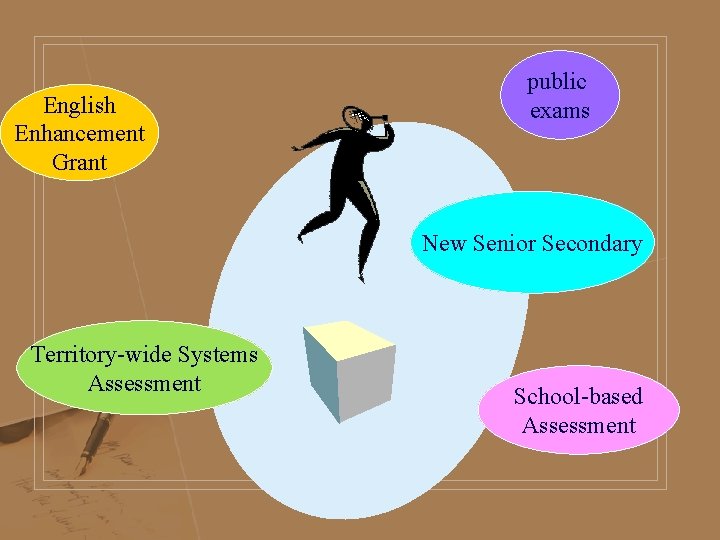
English Enhancement Grant public exams New Senior Secondary Territory-wide Systems Assessment School-based Assessment
There are so many of them. How can we deal with them all at the same time? Is there any relationship among them? How should we handle all these measures? Why do we have to do all these?
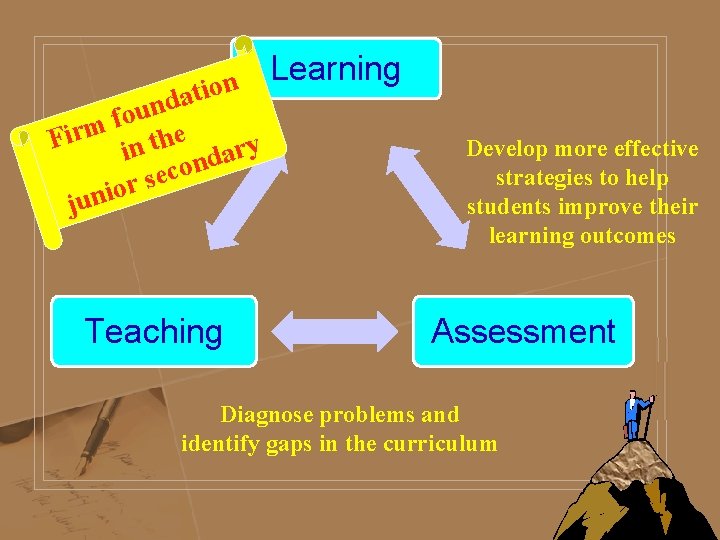
NSS firm foundation A S T Holistic view
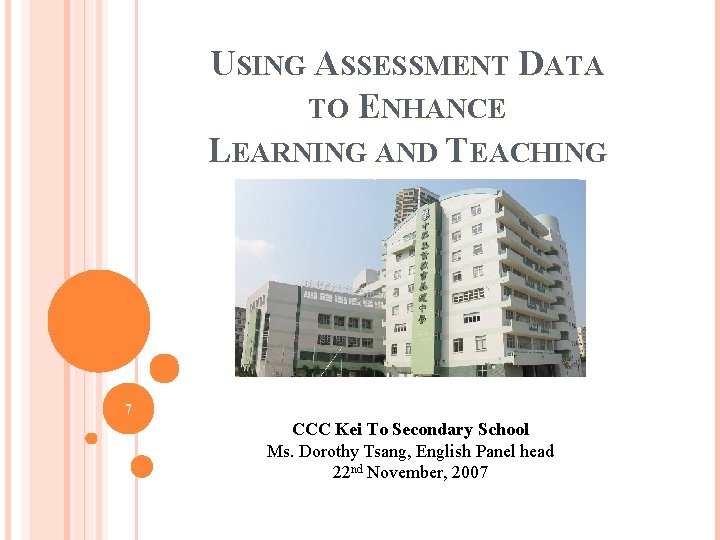
USING ASSESSMENT DATA TO ENHANCE LEARNING AND TEACHING 7 CCC Kei To Secondary School Ms. Dorothy Tsang, English Panel head 22 nd November, 2007
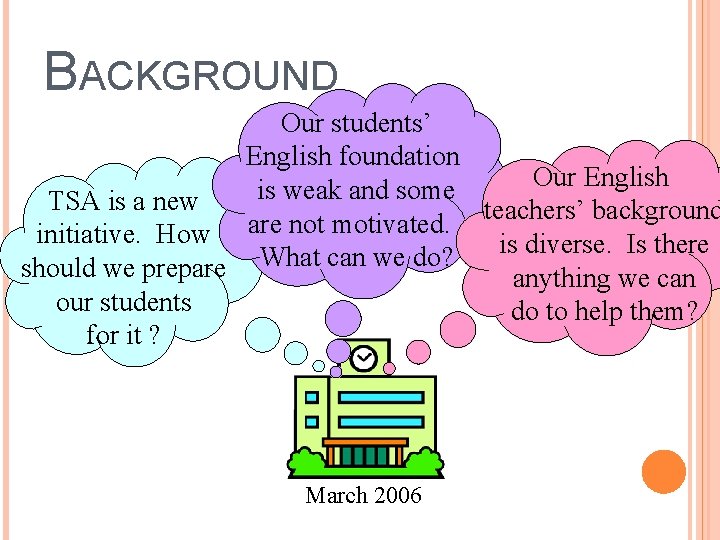
BACKGROUND Our students’ English foundation Our English is weak and some TSA is a new teachers’ background initiative. How are not motivated. is diverse. Is there What can we do? should we prepare anything we can our students do to help them? for it ? March 2006
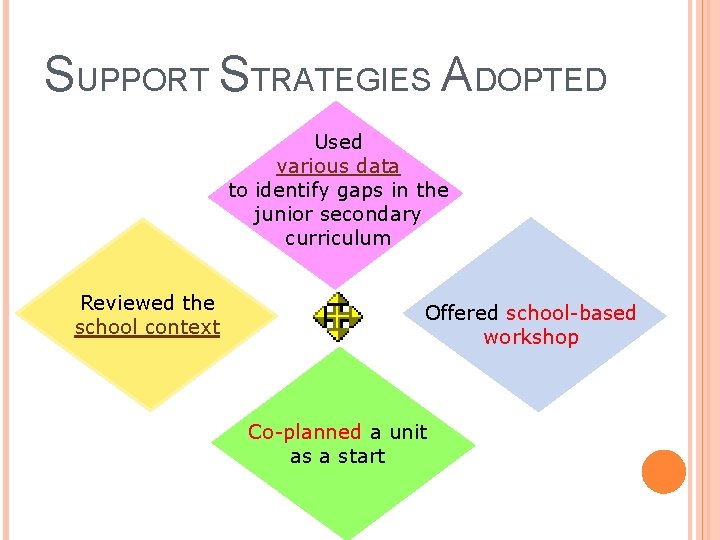
SUPPORT STRATEGIES ADOPTED Used various data to identify gaps in the junior secondary curriculum Reviewed the school context Offered school-based workshop Co-planned a unit as a start
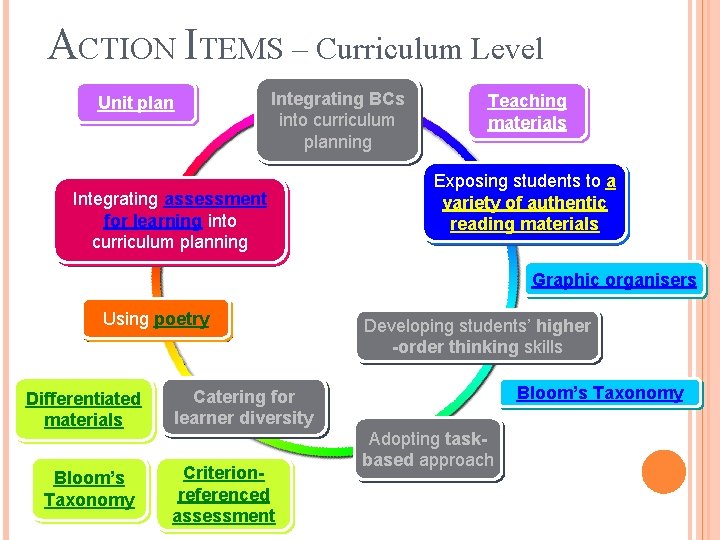
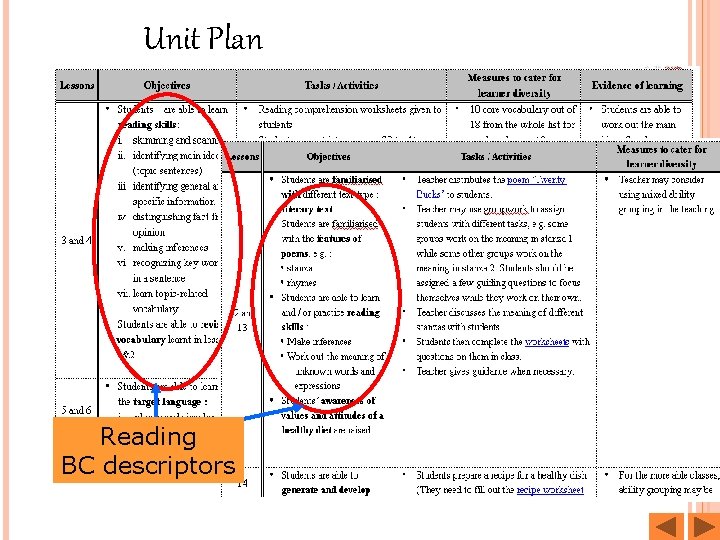
ACTION ITEMS – Curriculum Level Unit plan Integrating BCs into curriculum planning Integrating assessment for learning into curriculum planning Teaching materials Exposing students to a variety of authentic reading materials Graphic organisers Using poetry Differentiated materials Bloom’s Taxonomy Catering for learner diversity Criterionreferenced assessment Developing students’ higher -order thinking skills Bloom’s Taxonomy Adopting taskbased approach
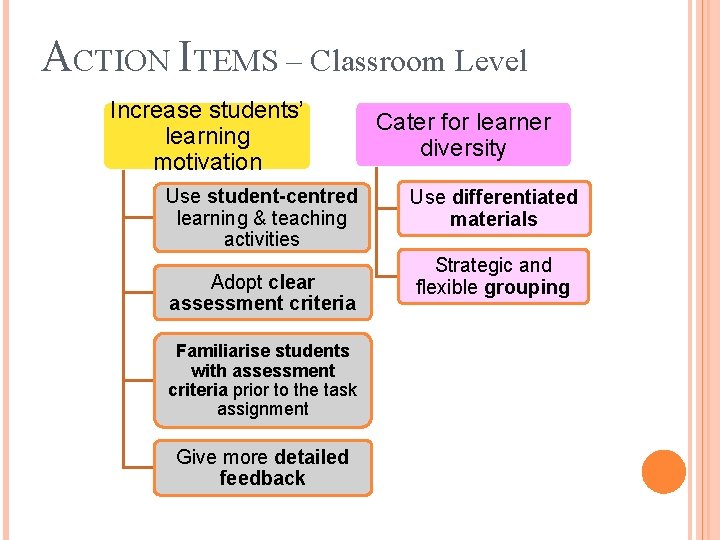
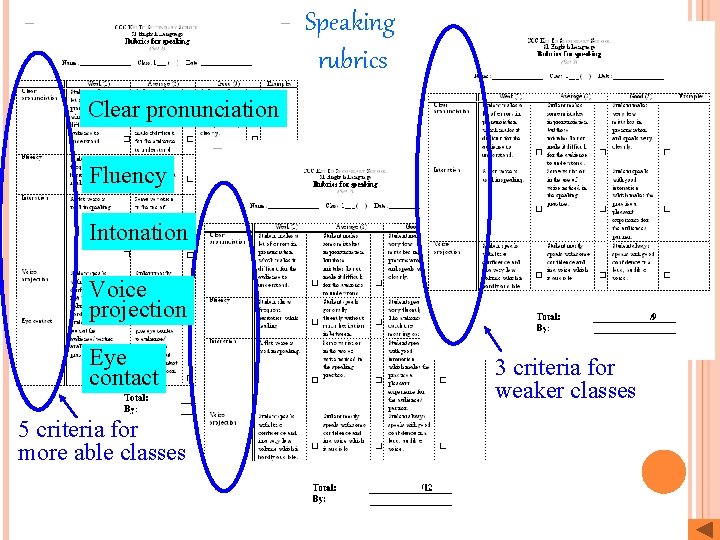
ACTION ITEMS – Classroom Level Increase students’ learning motivation Use student-centred learning & teaching activities Adopt clear assessment criteria Familiarise students with assessment criteria prior to the task assignment Give more detailed feedback Cater for learner diversity Use differentiated materials Strategic and flexible grouping
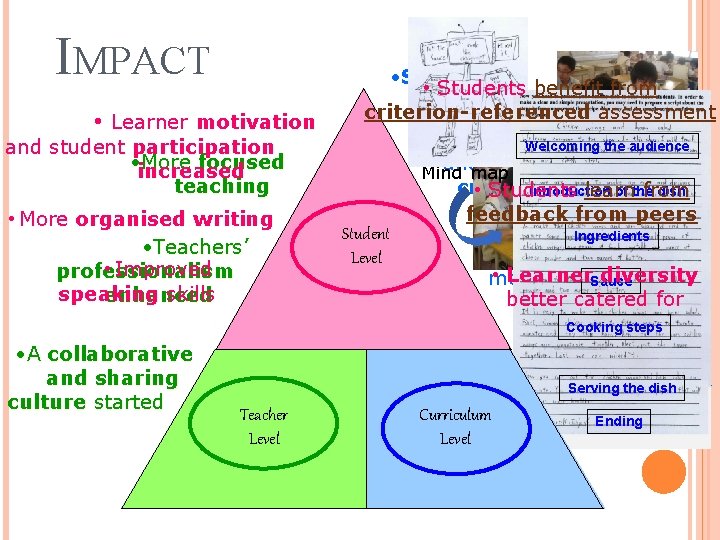
IMPACT • Learner motivation and student participation • increased More focused teaching • More organised writing • Teachers’ • Improved professionalism speaking skills enhanced • A collaborative and sharing culture started Teacher Level • Skill-based • Students benefit from curriculum criterion-referenced assessment • A more Welcoming balanced the audience and comprehensive Mind map curriculum Introduction of the dish • Students learn from feedback from peers • Learning, teaching Student Ingredients and assessment Level • Learner diversity more well-aligned Sauce better catered for • Heightened Cooking steps awareness in catering for Serving the dish learner diversity Curriculum at curriculum Ending Level level
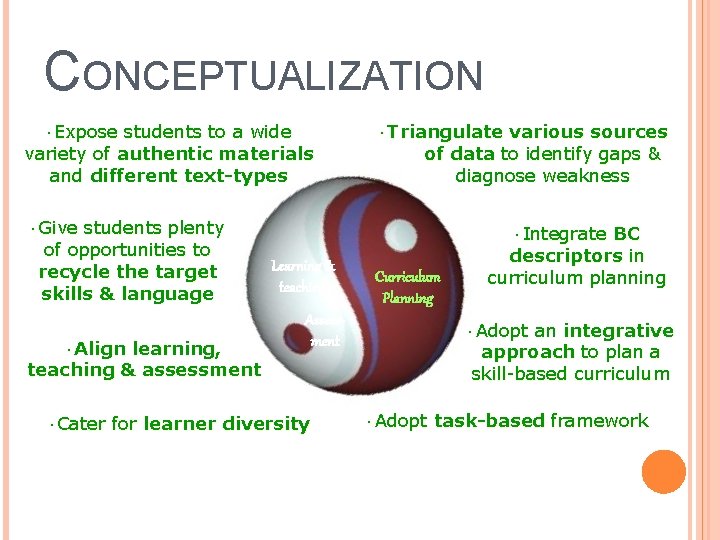
CONCEPTUALIZATION • Expose students to a wide variety of authentic materials and different text-types • Give students plenty of opportunities to recycle the target skills & language • Align learning, teaching & assessment Learning & teaching Assessment • Cater for learner diversity • Triangulate various sources of data to identify gaps & diagnose weakness Curriculum Planning • Integrate BC descriptors in curriculum planning • Adopt an integrative approach to plan a skill-based curriculum • Adopt task-based framework
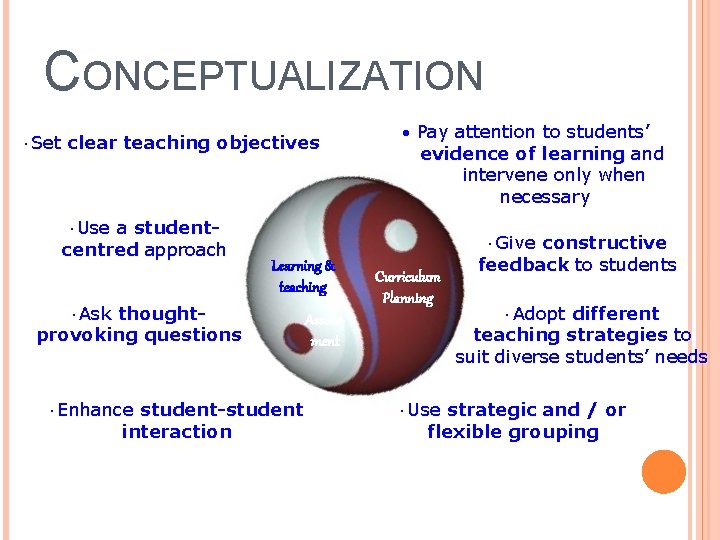
CONCEPTUALIZATION • Set clear teaching objectives • Use a studentcentred approach Learning & teaching • Ask thoughtprovoking questions • Enhance student-student interaction Assessment • Pay attention to students’ evidence of learning and intervene only when necessary Curriculum Planning • Give constructive feedback to students • Adopt different teaching strategies to suit diverse students’ needs • Use strategic and / or flexible grouping
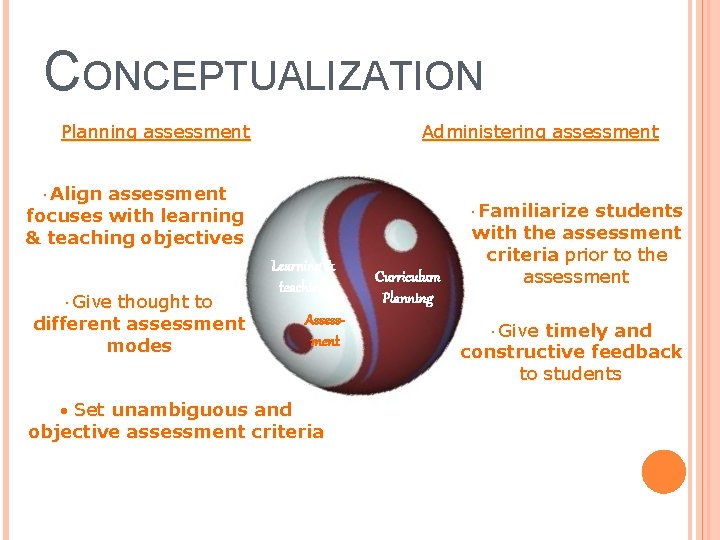
CONCEPTUALIZATION Administering assessment Planning assessment • Align assessment focuses with learning & teaching objectives • Give thought to different assessment modes Learning & teaching • Set unambiguous and Assessment objective assessment criteria Curriculum Planning • Familiarize students with the assessment criteria prior to the assessment • Give timely and constructive feedback to students
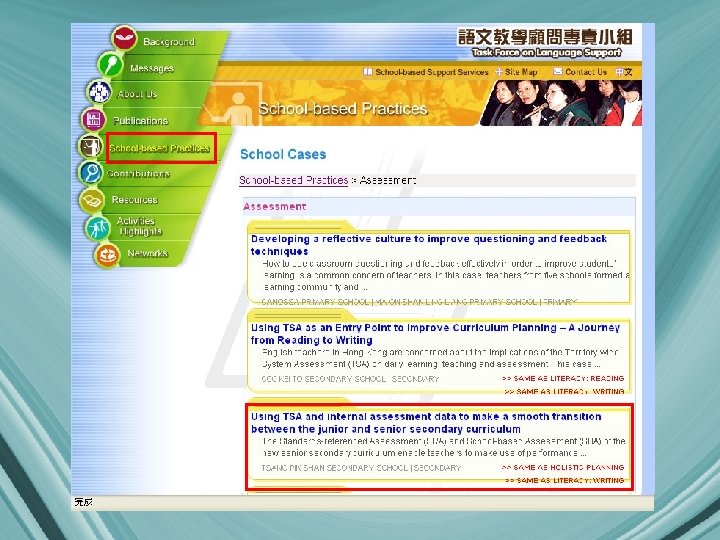
http: //cd 1. edb. hkedcity. net/cd/languagesupport/index. htm
Using TSA and internal assessment data to make a smooth transition between the junior and senior secondary curriculum LLSS
Background
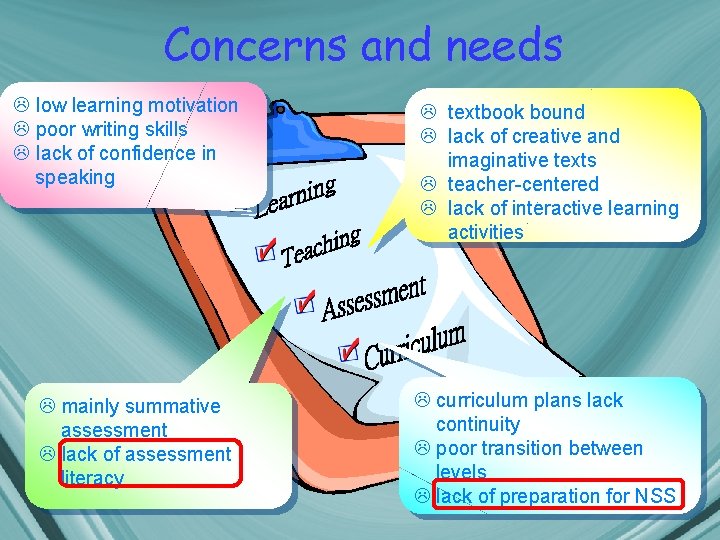
Concerns and needs L low learning motivation L poor writing skills L lack of confidence in speaking L mainly summative assessment L lack of assessment literacy L textbook bound L lack of creative and imaginative texts L teacher-centered L lack of interactive learning activities L curriculum plans lack continuity L poor transition between levels L lack of preparation for NSS
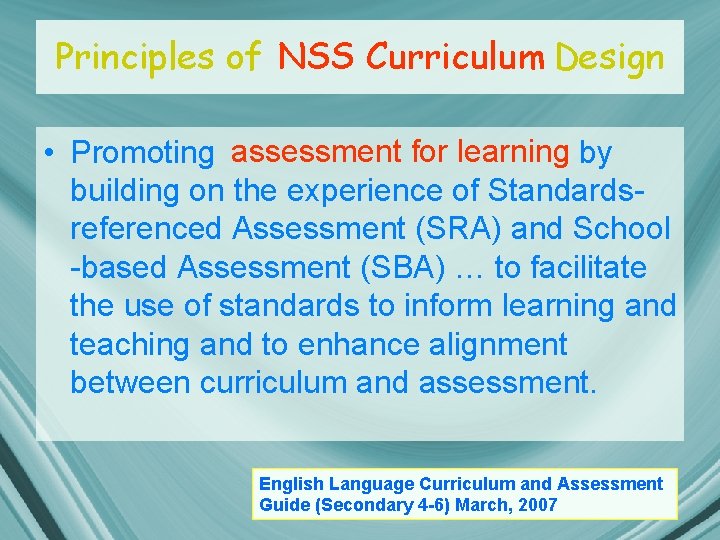
Principles of NSS Curriculum Design • Promoting assessment for learning by building on the experience of Standardsreferenced Assessment (SRA) and School -based Assessment (SBA) … to facilitate the use of standards to inform learning and teaching and to enhance alignment between curriculum and assessment. English Language Curriculum and Assessment Guide (Secondary 4 -6) March, 2007
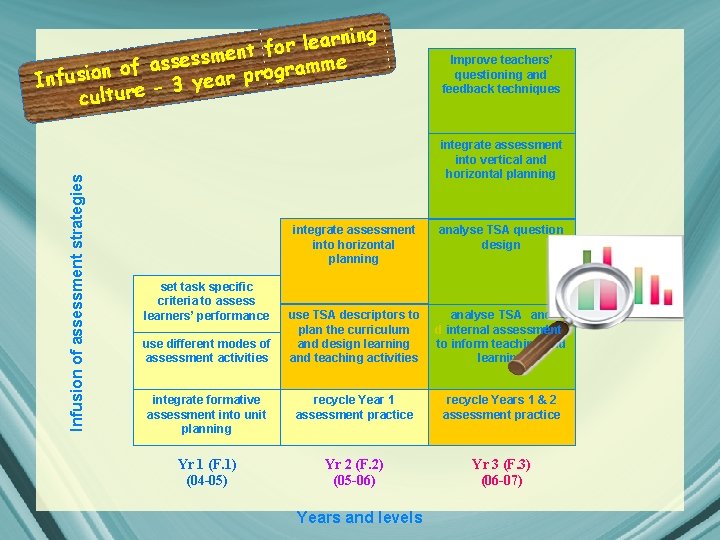
Infusion of assessment strategies arning e l r o f ment s s e s s a mme f a o r g n o o i r s p u Inf year 3 – e r cultu Improve teachers’ questioning and feedback techniques integrate assessment into vertical and horizontal planning integrate assessment into horizontal planning analyse TSA question design use TSA descriptors to plan the curriculum and design learning and teaching activities analyse TSA and d internal assessment data to inform teaching and learning integrate formative assessment into unit planning recycle Year 1 assessment practice recycle Years 1 & 2 assessment practice Yr 1 (F. 1) (04 -05) Yr 2 (F. 2) (05 -06) Yr 3 (F. 3) (06 -07) set task specific criteria to assess learners’ performance use different modes of assessment activities Years and levels
TSA data analysis Writing o t d a o r b c i f i c e p s
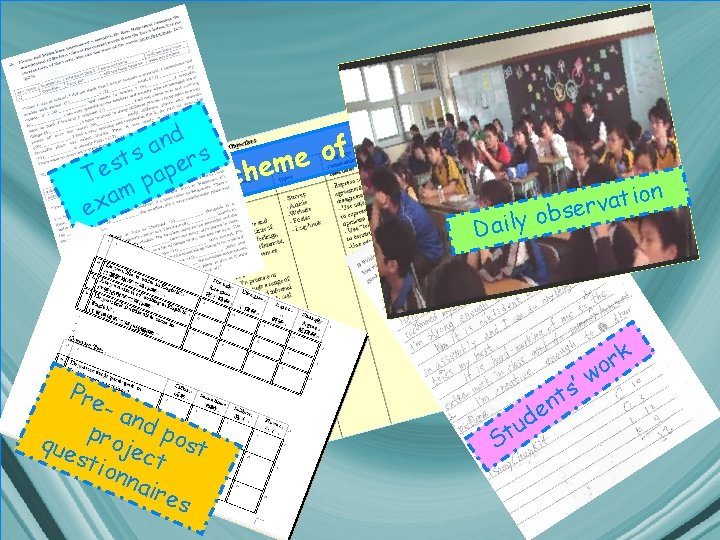
k r d o n w a f o s s t e r s Te pape Schem Analysis of internal m ion a t a x v r e bse o y l i Da assessment data Pre - an dp p r que oje ost ct sti onn air es ’ s t St n e ud rk o w
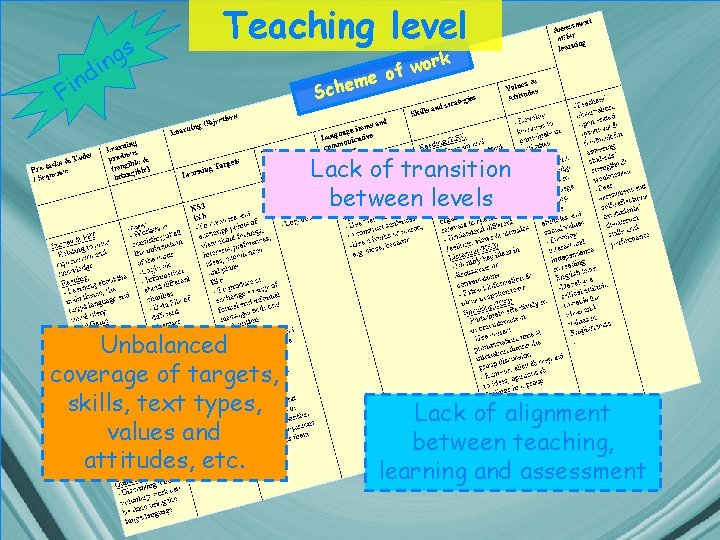
s g n i d in Teaching level F work f o me Sche Lack of transition between levels Unbalanced coverage of targets, skills, text types, values and attitudes, etc. Lack of alignment between teaching, learning and assessment
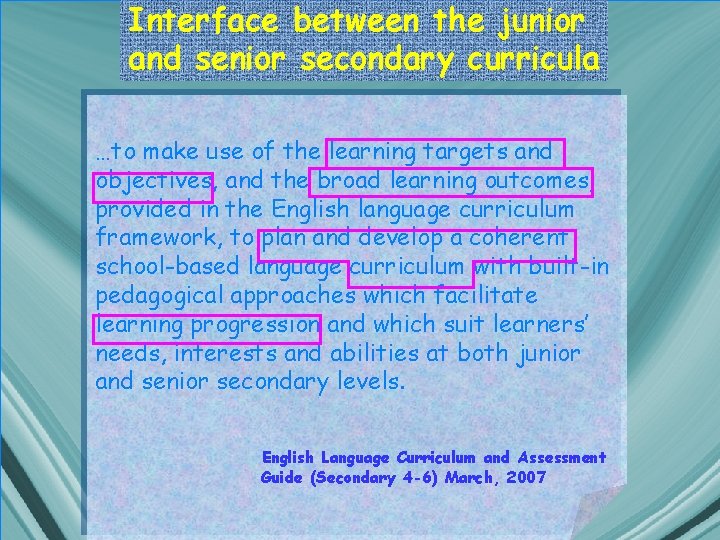
Interface between the junior and senior secondary curricula …to make use of the learning targets and objectives, and the broad learning outcomes, provided in the English language curriculum framework, to plan and develop a coherent school-based language curriculum with built-in pedagogical approaches which facilitate learning progression and which suit learners’ needs, interests and abilities at both junior and senior secondary levels. English Language Curriculum and Assessment Guide (Secondary 4 -6) March, 2007
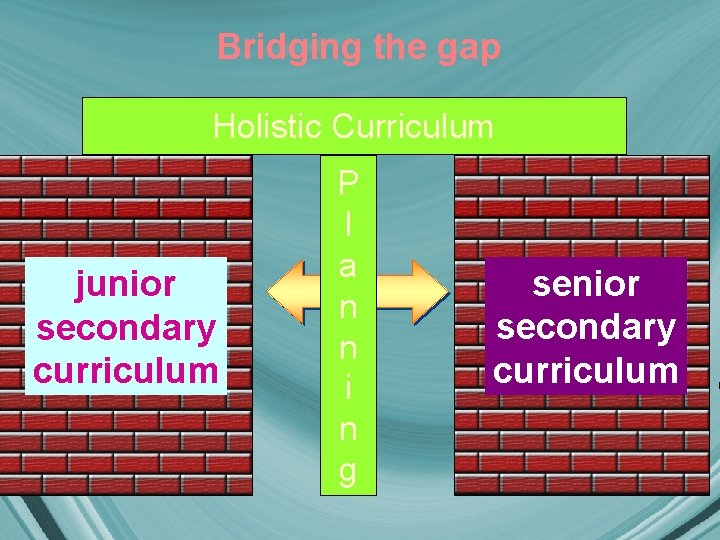
Bridging the gap Holistic Curriculum junior secondary curriculum P l a n n i n g senior secondary curriculum
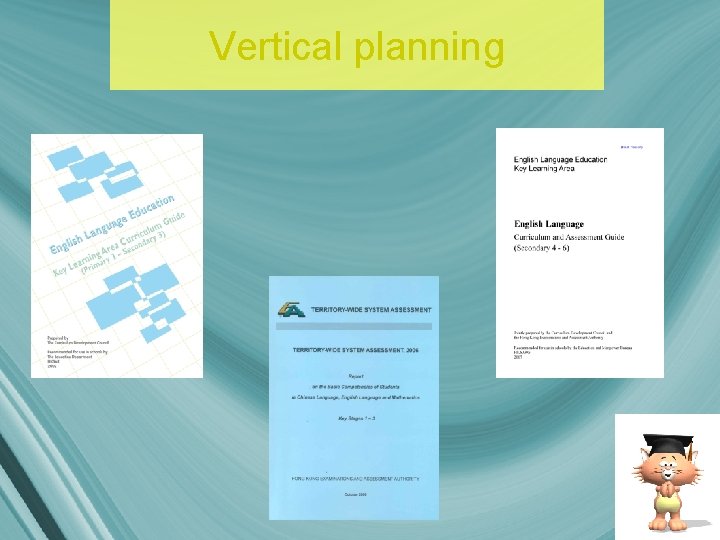
Vertical planning
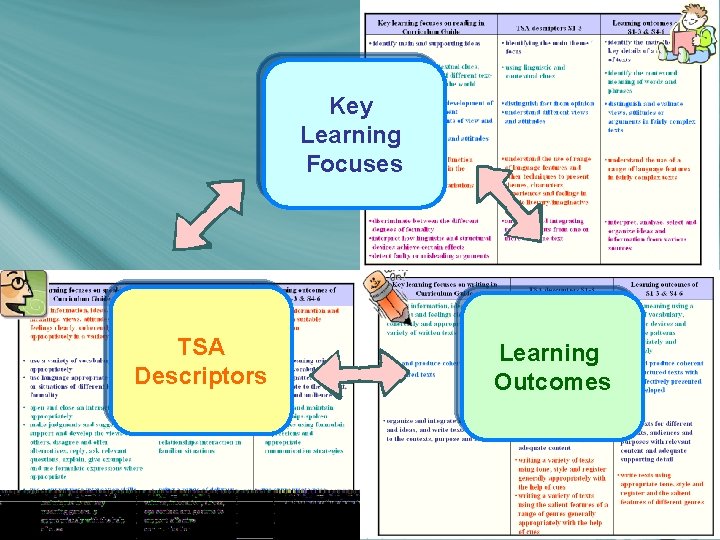
Key Learning Focuses TSA Descriptors Learning Outcomes
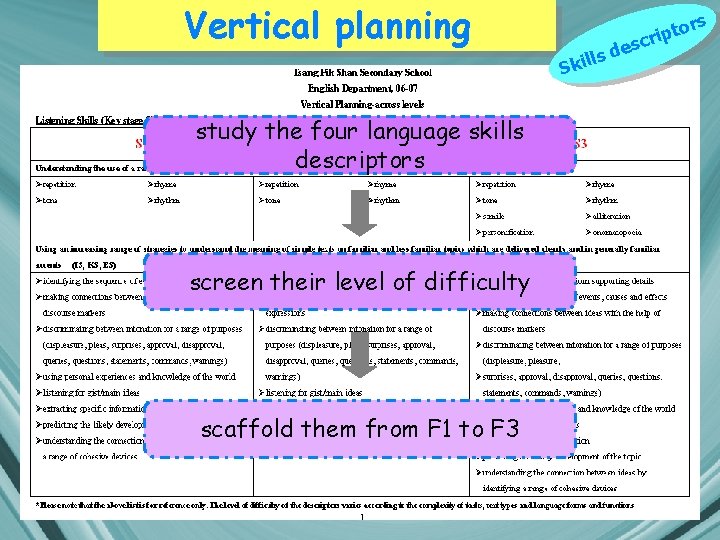
Vertical planning S d kills study the four language skills descriptors screen their level of difficulty scaffold them from F 1 to F 3 e ors t p i scr
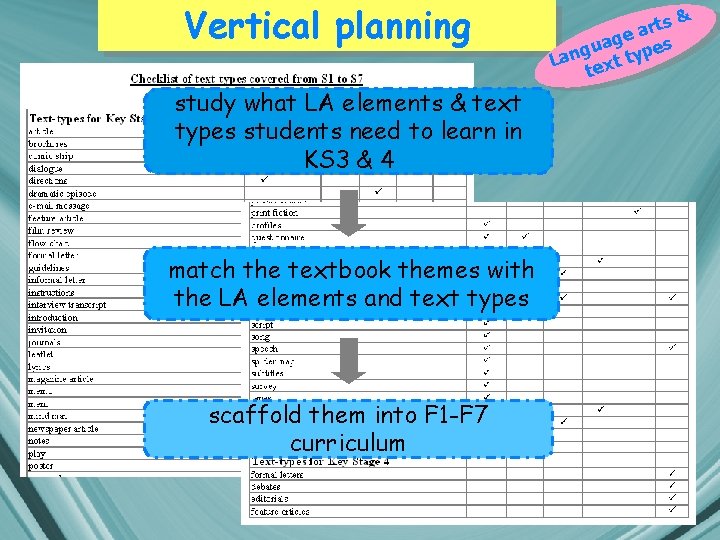
Vertical planning study what LA elements & text types students need to learn in KS 3 & 4 match the textbook themes with the LA elements and text types scaffold them into F 1 -F 7 curriculum rts a e ag pes u g Lan ext ty t &
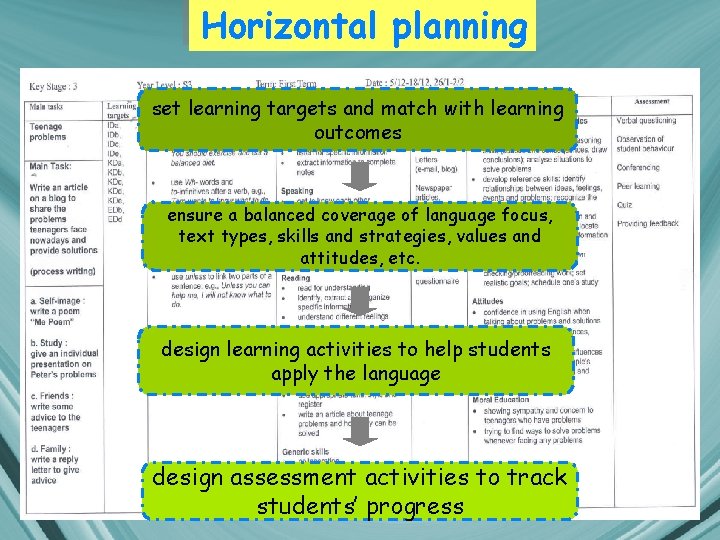
Horizontal planning set learning targets and match with learning outcomes ensure a balanced coverage of language focus, text types, skills and strategies, values and attitudes, etc. design learning activities to help students apply the language design assessment activities to track students’ progress
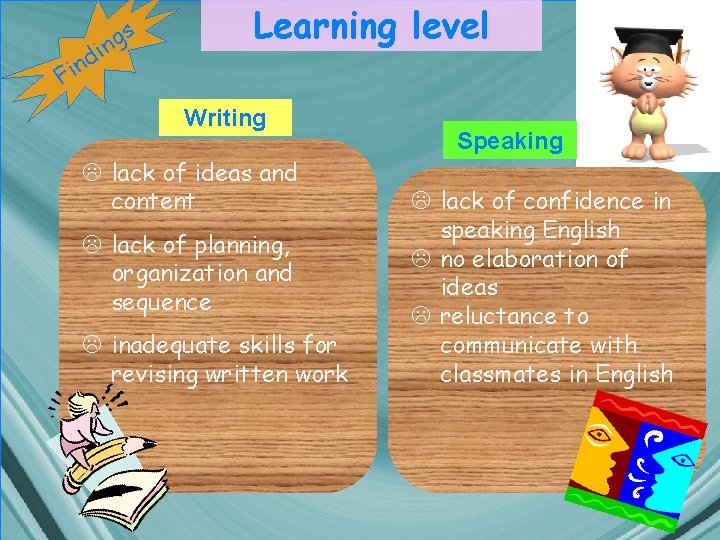
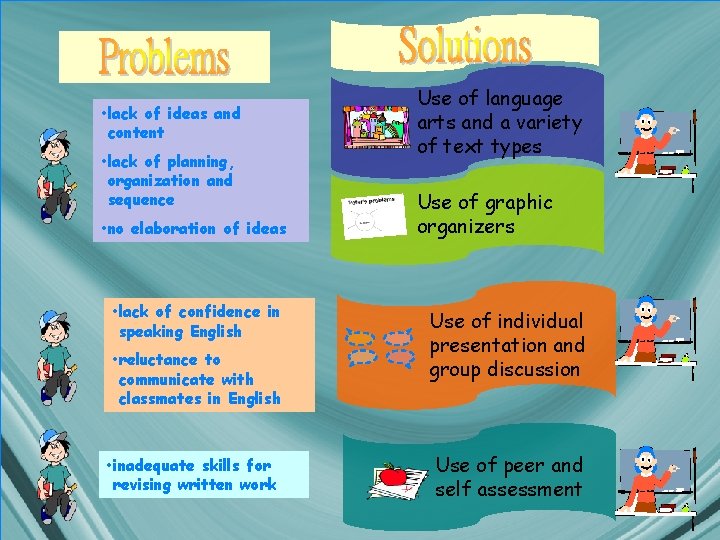
s g n i nd i F Learning level Writing L lack of ideas and content L lack of planning, organization and sequence L inadequate skills for revising written work Speaking L lack of confidence in speaking English L no elaboration of ideas L reluctance to communicate with classmates in English
Broad learning outcomes of senior secondary Writing 1. lack of ideas and content 2. lack of planning, organization and sequence 3. inadequate skills for revising written work Writing • Write texts for different contexts, audiences and purposes with relevant content and adequate supporting details • Convey meaning using varied vocabulary, linguistic devices and language patterns appropriately and accurately • Plan and produce coherent and structured texts with ideas effectively presented and developed • Write texts using appropriate tone, style and register and the salient features of different genres • Draft and revise written texts English Language Curriculum and Assessment Guide (Secondary 4 -6) March, 2007
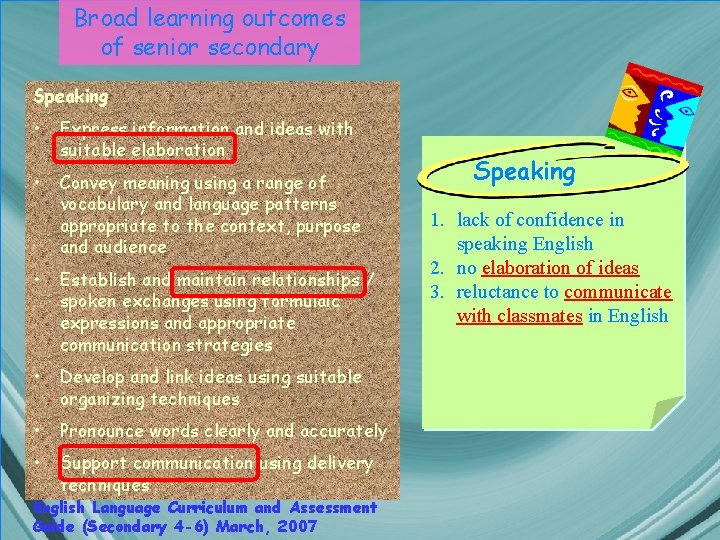
Broad learning outcomes of senior secondary Speaking • Express information and ideas with suitable elaboration • Convey meaning using a range of vocabulary and language patterns appropriate to the context, purpose and audience • Establish and maintain relationships / spoken exchanges using formulaic expressions and appropriate communication strategies • Develop and link ideas using suitable organizing techniques • Pronounce words clearly and accurately • Support communication using delivery techniques English Language Curriculum and Assessment Guide (Secondary 4 -6) March, 2007 Speaking 1. lack of confidence in speaking English 2. no elaboration of ideas 3. reluctance to communicate with classmates in English
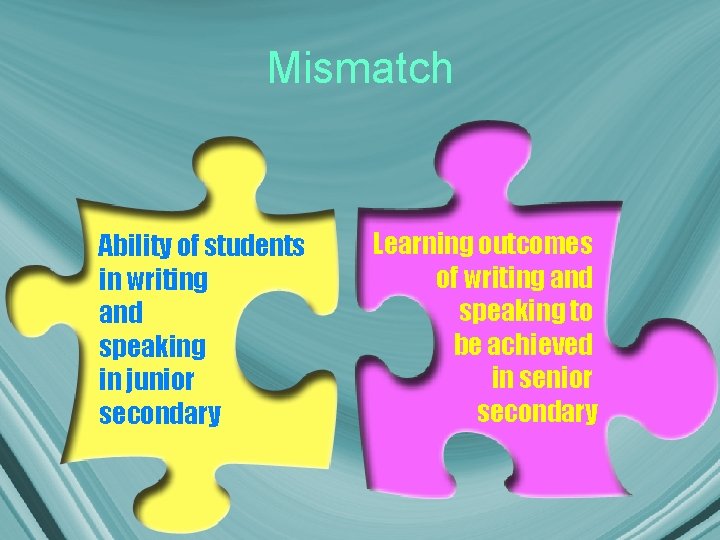
Mismatch Ability of students in writing and speaking in junior secondary Learning outcomes of writing and speaking to be achieved in senior secondary
• lack of ideas and content • lack of planning, organization and sequence • no elaboration of ideas • lack of confidence in speaking English • reluctance to communicate with classmates in English • inadequate skills for revising written work Use of language arts and a variety of text types Use of graphic organizers Use of individual presentation and group discussion Use of peer and self assessment
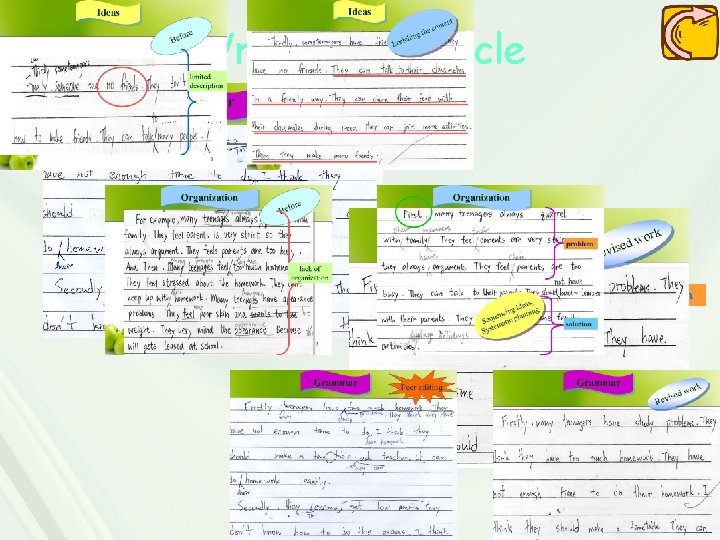
Process writing project
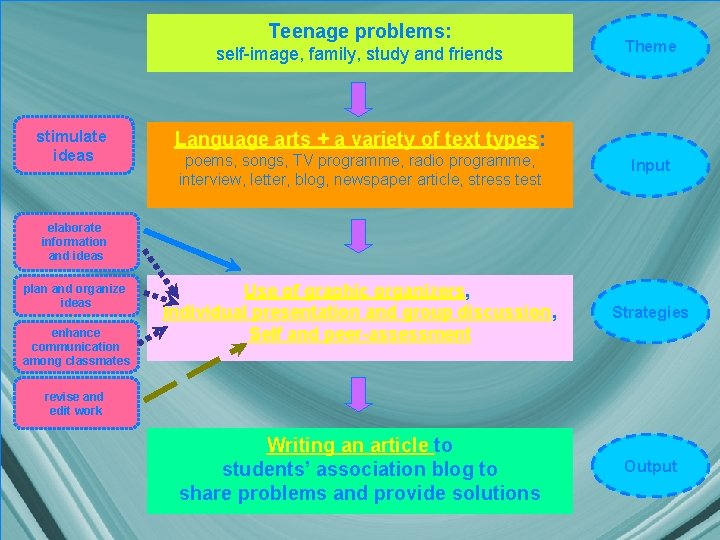
Teenage problems: self-image, family, study and friends stimulate ideas Theme Language arts + a variety of text types: poems, songs, TV programme, radio programme, interview, letter, blog, newspaper article, stress test Input Use of graphic organizers, Individual presentation and group discussion, Self and peer-assessment Strategies Writing an article to students’ association blog to share problems and provide solutions Output elaborate information and ideas plan and organize ideas enhance communication among classmates revise and edit work
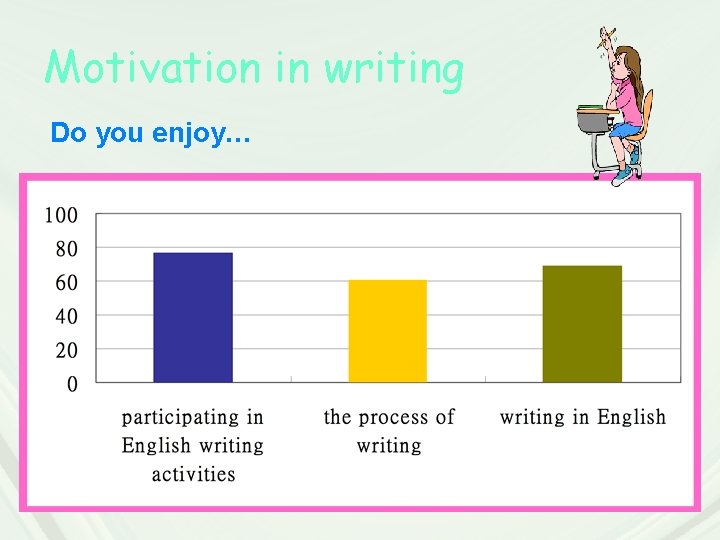
Motivation in writing Do you enjoy…
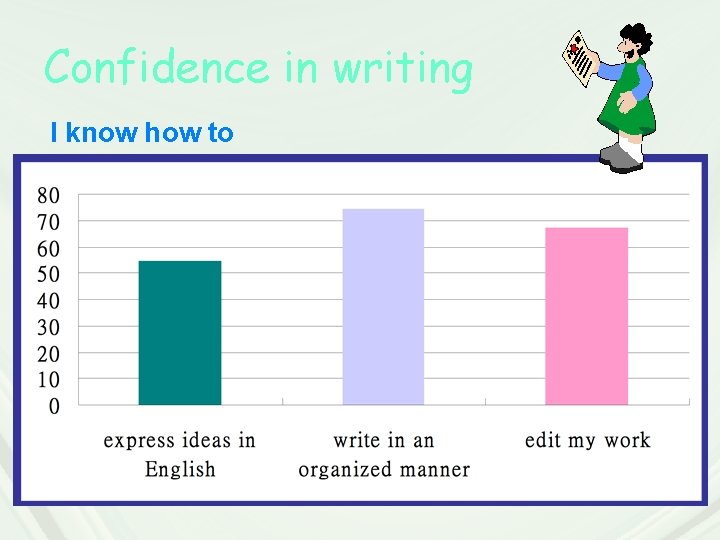
Confidence in writing I know how to
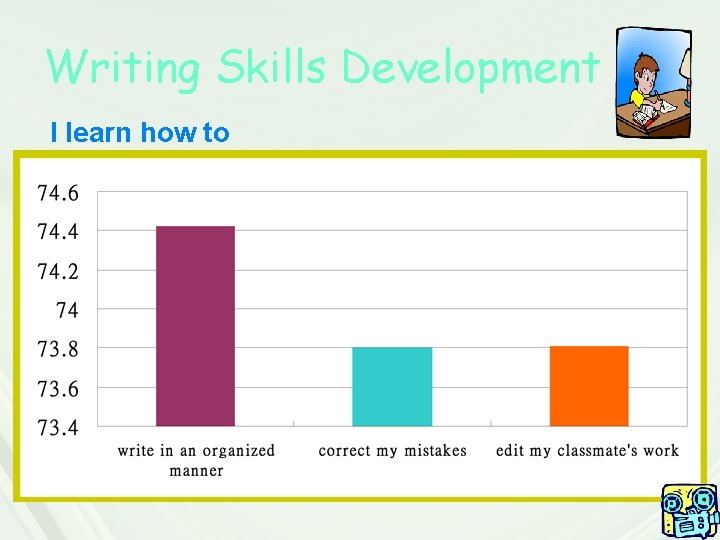
Writing Skills Development I learn how to
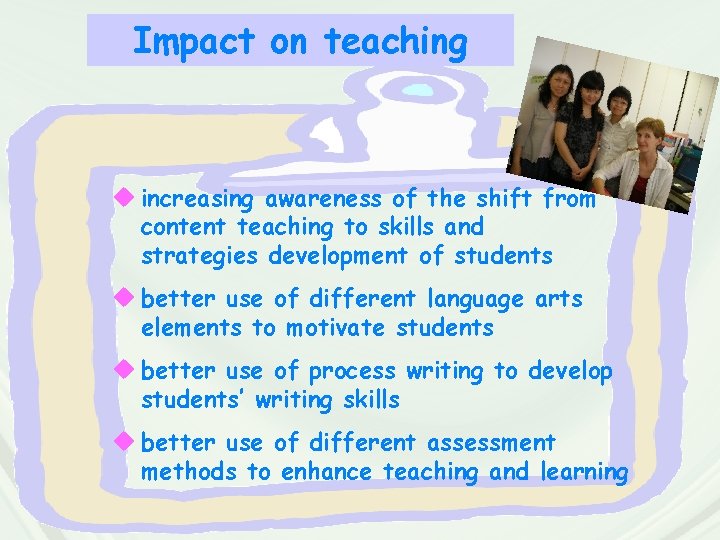
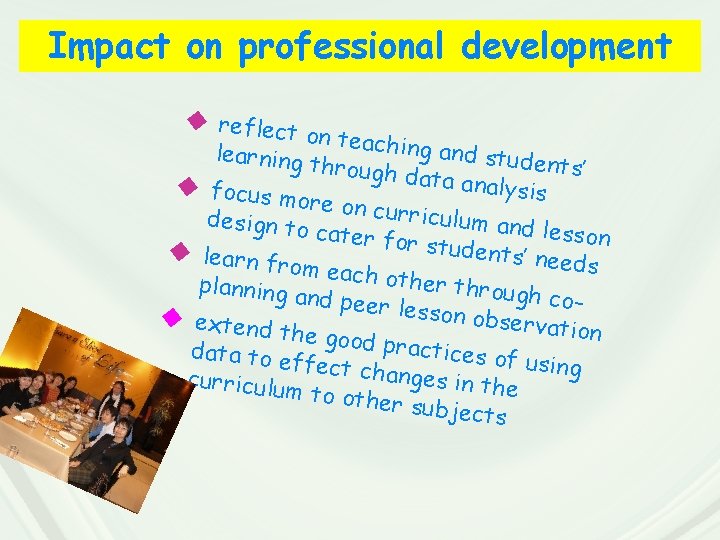
Impact on teaching u increasing awareness of the shift from content teaching to skills and strategies development of students u better use of different language arts elements to motivate students u better use of process writing to develop students’ writing skills u better use of different assessment methods to enhance teaching and learning
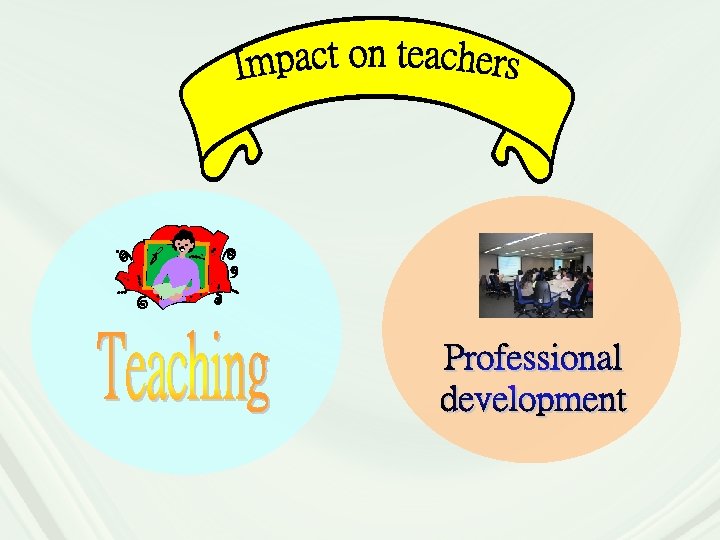
Impact on professional development u reflec t on teac hing and learning t students’ hrough da ta analys u focus is more on c urriculum design to and lesso cater for n students’ u learn f needs rom each other thr planning a ough cond peer le sson obse u extend rvation the good practices data to e of using ffect cha nges in th curriculum e to other subjects
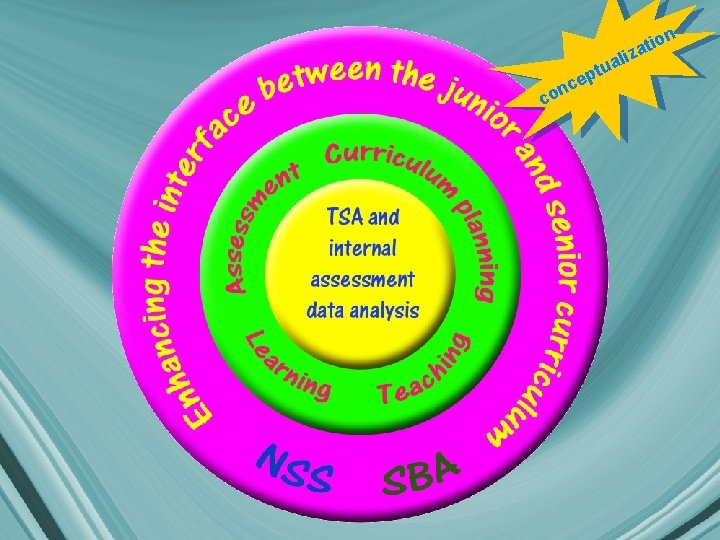
n io t a z nc o c e li a u pt
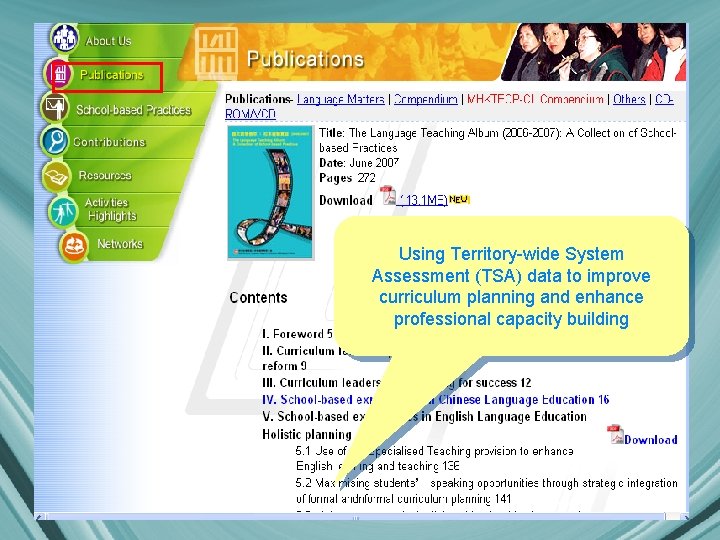
Using Territory-wide System Assessment (TSA) data to improve curriculum planning and enhance professional capacity building
Learning n io t a d un o f Firm in the y r a d n o c e s r o juni Teaching Develop more effective strategies to help students improve their learning outcomes Assessment Diagnose problems and identify gaps in the curriculum
What’s your preparation for the NSS?
Preparation for the NSS
Language Learning Support Section Mr Bruce Bolin Deputy Project Director Tel: 3698 -4067 Fax: 2364 -0273 Email: b_bolin@edb. gov. hk
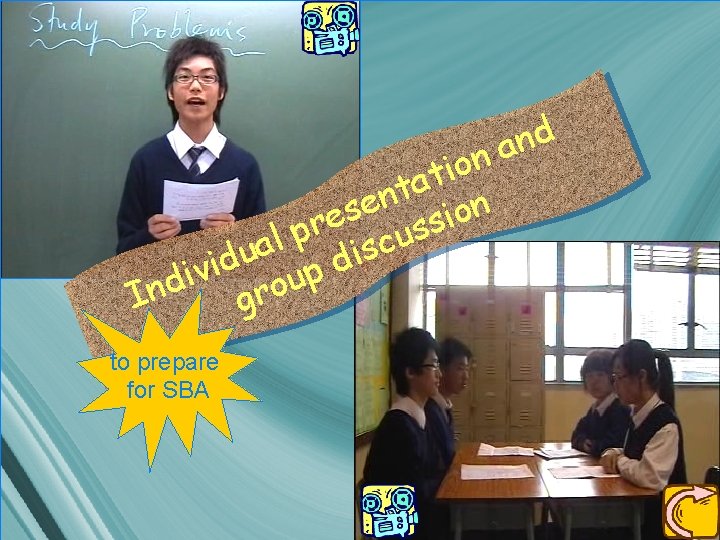
d n a n o i t a t n e n s o i e s r s p u l c a s u i d d i v p i u d o In gr to prepare for SBA
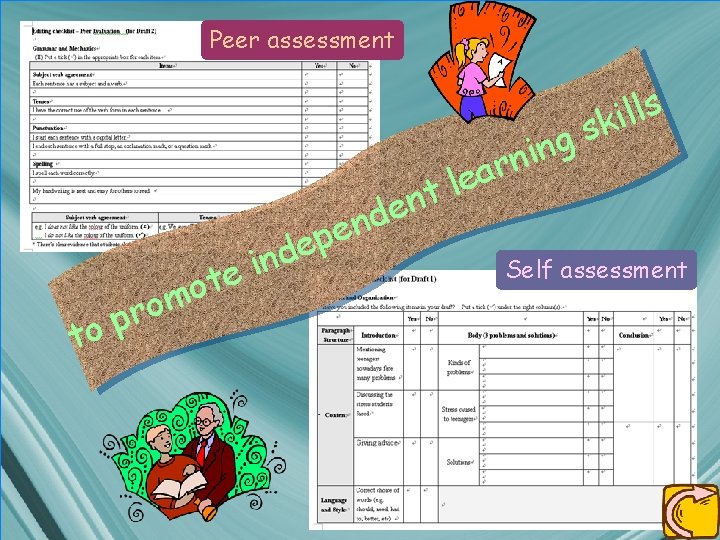
Peer assessment a e l nt g n i rn to m o pr e t o e d n e p e d in s l l i sk Self assessment
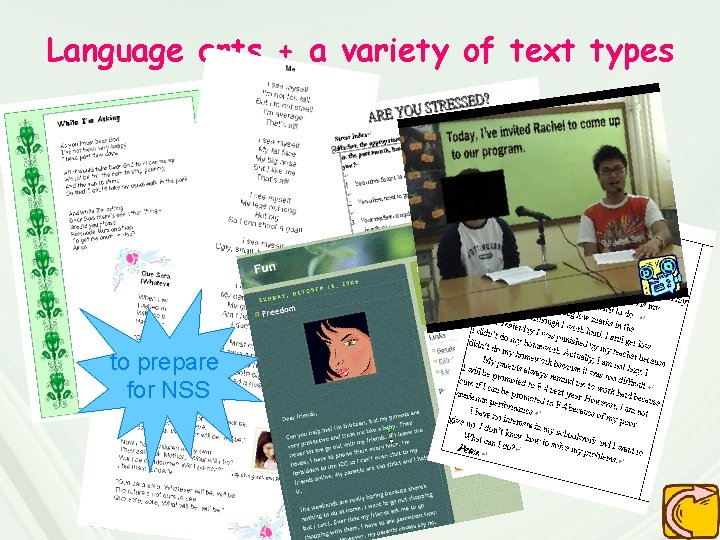
Language arts + a variety of text types ’ to prepare for NSS
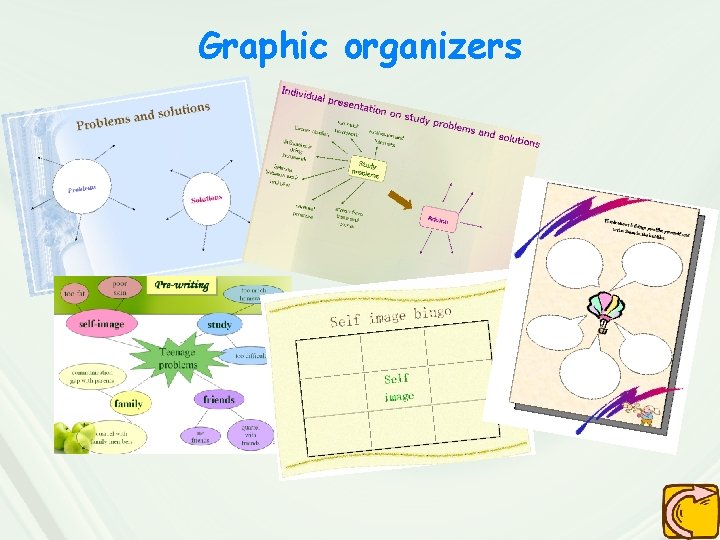
Graphic organizers
Writing an article lack of limited organization description problem s, idea ng g n ci ni uen ic plan q e S mat te Sys solution
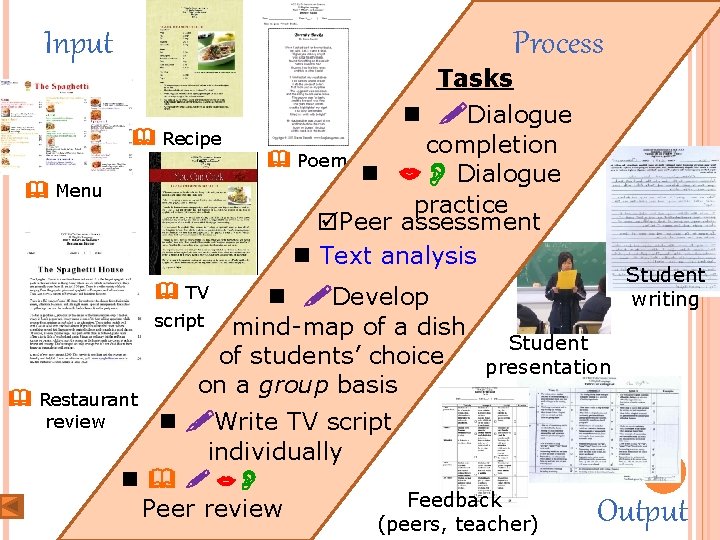
Input Process Tasks Recipe Menu n Dialogue completion Poem n Dialogue practice þPeer assessment n Text analysis n Develop script mind-map of a dish Student of students’ choice presentation on a group basis TV Restaurant review n Write TV script individually n Feedback Peer review (peers, teacher) Student writing Output
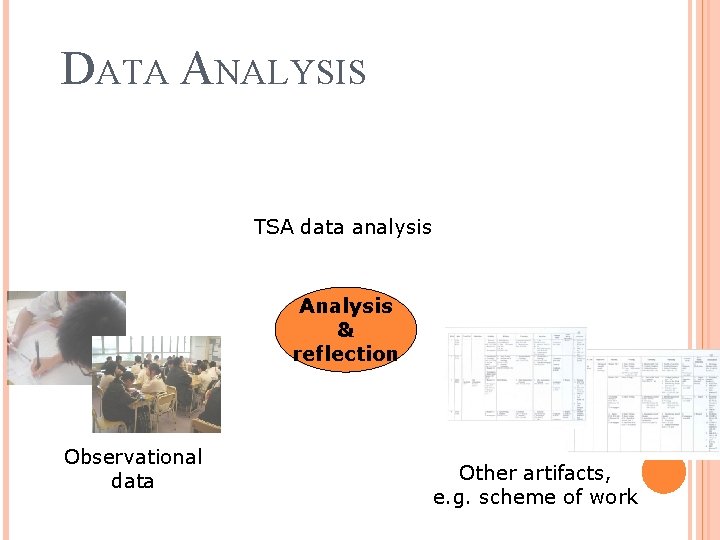
DATA ANALYSIS TSA data analysis Analysis & reflection Observational data Other artifacts, e. g. scheme of work
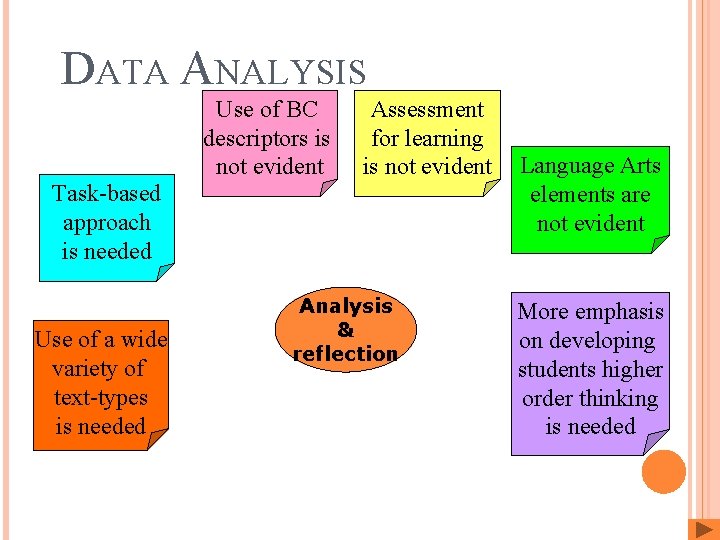
DATA ANALYSIS Use of BC descriptors is not evident Assessment for learning is not evident Task-based approach is needed Use of a wide variety of text-types is needed Analysis & reflection Language Arts elements are not evident More emphasis on developing students higher order thinking is needed
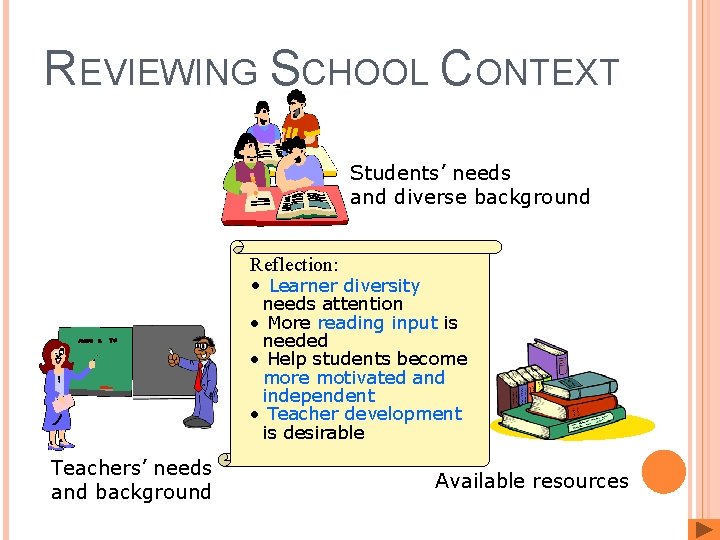
REVIEWING SCHOOL CONTEXT Students’ needs and diverse background Reflection: • Learner diversity needs attention • More reading input is needed • Help students become more motivated and independent • Teacher development is desirable Teachers’ needs and background Available resources
Unit Plan Reading BC descriptors
Speaking rubrics Clear pronunciation Fluency Intonation Voice projection Eye contact 5 criteria for more able classes 3 criteria for weaker classes