
Using and Interpreting Primary and Secondary Documents As
![“As citizens of Manchester [England], assembled at the Free-Trade Hall, we beg to express](https://slidetodoc.com/presentation_image_h2/9c2776fb61255b019c03ff8068525b46/image-4.jpg "“As citizens of Manchester [England], assembled at the Free-Trade Hall, we beg to express")
- Slides: 5
Using and Interpreting Primary and Secondary Documents
“As citizens of Manchester [England], assembled at the Free-Trade Hall, we beg to express our fraternal sentiments toward you and your country. We rejoice in your greatness as an outgrowth of England, whose blood and language you share, whose orderly and legal freedom you have applied to new circumstances, over a region immeasurably greater than our own. We honor your Free States, as a singularly happy abode for the working millions where industry is honored. One thing alone has, in the past, lessened our sympathy with your country and our confidence in it; we mean the ascendancy of politicians who not merely maintained Negro slavery, but desired to extend and root it more firmly. Since we have discerned, however, that the victory of the free north, in the war which has so sorely distressed us as well as afflicted you, will strike off the fetters of the slave, you have attracted our warm and earnest sympathy. We joyfully honor you, as the President, and the Congress with you, for many decisive steps toward practically exemplifying your belief in the words of your great founders: 'All men are created free and equal. '” --“Address from Working Men to President Lincoln, ” official letter sent to Lincoln, printed in the Manchester Guardian (UK), January 1 st, 1863
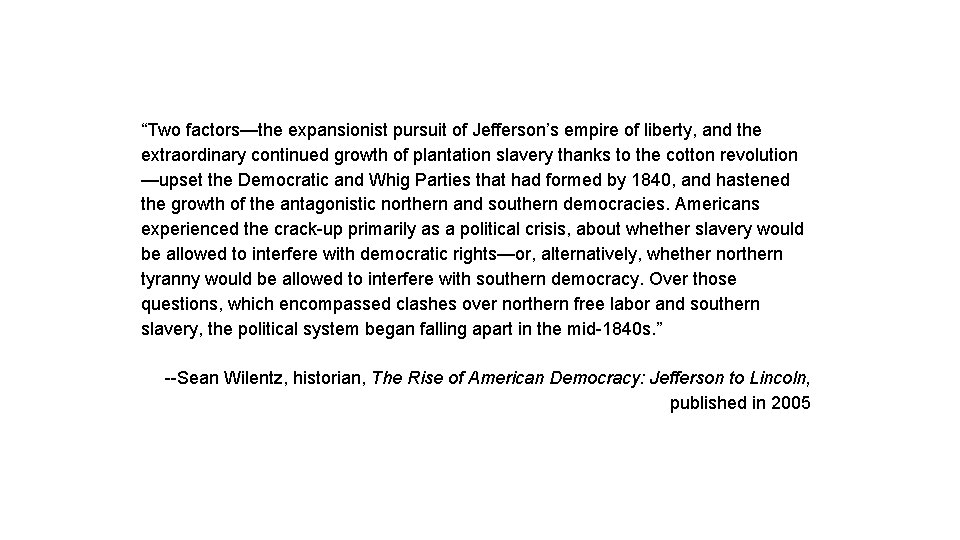
“Two factors—the expansionist pursuit of Jefferson’s empire of liberty, and the extraordinary continued growth of plantation slavery thanks to the cotton revolution —upset the Democratic and Whig Parties that had formed by 1840, and hastened the growth of the antagonistic northern and southern democracies. Americans experienced the crack-up primarily as a political crisis, about whether slavery would be allowed to interfere with democratic rights—or, alternatively, whether northern tyranny would be allowed to interfere with southern democracy. Over those questions, which encompassed clashes over northern free labor and southern slavery, the political system began falling apart in the mid-1840 s. ” --Sean Wilentz, historian, The Rise of American Democracy: Jefferson to Lincoln, published in 2005