
Using and extending the SPEM specifications to represent
- Slides: 20
Using and extending the SPEM specifications to represent agent oriented methodologies Valeria Seidita
Outline The need for a formal methodology description SPEM for describing an agent oriented methodology PASSI: an example The needed extension Discussion and conclusion Valeria Seidita 2
Introduction Adopting Situational Method Engineering for composing agent oriented design processes ◦ Process Requirements Analysis ◦ Method Fragments Selection ◦ Method Fragments Assembly It is fundamental the creation and the use of a method fragments repository ◦ To be constructed following a specific process Elements for constructing the repository ◦ A well known set of existing methodology ◦ The definition of method fragment to be used ◦ A notation to describe a development process Valeria Seidita 3
The Method Fragment Definition Valeria Seidita 4
The Process Description Three are the main elements of a design process ◦ ◦ Activity Process Role Work Product MMM Element The SPEM (Software Process Engineering Metamodel) is based on the idea that “a software development process is a collaboration between abstract entity called process role that perform operation called activities on tangible entities called work product”. Valeria Seidita 5
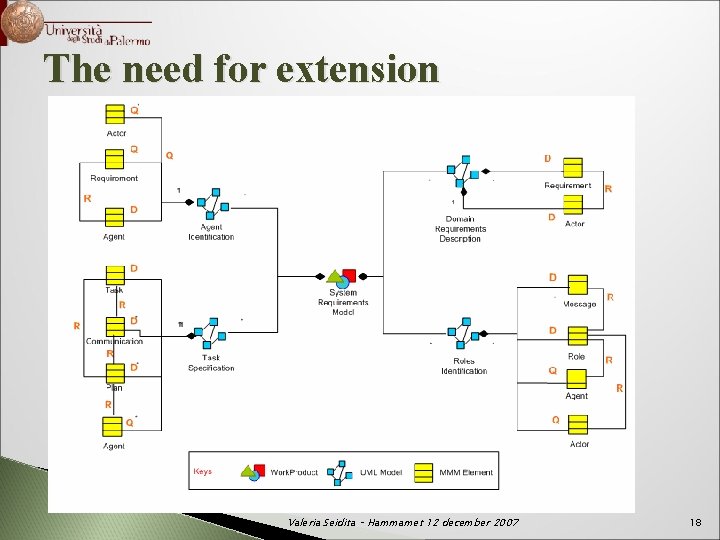
The Process Description Each fragment refers to one (or more) MMM element(s) The MMM element is the constituent part of a Work Product The MMM is not part of SPEM metamodel ◦ It is the element which leads us in modifying and extending SPEM diagram We introduced MMM elements in the process description because when we construct a new design process we start from the definition of its metamodel ◦ Each part (one or more elements) of this metamodel can be instantiated in one (or more) fragment(s) Valeria Seidita 6
The Process Description The need for establishing which is the real action a process role performs on a MMM element when he is carrying out a specific activity The set of actions: ◦ Define – it is performed when a MMM element is introduced for the first time and its features are defined in a portion of process (hence in a fragment) ◦ Relate – when a relationship is created (defined) among two or more MMM elements previously defined in another portion of process ◦ Quote – a MMM element or a relationship is quoted in a specific work product Valeria Seidita – Hammamet 12 december 2007 7
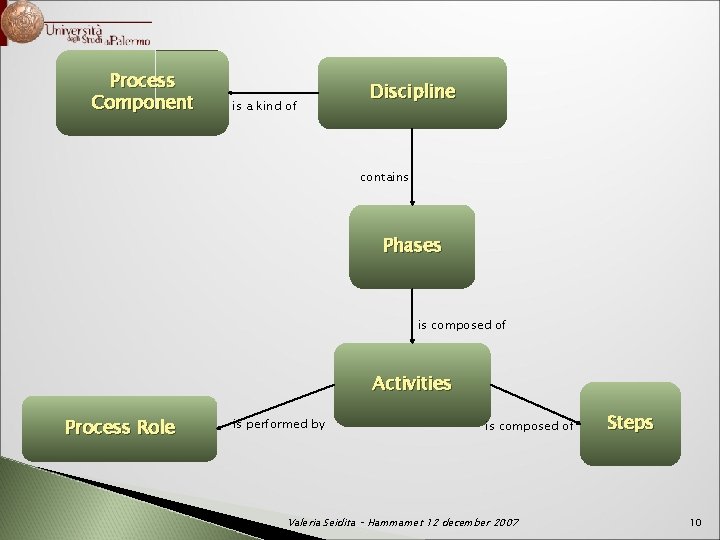
Modelling a methodology with SPEM version 1. 0 A top-down approach to describe who performs what and how SPEM main process component element we use: ◦ Process Component – a portion of process description that is internally consistent ◦ Discipline – is a specialization of process component that partitions activities under common theme Valeria Seidita – Hammamet 12 december 2007 8
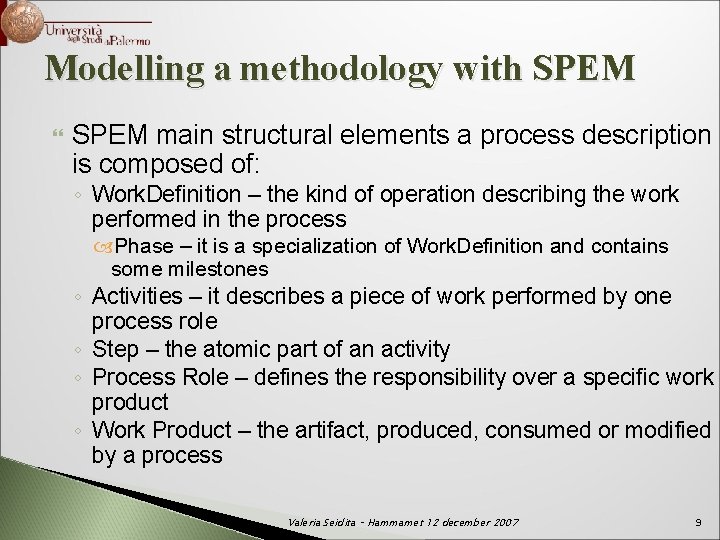
Modelling a methodology with SPEM main structural elements a process description is composed of: ◦ Work. Definition – the kind of operation describing the work performed in the process Phase – it is a specialization of Work. Definition and contains some milestones ◦ Activities – it describes a piece of work performed by one process role ◦ Step – the atomic part of an activity ◦ Process Role – defines the responsibility over a specific work product ◦ Work Product – the artifact, produced, consumed or modified by a process Valeria Seidita – Hammamet 12 december 2007 9
Process Component is a kind of Discipline contains Phases is composed of Activities Process Role is performed by is composed of Valeria Seidita – Hammamet 12 december 2007 Steps 10
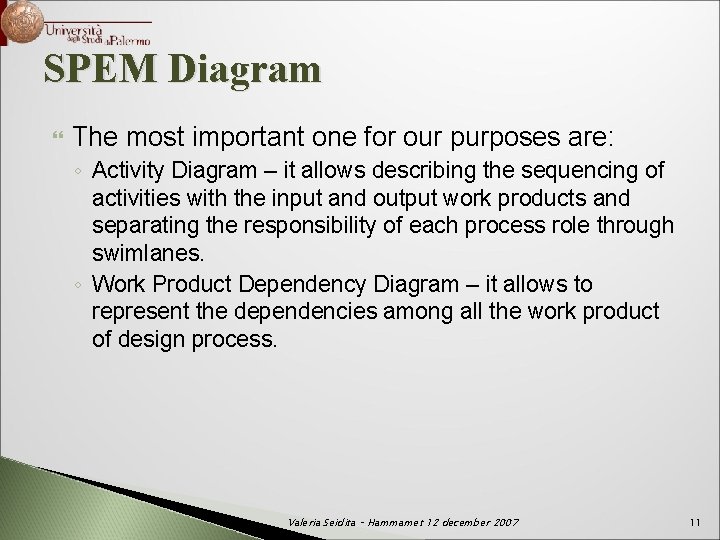
SPEM Diagram The most important one for our purposes are: ◦ Activity Diagram – it allows describing the sequencing of activities with the input and output work products and separating the responsibility of each process role through swimlanes. ◦ Work Product Dependency Diagram – it allows to represent the dependencies among all the work product of design process. Valeria Seidita – Hammamet 12 december 2007 11
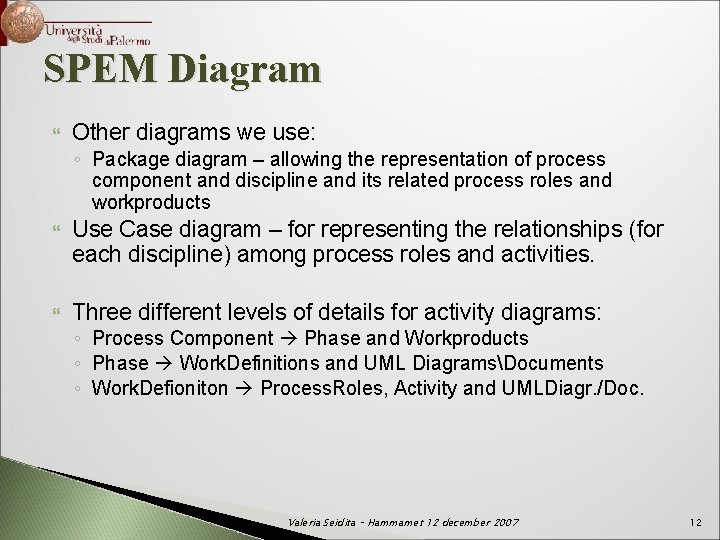
SPEM Diagram Other diagrams we use: ◦ Package diagram – allowing the representation of process component and discipline and its related process roles and workproducts Use Case diagram – for representing the relationships (for each discipline) among process roles and activities. Three different levels of details for activity diagrams: ◦ Process Component Phase and Workproducts ◦ Phase Work. Definitions and UML DiagramsDocuments ◦ Work. Defioniton Process. Roles, Activity and UMLDiagr. /Doc. Valeria Seidita – Hammamet 12 december 2007 12
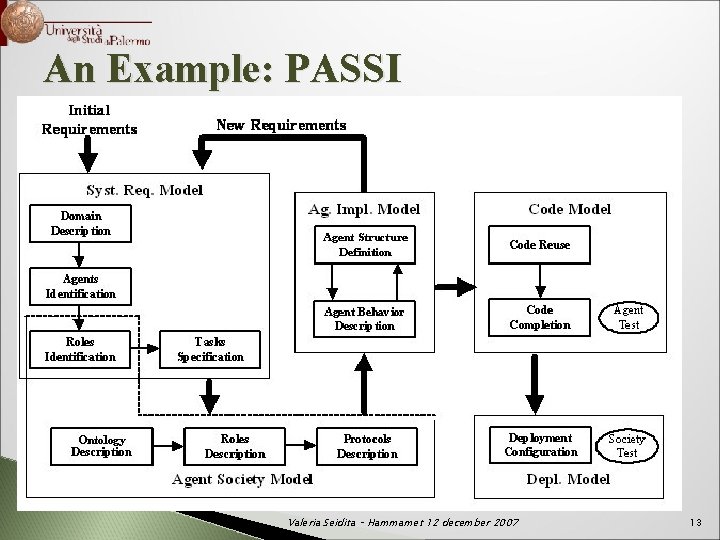
An Example: PASSI Valeria Seidita – Hammamet 12 december 2007 13
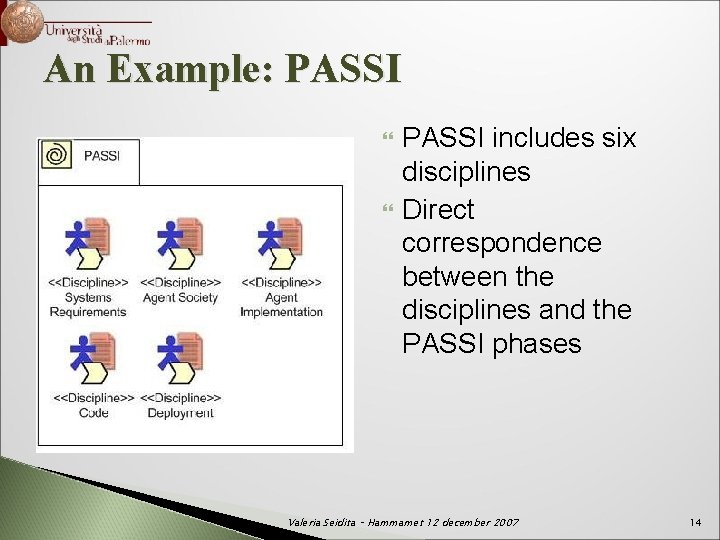
An Example: PASSI includes six disciplines Direct correspondence between the disciplines and the PASSI phases Valeria Seidita – Hammamet 12 december 2007 14
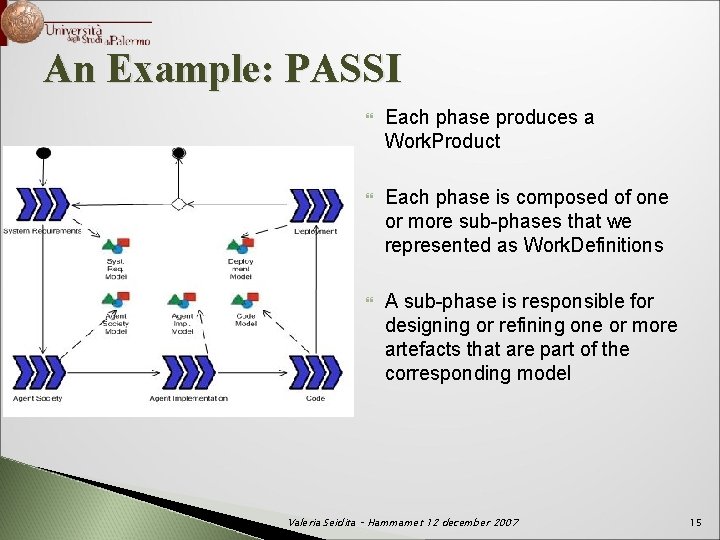
An Example: PASSI Each phase produces a Work. Product Each phase is composed of one or more sub-phases that we represented as Work. Definitions A sub-phase is responsible for designing or refining one or more artefacts that are part of the corresponding model Valeria Seidita – Hammamet 12 december 2007 15
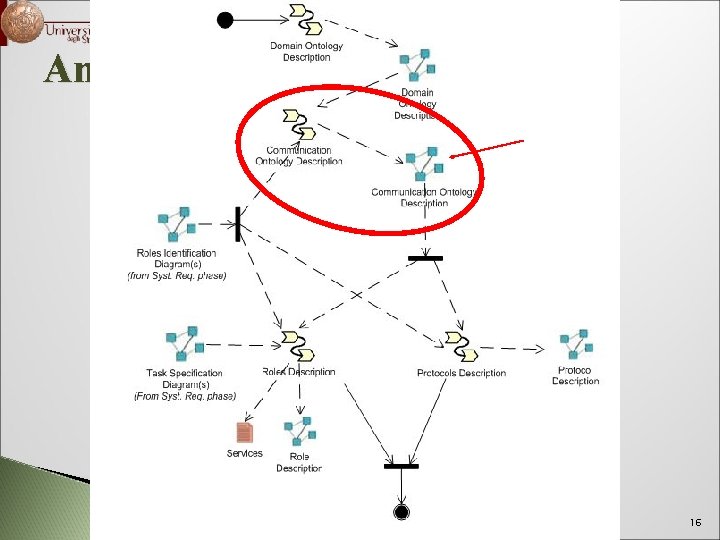
An Example: PASSI Valeria Seidita 16
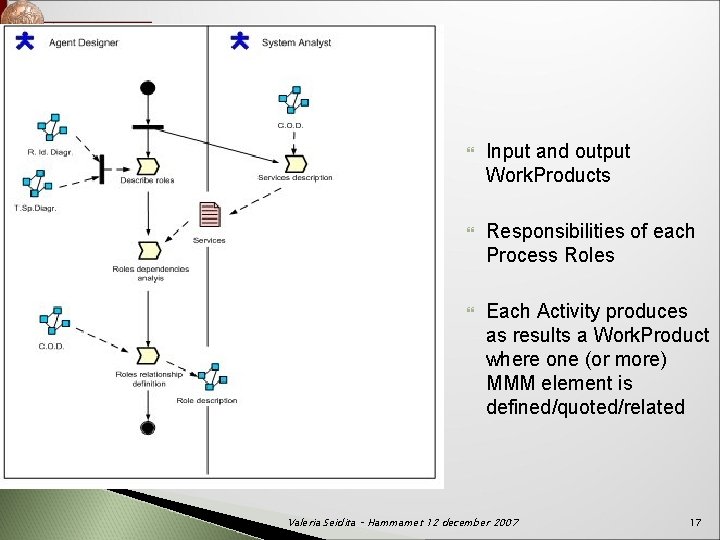
An Example: PASSI Input and output Work. Products Responsibilities of each Process Roles Each Activity produces as results a Work. Product where one (or more) MMM element is defined/quoted/related Valeria Seidita – Hammamet 12 december 2007 17
The need for extension Valeria Seidita – Hammamet 12 december 2007 18
Conclusion SPEM is well suited for the description of an agent oriented methodology It provides a set of elements allowing a top-down decomposition of a methodology The proposed decomposition allows an easy identification/extraction of method fragments However we found some difficulties in the application and discrimination of the concepts of Work. Definition, Phase and Activity; some simplifications was required Valeria Seidita 19
Thanks for your attention seidita@csai. unipa. it Valeria Seidita