
USING AN EXPERIENCE SAMPLING METHOD TO INVESTIGATE HOW















- Slides: 33
USING AN EXPERIENCE SAMPLING METHOD TO INVESTIGATE HOW PEOPLE SPEND THEIR TIME AT WORK Anna Rice anna. a. rice@wmich. edu John Austin Western Michigan University
What We Know • People are working more Belkin (2007) Microsoft (2005) • People are wasting time at work Jost (2005) • People feel unproductive Microsoft (2005)
How We Can Help • Technology
Why Is Their Little Research on This Subject? • Difficult to measure momentary behaviors and experiences – ESM • Complexity of work activities – Taxonomy
ESM • Experience sampling methods (ESM) – Research method that captures momentary behaviors • Systematically collect data
Taxonomies • Researchers’ solution to the complexity of work behaviorsdevelop taxonomies • Not only classify and organize workplace activities
Taxonomy-Dependent Variables • • Initiating Direction Delivering Results Organizing Aligning Investing in Individuals Inspiring People Other
Summary • Purpose – Develop and use a meaningful taxonomy of work behaviors – To measure how people are spending their time at work using an ESM method to sample these behaviors – Develop a technological tool
Method • Participants – 4 individuals – 2, 2 – 2 weeks • Design – 2 group pretest posttest
Participant Estimations • % of time they thought they spent in a week on each of the answer choices of the questions (i. e. , estimated time spent) • % of time they thought they should have been spending on each of the answer choices (i. e. , ideal time spent) • Again before they began to collect data for week 2
Participant Self-Recording • Each time the Palm signaled – Entered their behavior into the Palm by answering the series of questions • 8 times/day randomly spaced • Questions asked – Where are you? – What are you doing? – What is the activity’s time frame?
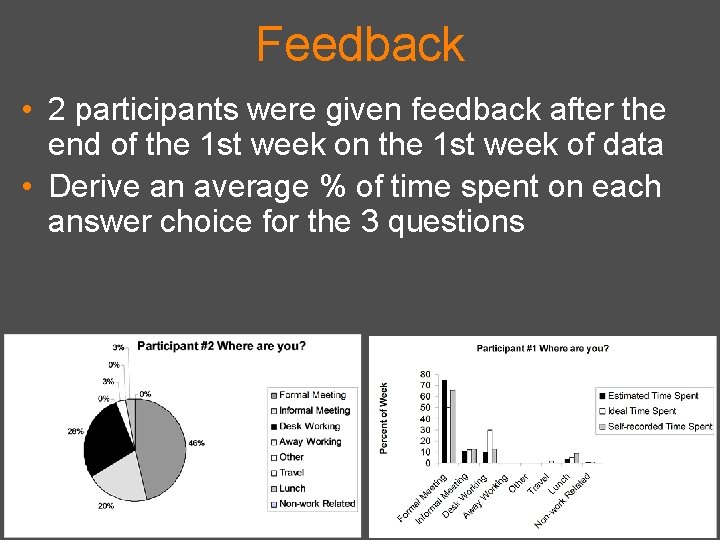
Feedback • 2 participants were given feedback after the end of the 1 st week on the 1 st week of data • Derive an average % of time spent on each answer choice for the 3 questions
IOA • Investigator accompanied the participant when possible • 97. 9% • 17% of total data collected
IV Integrity • To ensure that the participants recorded when the signal went off • Participants responded to signals 89% of the time
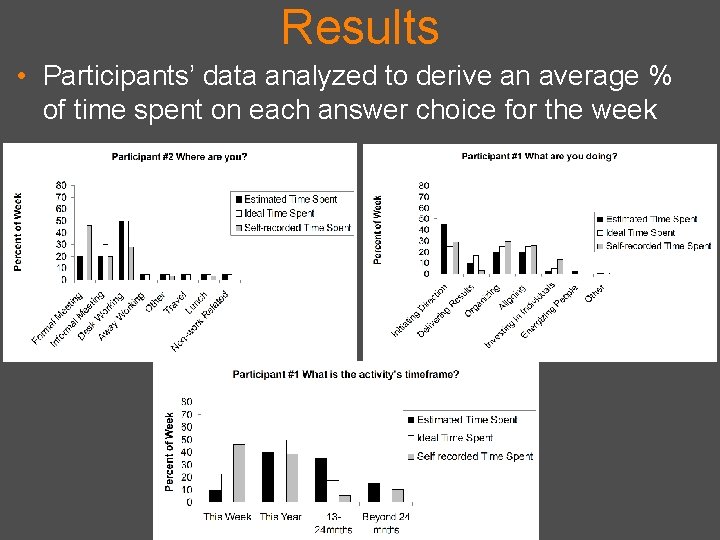
Results • Participants’ data analyzed to derive an average % of time spent on each answer choice for the week
Results • Dependent samples t-test (p <. 05) • Answer choice “at desk working”
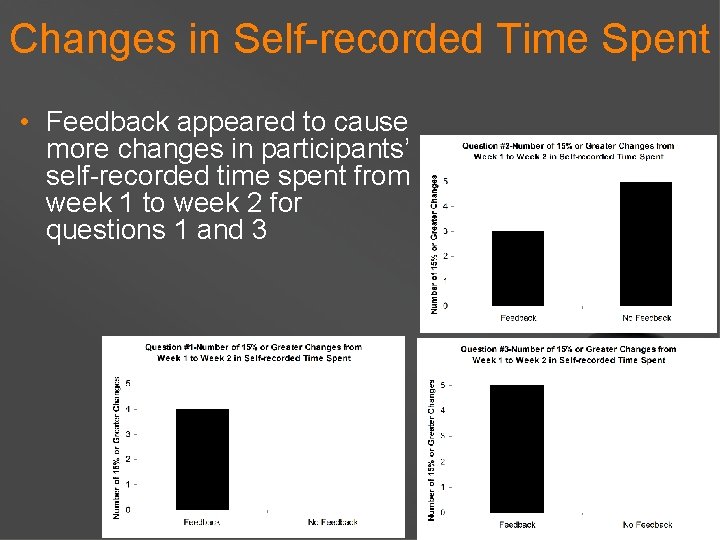
Changes in Self-recorded Time Spent • Feedback appeared to cause more changes in participants’ self-recorded time spent from week 1 to week 2 for questions 1 and 3
Changes in Estimated Time Spent • Feedback appeared to cause more changes in estimated time spent from week 1 to week 2 for questions 2 and 3
Changes in Ideal Time Spent • Feedback appeared to cause more changes in ideal time spent from week 1 to week 2 for all three questions
Difference in Ideal Time Spent and Selfrecorded Time Spent • Feedback appeared to decrease the difference between participants’ ideal time spent and selfrecorded time spent for question 1
Results • Successful at developing a tool that workers used to track how they were spending their time at work • The Palm consistently signaled and collected data
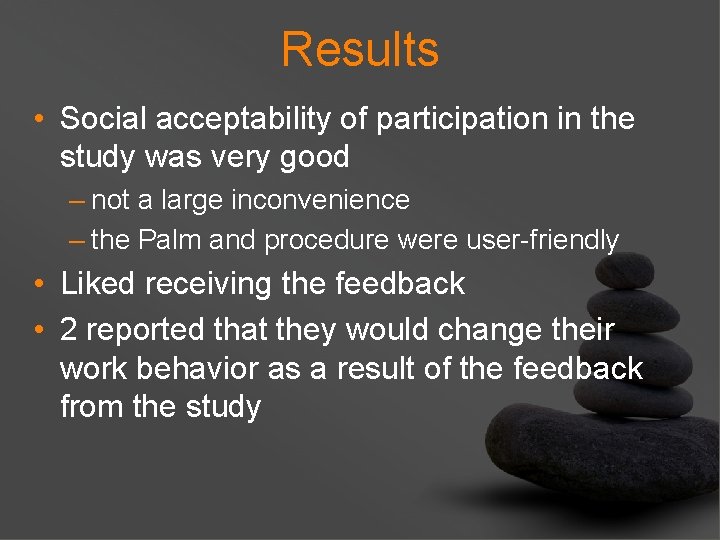
Results • Social acceptability of participation in the study was very good – not a large inconvenience – the Palm and procedure were user-friendly • Liked receiving the feedback • 2 reported that they would change their work behavior as a result of the feedback from the study
Suggested Improvements • • Louder beep and beep/vibrate “pause time” Cell phones/wearable with a clip If a question was missed
Future Studies • More participants • Collect data for more than 1 week after feedback • Fewer answer choices and/or questions • Participants who express an interest in changing how they spend their time at work
Future Studies • The questions that the Palm asks could be adjusted to the specific needs of the participant – Transitioning – Want to eliminate or increase a work behavior
Questions? Thank You!
Results • Dependent samples t-test to determine if there are significant differences – In the average %s between the 1 st and 2 nd week SD Fb 1 st Week Averages 2 nd Week Averages No SD
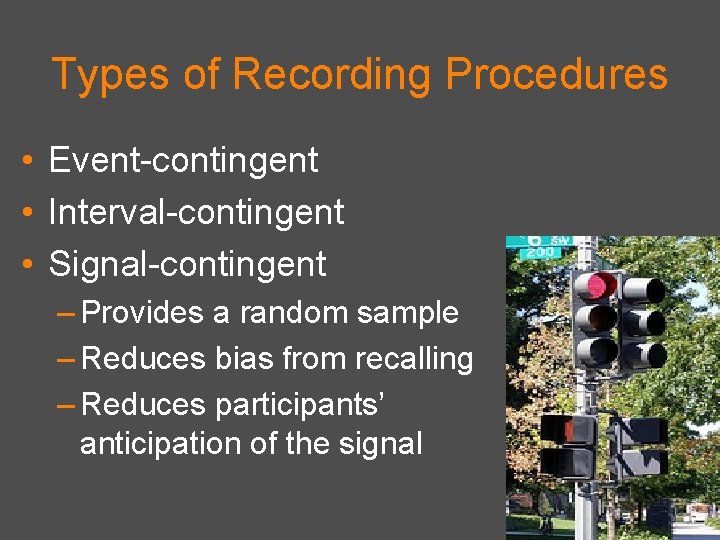
Types of Recording Procedures • Event-contingent • Interval-contingent • Signal-contingent – Provides a random sample – Reduces bias from recalling – Reduces participants’ anticipation of the signal
ESM in the Workplace • Did not begin in organizations until 1993 (Alliger & Williams, 1993) – Did not gain much traction before 2003 (Beal & Weiss, 2003) – Workaholism (Snir & Zohar, 2008) – Energy availability and emotional reactions to work events (Zohar, Tzischinski, & Epstein, 2003) – Relationship between job characteristics and strain (Totterdell, Wood, & Wall 2006) – Models of variation in events, moods, and behaviors (Miner, Glomb, & Hulin, 2001)
Taxonomies • Developed and administered various questionnaires to managers • Conducted a factor analysis of the responses to develop a taxonomy Fleishman (1953) Hemphill (1960) Prien (1963) Dowell and Wexley (1978) Tornow and Pinto (1976)
Taxonomies • Used direct observations to develop taxonomies Mintzberg (1973) Kotter (1982) Luthans, Rosenkrantz, and Hennessey (1985)
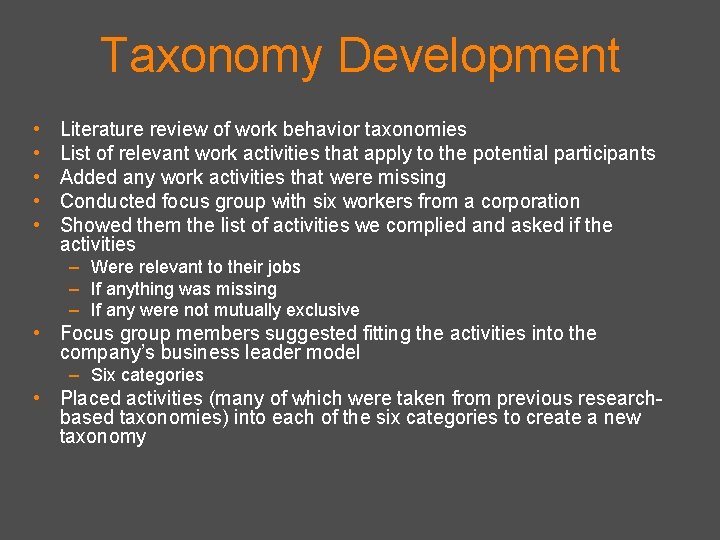
Taxonomy Development • • • Literature review of work behavior taxonomies List of relevant work activities that apply to the potential participants Added any work activities that were missing Conducted focus group with six workers from a corporation Showed them the list of activities we complied and asked if the activities – Were relevant to their jobs – If anything was missing – If any were not mutually exclusive • Focus group members suggested fitting the activities into the company’s business leader model – Six categories • Placed activities (many of which were taken from previous researchbased taxonomies) into each of the six categories to create a new taxonomy
Method • Device – Palm. Pilot – Randomly signals 8 times per day