
Using Amazons Mechanical Turk MTurk for Human Subjects
Using Amazon’s Mechanical Turk (MTurk) for Human Subjects Research AARON M. OGLETREE, PHD NIH/NIMHD
Guiding Questions 1. What is MTurk? 2. What are some practical considerations for planning a study using MTurk? 3. How might MTurk participants differ from community-based samples?
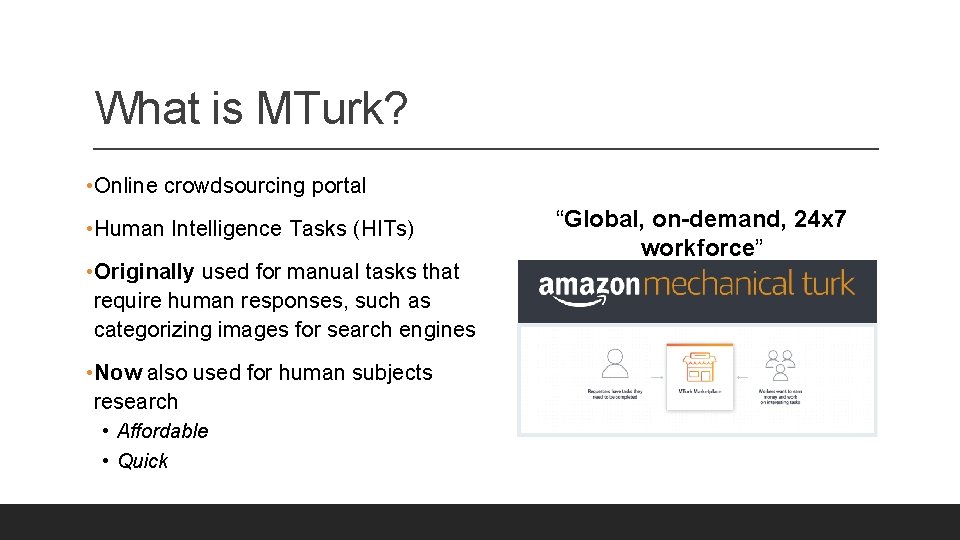
What is MTurk? • Online crowdsourcing portal • Human Intelligence Tasks (HITs) • Originally used for manual tasks that require human responses, such as categorizing images for search engines • Now also used for human subjects research • Affordable • Quick “Global, on-demand, 24 x 7 workforce”
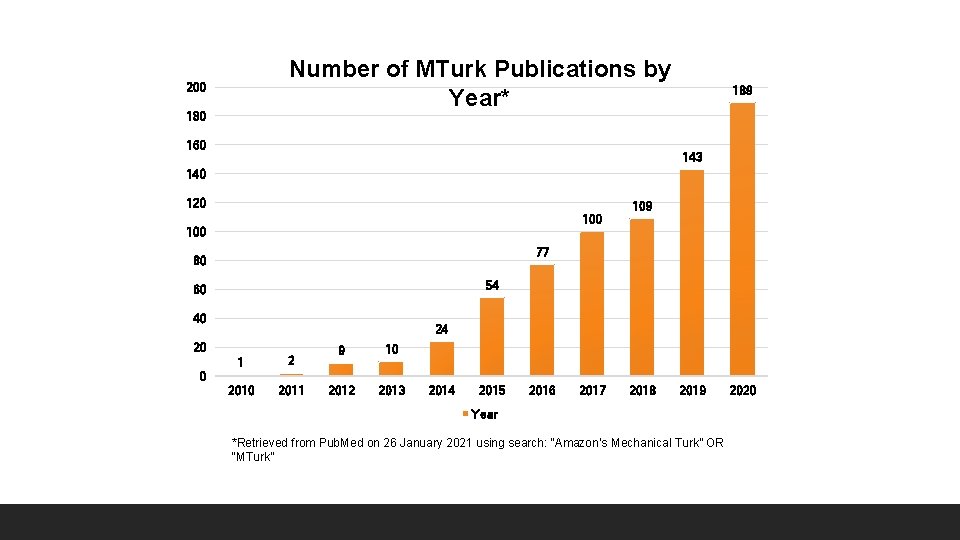
Number of MTurk Publications by Year* 200 180 160 189 143 140 120 100 109 77 80 54 60 40 24 20 1 2 2010 2011 9 10 2012 2013 0 2014 2015 2016 2017 2018 2019 Year *Retrieved from Pub. Med on 26 January 2021 using search: “Amazon’s Mechanical Turk” OR “MTurk” 2020

What is MTurk? MTurk features that are helpful for researchers: • Specify “Worker” qualifications, or characteristics • Options include Age, Marital Status, Primary News Source, and Geographic Location • Set remuneration amount • HITs reward as little as $0. 01 • Identify desired number of survey respondents • 500, 000 registered users • 15, 000 users available at any given time
Practical Considerations? Timing matters. ◦ When is your sample likely to be accessing MTurk? ◦ Consider time zone, days of the week, and time of day ◦ Timing of posting: mutually exclusive HITs or overlapping postings? Remuneration matters. ◦ More $$$, Less problems! Quality assurance matters. ◦ Attention checks, data screening, and data integrity are all IMPERATIVE. ◦ Recommend conducting a pilot study prior to full data collection.
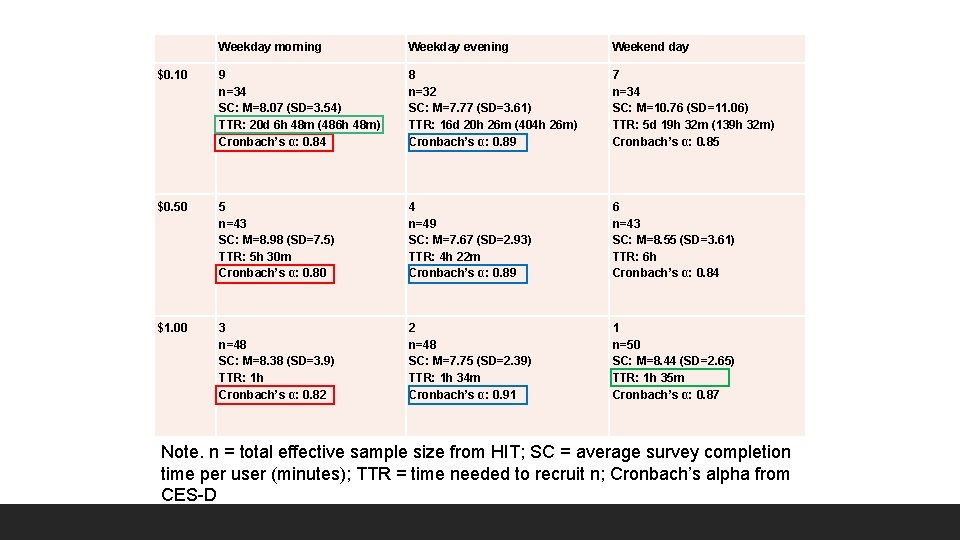
Weekday morning Weekday evening Weekend day $0. 10 9 n=34 SC: M=8. 07 (SD=3. 54) TTR: 20 d 6 h 48 m (486 h 48 m) Cronbach’s α: 0. 84 8 n=32 SC: M=7. 77 (SD=3. 61) TTR: 16 d 20 h 26 m (404 h 26 m) Cronbach’s α: 0. 89 7 n=34 SC: M=10. 76 (SD=11. 06) TTR: 5 d 19 h 32 m (139 h 32 m) Cronbach’s α: 0. 85 $0. 50 5 n=43 SC: M=8. 98 (SD=7. 5) TTR: 5 h 30 m Cronbach’s α: 0. 80 4 n=49 SC: M=7. 67 (SD=2. 93) TTR: 4 h 22 m Cronbach’s α: 0. 89 6 n=43 SC: M=8. 55 (SD=3. 61) TTR: 6 h Cronbach’s α: 0. 84 $1. 00 3 n=48 SC: M=8. 38 (SD=3. 9) TTR: 1 h Cronbach’s α: 0. 82 2 n=48 SC: M=7. 75 (SD=2. 39) TTR: 1 h 34 m Cronbach’s α: 0. 91 1 n=50 SC: M=8. 44 (SD=2. 65) TTR: 1 h 35 m Cronbach’s α: 0. 87 Note. n = total effective sample size from HIT; SC = average survey completion time per user (minutes); TTR = time needed to recruit n; Cronbach’s alpha from CES-D
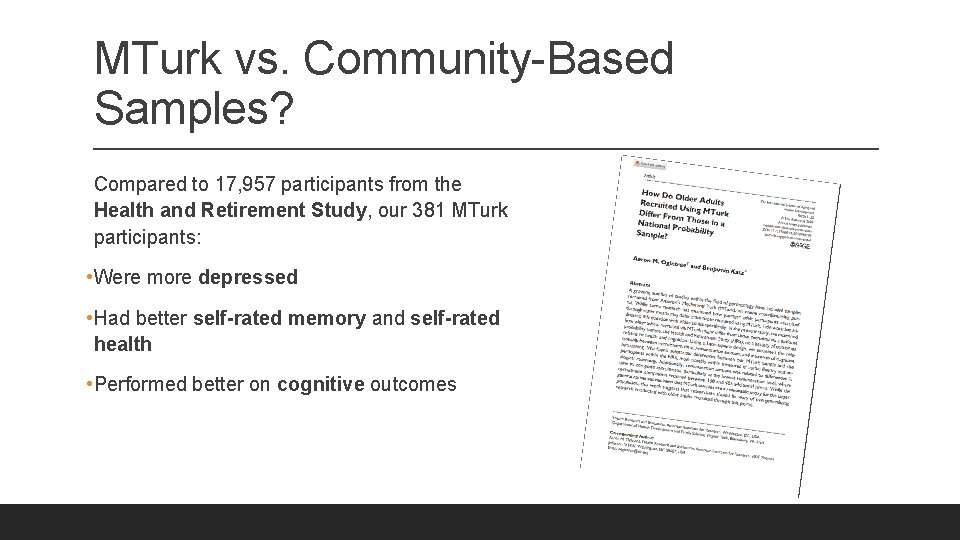
MTurk vs. Community-Based Samples? Compared to 17, 957 participants from the Health and Retirement Study, our 381 MTurk participants: • Were more depressed • Had better self-rated memory and self-rated health • Performed better on cognitive outcomes
Review 1. What is MTurk? 2. What are some practical considerations for planning a study using MTurk? 3. How might MTurk participants differ from community-based samples?
Thank you! Aaron M. Ogletree, Ph. D NIH/NIMHD Email: ogletreeam@mail. nih. gov
- Slides: 10