
Using Algebra Tiles for Student Understanding Examining the
Using Algebra Tiles for Student Understanding
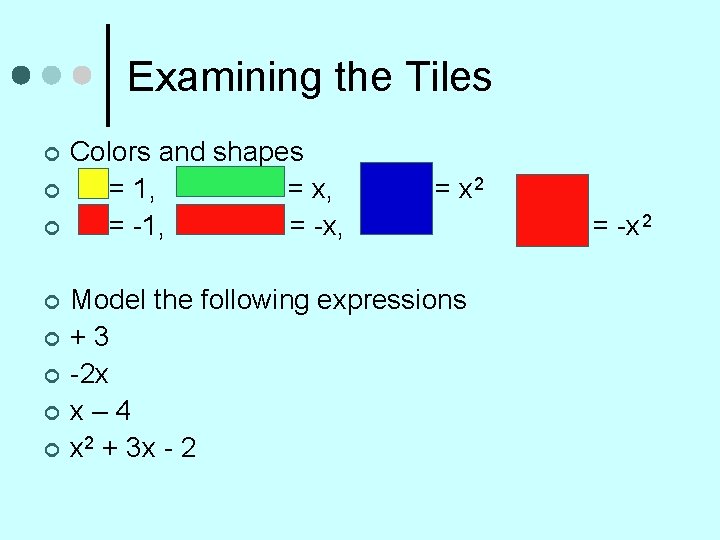
Examining the Tiles ¢ ¢ ¢ ¢ Colors and shapes = 1, = x, = -1, = -x, = x 2 Model the following expressions +3 -2 x x– 4 x 2 + 3 x - 2 = -x 2
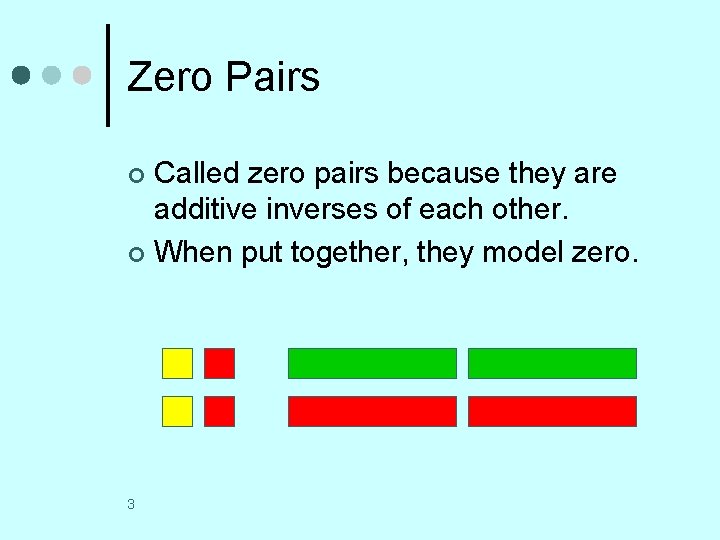
Zero Pairs Called zero pairs because they are additive inverses of each other. ¢ When put together, they model zero. ¢ 3
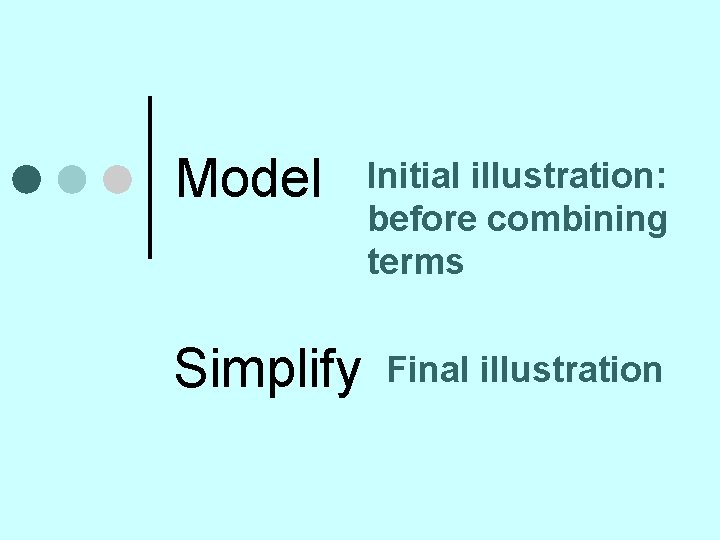
Model Simplify Initial illustration: before combining terms Final illustration
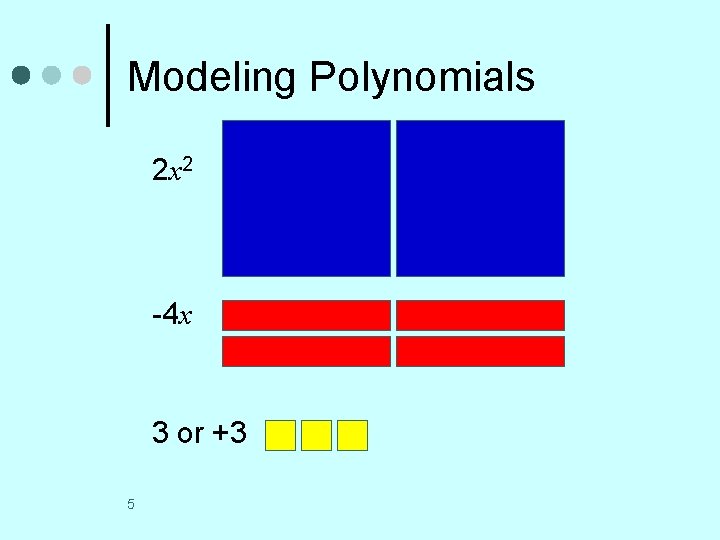
Modeling Polynomials 2 x 2 -4 x 3 or +3 5
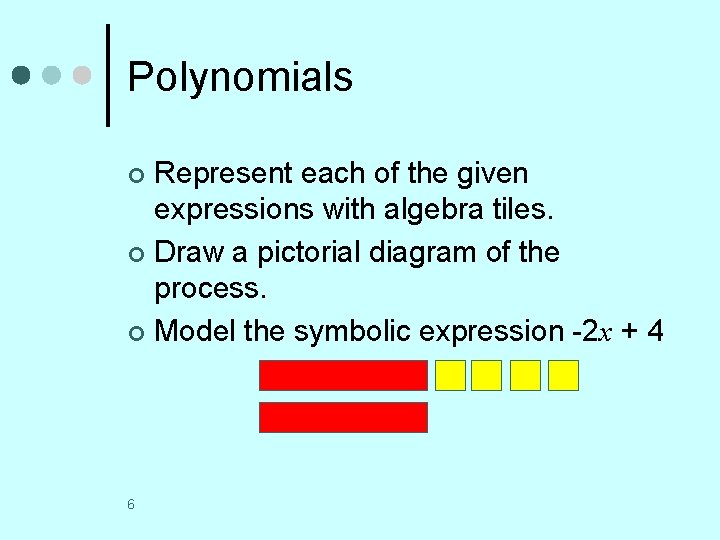
Polynomials Represent each of the given expressions with algebra tiles. ¢ Draw a pictorial diagram of the process. ¢ Model the symbolic expression -2 x + 4 ¢ 6
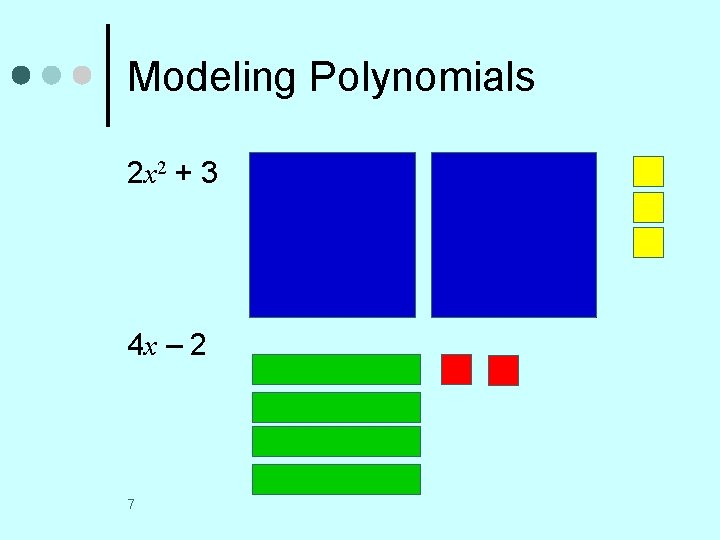
Modeling Polynomials 2 x 2 + 3 4 x – 2 7
Multiplying Polynomials Algebra tiles can be used to multiply polynomials. ¢ Use tiles and frame to represent the problem. The factors will form the dimensions of the frame. (vertical) and (horizontal) ¢ The product will form a rectangular array inside frame. “Area Model” ¢ 8
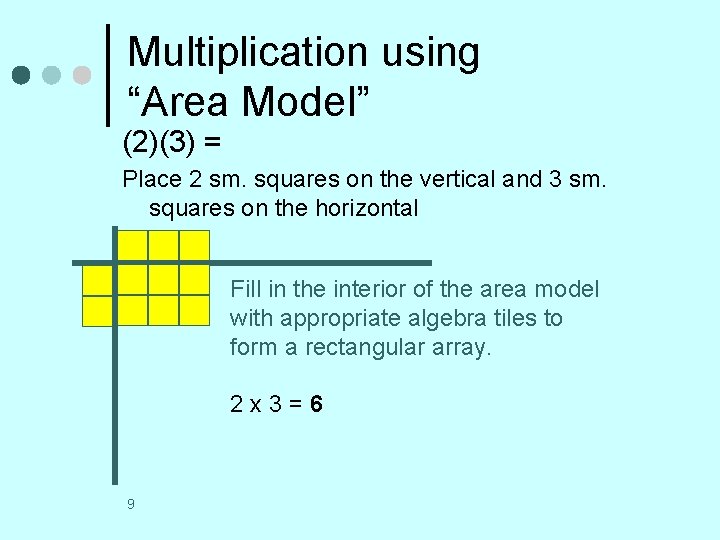
Multiplication using “Area Model” (2)(3) = Place 2 sm. squares on the vertical and 3 sm. squares on the horizontal Fill in the interior of the area model with appropriate algebra tiles to form a rectangular array. 2 x 3=6 9
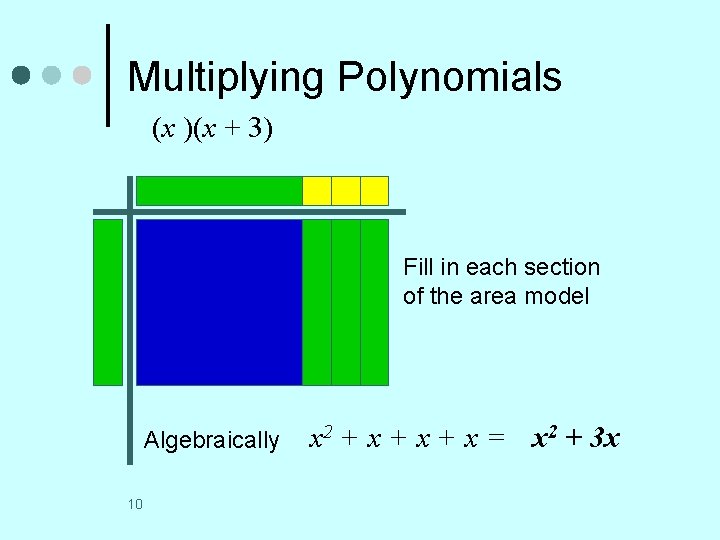
Multiplying Polynomials (x )(x + 3) Fill in each section of the area model Algebraically 10 x 2 + x + x = x 2 + 3 x
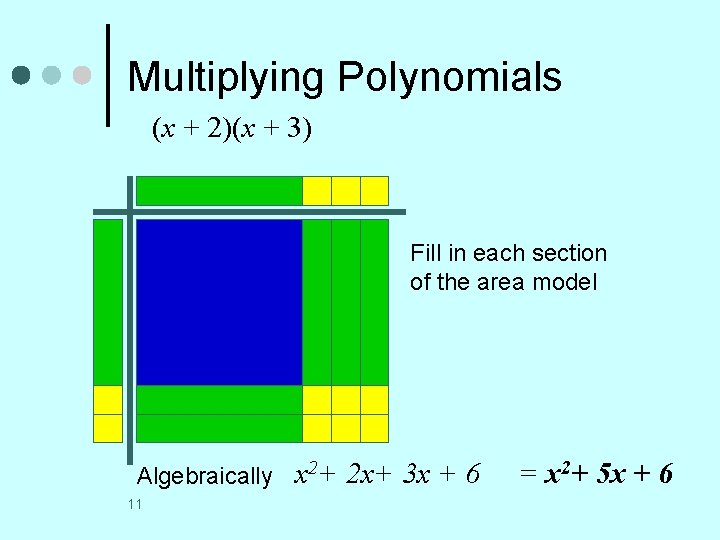
Multiplying Polynomials (x + 2)(x + 3) Fill in each section of the area model Algebraically 11 x 2+ 2 x+ 3 x + 6 = x 2+ 5 x + 6
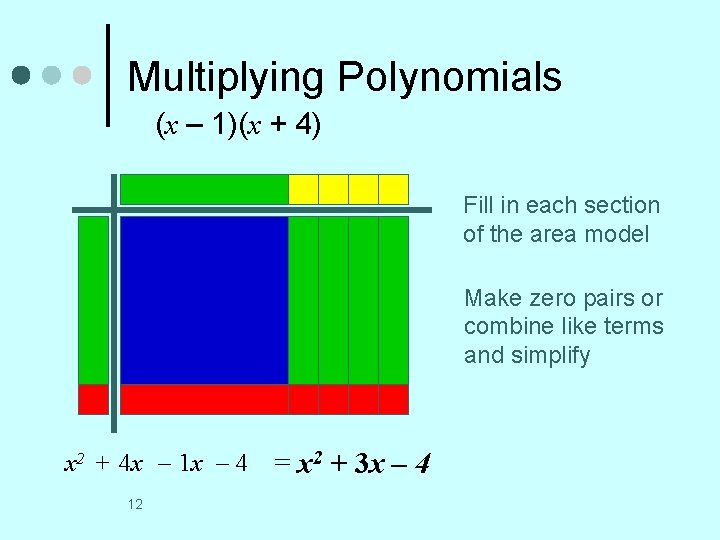
Multiplying Polynomials (x – 1)(x + 4) Fill in each section of the area model Make zero pairs or combine like terms and simplify x 2 + 4 x – 1 x – 4 = x 2 + 3 x – 4 12
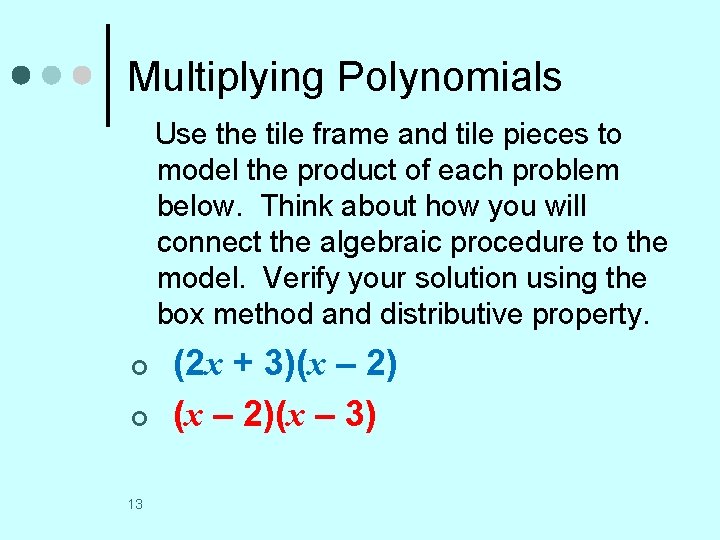
Multiplying Polynomials Use the tile frame and tile pieces to model the product of each problem below. Think about how you will connect the algebraic procedure to the model. Verify your solution using the box method and distributive property. ¢ ¢ 13 (2 x + 3)(x – 2)(x – 3)
Virtual Algebra Tiles http: . . media. mivu. org/mvu_pd/a 4 a/homework/applets_applet_home. html 14
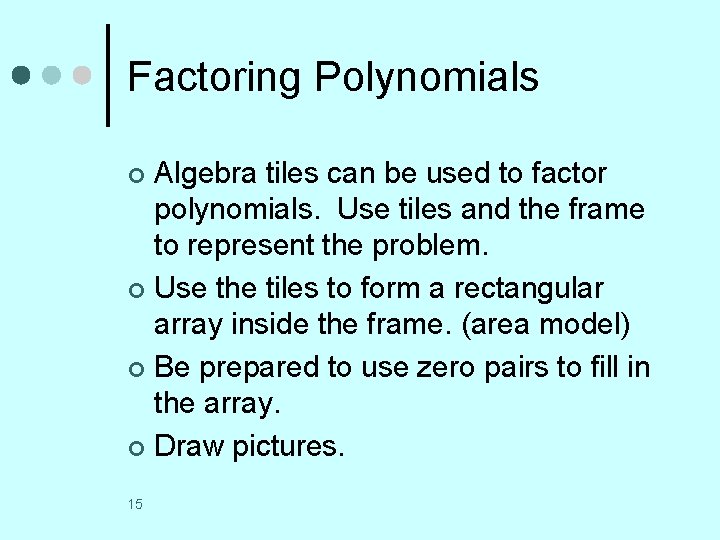
Factoring Polynomials Algebra tiles can be used to factor polynomials. Use tiles and the frame to represent the problem. ¢ Use the tiles to form a rectangular array inside the frame. (area model) ¢ Be prepared to use zero pairs to fill in the array. ¢ Draw pictures. ¢ 15
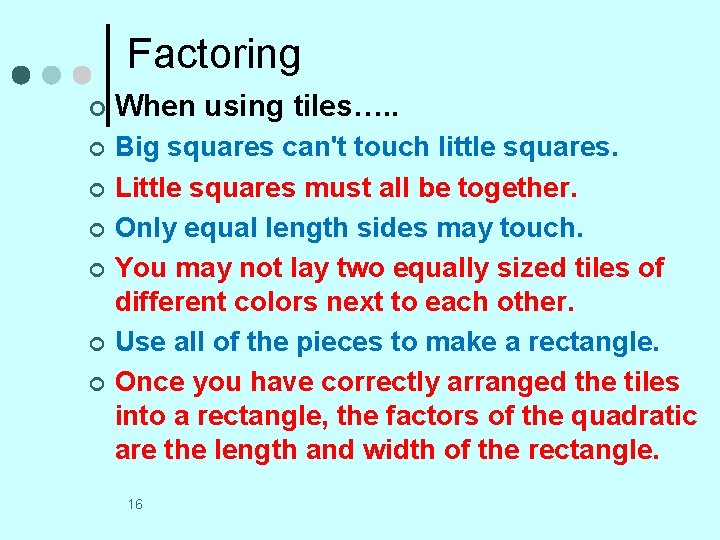
Factoring ¢ When using tiles…. . ¢ Big squares can't touch little squares. Little squares must all be together. Only equal length sides may touch. You may not lay two equally sized tiles of different colors next to each other. Use all of the pieces to make a rectangle. Once you have correctly arranged the tiles into a rectangle, the factors of the quadratic are the length and width of the rectangle. ¢ ¢ ¢ 16
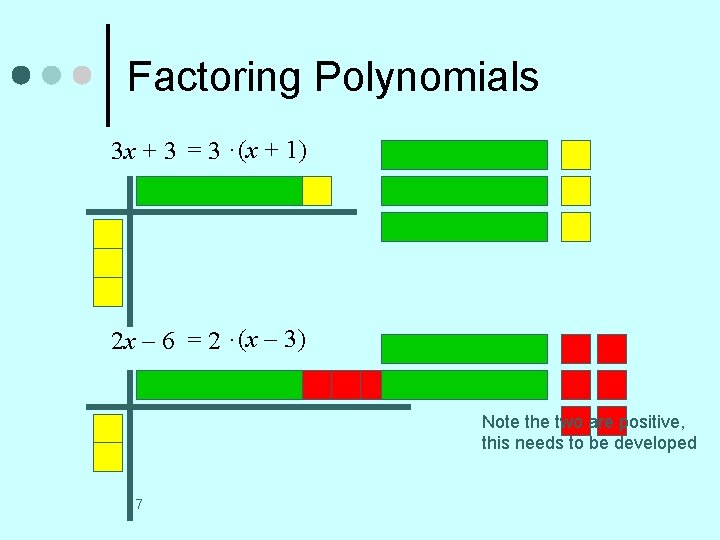
Factoring Polynomials 3 x + 3 = 3 · (x + 1) 2 x – 6 = 2 · (x – 3) Note the two are positive, this needs to be developed 17
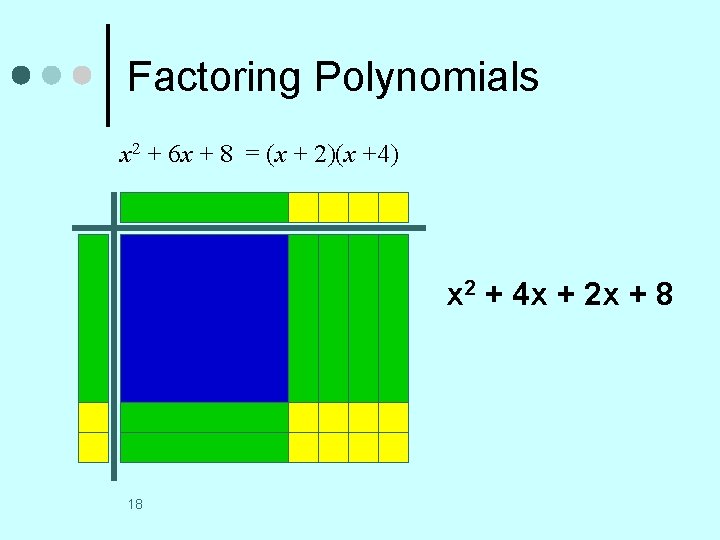
Factoring Polynomials x 2 + 6 x + 8 = (x + 2)(x +4) x 2 + 4 x + 2 x + 8 18
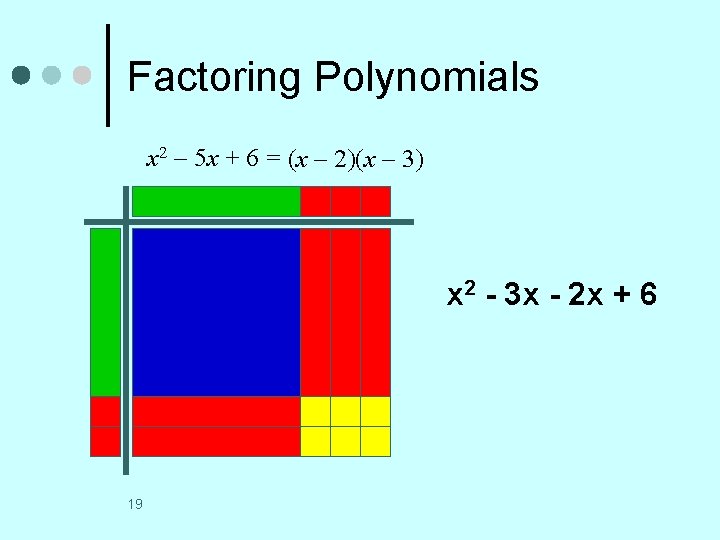
Factoring Polynomials x 2 – 5 x + 6 = (x – 2)(x – 3) x 2 - 3 x - 2 x + 6 19
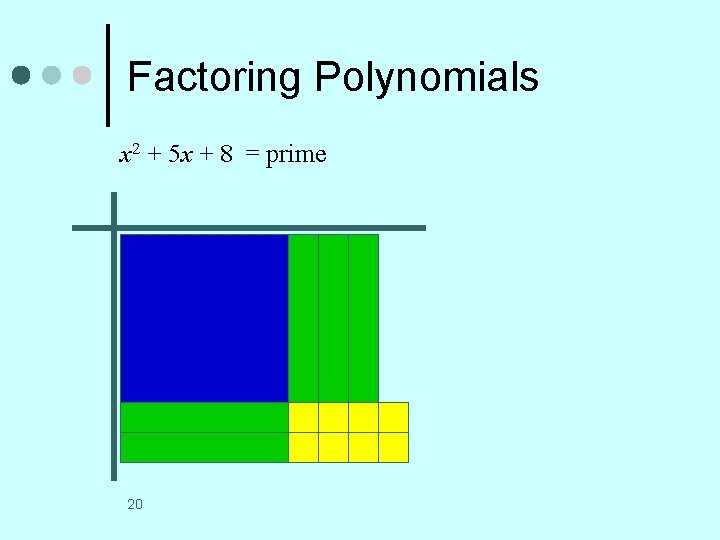
Factoring Polynomials x 2 + 5 x + 8 = prime 20
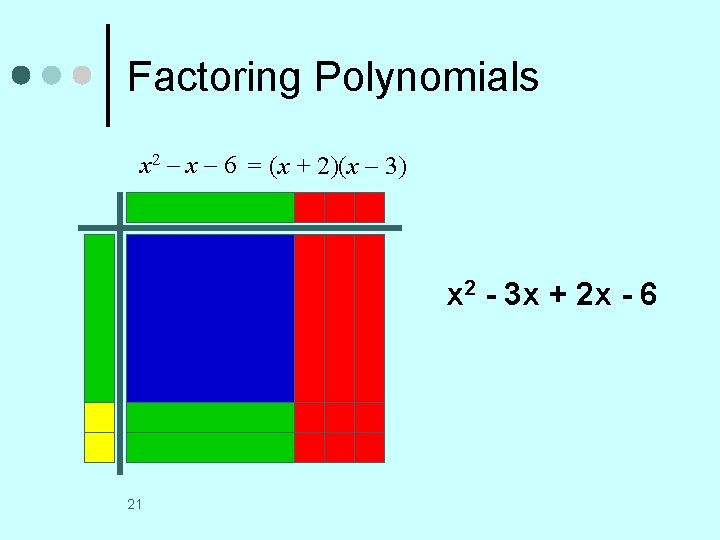
Factoring Polynomials x 2 – x – 6 = (x + 2)(x – 3) x 2 - 3 x + 2 x - 6 21
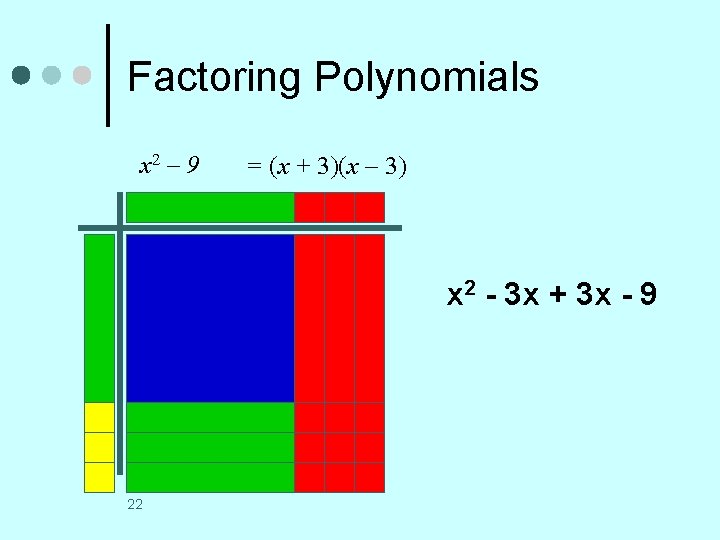
Factoring Polynomials x 2 – 9 = (x + 3)(x – 3) x 2 - 3 x + 3 x - 9 22
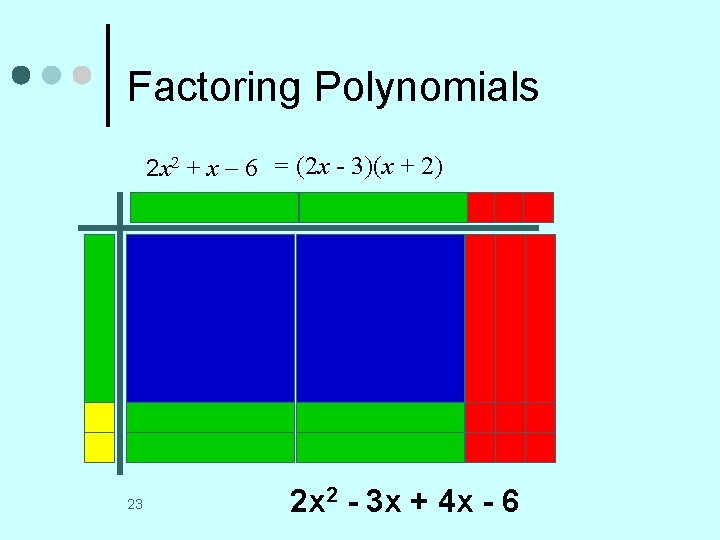
Factoring Polynomials 2 x 2 + x – 6 = (2 x - 3)(x + 2) 23 2 x 2 - 3 x + 4 x - 6
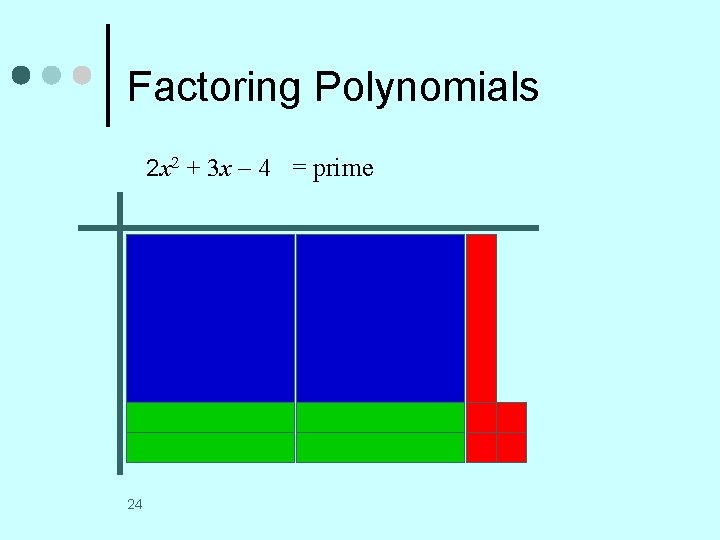
Factoring Polynomials 2 x 2 + 3 x – 4 = prime 24
Virtual Algebra Tiles http: . . media. mivu. org/mvu_pd/a 4 a/homework/applets_applet_home. html 25
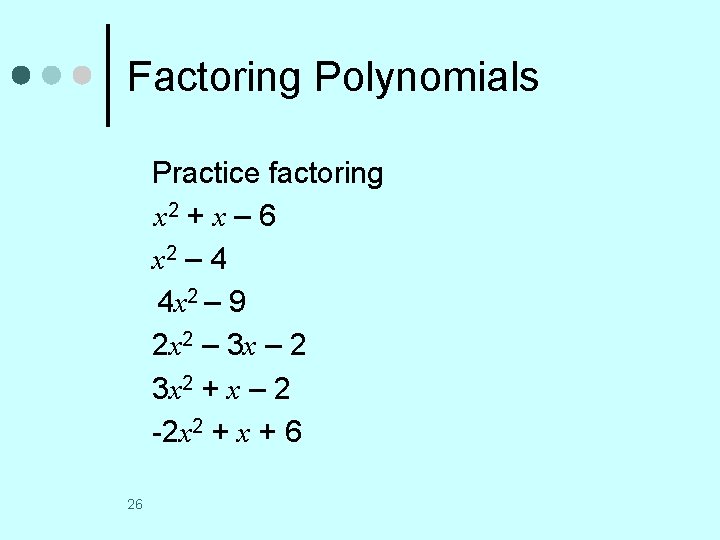
Factoring Polynomials Practice factoring x 2 + x – 6 x 2 – 4 4 x 2 – 9 2 x 2 – 3 x – 2 3 x 2 + x – 2 -2 x 2 + x + 6 26
- Slides: 26