
USING ADULT LEARNING THEORIES TO IMPROVE PRESENTATIONS Sana

- Slides: 47
USING ADULT LEARNING THEORIES TO IMPROVE PRESENTATIONS Sana Loue, J. D. , Ph. D. , M. P. H. , M. S. S. A. , M. A. For Sandplay Therapists of America April 2019
Where are we going? ¡ ¡ ¡ Nature of learning Nature of the learner The context of learning The learning process The educator
NATURE OF LEARNING ¡ All human activities occur in cultural context ¡ Many levels of interactions, shared beliefs, values, knowledge, skills, structured relationships, symbol systems ¡ Interactions and activities mediated through the use of l Technical tools, e. g. , machines, computers Psychological tools, e. g. , language. Writing, strategies for learning l That are provided by the culture l (Vygotsky, 1978, 1999)
How adults learn ¡ https: //www. youtube. com/watch? v =3 Ld. Ew. YDDJBg
Conceptual map ¡ ¡ The nature of the learner The context of the learning The learning process The educator
THE NATURE OF THE LEARNER ¡ ¡ ¡ Andragogy (Knowles, 1980) Characteristics of Adult Learners (Cross, 1981) Self-Directed Learning Theory (Grow, 1991)
Andragogy ¡ Theory originated in Germany ¡ Connected with move to professionalize adult education in US and Europe during latter half of 20 th century
Assumptions underlying andragogy ¡ During process of maturing, individual moves from being dependent personality to being self-directed ¡ Adults accumulate reservoir of experience that serves as a resource for learning ¡ The readiness of an adult to learn is associated with the developmental tasks of his or her social role ¡ Adults experience a change in perspective as they mature, from future application of knowledge to immediacy of application; become more problem-focused than subject-centered in learning
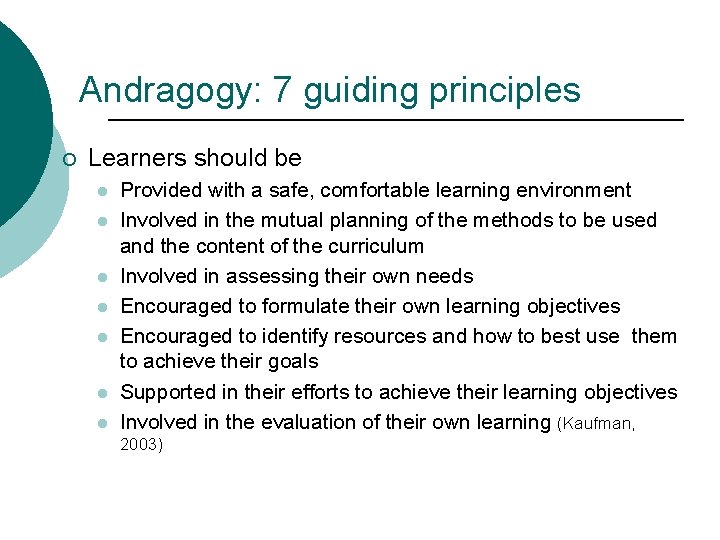
Andragogy: 7 guiding principles ¡ Learners should be l l l l Provided with a safe, comfortable learning environment Involved in the mutual planning of the methods to be used and the content of the curriculum Involved in assessing their own needs Encouraged to formulate their own learning objectives Encouraged to identify resources and how to best use them to achieve their goals Supported in their efforts to achieve their learning objectives Involved in the evaluation of their own learning (Kaufman, 2003)
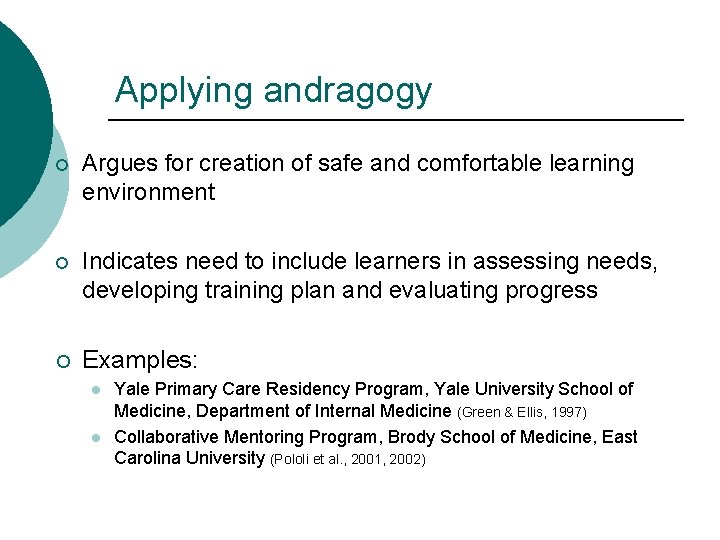
Applying andragogy ¡ Argues for creation of safe and comfortable learning environment ¡ Indicates need to include learners in assessing needs, developing training plan and evaluating progress ¡ Examples: l l Yale Primary Care Residency Program, Yale University School of Medicine, Department of Internal Medicine (Green & Ellis, 1997) Collaborative Mentoring Program, Brody School of Medicine, East Carolina University (Pololi et al. , 2001, 2002)
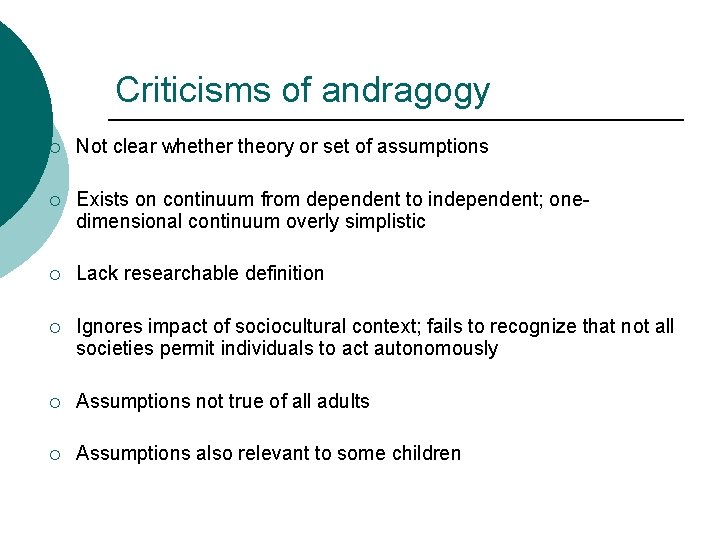
Criticisms of andragogy ¡ Not clear whether theory or set of assumptions ¡ Exists on continuum from dependent to independent; onedimensional continuum overly simplistic ¡ Lack researchable definition ¡ Ignores impact of sociocultural context; fails to recognize that not all societies permit individuals to act autonomously ¡ Assumptions not true of all adults ¡ Assumptions also relevant to some children
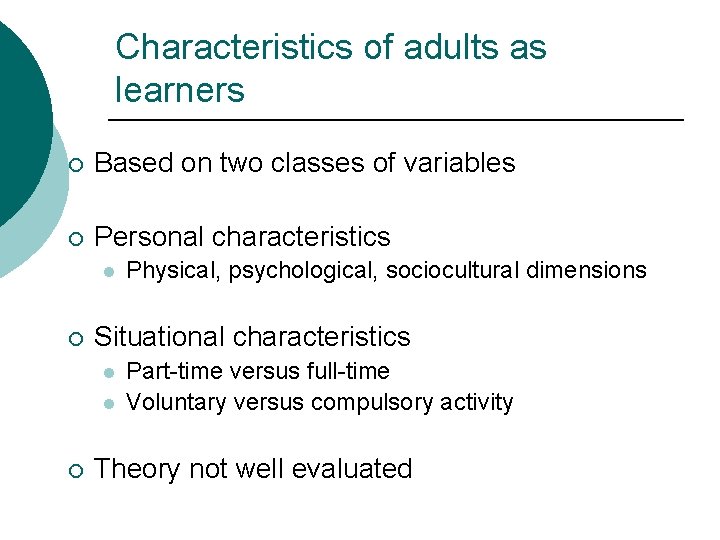
Characteristics of adults as learners ¡ Based on two classes of variables ¡ Personal characteristics l ¡ Situational characteristics l l ¡ Physical, psychological, sociocultural dimensions Part-time versus full-time Voluntary versus compulsory activity Theory not well evaluated
Self-directed learning theory 1. ¡ A process through “which people take the primary initiative for planning, carrying out, and evaluating their own learning experiences” (Merriam & Caffarella, 1999, p. 305) ¡ Goals: l l To develop lifelong, self-directed learners To foster transformational learning
Self-directed learning theory 2. ¡ Teaching varies in response to the learners; good teaching is situational ¡ The extent to which the learner is dependent or self-directed varies with the situation ¡ Dependency and self-direction can be taught and learned ¡ A theory can be useful even if it is not correct ¡ Extent to which a learner is self directed varies along spectrum from dependent (stage 1) to self-directed (stage 4); teacher should try to accommodate learner at each of these stages
Self-directed learning models ¡ ¡ ¡ Sequential (process) Interwoven (learner) Instructional
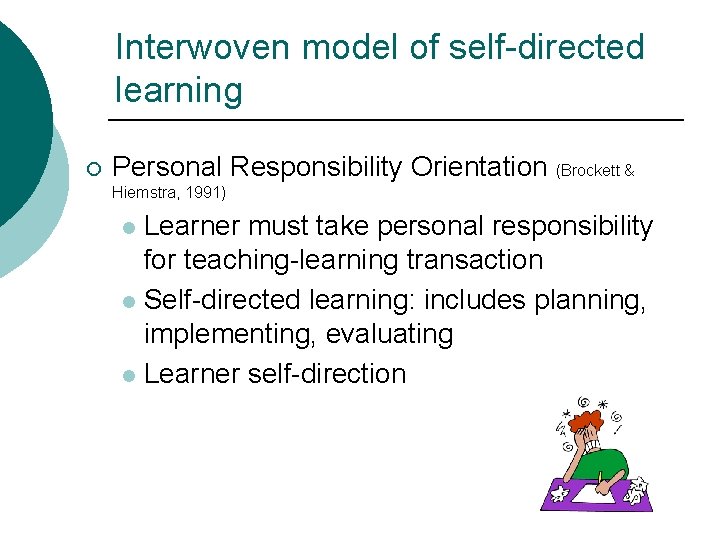
Interwoven model of self-directed learning ¡ Personal Responsibility Orientation (Brockett & Hiemstra, 1991) Learner must take personal responsibility for teaching-learning transaction l Self-directed learning: includes planning, implementing, evaluating l Learner self-direction l
Applying self-directed learning theory ¡ Places primary responsibility for learning on the learner ¡ Encourages instructor to foster increasing learner autonomy and skill acquisition ¡ Example: Collaborative Mentoring Program, Brody School of Medicine, East Carolina University (Pololi et al. , 2001, 2002)
Criticisms of self-directed learning theory ¡ Reflects White, Western values of independence and autonomy
THE CONTEXT OF THE LEARNING ¡ ¡ Theory of Margin (Mc. Clusky, 1963, 1970, 1971) Proficiency Theory (Knox, 1980)
Theory of margin ¡ Adults seeks balance between amount of energy needed and amount available l ¡ ¡ ¡ Conceptualized as ratio between load of life, which dissipates energy, and power of life, which allows individual to deal with the load Margin in life= power of life - load of life Control Margin by modifying Load and/or Power Greater the Margin, the more likely the learner is to learn, be creative, take risks
Proficiency theory: Proficiency ¡ Proficiency: “the capability to perform satisfactorily if given the opportunity” (Knox, 1980, p. 378) l l Involves knowledge, attitude, and skill Interest in enhanced proficiency facilitates persistence in productive learning activities
Proficiency theory: Adult learning ¡ Developmental: learning integral to internal and external changes as individuals age ¡ Transactional: individuals interact with environment and individuals in the learning environment ¡ Interactive components: General environment, past and current characteristics, performance, aspiration, self, discrepancies, Specific environments, learning activity, and teacher role
THE LEARNING PROCESS ¡ Theory of Perspective Transformation (Mezirow, 1981) ¡ ¡ Theory of Conscientization (Freire, 1970) Kolb’s Process of Learning (1971) Curry’s Onion Model (1983, 1987) Honey & Mumford’s Model of Experiential Learning (Honey & Mumford, 1992; Mumford, 1985)
Theory of perspective transformation ¡ New learning transforms existing knowledge into new perspective, thereby emancipating the learner ¡ Ultimate goal: To become aware of cultural assumptions governing rules, roles, conventions, and social expectations that dictate how we see, feel, think, act ¡ Process often begins with disorienting event that results in individuals questioning their underlying assumptions ¡ Process is irreversible
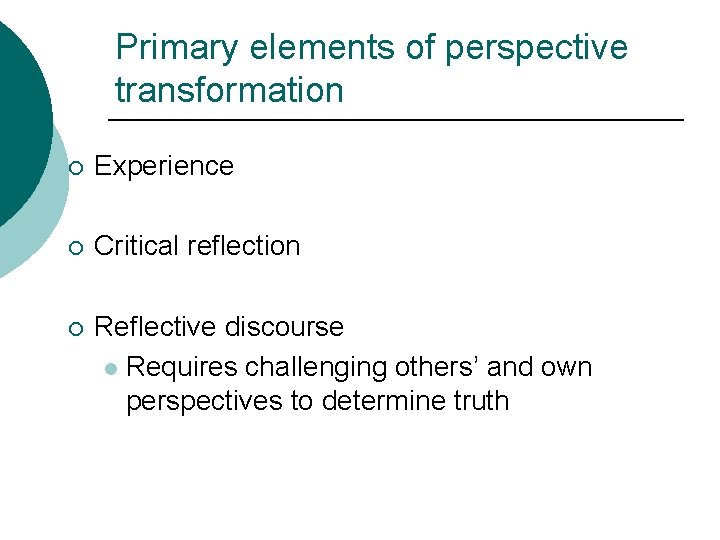
Primary elements of perspective transformation ¡ Experience ¡ Critical reflection ¡ Reflective discourse l Requires challenging others’ and own perspectives to determine truth
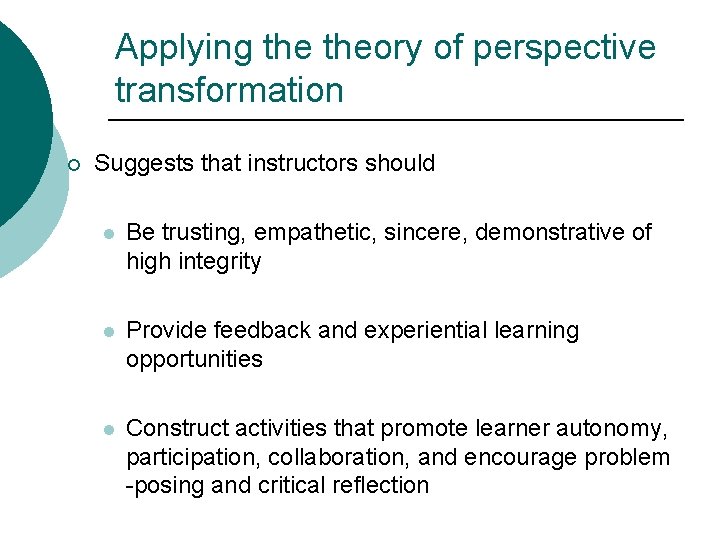
Applying theory of perspective transformation ¡ Suggests that instructors should l Be trusting, empathetic, sincere, demonstrative of high integrity l Provide feedback and experiential learning opportunities l Construct activities that promote learner autonomy, participation, collaboration, and encourage problem -posing and critical reflection
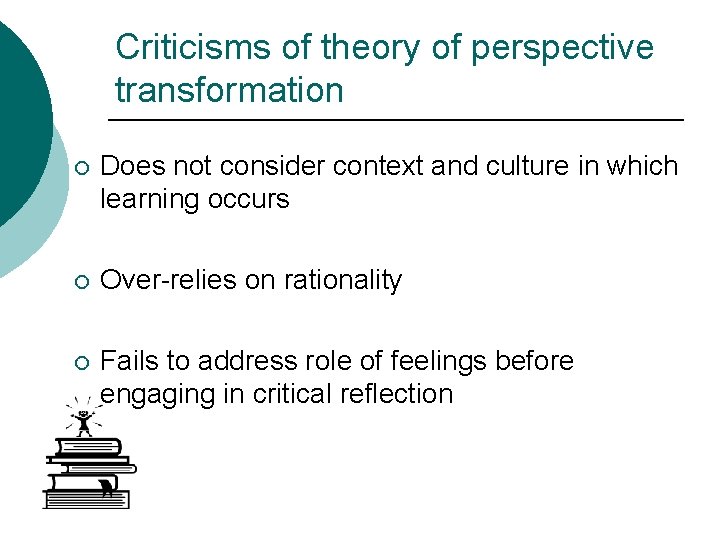
Criticisms of theory of perspective transformation ¡ Does not consider context and culture in which learning occurs ¡ Over-relies on rationality ¡ Fails to address role of feelings before engaging in critical reflection
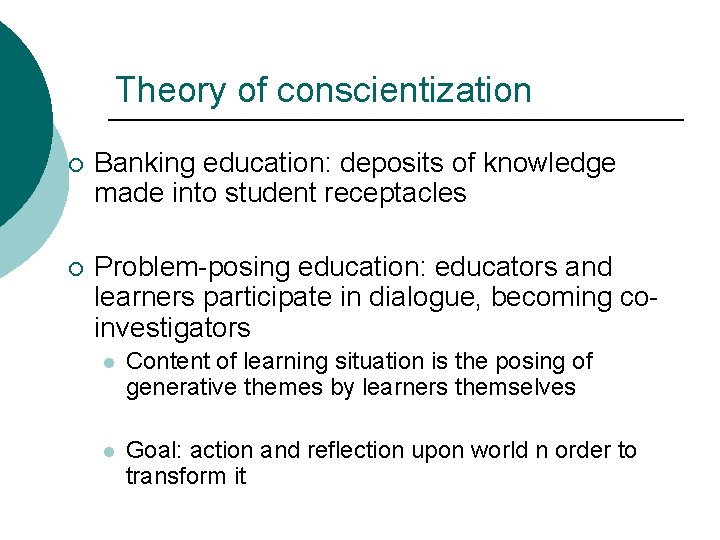
Theory of conscientization ¡ Banking education: deposits of knowledge made into student receptacles ¡ Problem-posing education: educators and learners participate in dialogue, becoming coinvestigators l Content of learning situation is the posing of generative themes by learners themselves l Goal: action and reflection upon world n order to transform it
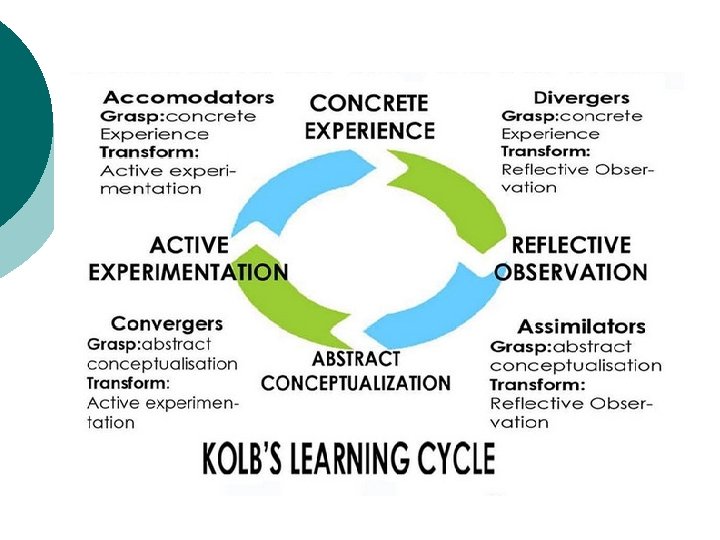
Kolb’s process of learning 1. ¡ Learning: “process whereby knowledge is created through the transformation of experience” ¡ Two dimensions required for learning: l l ¡ A grasping, perceiving medium A processing, transforming medium Learning occurs as a result of the way people perceive an process information, making it their knowledge
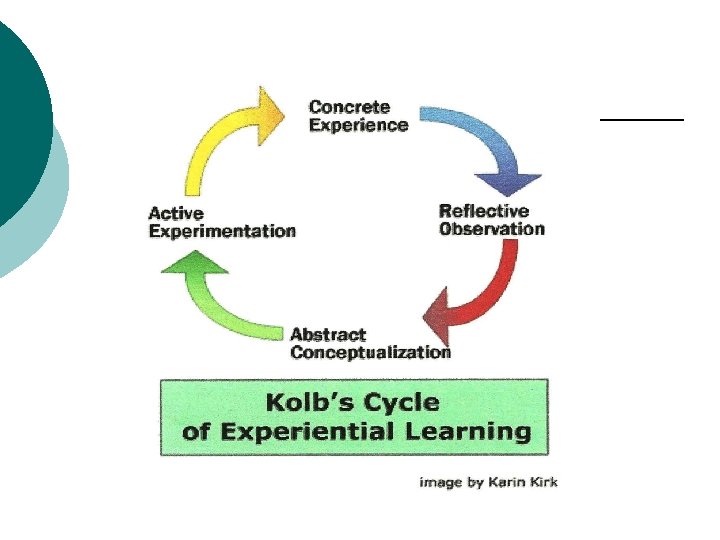
Kolb’s process of learning 2. ¡ Cyclical process that considers the learning style of the learner l l Learner has a concrete experience Experience is observed and reflected upon Experience is abstracted, conceptualized, and generalized Generalization is tested in new situations, leading to a new concrete experience
How Kolb’s cycle works ¡ https: //www. youtube. com/watch? v =Ob. Q 2 Dhe. GOKA
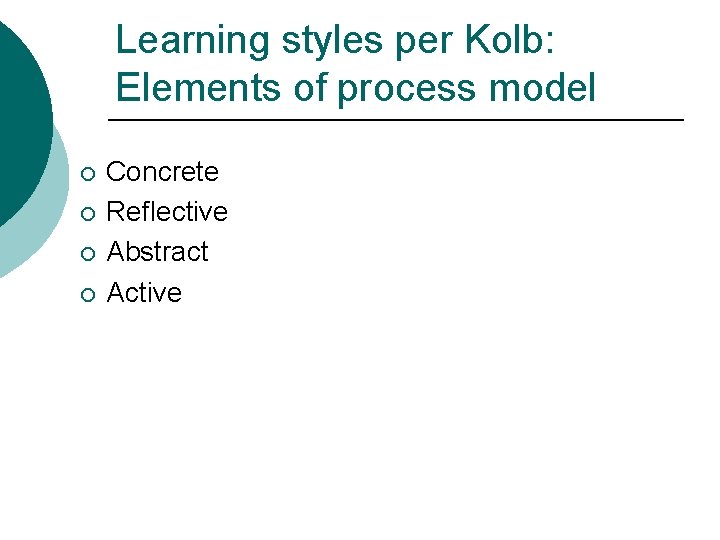
Learning styles per Kolb: Elements of process model ¡ ¡ Concrete Reflective Abstract Active
Kolb’s model ¡ Learning style as relatively consistent response to and use of stimuli in context of learning ¡ Ideally learner utilizes four different kinds of abilities ¡ Course design, class session, educational program can be assessed with respect to degree to which is oriented toward each of four learning modes ¡ Ideal environment accommodates all four styles ¡ Knowledge of learning style particularly helpful in context of mentoring and advising
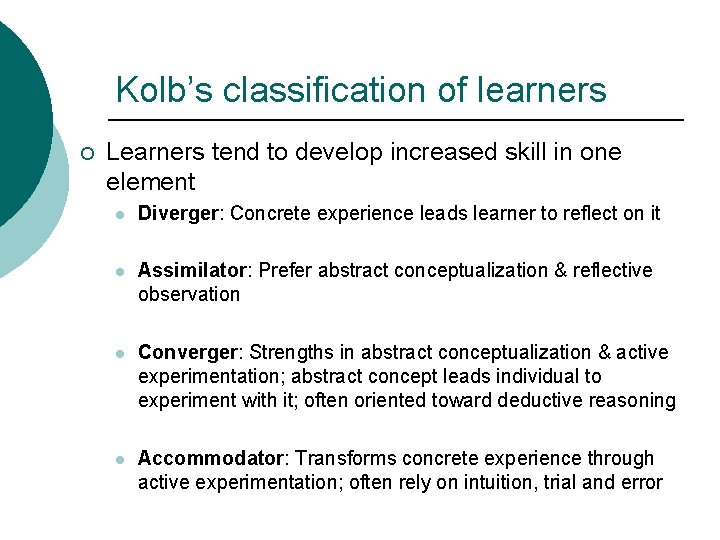
Kolb’s classification of learners ¡ Learners tend to develop increased skill in one element l Diverger: Concrete experience leads learner to reflect on it l Assimilator: Prefer abstract conceptualization & reflective observation l Converger: Strengths in abstract conceptualization & active experimentation; abstract concept leads individual to experiment with it; often oriented toward deductive reasoning l Accommodator: Transforms concrete experience through active experimentation; often rely on intuition, trial and error
Designing a course/session based on Kolb ¡ Requires sequential movement through various approaches l l ¡ Activate learner’s prior knowledge Provide learner with new knowledge Facilitate learner’s movement from theory to practice by having learner apply new knowledge in safe environment Commitment by learner to utilize new behavior Suggests need for instruction to encompass learning opportunities that focus on: l l l Skills Behaviors Attitudes
Curry’s onion model ¡ ¡ Level of stability increases and susceptibility to external events decreases from outermost layer of model to innermost layer Four layer mode l l Instructional process: preferred mode of learning in specific situations Social interaction: individual’s preference relating to social interaction during learning process Information process style: how individuals assimilate information through orienting, sensory loading, short-term memory, enhanced association, coding, long-term storage Cognitive personality style: how individuals adapt information as it has been assimilated through information processing style
Model of experiential learning ¡ Each experiential learning style reflects a particular stage in the learning cycle ¡ Four types of learners: l l Activists: corresponds to having an experience; appreciates challenge of new experience; engages with people Reflectors: collect and analyze data before making decisions or pursuing course of action; more likely to observe than take active role Theorists: focus on theories, models, systems; value rationality and logic, dislike ambiguity Pragmatists: view problems as challenges; actively pursue new solutions; eager to experiment
THE LEARNER AND THE EDUCATOR: Rogerian theory ¡ Advocated establishment of conditions that facilitate student development of “inward freedom” ¡ Ultimate goal is transformation of both student and instructor
Rogerian theory: Role of instructor ¡ ¡ ¡ Presents learner with real problem that has meaning and relevance to learner Trusts in capacity of student to develop their own potentiality Accepts and values the worth of each student Is empathic; understands how the process of education and learning appears to the learner Provides necessary resources, including access to other individuals “Guide on the side” rather than “sage on the stage”
Applying Rogerian theory ¡ Encourages instructor to present learners with relevant problems and challenges l l ¡ ¡ ¡ Engage learners Pose provocative questions Underscores need to provide learner with necessary resources and opportunities to be successful Encourages learner to utilize problem-solving strategies Example: Collaborative Mentoring Program, Brody School of Medicine, East Carolina University (Pololi et al. , 2001, 2002)
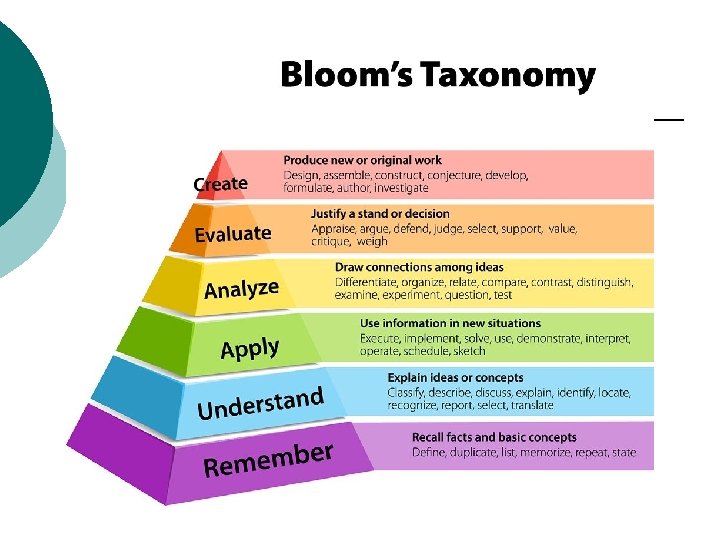
Applying theory to presentations ¡ ¡ ¡ ¡ Create a safe space Use multiple modalities Relevant topic and presentation Involve learners in the learning Consider learner level Consider sociocultural context Target specific levels of learning
Helpful resources ¡ ¡ Kolb learning style questionnaire: http: //www. bunbury. wa. gov. au/pdf/envir onment/u 472/Appendix%2019%20 U 472 %20 Community%20 Facilitator%20 Kolb% 20 Questionnaire%20 Final. pdf Learning Style Inventory: http: //med. fau. edu/students/md_m 1_orie ntation/M 1%20 Kolb%20 Learning%20 Styl e%20 Inventory. pdf