
Using ACT to Improve Management of Chronic Pain
- Slides: 44
Using ACT to Improve Management of Chronic Pain in Primary Care Patricia J. Robinson, Ph. D Mountainview Consulting Group behavioral-health-integration. com patti 1510@msn. com (509)307 -5333 1
Workshop Overview Learn strategies for teaching ACT to medical colleagues Based on an ACT conceptualization of experience of chronic pain in the primary care setting Learn techniques for using ACT in monthly primary care classes, and ways to integrate the class into a primary care pathway approach to delivering services Learn strategies for preventing onset of chronic pain 2
Abbreviations & Definitions PCP= primary care provider PC= primary care BHC= behavioral health consultant “Addiction”= impaired control, compulsive use, cont’d use despite harm, cravings “Dependence”= state of adaptation manifested by a withdrawal syndrome if the drug is decreased/stopped “Chronic pain”= noncancer pain lasting > 3 months “Misuse”=unintended use (recreation, give away, sell) ACT=Acceptance and Commitment Therapy 3
Chronic Pain in PC: Basic Info 10 -20% of PC pts report CP (Guereje et al. , 1988) 14% of PC pts with CP need tx for it (Smith et al. , 2001) Most CP pts are treated in PC (Khouzam, 2000; Olsen & Daumit, 2002) and the number is rising Mismatch between patient expectations and PC and BH abilities, resulting in relationship problems HC Resources limited, specialty services often inaccessible 4
Chronic Pain in PC: Basic Info PCP training “sorely lacking” (Olsen & Daumit, 2004) Survey of residents: mean 2. 2 and 2. 3 for preparedness and confidence, respectively, for treating CP (1 -5 scale) (Fagan, 2007) 15% of PCPs feel comfortable with TX of CP (Potter et a, 2001) Lack of specialty help Application bio-medical model which works well with acute problems and many problems with organic basis Time 5
Chronic Pain in PC: Medication TX Info As pain medications become more powerful, pain sensitivity increases Charges of under-treatment of pain Unclear effectiveness after 4 months (Marteil, et al) Studies often show decreased pain but not increased function Studies lacking (use inactive placebos, unclear methods, lack long-term) 6
Chronic Pain in PC: Medication TX Info Addiction and Overuse (self-medicating) 181% increase in opiod abuse in 90 s (NIDA, 2005) 25 -30% of PC pts abuse meds (Chelminski, 2005, Reid, 2002) Diversion and Misuse (recreational) common Fear of DEA is a deterrent to RX’ing (Olsen & Daumit, 2004) (Criminal charges after Oxycontin deaths) 7
Evidence for an ACT Approach to CP: Evidence vs. Experience Attempt to suppress pain tends to increase it (Cioffi & Holloway, 1993) ACT interventions improve tolerance of pain in normal populations more so than CBT interventions (Gutierrez, Luciano, Rodriguez, & Fink, in press; Hayes, Bissett, Korn, Zettle, Rosenfarb, Cooper, & Grundt, 1999) Acceptance accounts for more of variance in outcome on pain, depression, anxiety, disability, vocational functioning, and physical functioning than existing measures of coping with pain (Mc. Cracken & Eccleston, 2003) 8
Physical damage bears little relation to amount of pain and relationship between functioning and pain is weak; willingness to experience pain and ability to act in a valued direction while experiencing pain predicts functioning (Mc. Cracken, Vowles, &Eccleston, 2004, later in week at conference!) Supportive uncontrolled studies of ACT-based pain programs (Robinson & Brockey, 1996) Controlled clinical trials supportive (Dahl, Wilson, & Nilsson, 2007) 9
Experiential Exercise 10
Experiential Exercise 11
Experiential Exercise 12
ACT Perspective: Challenges to PC Management of Chronic Pain Primary care providers struggle with problematic relational frames Primary value is to help (most compassionate sometimes most vulnerable) Lack of training and lack of positive impact promotes avoidance (“Oh my gosh, Mr. X is here again, and I have no idea. . . ”) Limited time Limited resources for responding to demanding and/or aggressive pt behavior (often no BH provider on team) 13
ACT Perspective: Challenges to PC Management of Chronic Pain Patients with (vulnerability to) chronic pain Have histories consistent with development of problematic relational frames Lack of control and danger (trauma backgrounds) Negative mood states and avoidant response strategies (withdraw when “down”) Use of alcohol / drugs to avoid suffering Victim, aggressor perspective (right / wrong) Limited skills for mindfulness and acceptance Limited support for value-consistent actions 14
ACT Perspective: Challenges to PC Management of Chronic Pain Medications (oral and other) have problematic relational frames “Magic” and often free “Happy” pills “Holding the wolf at the door” “More would be better” 15
ACT Perspective: Challenges to PC Management of Chronic Pain detection and elimination are foci of primary care services The Fifth Vital Sign Medical Model (search for organic basis) Often delays between transition from treating acute pain to treating chronic pain (awaiting specialist care) Pt practices avoidance strategies Pt’s behavior becomes less consistent with values 16
ACT Perspective: Challenges to PC Management of Chronic Pain Chronic pain is pain and unwillingness to have it Distress prominent in patient presentation Acute to chronic phase: More anxious Chronic: More depressed, angry, demanding, dull 17
An ACT Perspective on Challenges to PC Management of Chronic Pain Tendency for treatment of chronic pain to be some one else’s job Referral to specialist (curative) Specialist return of pt to primary care Referral to pain clinic Pain clinic return of pt to primary care Tendency to see chronic pain treatment problems to be due to care delivered by someone else Initial or previous prescriber of pain medications Failed back surgery Labor & Industry open claims 18
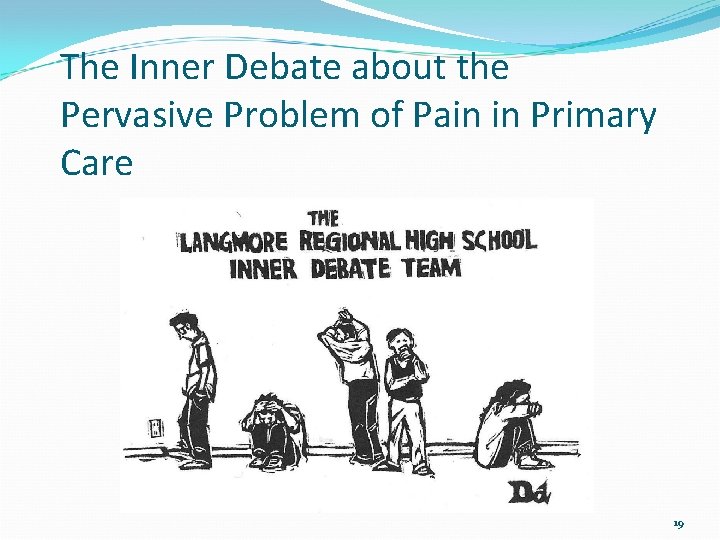
The Inner Debate about the Pervasive Problem of Pain in Primary Care 19
Teaching ACT to PC Providers: The Problem Fusion (attachment to scary and/or depressing thoughts, pt and provider) Evaluation of pain/fear/discouragement/ depression in good-bad terms (pt and provider) Avoidance of unwanted private experience (pt: victim or aggressor behavior, provider: hand on the door) Reason giving to explain behavioral excesses or deficits (pt: The pain/provider – is the reason --- for X; PC provider: The pt is – difficult –a tx failure, a drug seeker, etc. ) 20
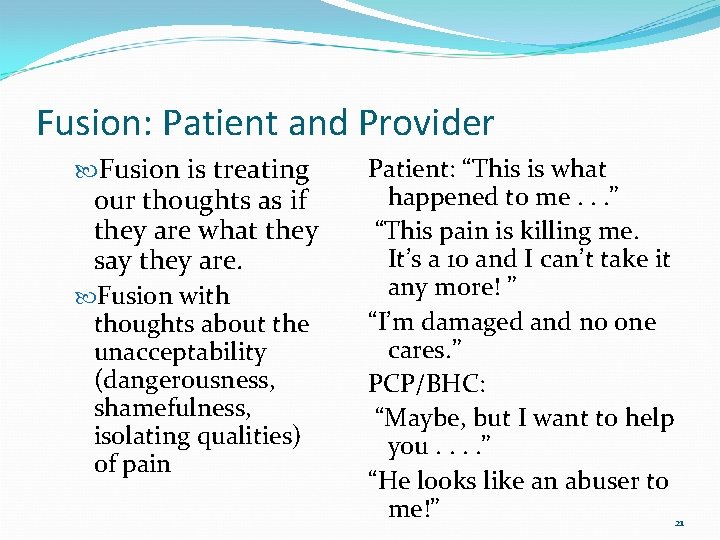
Fusion: Patient and Provider Fusion is treating our thoughts as if they are what they say they are. Fusion with thoughts about the unacceptability (dangerousness, shamefulness, isolating qualities) of pain Patient: “This is what happened to me. . . ” “This pain is killing me. It’s a 10 and I can’t take it any more! ” “I’m damaged and no one cares. ” PCP/BHC: “Maybe, but I want to help you. . ” “He looks like an abuser to me!” 21
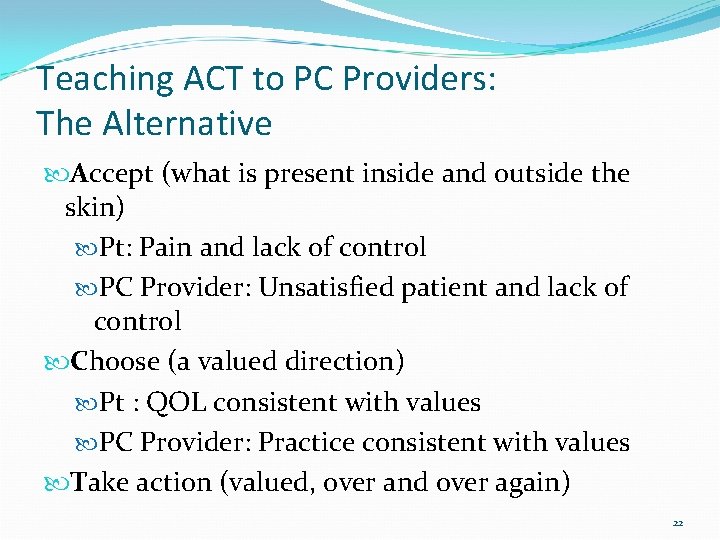
Teaching ACT to PC Providers: The Alternative Accept (what is present inside and outside the skin) Pt: Pain and lack of control PC Provider: Unsatisfied patient and lack of control Choose (a valued direction) Pt : QOL consistent with values PC Provider: Practice consistent with values Take action (valued, over and over again) 22
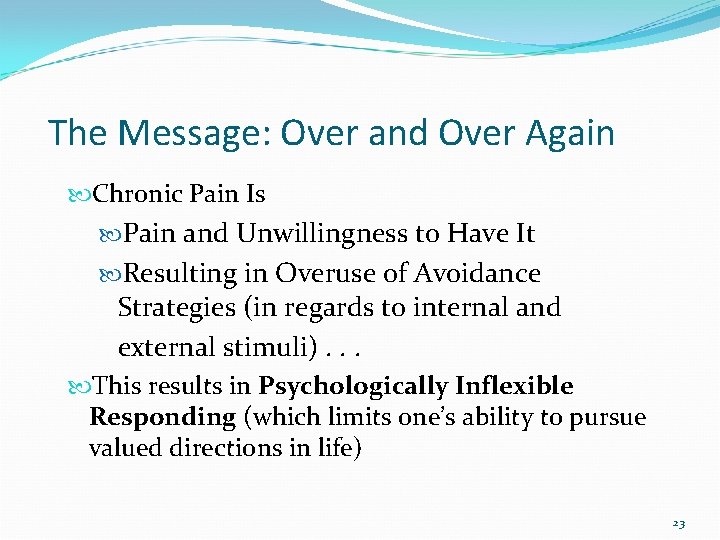
The Message: Over and Over Again Chronic Pain Is Pain and Unwillingness to Have It Resulting in Overuse of Avoidance Strategies (in regards to internal and external stimuli). . . This results in Psychologically Inflexible Responding (which limits one’s ability to pursue valued directions in life) 23
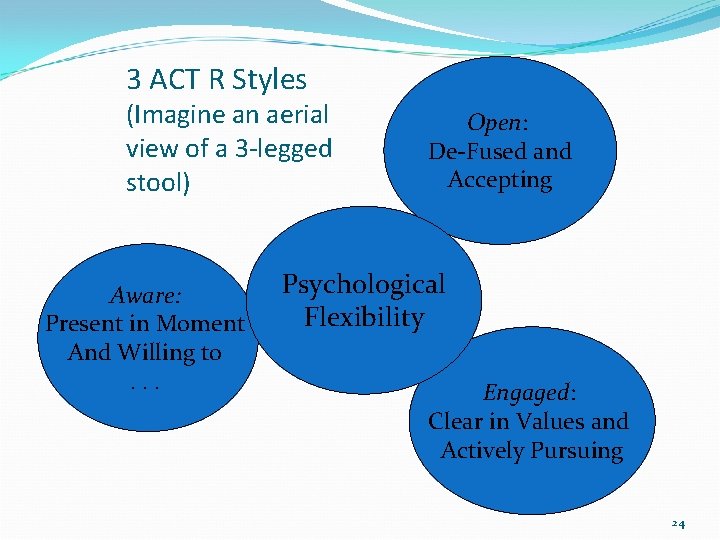
3 ACT R Styles (Imagine an aerial view of a 3 -legged stool) Aware: Present in Moment And Willing to. . . Open: De-Fused and Accepting Psychological Flexibility Engaged: Clear in Values and Actively Pursuing 24
Open: Defused and Accepting Hands to face and breathing them out Nose on computer and breathing self out 2 feet On-going 5 minute morning practice (pt at home, MD and RN in clinic) Jotting down thoughts on paper (carrying in pocket of pt coat, provider’s white coat) Physical rope in room (picking up when struggle begins, changing use of space to allow pt and provider to hold it together 25
Aware: Present in Moment and Accepting Breathing together Bowl of chronic pain soup Holding bowl Describing negative thoughts and feelings aloud, as disliked and integral ingredients in soup Songs on a CD played in the clinic Eagle’s Eye view 26
Engaged: Clear in Values and Actively Pursuing Values vs. Goals (Plane Crash on a Dessert Island) Value Statement: Love, Work or Play (Alternatively, Relationships, Health, Work/Study, Play/Spirituality) Bull’s Eye Prescription Pad Consistency pat 2 weeks, consistency score after initiation of ACT strategies Exploration of barriers Teaching ACT skills that address the barriers 27
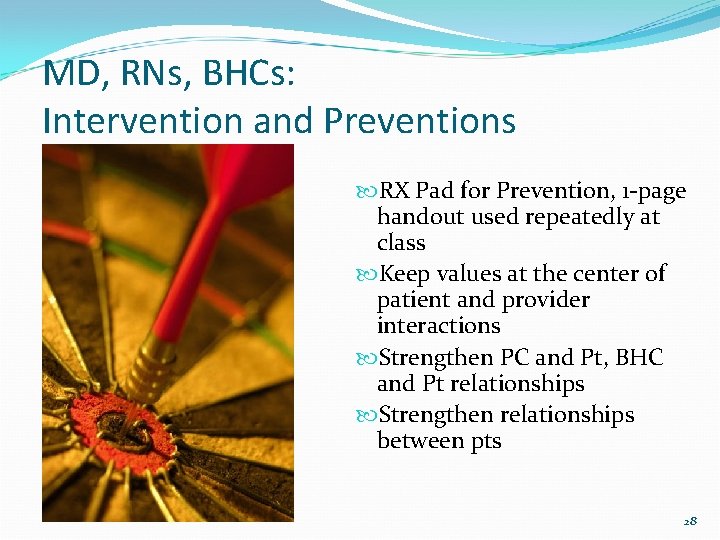
MD, RNs, BHCs: Intervention and Preventions RX Pad for Prevention, 1 -page handout used repeatedly at class Keep values at the center of patient and provider interactions Strengthen PC and Pt, BHC and Pt relationships Strengthen relationships between pts 28
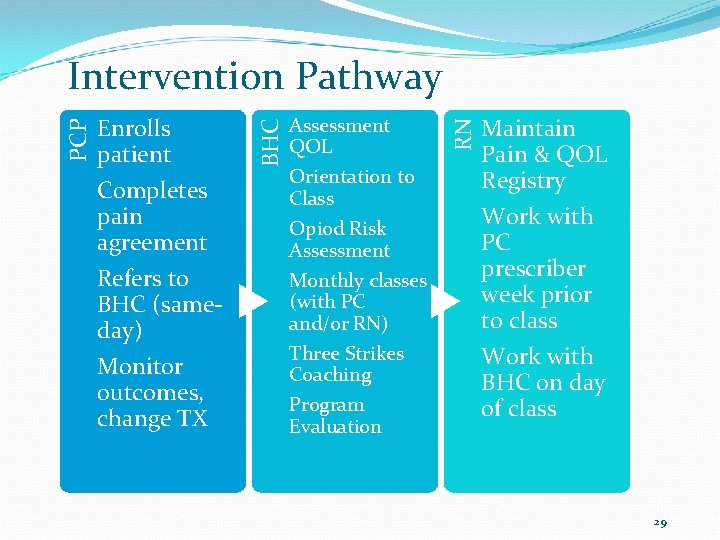
Completes pain agreement Refers to BHC (sameday) Monitor outcomes, change TX Assessment QOL Orientation to Class Opiod Risk Assessment Monthly classes (with PC and/or RN) Three Strikes Coaching Program Evaluation RN Enrolls patient BHC PCP Intervention Pathway Maintain Pain & QOL Registry Work with PC prescriber week prior to class Work with BHC on day of class 29
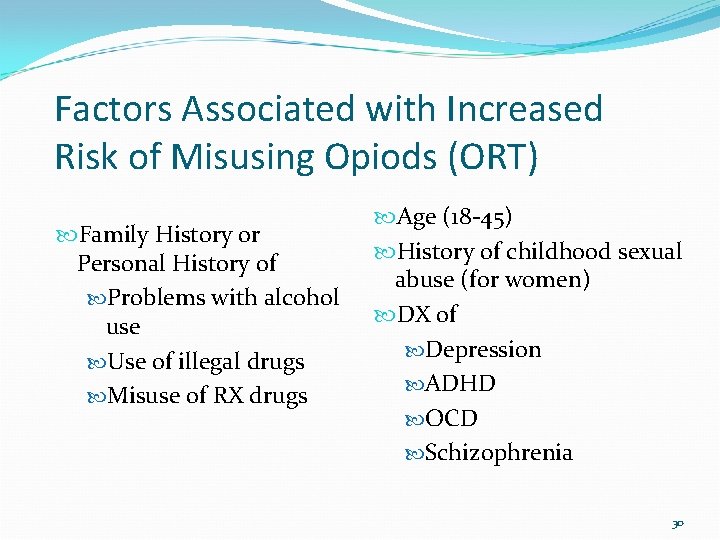
Factors Associated with Increased Risk of Misusing Opiods (ORT) Family History or Personal History of Problems with alcohol use Use of illegal drugs Misuse of RX drugs Age (18 -45) History of childhood sexual abuse (for women) DX of Depression ADHD OCD Schizophrenia 30
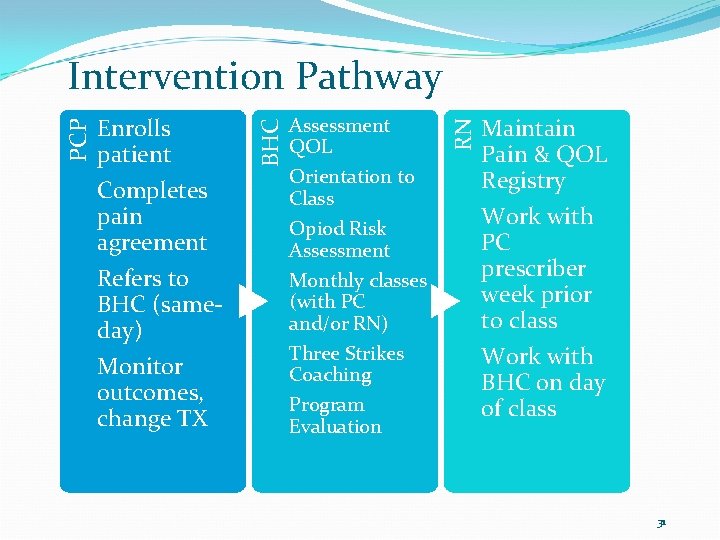
Completes pain agreement Refers to BHC (sameday) Monitor outcomes, change TX Assessment QOL Orientation to Class Opiod Risk Assessment Monthly classes (with PC and/or RN) Three Strikes Coaching Program Evaluation RN Enrolls patient BHC PCP Intervention Pathway Maintain Pain & QOL Registry Work with PC prescriber week prior to class Work with BHC on day of class 31
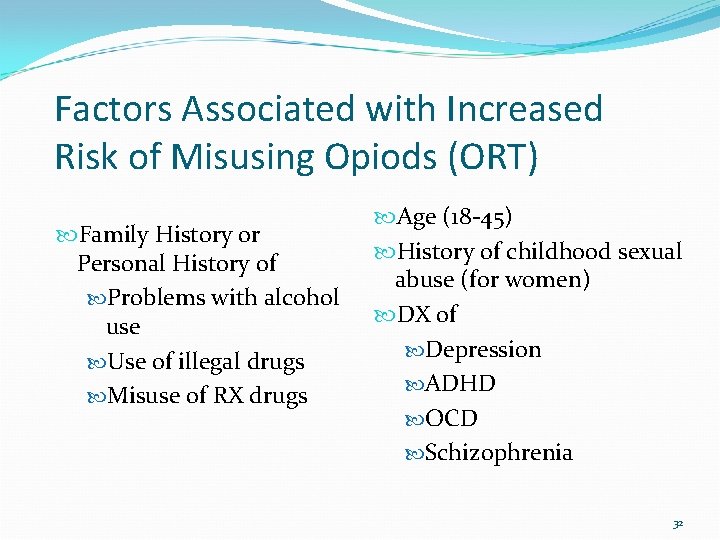
Factors Associated with Increased Risk of Misusing Opiods (ORT) Family History or Personal History of Problems with alcohol use Use of illegal drugs Misuse of RX drugs Age (18 -45) History of childhood sexual abuse (for women) DX of Depression ADHD OCD Schizophrenia 32
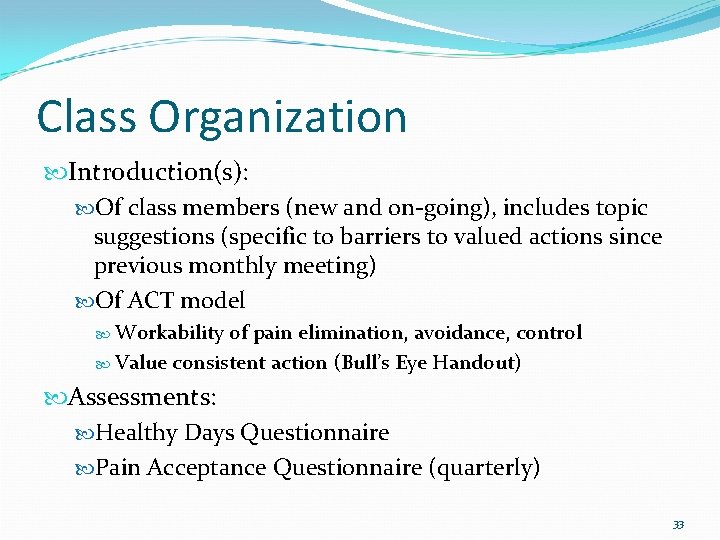
Class Organization Introduction(s): Of class members (new and on-going), includes topic suggestions (specific to barriers to valued actions since previous monthly meeting) Of ACT model Workability of pain elimination, avoidance, control Value consistent action (Bull’s Eye Handout) Assessments: Healthy Days Questionnaire Pain Acceptance Questionnaire (quarterly) 33
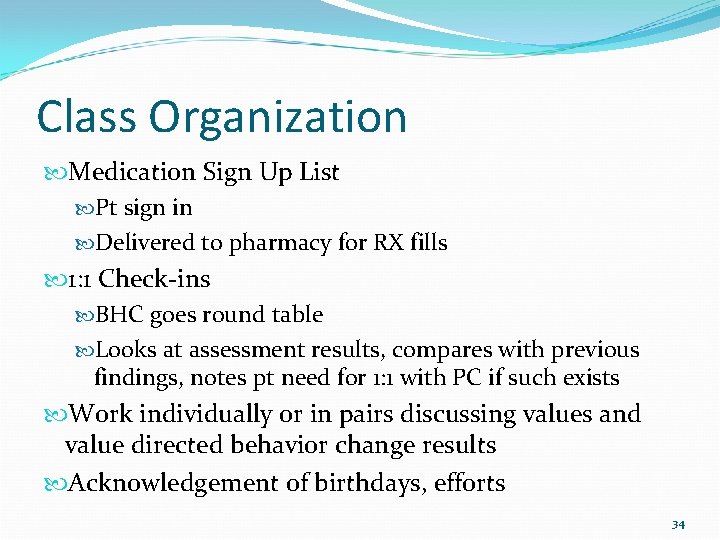
Class Organization Medication Sign Up List Pt sign in Delivered to pharmacy for RX fills 1: 1 Check-ins BHC goes round table Looks at assessment results, compares with previous findings, notes pt need for 1: 1 with PC if such exists Work individually or in pairs discussing values and value directed behavior change results Acknowledgement of birthdays, efforts 34
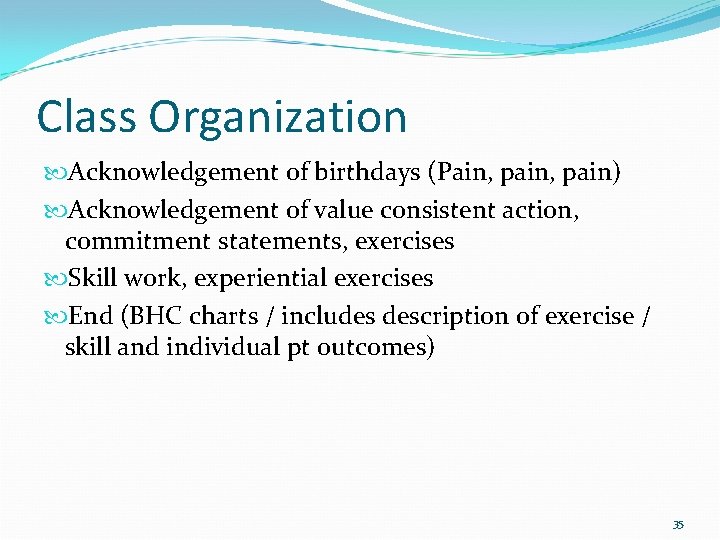
Class Organization Acknowledgement of birthdays (Pain, pain) Acknowledgement of value consistent action, commitment statements, exercises Skill work, experiential exercises End (BHC charts / includes description of exercise / skill and individual pt outcomes) 35
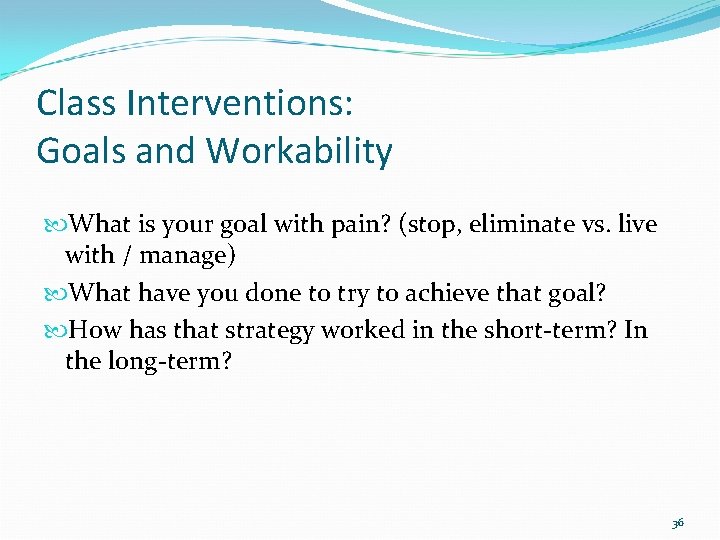
Class Interventions: Goals and Workability What is your goal with pain? (stop, eliminate vs. live with / manage) What have you done to try to achieve that goal? How has that strategy worked in the short-term? In the long-term? 36
Class Interventions: De. Fusion Courage Breath Pain, pain (tune of Happy Birthday) Passengers on a Bus Silent together and holding our thoughts and feelings lightly, like we might hold a crying baby 37
Class Interventions: Observer Self and Mindfulness Observer Self vs. Self as Content (story) Life Circle Time Line Mindfulness Wise Self Eagle River video, Eagle perspective 38
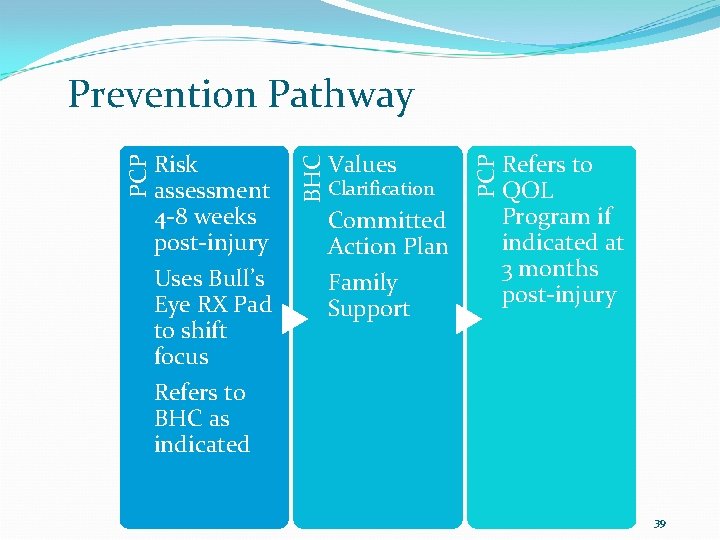
Values Clarification Committed Action Plan Family Support PCP Risk assessment 4 -8 weeks post-injury Uses Bull’s Eye RX Pad to shift focus BHC PCP Prevention Pathway Refers to QOL Program if indicated at 3 months post-injury Refers to BHC as indicated 39
Patient Interventions: Actions Consistent with Values Clarifying values Committed Action Making and implementing behavior change plans that are consistent with values Bull’s Eye 40
Patient Satisfaction 41
PCP Satisfaction 42
PCP Top Ratings Year 1: Able to access effective programs, Have skills to work effectively, Look forward to seeing CP patients Year 4: Able to access effective programs, Pain meds are very helpful, Have skills to work effectively Year 5: Pain meds are very helpful, Able to access effective programs, Have skills to work effectively, I usually have a new idea about how to help my most difficult CP patients 43
Dr. Sauerwein Prevention of chronic pain 44