
Using a multivariate DOE method for congestion study

- Slides: 26
Using a multivariate DOE method for congestion study under impacts of PEVs Hamed V. HAGHI M. A. GOLKAR valizadeh@ieee. org
Frankfurt (Germany), 6 -9 June 2011 Main Topics p General Outline p Design of Experiment (DOE) Technique p Generalized linear model (GLM) p Multivariate DOE by frank Copula p Congestion study p Conclusion Haghi – Iran – RIF Session 5 – Paper 0718 2
Frankfurt (Germany), 6 -9 June 2011 General Outline p Undertaking a partial development in the planning stage is further encouraged in ADN n Proliferation of plug-in electric vehicles (PEVs) n congestion may appear if a network development decision is not taken at the right time n Assuming overestimated network developments may be economically unsuccessful Haghi – Iran – RIF Session 5 – Paper 0718 3
Frankfurt (Germany), 6 -9 June 2011 General Outline p Evaluation of potential impacts of PEVs n Probabilistic projections of both spatial and temporal diversity n Monte Carlo simulation n Simulations are composed of probabilistic assignment of PEVs to the distribution base case Haghi – Iran – RIF Session 5 – Paper 0718 4
Frankfurt (Germany), 6 -9 June 2011 General Outline p Each PEV is randomly assigned a location, type, and daily charge profiles based on the provided pdf for each characteristic p Multiple probabilistic scenarios are generated from the system and pdf p There are millions of possible configurations when the chosen factors vary Haghi – Iran – RIF Session 5 – Paper 0718 5
Frankfurt (Germany), 6 -9 June 2011 General Outline p Design of experiment (DOE) method n To create an optimal DOE of fewer configurations chosen between the millions of possible configurations n Multivariate distribution underlying a pre-chosen model Haghi – Iran – RIF Session 5 – Paper 0718 6
Frankfurt (Germany), 6 -9 June 2011 General Outline p Proposed DOE method for impacts of PEVs n bivariate DOE for two of the correlated variables in the randomization process PEVs location p Base typical load profiles p n Using a Frank Copula function to create multivaraite distributional dependency Haghi – Iran – RIF Session 5 – Paper 0718 7
Frankfurt (Germany), 6 -9 June 2011 General Outline 1. Modeling uncertainties (database creation) 2. Applying multivariate DOE 3. Power flow calculations on the reduced scenarios 4. Statistical analysis of the results Haghi – Iran – RIF Session 5 – Paper 0718 8
Frankfurt (Germany), 6 -9 June 2011 Main Topics p General Outline p Design of Experiment (DOE) Technique p Generalized linear model (GLM) p Multivariate DOE by frank Copula p Congestion study p Conclusion Haghi – Iran – RIF Session 5 – Paper 0718 9
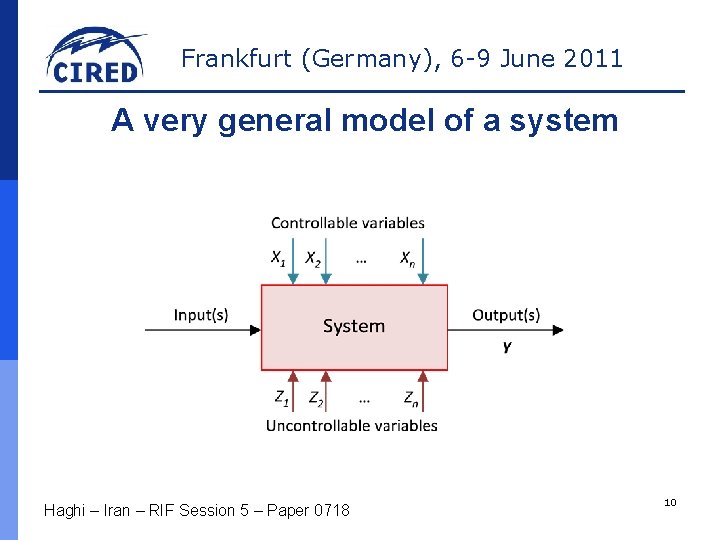
Frankfurt (Germany), 6 -9 June 2011 A very general model of a system Haghi – Iran – RIF Session 5 – Paper 0718 10
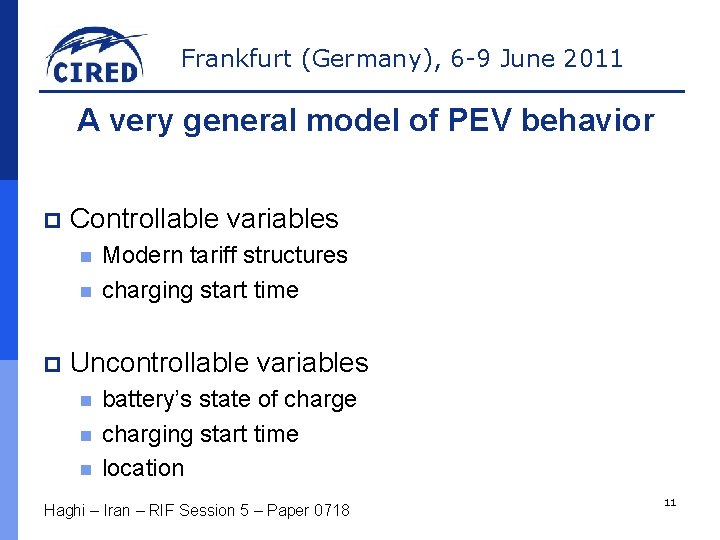
Frankfurt (Germany), 6 -9 June 2011 A very general model of PEV behavior p Controllable variables n n p Modern tariff structures charging start time Uncontrollable variables n n n battery’s state of charge charging start time location Haghi – Iran – RIF Session 5 – Paper 0718 11
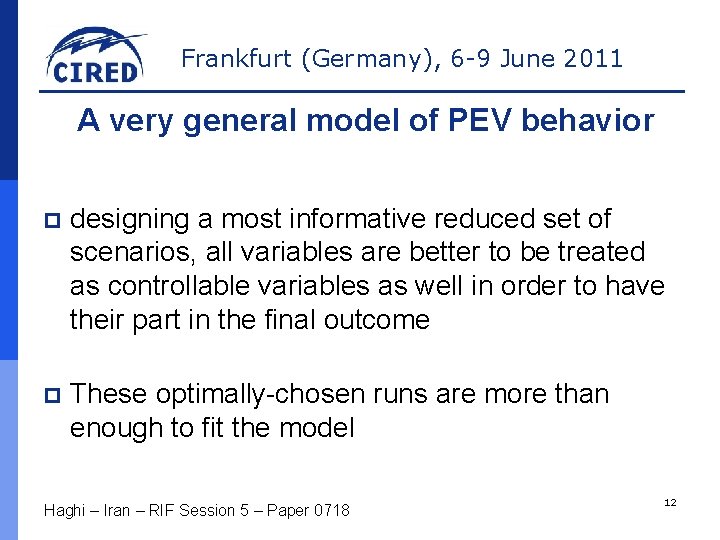
Frankfurt (Germany), 6 -9 June 2011 A very general model of PEV behavior p designing a most informative reduced set of scenarios, all variables are better to be treated as controllable variables as well in order to have their part in the final outcome p These optimally-chosen runs are more than enough to fit the model Haghi – Iran – RIF Session 5 – Paper 0718 12
Frankfurt (Germany), 6 -9 June 2011 Design of Experiment (DOE) Technique A technique to obtain and organize the maximum amount of conclusive information from minimum empirical work p Efficiency p n p getting more information from fewer experiments/data Focusing n collecting only the information that is really needed Haghi – Iran – RIF Session 5 – Paper 0718 13
Frankfurt (Germany), 6 -9 June 2011 Design of Experiment (DOE) Technique p The critical part is to decide which variables to change, the intervals for this variation, and the pattern of the experimental points p limited resource here is the computational time required for calculating load flow for all scenarios Haghi – Iran – RIF Session 5 – Paper 0718 14
Frankfurt (Germany), 6 -9 June 2011 DOE of PEVs p A probabilistic model should be fitted the system response p Here, the generalized linear model (GLM) is used Haghi – Iran – RIF Session 5 – Paper 0718 15
Frankfurt (Germany), 6 -9 June 2011 Main Topics p General Outline p Design of Experiment (DOE) Technique p Generalized linear model (GLM) p Multivariate DOE by frank Copula p Congestion study p Conclusion Haghi – Iran – RIF Session 5 – Paper 0718 16
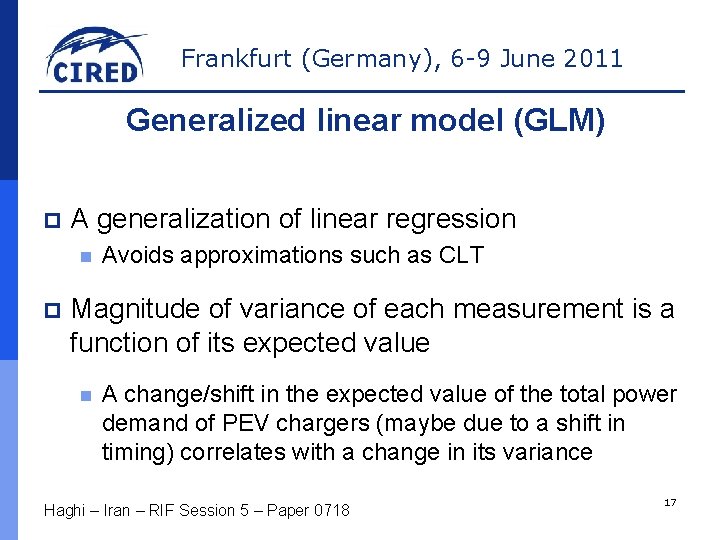
Frankfurt (Germany), 6 -9 June 2011 Generalized linear model (GLM) p A generalization of linear regression n p Avoids approximations such as CLT Magnitude of variance of each measurement is a function of its expected value n A change/shift in the expected value of the total power demand of PEV chargers (maybe due to a shift in timing) correlates with a change in its variance Haghi – Iran – RIF Session 5 – Paper 0718 17
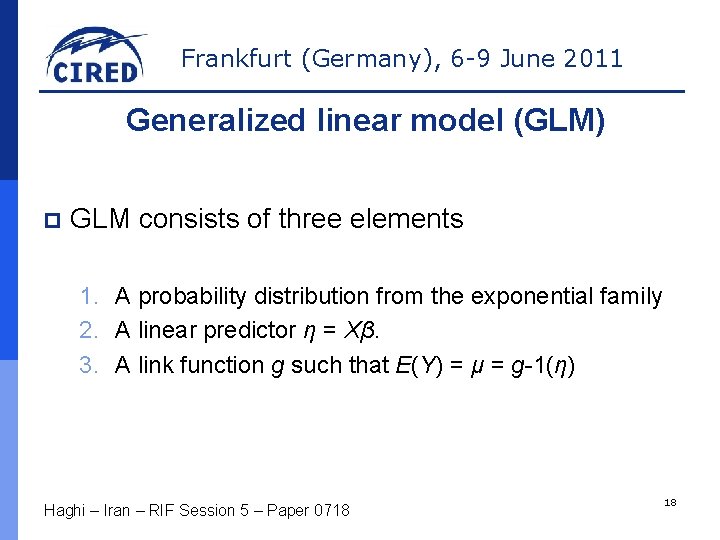
Frankfurt (Germany), 6 -9 June 2011 Generalized linear model (GLM) p GLM consists of three elements 1. A probability distribution from the exponential family 2. A linear predictor η = Xβ. 3. A link function g such that E(Y) = μ = g-1(η) Haghi – Iran – RIF Session 5 – Paper 0718 18
Frankfurt (Germany), 6 -9 June 2011 Main Topics p General Outline p Design of Experiment (DOE) Technique p Generalized linear model (GLM) p Multivariate DOE by frank Copula p Congestion study p Conclusion Haghi – Iran – RIF Session 5 – Paper 0718 19
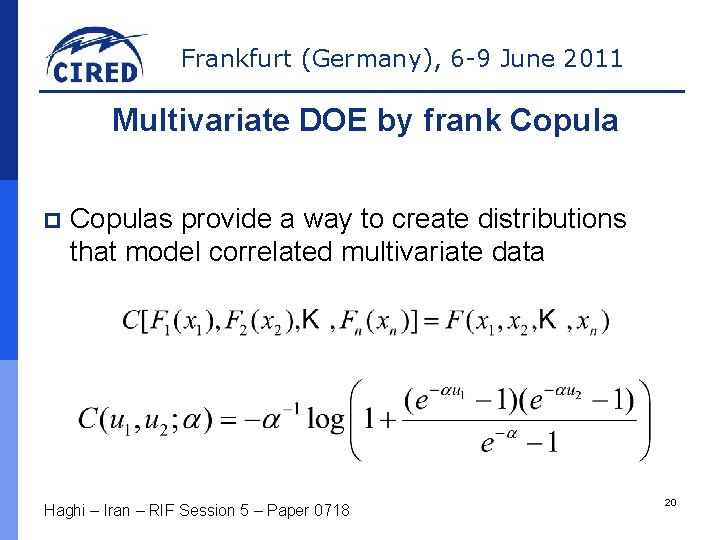
Frankfurt (Germany), 6 -9 June 2011 Multivariate DOE by frank Copula p Copulas provide a way to create distributions that model correlated multivariate data Haghi – Iran – RIF Session 5 – Paper 0718 20
Frankfurt (Germany), 6 -9 June 2011 Main Topics p General Outline p Design of Experiment (DOE) Technique p Generalized linear model (GLM) p Multivariate DOE by frank Copula p Congestion study p Conclusion Haghi – Iran – RIF Session 5 – Paper 0718 21
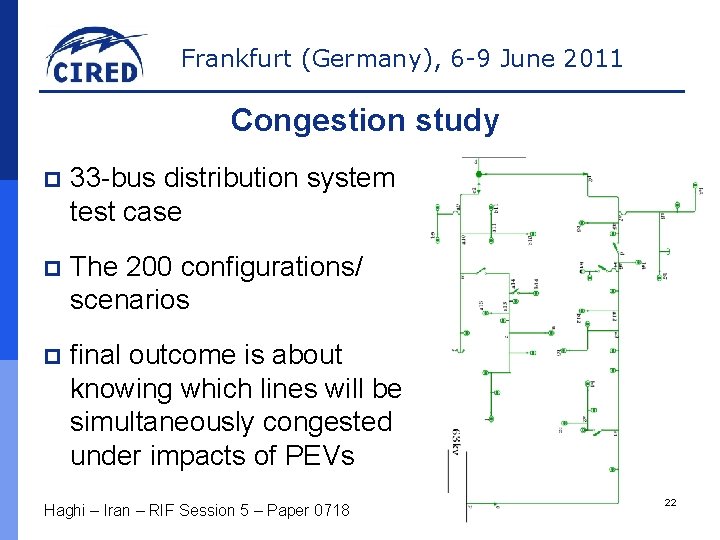
Frankfurt (Germany), 6 -9 June 2011 Congestion study p 33 -bus distribution system test case p The 200 configurations/ scenarios p final outcome is about knowing which lines will be simultaneously congested under impacts of PEVs Haghi – Iran – RIF Session 5 – Paper 0718 22
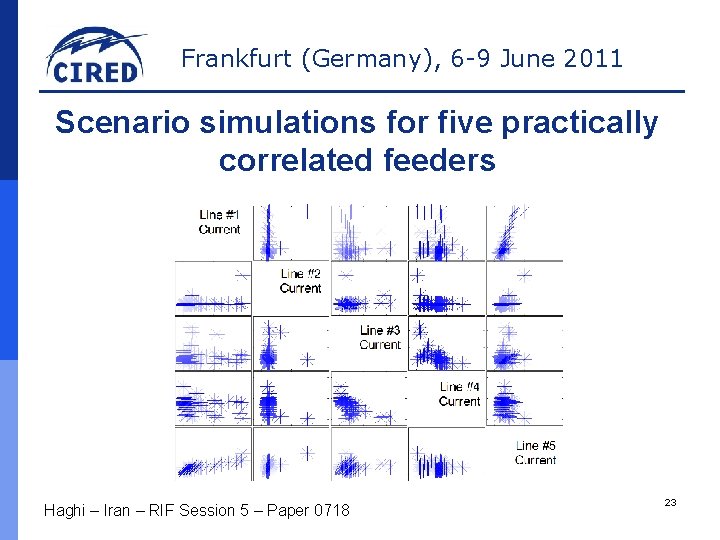
Frankfurt (Germany), 6 -9 June 2011 Scenario simulations for five practically correlated feeders Haghi – Iran – RIF Session 5 – Paper 0718 23
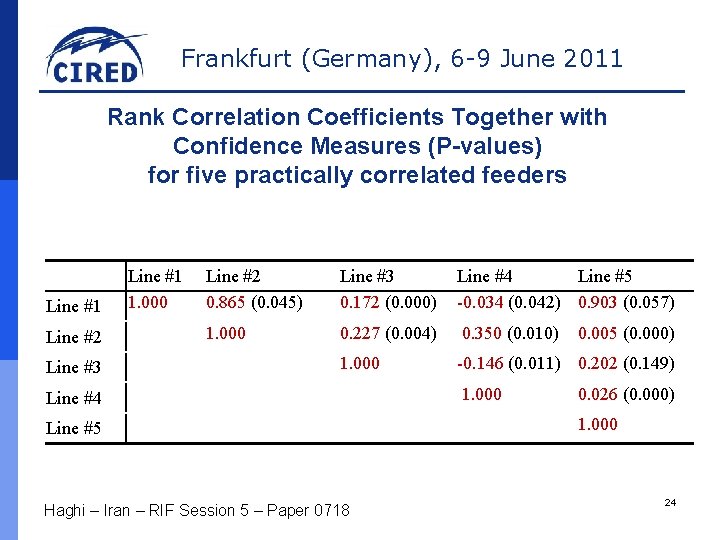
Frankfurt (Germany), 6 -9 June 2011 Rank Correlation Coefficients Together with Confidence Measures (P-values) for five practically correlated feeders Line #1 Line #2 Line #3 Line #1 1. 000 Line #2 0. 865 (0. 045) Line #3 0. 172 (0. 000) Line #4 Line #5 -0. 034 (0. 042) 0. 903 (0. 057) 1. 000 0. 227 (0. 004) 0. 350 (0. 010) 1. 000 -0. 146 (0. 011) 0. 202 (0. 149) Line #4 Line #5 Haghi – Iran – RIF Session 5 – Paper 0718 1. 000 0. 005 (0. 000) 0. 026 (0. 000) 1. 000 24
Frankfurt (Germany), 6 -9 June 2011 Conclusions p Correlation analysis applicable to a database of currents in the lines n n Forecast which congestions are correlated Illustrate where congestions will appear in the future p Planner could implement a line reinforcement which removes correlated congestions p A technique to take into account the impacts of PEVs in other types of studies Haghi – Iran – RIF Session 5 – Paper 0718 25
Frankfurt (Germany), 6 -9 June 2011 Thank You! Contact: Hamed VALIZADEH HAGHI Ph. Dc, P. Eng Faculty of Electrical and Computer Engineering K. N. Toosi University of Technology, Tehran 16315 -1355, Iran +98 (21) 2793 5698 valizadeh@ieee. org 26