
Using a Modified Lorenz Curve and Gini Coefficient



![A Lorenz Curve [Gini Coefficient = A / (A + B)] 7](https://slidetodoc.com/presentation_image/d23e25d0fbceb115080c4ac26f7aa0a8/image-7.jpg "A Lorenz Curve [Gini Coefficient = A / (A + B)] 7")






- Slides: 27
Using a Modified Lorenz Curve and Gini Coefficient to Enhance Interpretation of Treatment Effect on Patient-Reported Outcomes Joseph C. Cappelleri Andrew G. Bushmakin Pfizer Inc Riad Dirani Johnson & Johnson Oral presentation delivered at the 7 th International Conference on Health Policy Statistics, January 17 -18, 2008, Philadelphia, Pennsylvania Correspondence: joseph. c. cappelleri@pfizer. com 1
Outline • Introduction • Methodology • Examples • Conclusions 2
Introduction • Interpretation of treatment effect can pose challenges for patient-reported outcomes • Need for relevance of treatment effect – Beyond statistical significance • What is the relevance of difference score of 10 points between the means of two groups? • How does it differ from a difference score of 5 or 20? 3
Introduction • Objective: – To introduce and develop a modified Gini coefficient from a modified Lorenz curve to enrich interpretation of patient-reported outcomes – To illustrate the approach with a synthetic example and a real example 4
Methodology 5
Original Lorenz Curve and Gini Coefficient • Lorenz curve – plots the cumulative share (percent) of individuals on the horizontal axis and the cumulative share of income on the vertical axis (Lorenz 1905, Gastwirth 1972) – For every point, bottom X% of individuals have Y% of total income • Gini coefficient – represents the area between the line of perfect equality and the observed Lorenz curve, divided by the area between the lines of perfect equality and perfect inequality • Used to quantify the extent of income inequality within country and across different countries 6
A Lorenz Curve [Gini Coefficient = A / (A + B)] 7
Modified Lorenz Curve • Extends Lorenz curve and Gini coefficient to two independent samples • Plots the cumulative percentage of individuals in the control group on the horizontal axis • Plots the cumulative percentage of individuals in the treatment group on the vertical axis 8
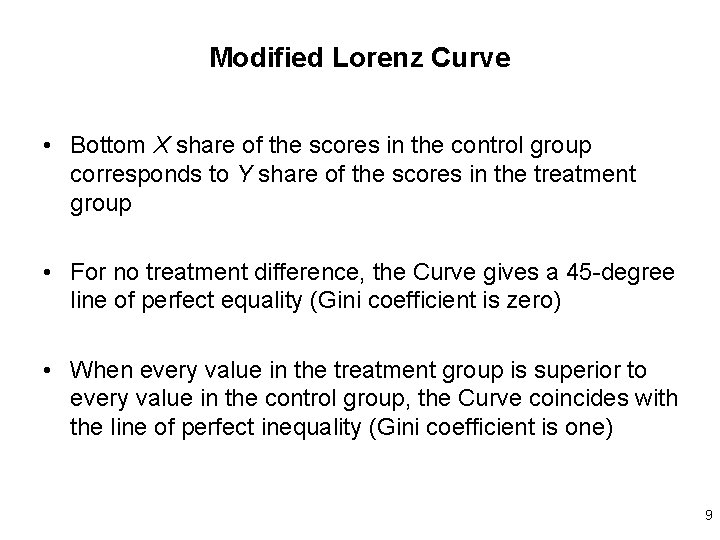
Modified Lorenz Curve • Bottom X share of the scores in the control group corresponds to Y share of the scores in the treatment group • For no treatment difference, the Curve gives a 45 -degree line of perfect equality (Gini coefficient is zero) • When every value in the treatment group is superior to every value in the control group, the Curve coincides with the line of perfect inequality (Gini coefficient is one) 9
Modified Gini Coefficient • Modified Gini coefficient can range from -1 to 1 • Assume (without loss of generality) that lower scores are more favorable and that the treatment is beneficial • This coefficient can be defined by the integration of vertical deviations between the Lorenz curve and the perfect equality (no effect) line, divided by the difference between the perfect equality and inequality lines • Can apply numerical integration using the trapezoidal formula to compute a region’s area 10
U 3 and BESD • The modified Gini coefficient and Lorenz curve is an augmentation of principles found in the U 3 measure (Cohen 1988) and the binomial effect size display (BESD) (Rosenthal and Rubin 1982) • U 3 = the percentage of individuals in the treatment group relative to the median (50 th percentile) of the control group • BESD = percentages of individuals in the treatment group and in the control group relative to the 50 th percentile of the combined treatment and control distributions 11
Synthetic Example 12
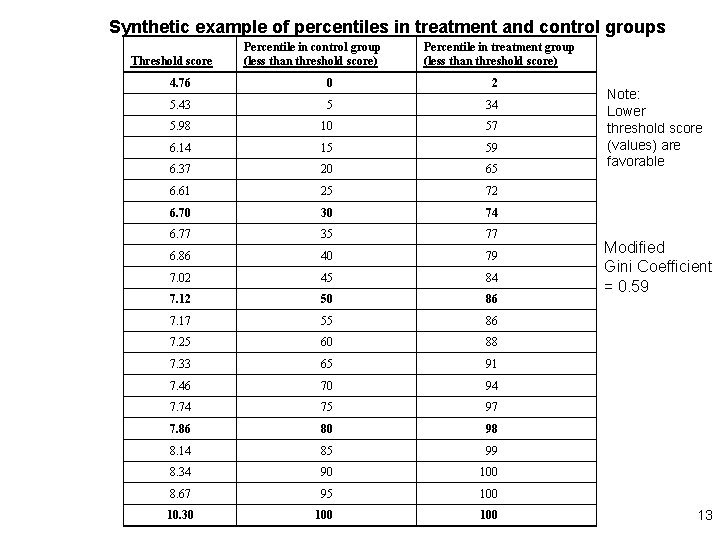
Synthetic example of percentiles in treatment and control groups Threshold score Percentile in control group (less than threshold score) Percentile in treatment group (less than threshold score) 4. 76 0 2 5. 43 5 34 5. 98 10 57 6. 14 15 59 6. 37 20 65 6. 61 25 72 6. 70 30 74 6. 77 35 77 6. 86 40 79 7. 02 45 84 7. 12 50 86 7. 17 55 86 7. 25 60 88 7. 33 65 91 7. 46 70 94 7. 74 75 97 7. 86 80 98 8. 14 85 99 8. 34 90 100 8. 67 95 100 10. 30 100 Note: Lower threshold score (values) are favorable Modified Gini Coefficient = 0. 59 13
Modified Lorenz Curve Modified Gini Coefficient = 0. 59 14
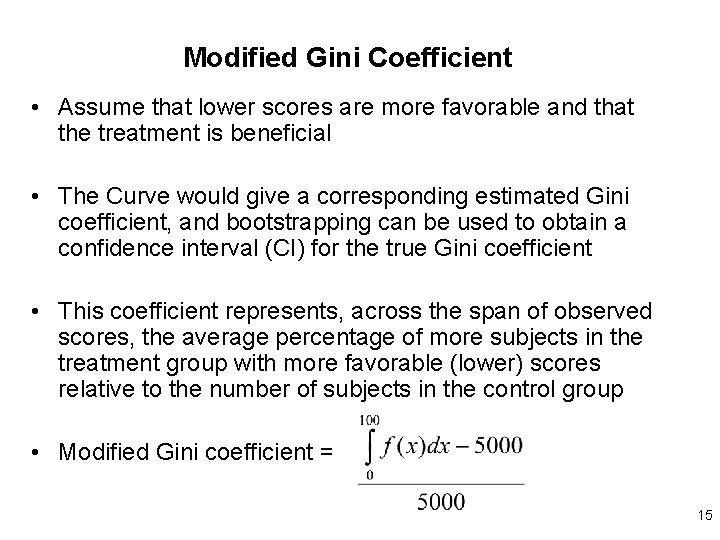
Modified Gini Coefficient • Assume that lower scores are more favorable and that the treatment is beneficial • The Curve would give a corresponding estimated Gini coefficient, and bootstrapping can be used to obtain a confidence interval (CI) for the true Gini coefficient • This coefficient represents, across the span of observed scores, the average percentage of more subjects in the treatment group with more favorable (lower) scores relative to the number of subjects in the control group • Modified Gini coefficient = 15
Modified Gini Coefficient • In the example, the value of the modified Gini coefficient is 0. 59 • Thus, across each outcome score, on average 59% more subjects in the treatment group had better scores compared with the number of subjects in the control group 16
Real Example 17
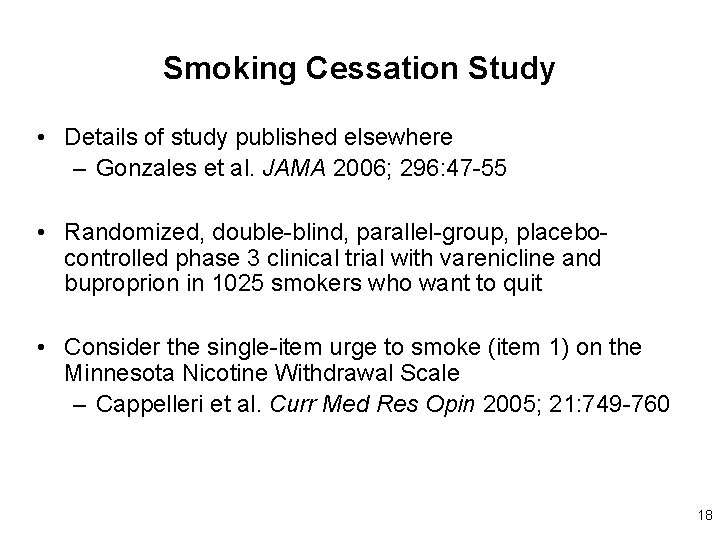
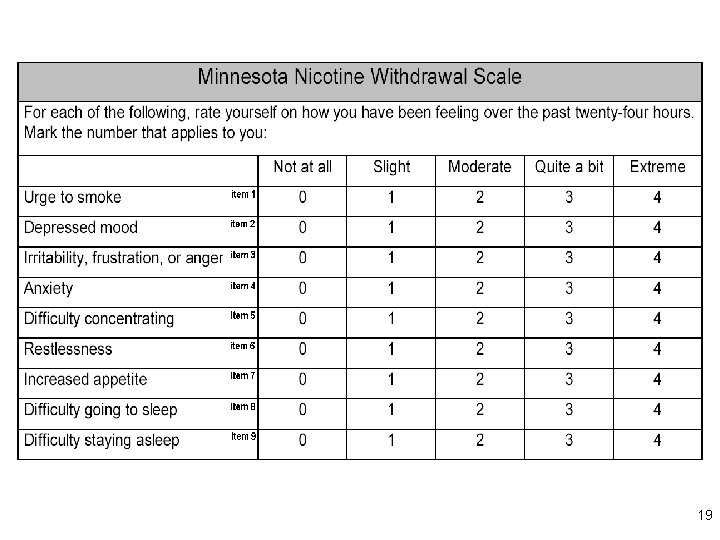
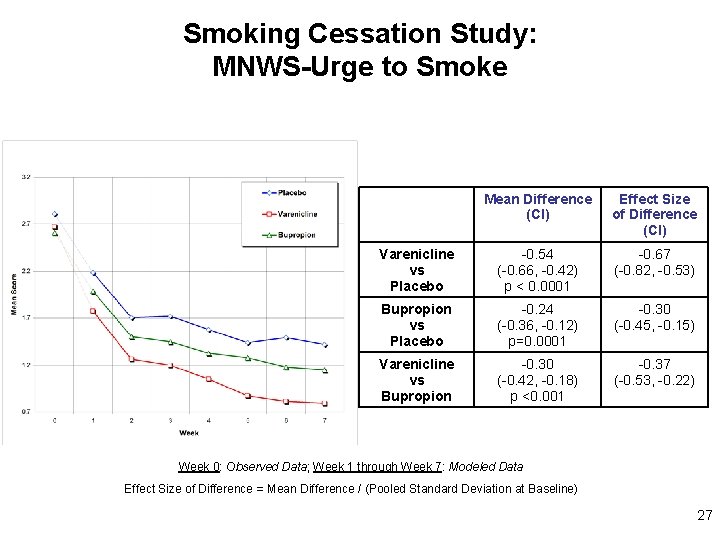
Smoking Cessation Study • Details of study published elsewhere – Gonzales et al. JAMA 2006; 296: 47 -55 • Randomized, double-blind, parallel-group, placebocontrolled phase 3 clinical trial with varenicline and buproprion in 1025 smokers who want to quit • Consider the single-item urge to smoke (item 1) on the Minnesota Nicotine Withdrawal Scale – Cappelleri et al. Curr Med Res Opin 2005; 21: 749 -760 18
19
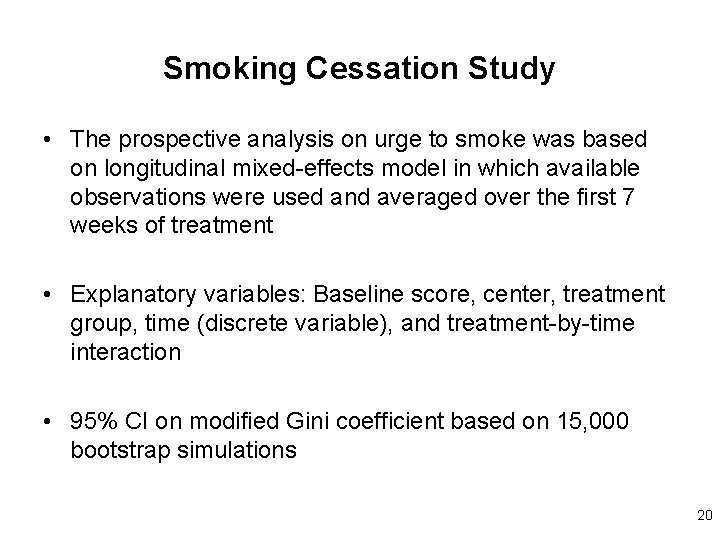
Smoking Cessation Study • The prospective analysis on urge to smoke was based on longitudinal mixed-effects model in which available observations were used and averaged over the first 7 weeks of treatment • Explanatory variables: Baseline score, center, treatment group, time (discrete variable), and treatment-by-time interaction • 95% CI on modified Gini coefficient based on 15, 000 bootstrap simulations 20
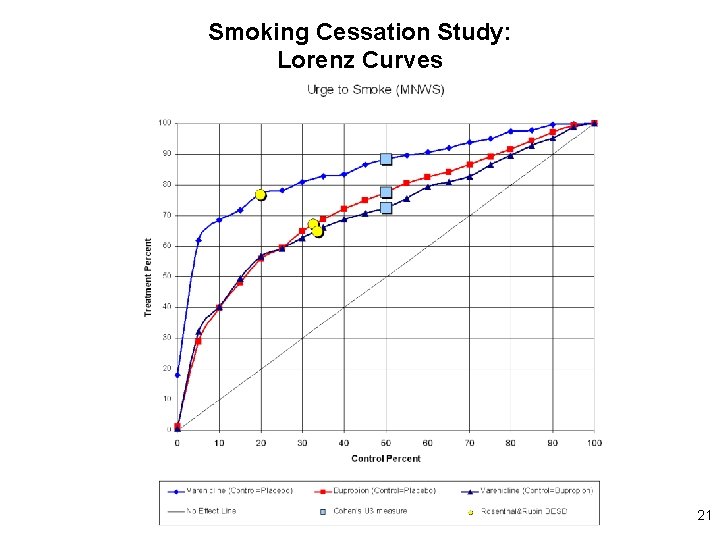
Smoking Cessation Study: Lorenz Curves 21
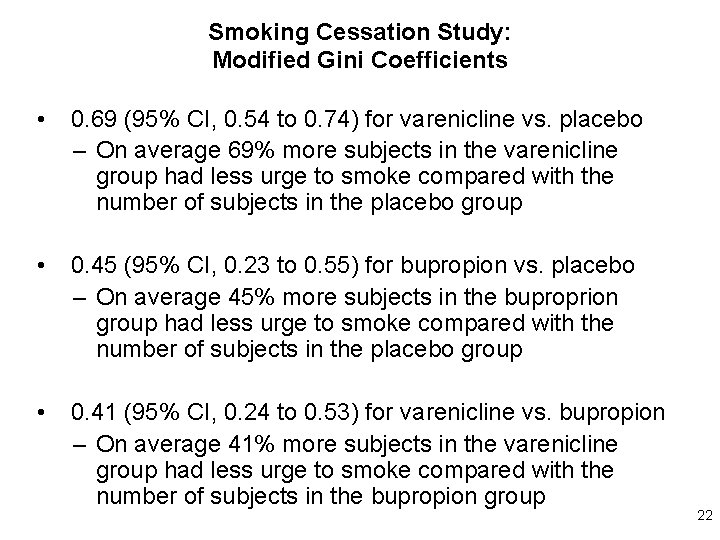
Smoking Cessation Study: Modified Gini Coefficients • 0. 69 (95% CI, 0. 54 to 0. 74) for varenicline vs. placebo – On average 69% more subjects in the varenicline group had less urge to smoke compared with the number of subjects in the placebo group • 0. 45 (95% CI, 0. 23 to 0. 55) for bupropion vs. placebo – On average 45% more subjects in the buproprion group had less urge to smoke compared with the number of subjects in the placebo group • 0. 41 (95% CI, 0. 24 to 0. 53) for varenicline vs. bupropion – On average 41% more subjects in the varenicline group had less urge to smoke compared with the number of subjects in the bupropion group 22
Conclusions • Modified Gini coefficient optimizes information by integrating across all percentiles of two treatment groups (two independent samples) • The coefficient does not impose distributional assumptions • It is a useful adjunct to enrich interpretation and measure treatment effect in patient-reported outcomes 23
Summary • Introduction – motivation for measure to enhance interpretation of patient-reported outcomes • Methodology – modified Gini curve and coefficient • Examples – synthetic and real • Conclusions – modified Gini coefficient encompasses all information in distribution to provide comprehensive and understandable measure of treatment effect 24
Methodological References • Lorenz MO. Methods of measuring the concentration of wealth. Publications of the American Statistical Association 1905; 70: 209– 219. • Gastwirth JL. The estimation of the Lorenz curve and Gini index. The Review of Economics and Statistics 1972; 54: 306– 316. • Cohen J. Statistical Power Analyses for the Behavioral Sciences. Hillsdale, NJ: Lawrence Erlbaum Associates, 1988. • Rosenthal R, Rubin DB. A simple, general purpose display of magnitude of experimental effect. Journal of Educational Psychology 1982; 74: 166– 169. 25
Backup Slides 26
Smoking Cessation Study: MNWS-Urge to Smoke Mean Difference (CI) Effect Size of Difference (CI) Varenicline vs Placebo -0. 54 (-0. 66, -0. 42) p < 0. 0001 -0. 67 (-0. 82, -0. 53) Bupropion vs Placebo -0. 24 (-0. 36, -0. 12) p=0. 0001 -0. 30 (-0. 45, -0. 15) Varenicline vs Bupropion -0. 30 (-0. 42, -0. 18) p <0. 001 -0. 37 (-0. 53, -0. 22) Week 0: Observed Data; Week 1 through Week 7: Modeled Data Effect Size of Difference = Mean Difference / (Pooled Standard Deviation at Baseline) 27