
USING A FARM BALANCE SHEET AAE 320 Paul
USING A FARM BALANCE SHEET AAE 320 Paul D. Mitchell Agricultural & Applied Economics
Learning Goals § How to calculate and interpret common Financial Ratios for Liquidity and Solvency § Develop an awareness of typical financial ratios by farm type § Current Ratio and Debt: Asset • Suggestions for where to go for more information

What use is a Balance Sheet? • Can see where assets and liabilities are and their relative sizes • Can look at changes if have balance sheets from previous years —see if you’re gaining • Typically focus on ratios to look at Liquidity and Solvency of the business • Ratios control for differences in business size
Current Ratio and Liquidity • Measures ability to meet current financial obligations as they come due without disrupting normal business § Ability to generate cash in the short-term • Current Ratio = Current Assets/Current Liabilities • Example: 1. 4 or 40%
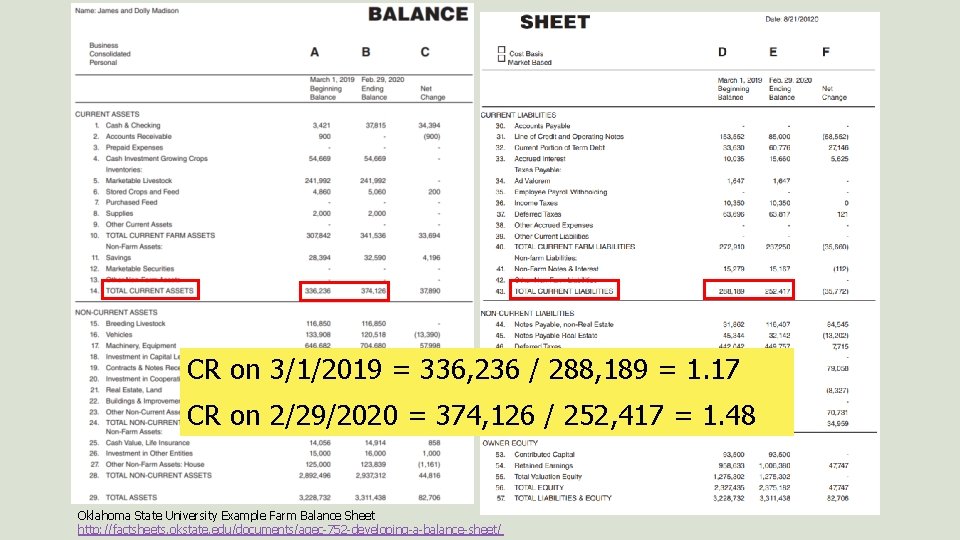
CR on 3/1/2019 = 336, 236 / 288, 189 = 1. 17 CR on 2/29/2020 = 374, 126 / 252, 417 = 1. 48 Oklahoma State University Example Farm Balance Sheet http: //factsheets. okstate. edu/documents/agec-752 -developing-a-balance-sheet/
Current Ratio • Too low: cash flow problems § If asset prices change or costs suddenly arise (repairs), can have trouble meeting current liabilities § Don’t want to sell 1 acre to put new roof on barn § Can’t take advantage of opportunities when they arise • Too high: holding too much cash, current assets typically have lower returns than if put capital into productive assets or market § Income lost by keeping cash “under the mattress” § Parable of the talents: buried gold in ground
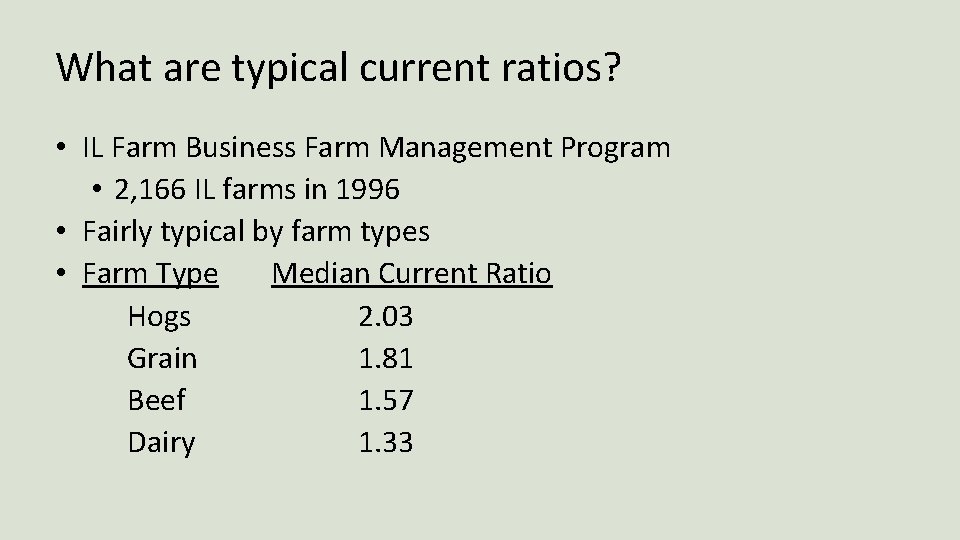
What are typical current ratios? • IL Farm Business Farm Management Program • 2, 166 IL farms in 1996 • Fairly typical by farm types • Farm Type Median Current Ratio Hogs 2. 03 Grain 1. 81 Beef 1. 57 Dairy 1. 33
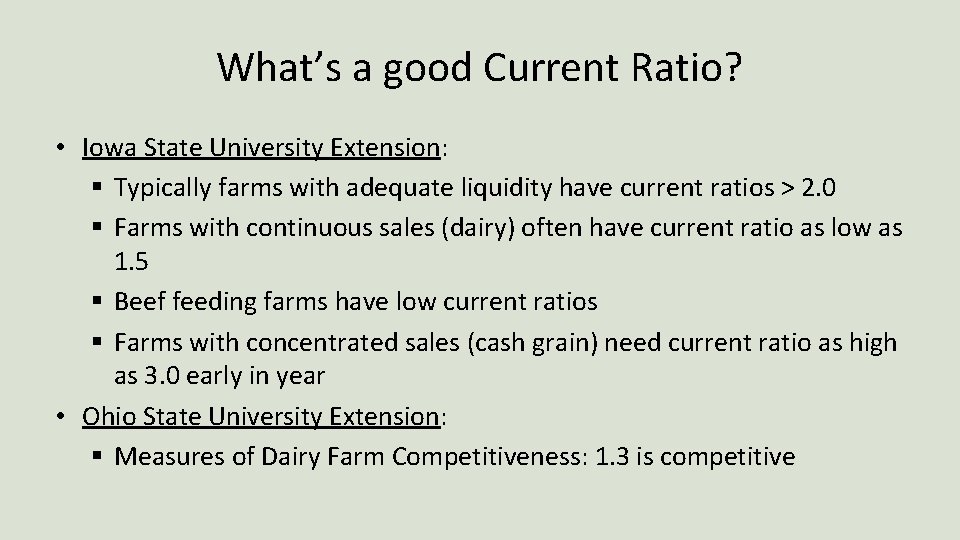
What’s a good Current Ratio? • Iowa State University Extension: § Typically farms with adequate liquidity have current ratios > 2. 0 § Farms with continuous sales (dairy) often have current ratio as low as 1. 5 § Beef feeding farms have low current ratios § Farms with concentrated sales (cash grain) need current ratio as high as 3. 0 early in year • Ohio State University Extension: § Measures of Dairy Farm Competitiveness: 1. 3 is competitive
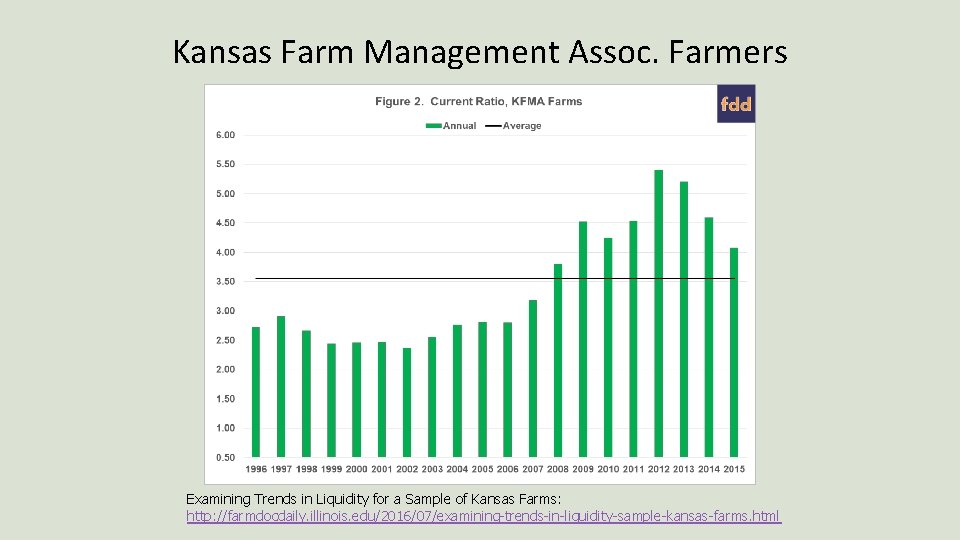
Kansas Farm Management Assoc. Farmers Examining Trends in Liquidity for a Sample of Kansas Farms: http: //farmdocdaily. illinois. edu/2016/07/examining-trends-in-liquidity-sample-kansas-farms. html
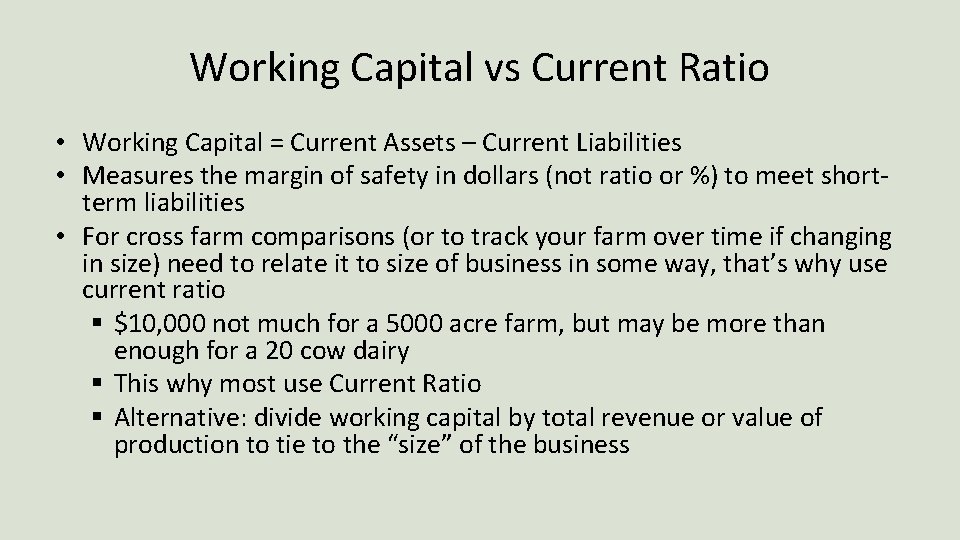
Working Capital vs Current Ratio • Working Capital = Current Assets – Current Liabilities • Measures the margin of safety in dollars (not ratio or %) to meet shortterm liabilities • For cross farm comparisons (or to track your farm over time if changing in size) need to relate it to size of business in some way, that’s why use current ratio § $10, 000 not much for a 5000 acre farm, but may be more than enough for a 20 cow dairy § This why most use Current Ratio § Alternative: divide working capital by total revenue or value of production to tie to the “size” of the business
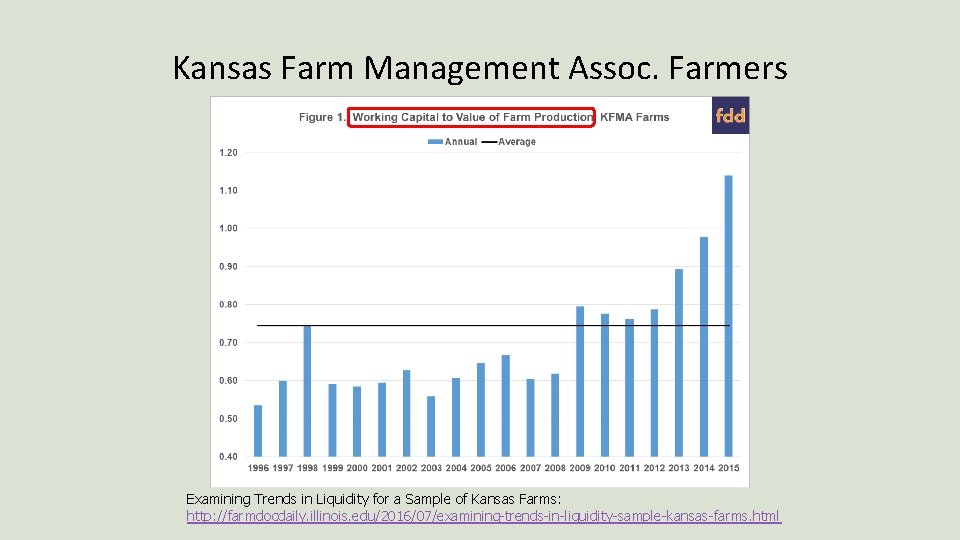
Kansas Farm Management Assoc. Farmers Examining Trends in Liquidity for a Sample of Kansas Farms: http: //farmdocdaily. illinois. edu/2016/07/examining-trends-in-liquidity-sample-kansas-farms. html
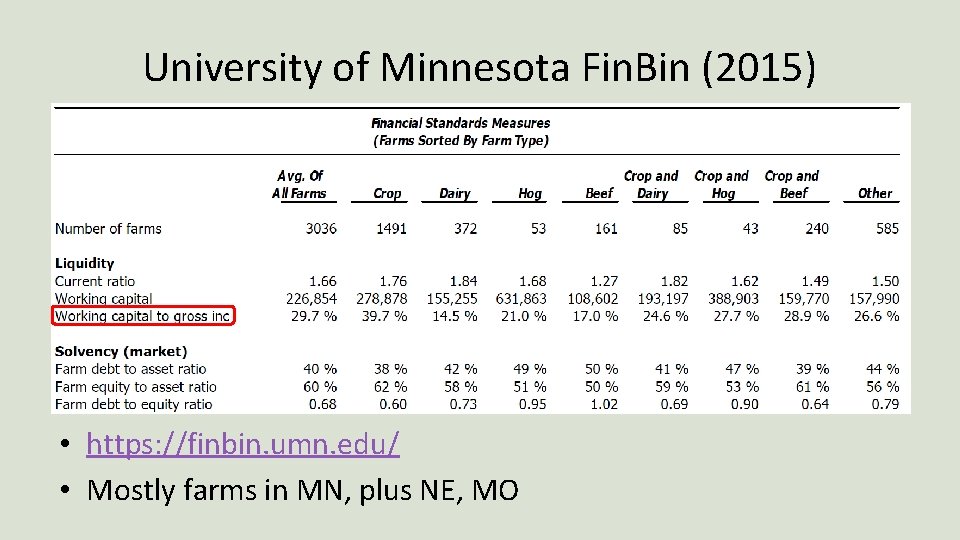
University of Minnesota Fin. Bin (2015) • https: //finbin. umn. edu/ • Mostly farms in MN, plus NE, MO
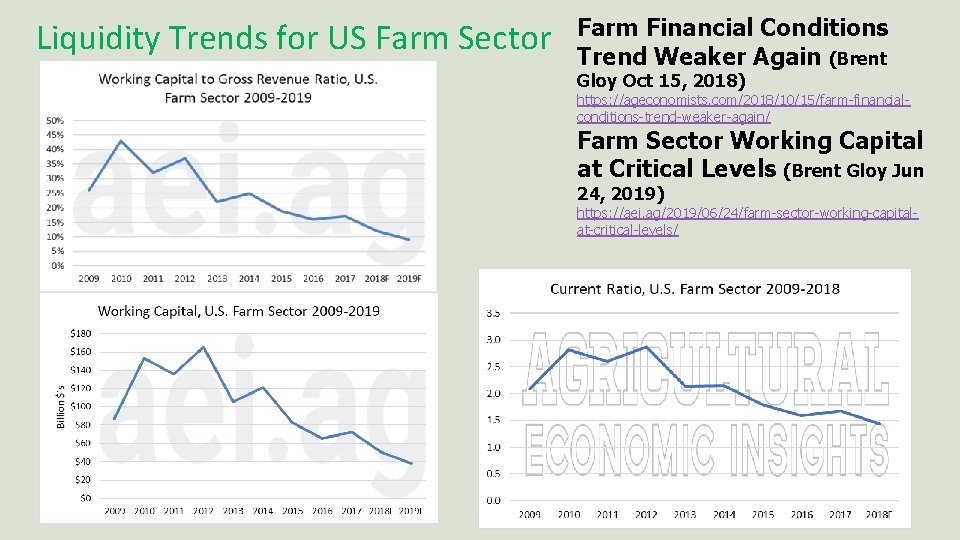
Liquidity Trends for US Farm Sector Farm Financial Conditions Trend Weaker Again (Brent Gloy Oct 15, 2018) https: //ageconomists. com/2018/10/15/farm-financialconditions-trend-weaker-again/ Farm Sector Working Capital at Critical Levels (Brent Gloy Jun 24, 2019) https: //aei. ag/2019/06/24/farm-sector-working-capitalat-critical-levels/
Solvency • Measures relative relationships among assets, liabilities, and equity to assess “health” of firm • Could the farm’s debts be paid off if foreclosed? Requires that Assets > Liabilities • Measured by three ratios § Debt to Asset Ratio § Equity to Asset Ratio § Debt to Equity Ratio • Given any one ratio, you can derive the others, so each is a different way to look at Solvency
Debt to Asset Ratio • Debt/Asset = Total Liabilities/Total Assets • Proportion (or %) of business assets owed to lenders (i. e. % the bank owns) • 0. 70 means you owe 70% of farm assets to lenders (bank owns 70%) • 1. 0 means debts = assets § Means owner equity is zero, bank owns 100% • > 1. 0 means business is insolvent
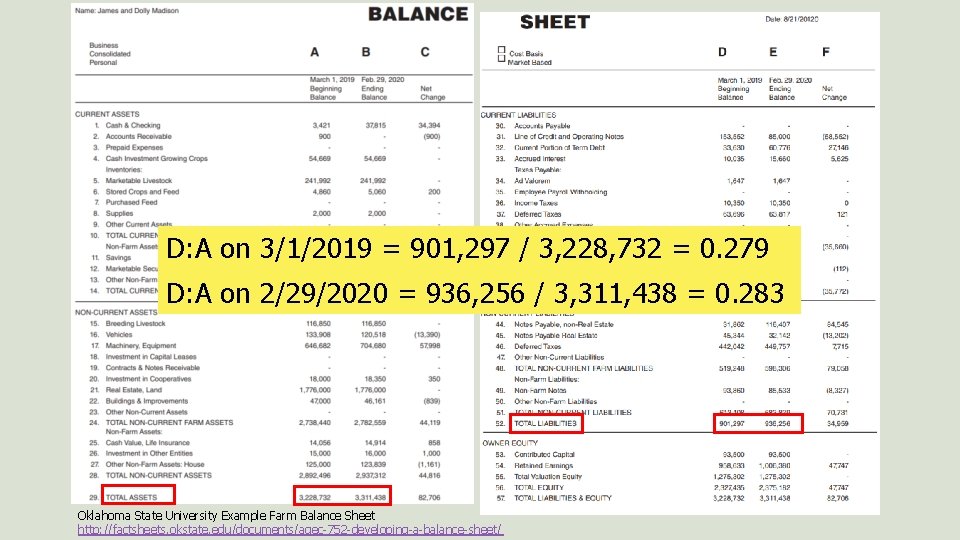
D: A on 3/1/2019 = 901, 297 / 3, 228, 732 = 0. 279 D: A on 2/29/2020 = 936, 256 / 3, 311, 438 = 0. 283 Oklahoma State University Example Farm Balance Sheet http: //factsheets. okstate. edu/documents/agec-752 -developing-a-balance-sheet/
Equity to Asset Ratio • • Equity/Asset = Total Equity/Total Assets Proportion (or %) of assets owned 0. 45 means you own 45% of farm 1. 0 means equity = assets so owner has no liabilities (he/she owns all equity) § Own 100% of the farm • < 0 means business is insolvent—has no or negative equity
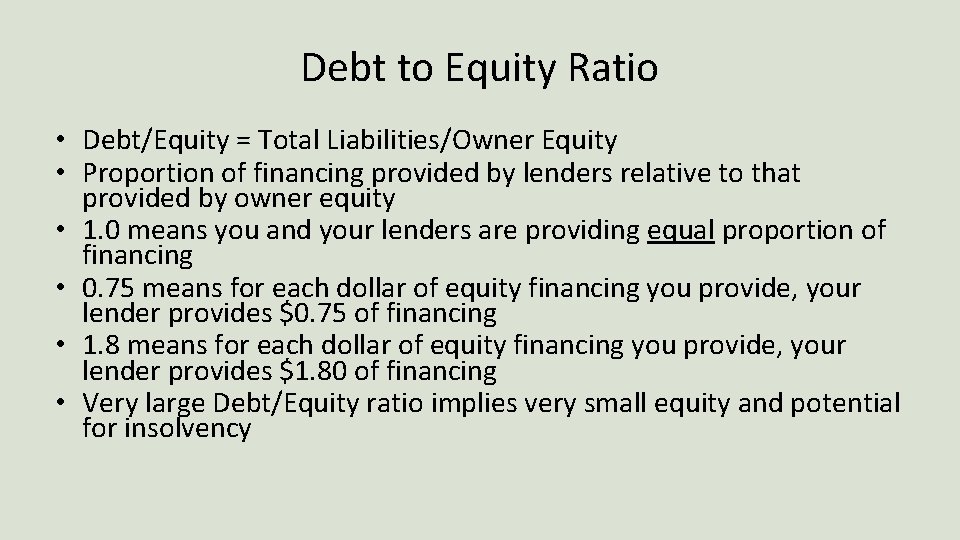
Debt to Equity Ratio • Debt/Equity = Total Liabilities/Owner Equity • Proportion of financing provided by lenders relative to that provided by owner equity • 1. 0 means you and your lenders are providing equal proportion of financing • 0. 75 means for each dollar of equity financing you provide, your lender provides $0. 75 of financing • 1. 8 means for each dollar of equity financing you provide, your lender provides $1. 80 of financing • Very large Debt/Equity ratio implies very small equity and potential for insolvency
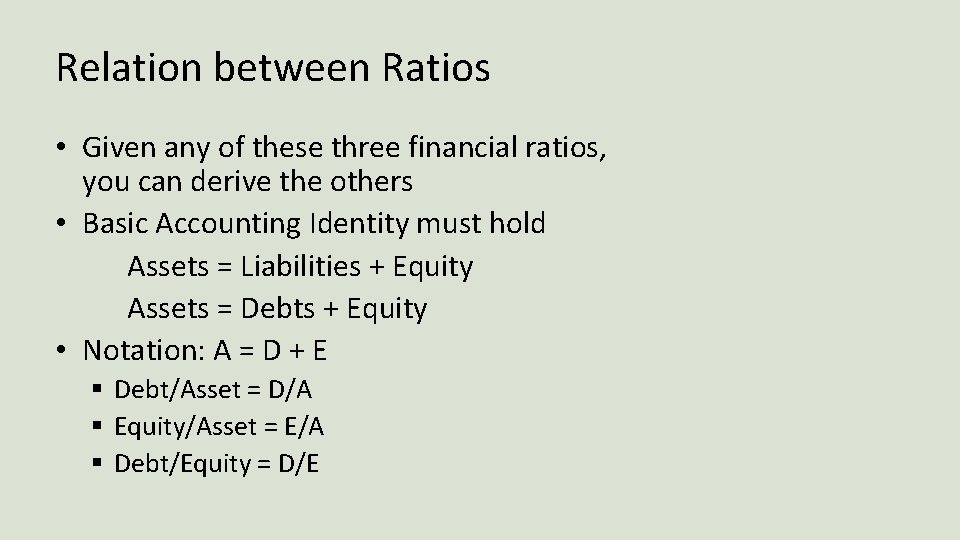
Relation between Ratios • Given any of these three financial ratios, you can derive the others • Basic Accounting Identity must hold Assets = Liabilities + Equity Assets = Debts + Equity • Notation: A = D + E § Debt/Asset = D/A § Equity/Asset = E/A § Debt/Equity = D/E
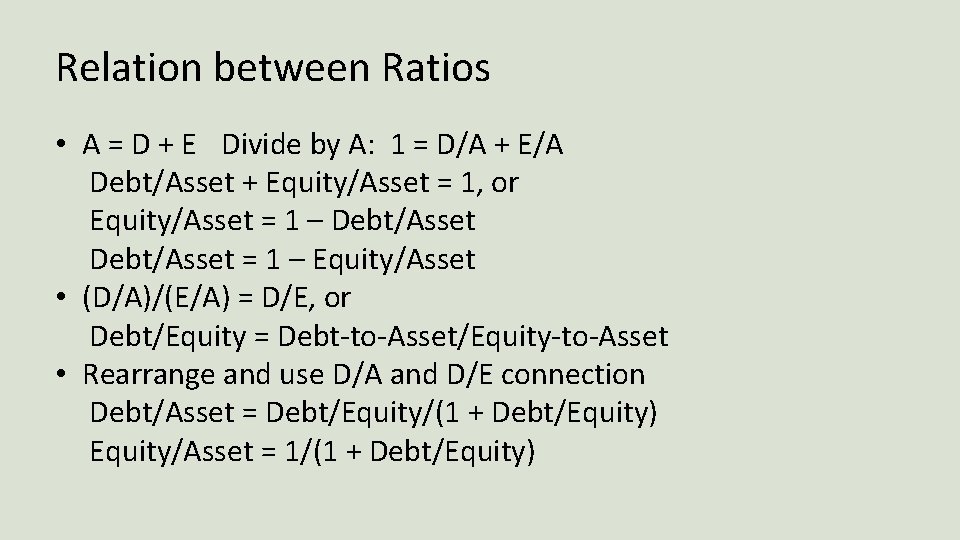
Relation between Ratios • A = D + E Divide by A: 1 = D/A + E/A Debt/Asset + Equity/Asset = 1, or Equity/Asset = 1 – Debt/Asset = 1 – Equity/Asset • (D/A)/(E/A) = D/E, or Debt/Equity = Debt-to-Asset/Equity-to-Asset • Rearrange and use D/A and D/E connection Debt/Asset = Debt/Equity/(1 + Debt/Equity) Equity/Asset = 1/(1 + Debt/Equity)
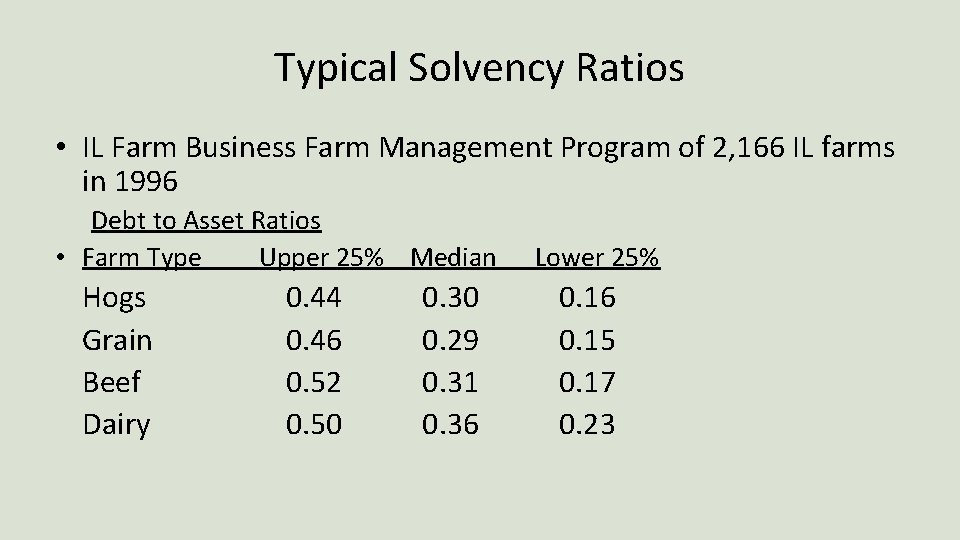
Typical Solvency Ratios • IL Farm Business Farm Management Program of 2, 166 IL farms in 1996 Debt to Asset Ratios • Farm Type Upper 25% Median Hogs Grain Beef Dairy 0. 44 0. 46 0. 52 0. 50 0. 30 0. 29 0. 31 0. 36 Lower 25% 0. 16 0. 15 0. 17 0. 23
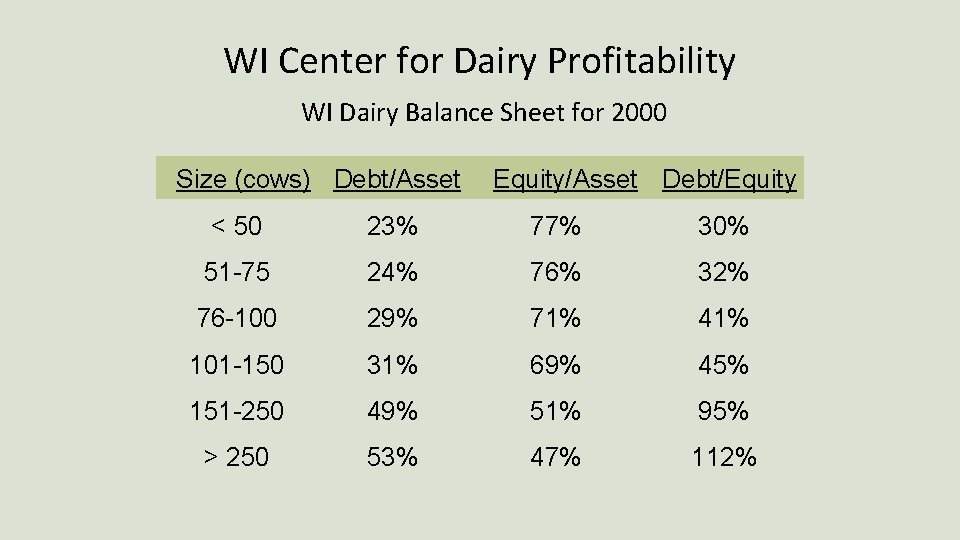
WI Center for Dairy Profitability WI Dairy Balance Sheet for 2000 Size (cows) Debt/Asset Equity/Asset Debt/Equity < 50 23% 77% 30% 51 -75 24% 76% 32% 76 -100 29% 71% 41% 101 -150 31% 69% 45% 151 -250 49% 51% 95% > 250 53% 47% 112%
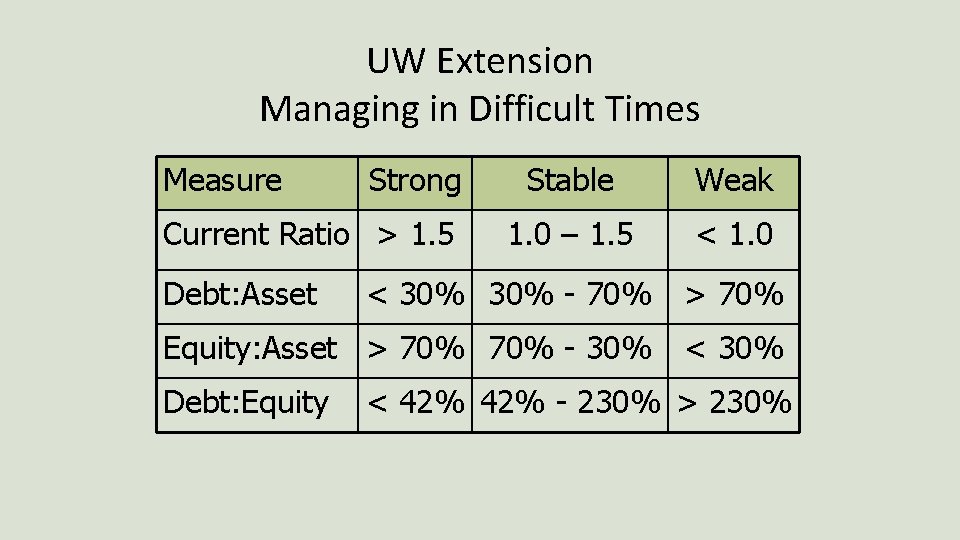
UW Extension Managing in Difficult Times Measure Strong Current Ratio > 1. 5 Debt: Asset Stable Weak 1. 0 – 1. 5 < 1. 0 < 30% - 70% > 70% Equity: Asset > 70% - 30% < 30% Debt: Equity < 42% - 230% > 230%
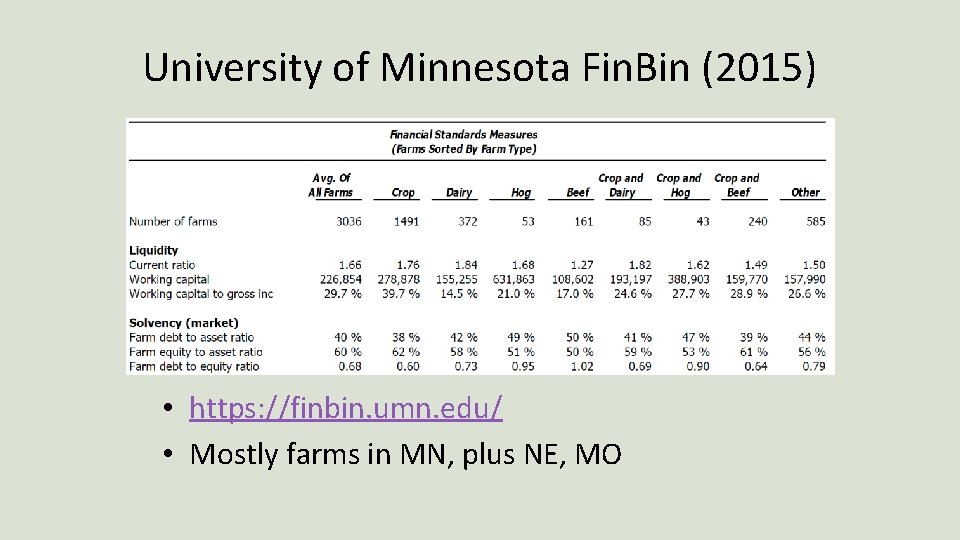
University of Minnesota Fin. Bin (2015) • https: //finbin. umn. edu/ • Mostly farms in MN, plus NE, MO
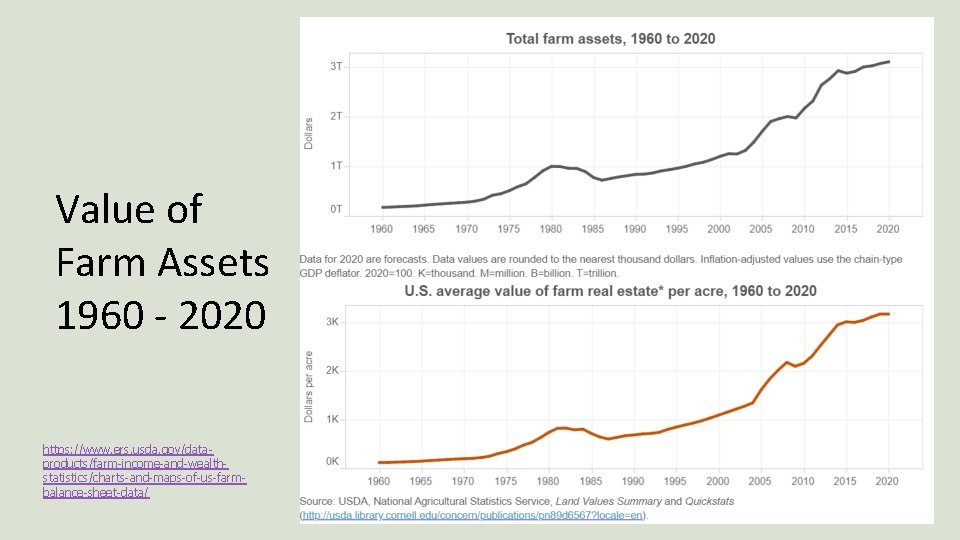
Value of Farm Assets 1960 - 2020 https: //www. ers. usda. gov/dataproducts/farm-income-and-wealthstatistics/charts-and-maps-of-us-farmbalance-sheet-data/
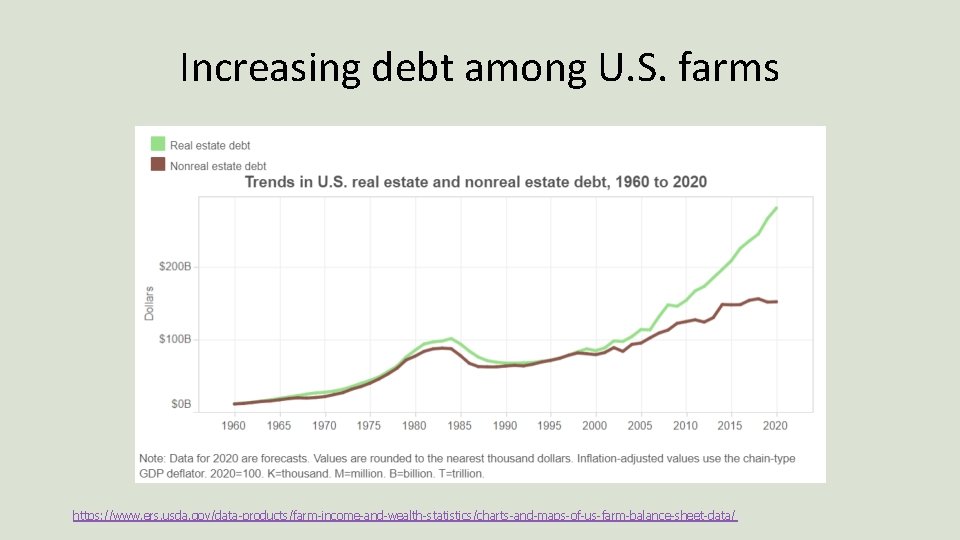
Increasing debt among U. S. farms https: //www. ers. usda. gov/data-products/farm-income-and-wealth-statistics/charts-and-maps-of-us-farm-balance-sheet-data/
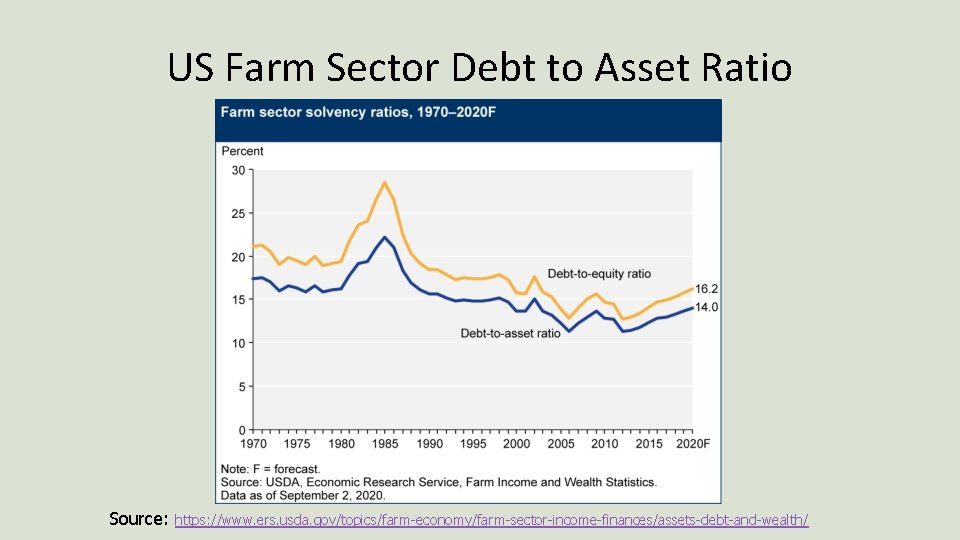
US Farm Sector Debt to Asset Ratio Source: https: //www. ers. usda. gov/topics/farm-economy/farm-sector-income-finances/assets-debt-and-wealth/
More Information • Provide a quick list/overview of what sort of information is available on farm finance • Farm Financial Standards Council • University Extension: UW and other states • UW Center for Dairy Profitability
Farm Financial Standards Council • Home page: http: //www. ffsc. org/index. html • Mission: “To provide education and a national forum to facilitate the development, review, communication and promotion of uniformity and integrity in both financial reporting and the analytic techniques useful for effective and realistic measurement of the financial position and the financial performance of agricultural producers. ” • Financial Guidelines for Agricultural Producers http: //www. ffsc. org/html/guidelin. htm • Recommendations of how to prepare Farm Financial Balance Sheet with several examples • The source for this sort of information
UW Center for Dairy Profitability • Homepage: http: //www. cdp. wisc. edu/ • Focuses mostly (not exclusively) on dairy • Lots of materials, some financial, the midst of updating – Financial analysis reports have become dated • WI dairy data as Farm Balance Sheets for comparison and benchmarking http: //www. cdp. wisc. edu/Financial%20 Benchmarks. htm • Ag. FA (Agricultural Financial Advisor) becoming Farm. Bench • Collect, analyze, and store financial data, create farm specific benchmarks and reports http: //cdp. wisc. edu/Ag. FAnew 2. htm
Neighboring States • University of Minnesota: Center for Farm Financial Management http: //www. cffm. umn. edu/ • Sell/Support FINPACK: “The most comprehensive computerized farm financial planning and analysis system available“ • Iowa State University: Ag. Decision Maker http: //www. extension. iastate. edu/agd m/homepage. html • University of Illinois: Farm. Doc http: //www. farmdoc. uiuc. edu/ • Both have sections on Farm Finance with several publications and decision aids
Summary § How to calculate and interpret common Financial Ratios for Liquidity and Solvency § Know how to construct and interpret Current Ratio and Debt: Asset § Develop an awareness of typical financial ratios by farm type § Know what is typical for farms • Suggestions for where to go for more information
- Slides: 32