
Using a digital micromirror device for highprecision laserbased

Using a digital micromirror device for high-precision laser-based manufacturing on the microscale B. Mills, D. J. Heath, M. Feinaeugle, R. W. Eason Optoelectronics Research Centre, University of Southampton, UK
Outline • The manufacturing process • The experimental setup • Results: Additive & subtractive manufacturing • Advanced techniques • Future work and conclusions
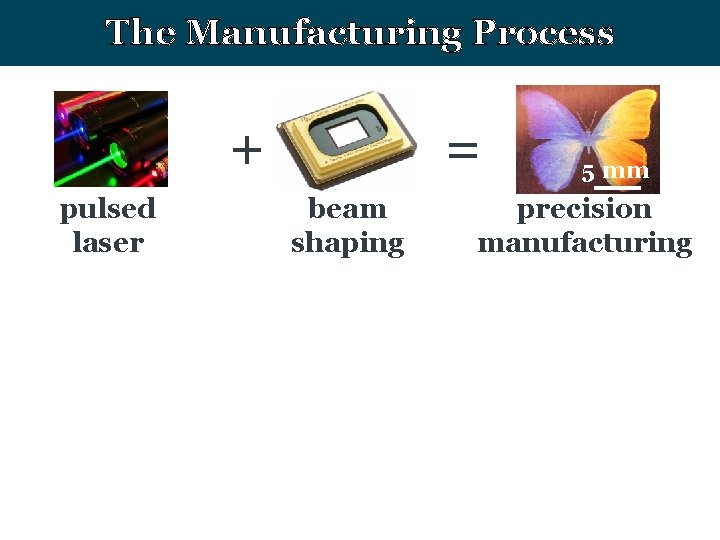
The Manufacturing Process + pulsed laser = beam shaping 5 mm precision manufacturing
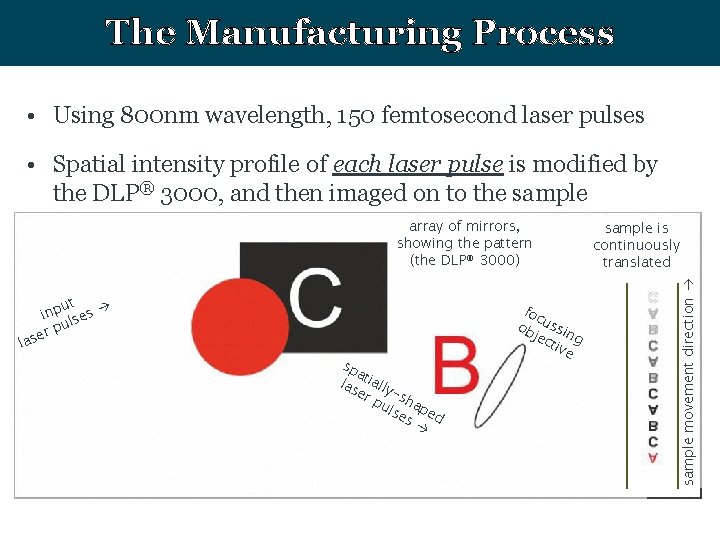
The Manufacturing Process • Using 800 nm wavelength, 150 femtosecond laser pulses • Spatial intensity profile of each laser pulse is modified by the DLP® 3000, and then imaged on to the sample ut p n i es s l u rp e s la sp a las tially er pu shap lse s ed sample is continuously translated foc ob ussin jec tiv g e 4 sample movement direction array of mirrors, showing the pattern (the DLP® 3000)
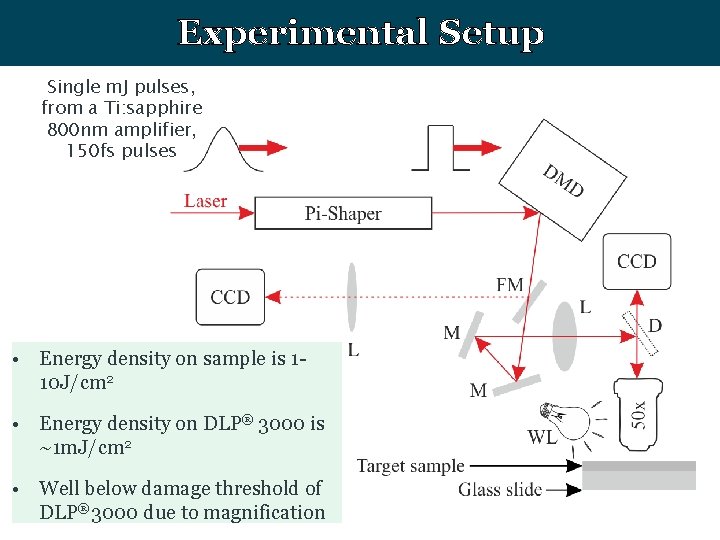
Experimental Setup Single m. J pulses, from a Ti: sapphire 800 nm amplifier, 150 fs pulses • Energy density on sample is 110 J/cm 2 • Energy density on DLP® 3000 is ~1 m. J/cm 2 • Well below damage threshold of DLP® 3000 due to magnification
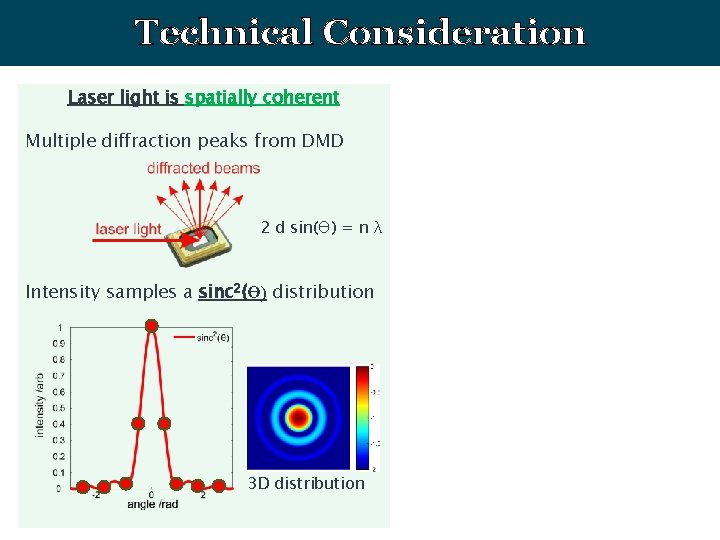
Technical Consideration Laser light is spatially coherent Multiple diffraction peaks from DMD 2 d sin(ϴ) = n λ Intensity samples a sinc 2(ϴ) distribution 3 D distribution
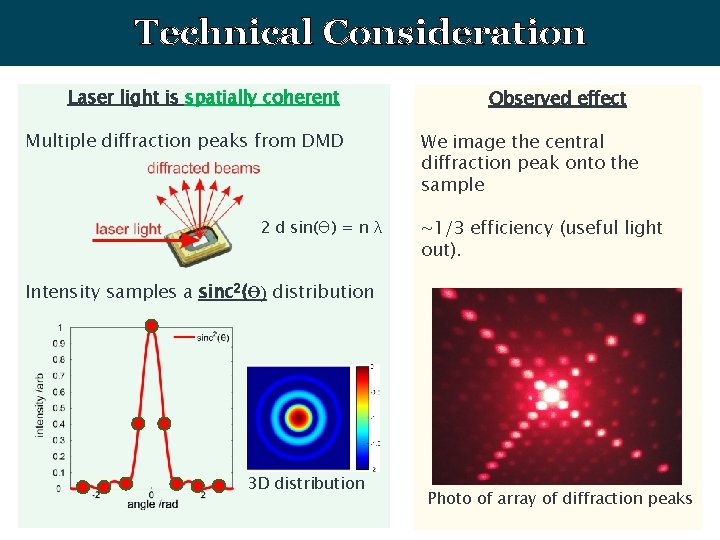
Technical Consideration Laser light is spatially coherent Multiple diffraction peaks from DMD 2 d sin(ϴ) = n λ Observed effect We image the central diffraction peak onto the sample ~1/3 efficiency (useful light out). Intensity samples a sinc 2(ϴ) distribution 3 D distribution Photo of array of diffraction peaks
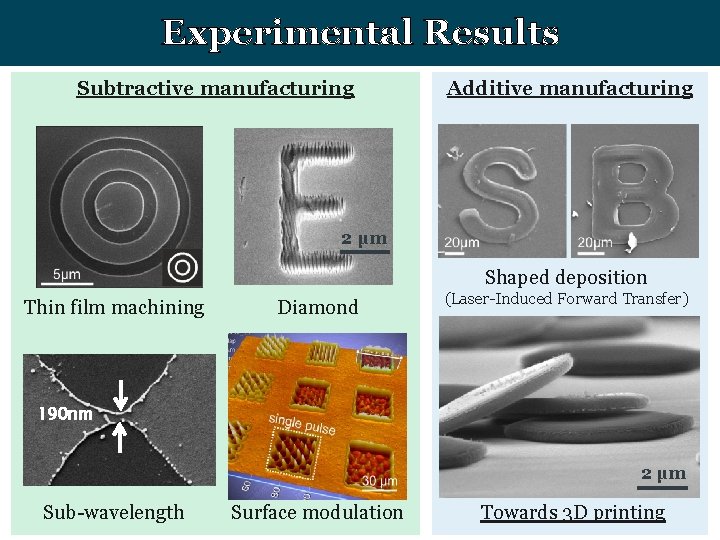
Experimental Results Subtractive manufacturing Additive manufacturing 2 µm Shaped deposition Thin film machining Diamond (Laser-Induced Forward Transfer) 190 nm 2 µm Sub-wavelength Surface modulation Towards 3 D printing
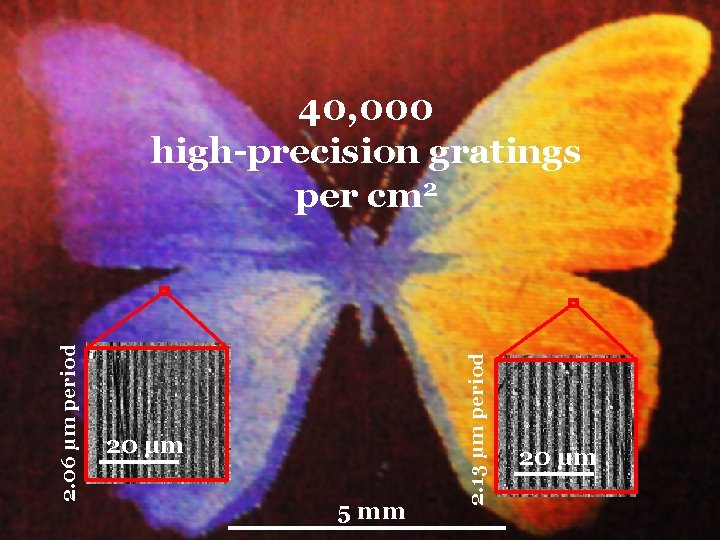
20 μm 5 mm 2. 13 μm period 2. 06 μm period 40, 000 high-precision gratings per cm 2 20 μm
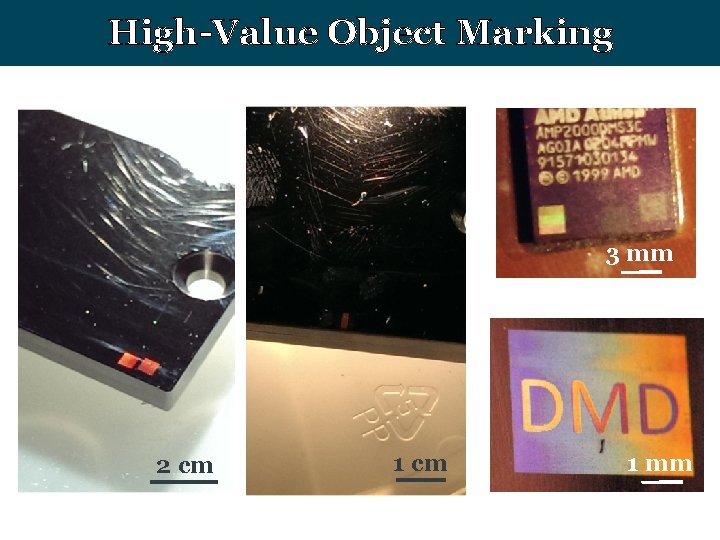
High-Value Object Marking 3 mm 2 cm 1 mm
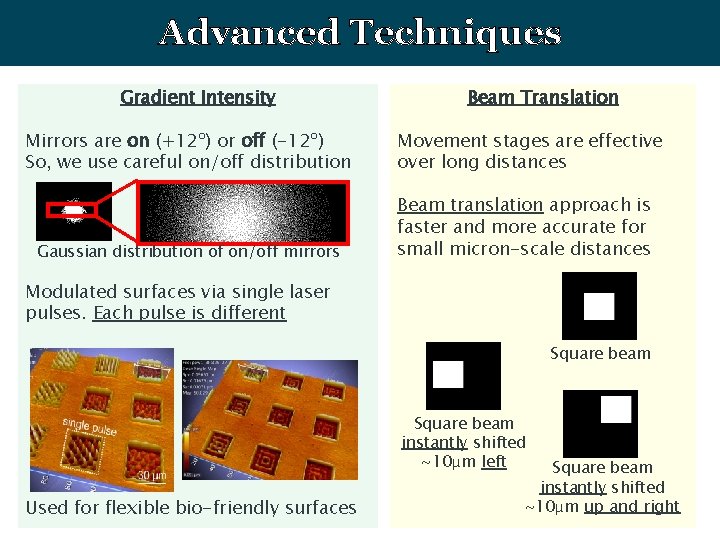
Advanced Techniques Gradient Intensity Mirrors are on (+12º) or off (-12º) So, we use careful on/off distribution Gaussian distribution of on/off mirrors Beam Translation Movement stages are effective over long distances Beam translation approach is faster and more accurate for small micron-scale distances Modulated surfaces via single laser pulses. Each pulse is different Square beam instantly shifted ~10μm left Used for flexible bio-friendly surfaces Square beam instantly shifted ~10μm up and right
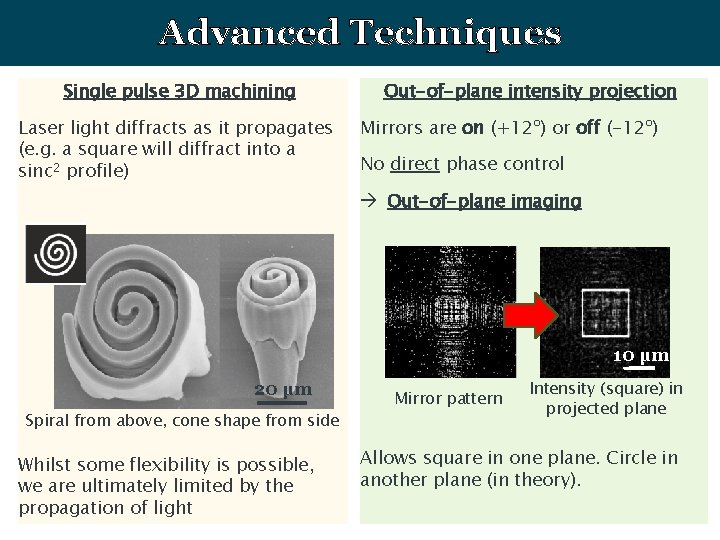
Advanced Techniques Single pulse 3 D machining Laser light diffracts as it propagates (e. g. a square will diffract into a sinc 2 profile) Out-of-plane intensity projection Mirrors are on (+12º) or off (-12º) No direct phase control Out-of-plane imaging 10 µm 20 µm Spiral from above, cone shape from side Whilst some flexibility is possible, we are ultimately limited by the propagation of light Mirror pattern Intensity (square) in projected plane Allows square in one plane. Circle in another plane (in theory).
The (Near) Future • Just awarded: EPSRC Early Career Fellowship (5 year, £ 1. 0 m), developing high-precision laserbased manufacturing processes using beam shaping technologies • Collaborations welcome • Applications-driven research • Pathway to commercialisation? Higher powers, different wavelengths, higher repetition rates, increase efficiency etc.
Conclusions • Beam shaping is an exciting enablingtechnology for high-precision laser-based manufacturing • Some technical considerations (i. e. diffraction) • Additive and subtractive laser-based manufacturing • Many applications, across photonics and biomedical domains • Potential for more advanced techniques that really utilise the flexibility of DLP® technology
- Slides: 14