
Using a combination of Gangliosides and Cell Surface
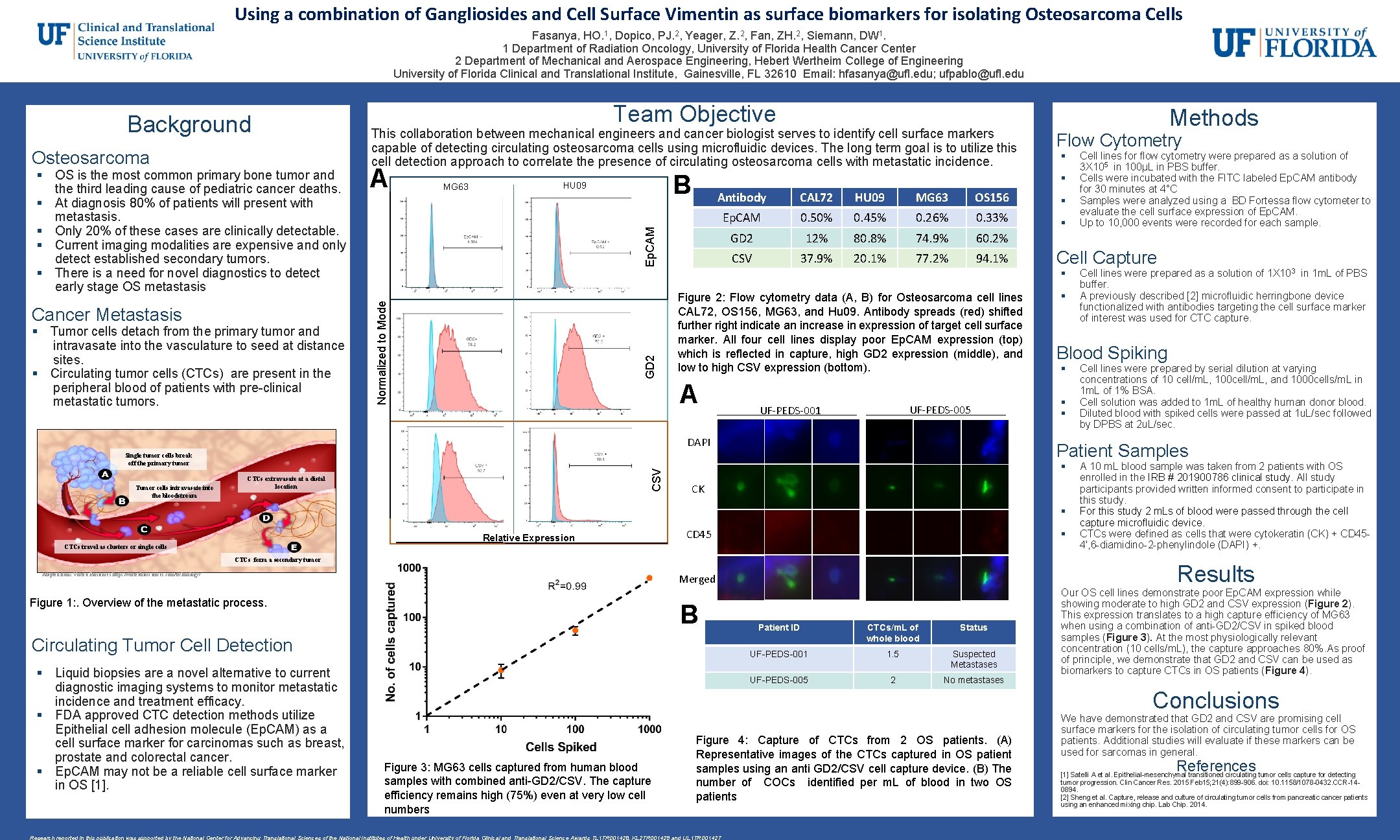
Using a combination of Gangliosides and Cell Surface Vimentin as surface biomarkers for isolating Osteosarcoma Cells Fasanya, HO. 1, Dopico, PJ. 2, Yeager, Z. 2, Fan, ZH. 2, Siemann, DW 1. 1 Department of Radiation Oncology, University of Florida Health Cancer Center 2 Department of Mechanical and Aerospace Engineering, Hebert Wertheim College of Engineering University of Florida Clinical and Translational Institute, Gainesville, FL 32610 Email: hfasanya@ufl. edu; ufpablo@ufl. edu Cancer Metastasis § Tumor cells detach from the primary tumor and intravasate into the vasculature to seed at distance sites. § Circulating tumor cells (CTCs) are present in the peripheral blood of patients with pre-clinical metastatic tumors. A MG 63 B HU 09 Flow Cytometry § Antibody CAL 72 HU 09 MG 63 OS 156 § Ep. CAM 0. 50% 0. 45% 0. 26% 0. 33% § GD 2 12% 80. 8% 74. 9% 60. 2% CSV 37. 9% 20. 1% 77. 2% 94. 1% Figure 2: Flow cytometry data (A, B) for Osteosarcoma cell lines CAL 72, OS 156, MG 63, and Hu 09. Antibody spreads (red) shifted further right indicate an increase in expression of target cell surface marker. All four cell lines display poor Ep. CAM expression (top) which is reflected in capture, high GD 2 expression (middle), and low to high CSV expression (bottom). A UF-PEDS-005 UF-PEDS-001 CSV § Blood Spiking § § CK § Relative Expression CTCs travel as clusters or single cells CD 45 § CTCs form a secondary tumor Figure 1: . Overview of the metastatic process. B Circulating Tumor Cell Detection § Liquid biopsies are a novel alternative to current diagnostic imaging systems to monitor metastatic incidence and treatment efficacy. § FDA approved CTC detection methods utilize Epithelial cell adhesion molecule (Ep. CAM) as a cell surface marker for carcinomas such as breast, prostate and colorectal cancer. § Ep. CAM may not be a reliable cell surface marker in OS [1]. Cell lines were prepared by serial dilution at varying concentrations of 10 cell/m. L, 100 cell/m. L, and 1000 cells/m. L in 1 m. L of 1% BSA. Cell solution was added to 1 m. L of healthy human donor blood. Diluted blood with spiked cells were passed at 1 u. L/sec followed by DPBS at 2 u. L/sec. A 10 m. L blood sample was taken from 2 patients with OS enrolled in the IRB # 201900786 clinical study. All study participants provided written informed consent to participate in this study. For this study 2 m. Ls of blood were passed through the cell capture microfluidic device. CTCs were defined as cells that were cytokeratin (CK) + CD 454', 6 -diamidino-2 -phenylindole (DAPI) +. Results Merged Adapted from: Vortex Biosiences https: //vortexbiosciences. com/technology/ Cell lines were prepared as a solution of 1 X 10³ in 1 m. L of PBS buffer. A previously described [2] microfluidic herringbone device functionalized with antibodies targeting the cell surface marker of interest was used for CTC capture. Patient Samples Single tumor cells break off the primary tumor CTCs extravasate at a distal location Cell lines for flow cytometry were prepared as a solution of 3 X 10⁵ in 100µL in PBS buffer. Cells were incubated with the FITC labeled Ep. CAM antibody for 30 minutes at 4°C Samples were analyzed using a BD Fortessa flow cytometer to evaluate the cell surface expression of Ep. CAM. Up to 10, 000 events were recorded for each sample. Cell Capture § DAPI Tumor cells intravasate into the bloodstream Methods § Ep. CAM § OS is the most common primary bone tumor and the third leading cause of pediatric cancer deaths. § At diagnosis 80% of patients will present with metastasis. § Only 20% of these cases are clinically detectable. § Current imaging modalities are expensive and only detect established secondary tumors. § There is a need for novel diagnostics to detect early stage OS metastasis GD 2 Osteosarcoma This collaboration between mechanical engineers and cancer biologist serves to identify cell surface markers capable of detecting circulating osteosarcoma cells using microfluidic devices. The long term goal is to utilize this cell detection approach to correlate the presence of circulating osteosarcoma cells with metastatic incidence. Normalized to Mode Background Team Objective Patient ID CTCs/m. L of whole blood Status UF-PEDS-001 1. 5 Suspected Metastases UF-PEDS-005 2 No metastases Our OS cell lines demonstrate poor Ep. CAM expression while showing moderate to high GD 2 and CSV expression (Figure 2). This expression translates to a high capture efficiency of MG 63 when using a combination of anti-GD 2/CSV in spiked blood samples (Figure 3). At the most physiologically relevant concentration (10 cells/m. L), the capture approaches 80%. As proof of principle, we demonstrate that GD 2 and CSV can be used as biomarkers to capture CTCs in OS patients (Figure 4). Conclusions Figure 3: MG 63 cells captured from human blood samples with combined anti-GD 2/CSV. The capture efficiency remains high (75%) even at very low cell numbers Figure 4: Capture of CTCs from 2 OS patients. (A) Representative images of the CTCs captured in OS patient samples using an anti GD 2/CSV cell capture device. (B) The number of COCs identified per m. L of blood in two OS patients We have demonstrated that GD 2 and CSV are promising cell surface markers for the isolation of circulating tumor cells for OS patients. Additional studies will evaluate if these markers can be used for sarcomas in general. References [1] Satelli A et al. Epithelial-mesenchymal transitioned circulating tumor cells capture for detecting tumor progression. Clin Cancer Res. 2015 Feb 15; 21(4): 899 -906. doi: 10. 1158/1078 -0432. CCR-140894. [2] Sheng et al. Capture, release and culture of circulating tumor cells from pancreatic cancer patients using an enhanced mixing chip. Lab Chip. 2014.
- Slides: 1