
Using a Centered Moving Average to Extract the

- Slides: 7
Using a Centered Moving Average to Extract the Seasonal Component of a Time Series If we are forecasting with say, quarterly time series data, a 4 -period moving average should be free of seasonality since it always includes one observation for each quarter of the year
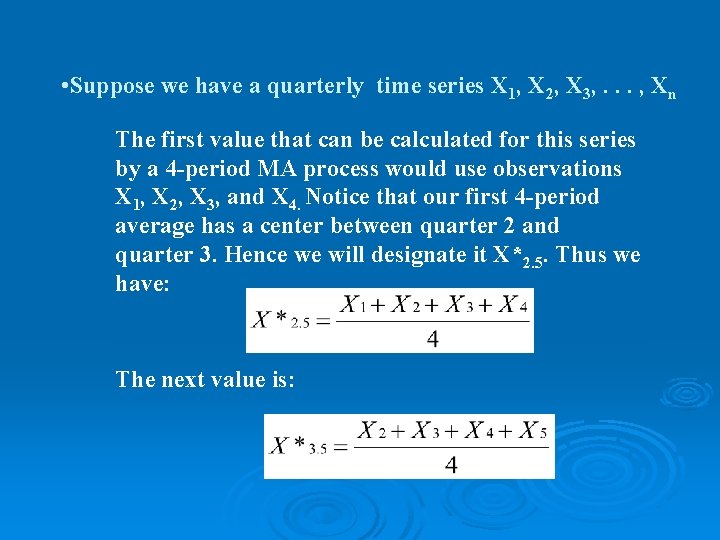
• Suppose we have a quarterly time series X 1, X 2, X 3, . . . , Xn The first value that can be calculated for this series by a 4 -period MA process would use observations X 1, X 2, X 3, and X 4. Notice that our first 4 -period average has a center between quarter 2 and quarter 3. Hence we will designate it X*2. 5. Thus we have: The next value is:
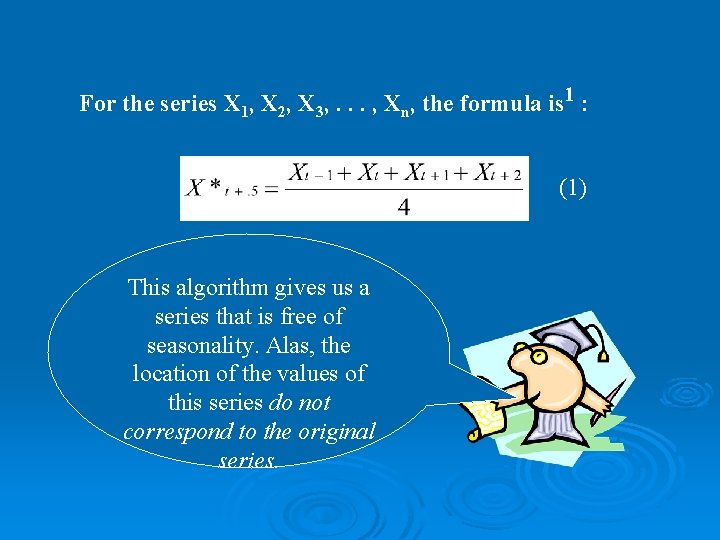
For the series X 1, X 2, X 3, . . . , Xn, the formula is 1 : (1) This algorithm gives us a series that is free of seasonality. Alas, the location of the values of this series do not correspond to the original series.
We can correct this problem with a centered moving average If we average adjacent pairs of X*t’s, we obtain a series that is free of seasonality and is aligned correctly with our original series
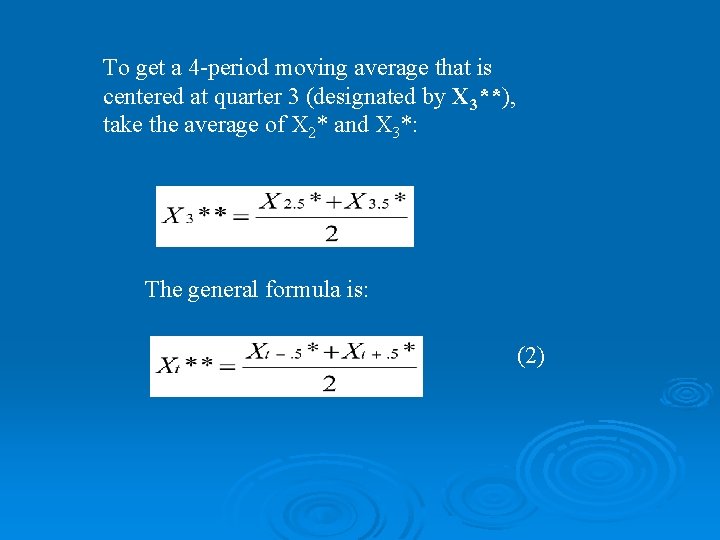
To get a 4 -period moving average that is centered at quarter 3 (designated by X 3**), take the average of X 2* and X 3*: The general formula is: (2)
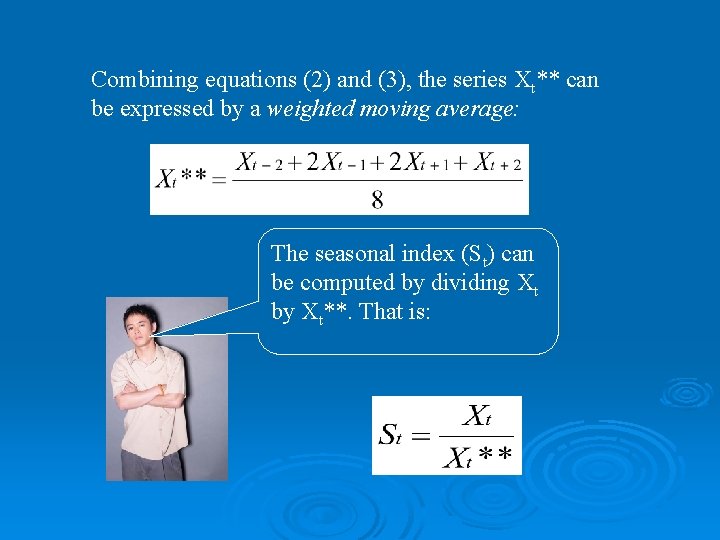
Combining equations (2) and (3), the series Xt** can be expressed by a weighted moving average: The seasonal index (St) can be computed by dividing Xt by Xt**. That is:
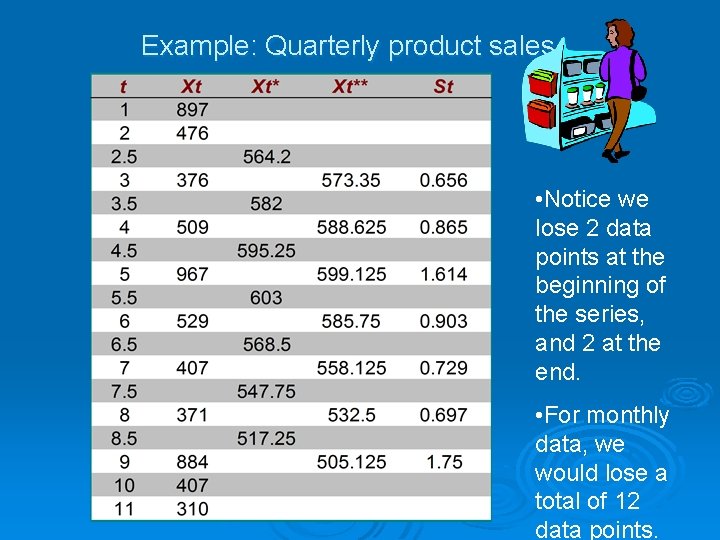
Example: Quarterly product sales • Notice we lose 2 data points at the beginning of the series, and 2 at the end. • For monthly data, we would lose a total of 12 data points.