
Using 3 D water models to investigate fundamental


- Slides: 38
Using 3 D water models to investigate fundamental and powerful concepts in the biological sciences Nora Egan Demers Joanna Salapska-Gelleri
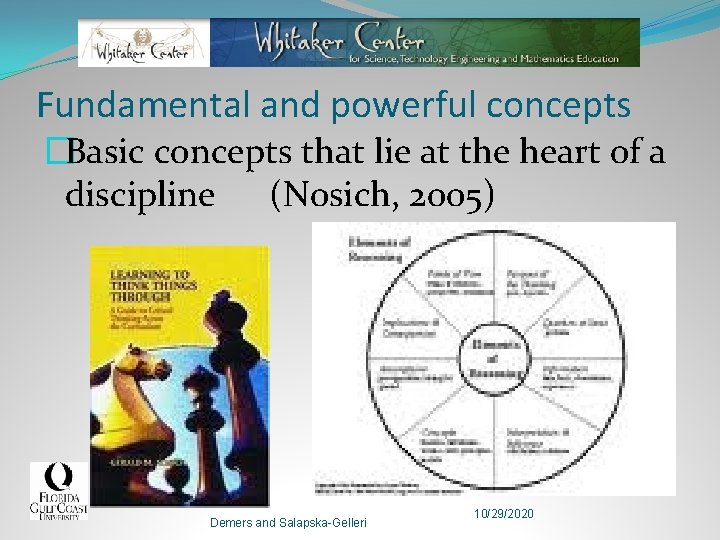
Fundamental and powerful concepts �Basic concepts that lie at the heart of a discipline (Nosich, 2005) Demers and Salapska-Gelleri 10/29/2020
Background- How we got here �Whitaker Center sponsored �support to attend Gordon Research Conference – (confidential)�but the NSF sponsors preconference workshops we can talk about! Demers and Salapska-Gelleri 10/29/2020
GRC VISUALIZATION IN SCIENCE & EDUCATION July 3 -8, 2005 The Queen's College Oxford, United Kingdom Demers and Salapska-Gelleri 10/29/2020
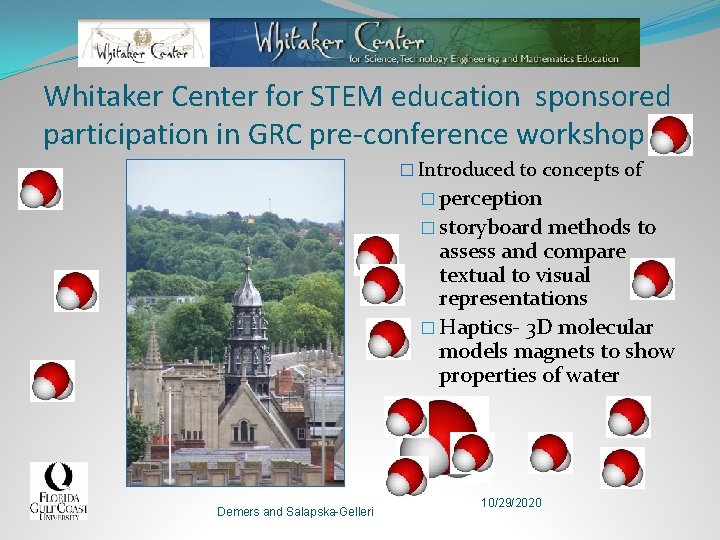
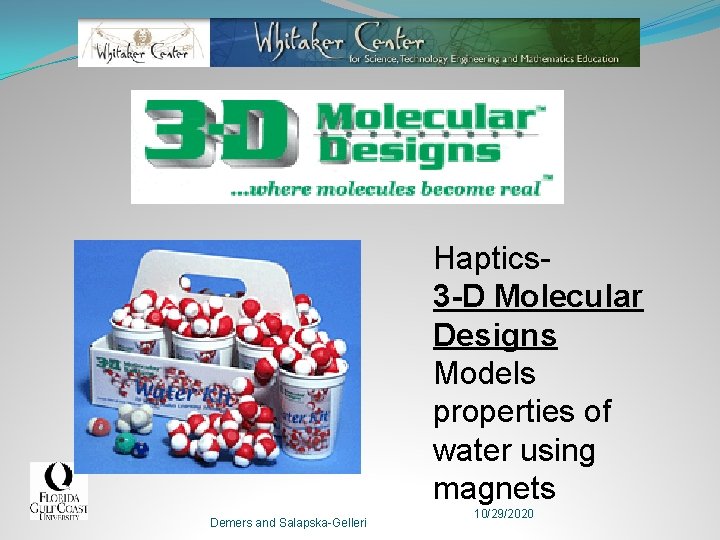
Whitaker Center for STEM education sponsored participation in GRC pre-conference workshop � Introduced to concepts of � perception � storyboard methods to assess and compare textual to visual representations � Haptics- 3 D molecular models magnets to show properties of water Demers and Salapska-Gelleri 10/29/2020
Haptics 3 -D Molecular Designs Models properties of water using magnets Demers and Salapska-Gelleri 10/29/2020
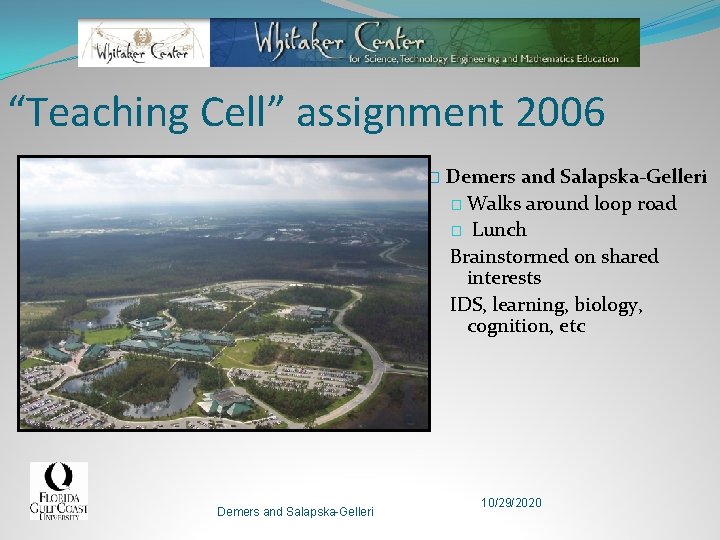
“Teaching Cell” assignment 2006 � Demers and Salapska-Gelleri � Walks around loop road � Lunch Brainstormed on shared interests IDS, learning, biology, cognition, etc Demers and Salapska-Gelleri 10/29/2020
FGCU Demographics of course �(Freshman) General Biology I for majors, health professions, forensics, environmental studies, marine science and General Education science with lab (semester-long) �FGCU grew from 1500 students at inception in 1997 to over 10, 000 FTE today � 2006 -2007 Freshman Class Profile �Top 10 percent of high school class: 16% Top 25 percent of high school class: 46% Top 50 percent of high school class: 84% 10/29/2020 Demers and Salapska-Gelleri
Learning Outcomes �Structure function relationship reinforced �Greater understanding of role of electronegativity in emergent properties of water �Types of bonds- Ionic vs Polar covalent bonds versus hydrogen bonds (inter vs intramolecular forces) Demers and Salapska-Gelleri 10/29/2020
Learning Outcomes cont’ �knowledge of emergent properties of water based on polarity (caused by differences in electronegativity) �Cohesion/Adhesion �Versatile solvent �Expansion upon freezing �Moderate temperatures (not addressed) �Hydrophobic/ydrophilic �data analysis especially variation Integrate explanation into lecture interspersed with activities Demers and Salapska-Gelleri 10/29/2020
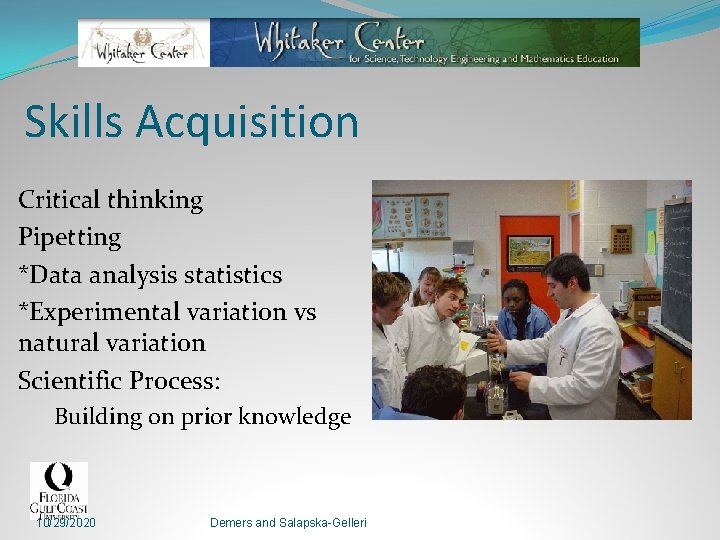
Skills Acquisition Critical thinking Pipetting *Data analysis statistics *Experimental variation vs natural variation Scientific Process: Building on prior knowledge 10/29/2020 Demers and Salapska-Gelleri
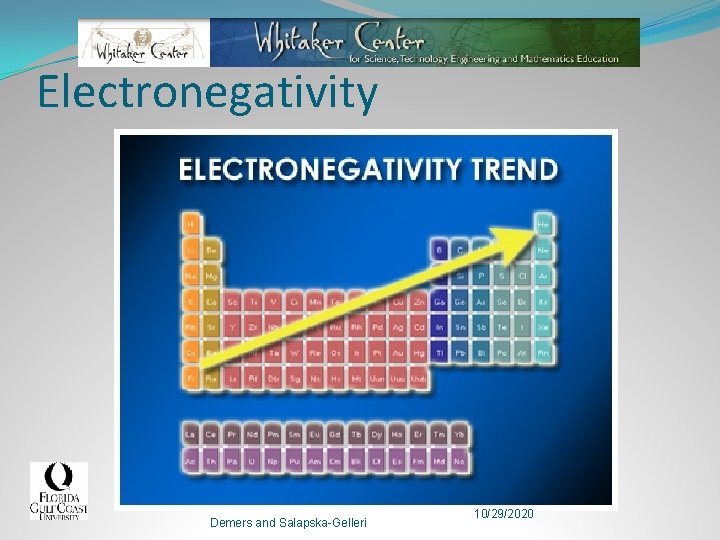
Electronegativity Demers and Salapska-Gelleri 10/29/2020
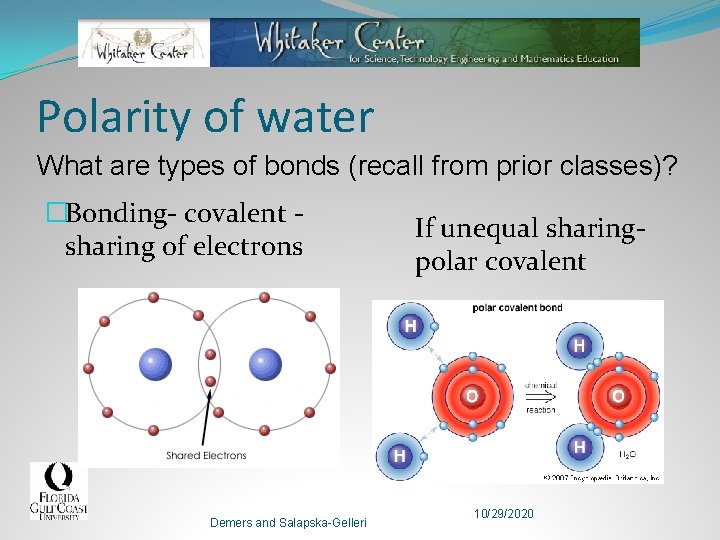
Polarity of water What are types of bonds (recall from prior classes)? �Bonding- covalent sharing of electrons Demers and Salapska-Gelleri If unequal sharingpolar covalent 10/29/2020
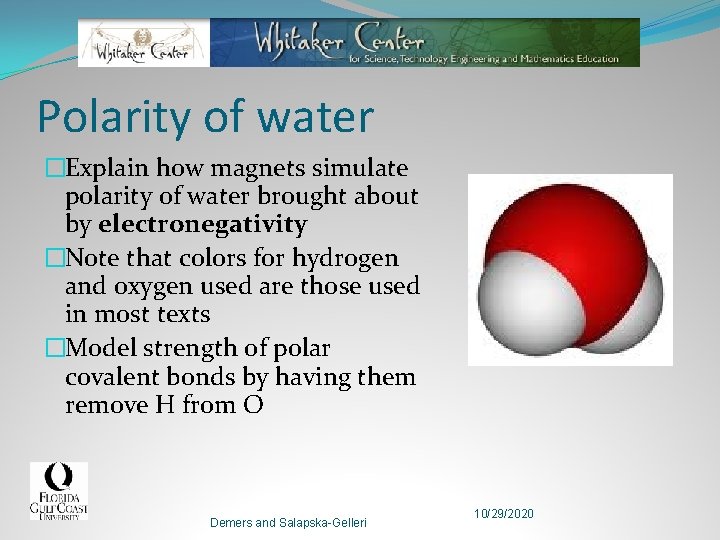
Polarity of water �Explain how magnets simulate polarity of water brought about by electronegativity �Note that colors for hydrogen and oxygen used are those used in most texts �Model strength of polar covalent bonds by having them remove H from O Demers and Salapska-Gelleri 10/29/2020
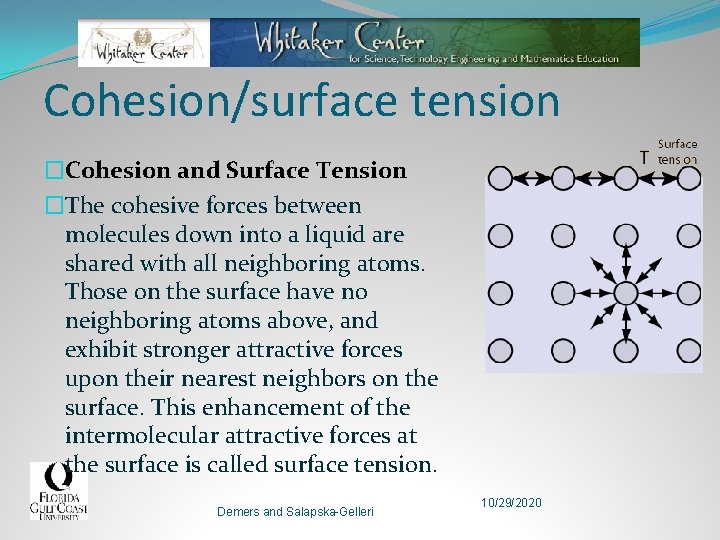
Cohesion/surface tension �Cohesion and Surface Tension �The cohesive forces between molecules down into a liquid are shared with all neighboring atoms. Those on the surface have no neighboring atoms above, and exhibit stronger attractive forces upon their nearest neighbors on the surface. This enhancement of the intermolecular attractive forces at the surface is called surface tension. Demers and Salapska-Gelleri 10/29/2020
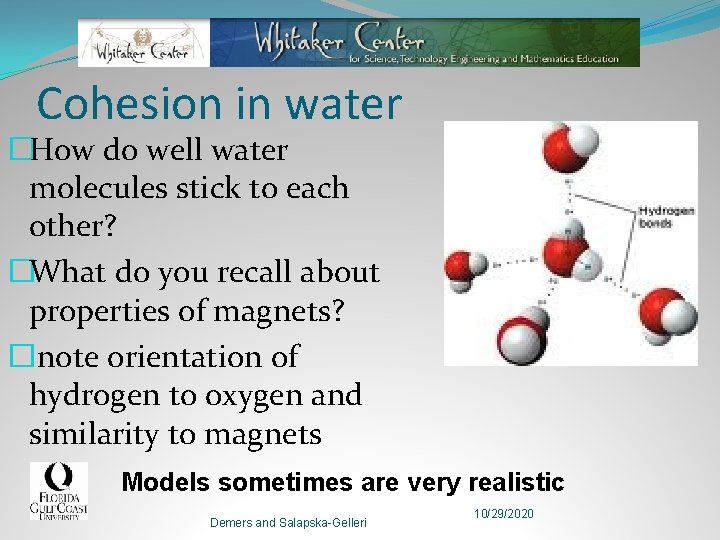
Cohesion in water �How do well water molecules stick to each other? �What do you recall about properties of magnets? �note orientation of hydrogen to oxygen and similarity to magnets Models sometimes are very realistic Demers and Salapska-Gelleri 10/29/2020
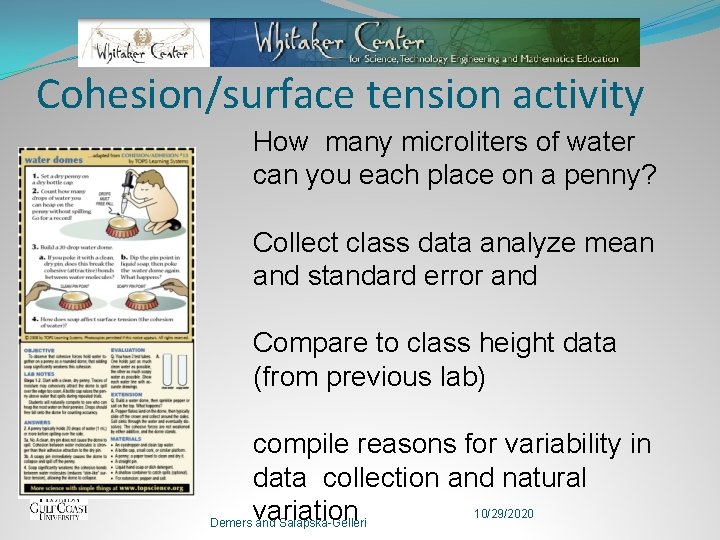
Cohesion/surface tension activity How many microliters of water can you each place on a penny? Collect class data analyze mean and standard error and Compare to class height data (from previous lab) compile reasons for variability in data collection and natural 10/29/2020 variation Demers and Salapska-Gelleri
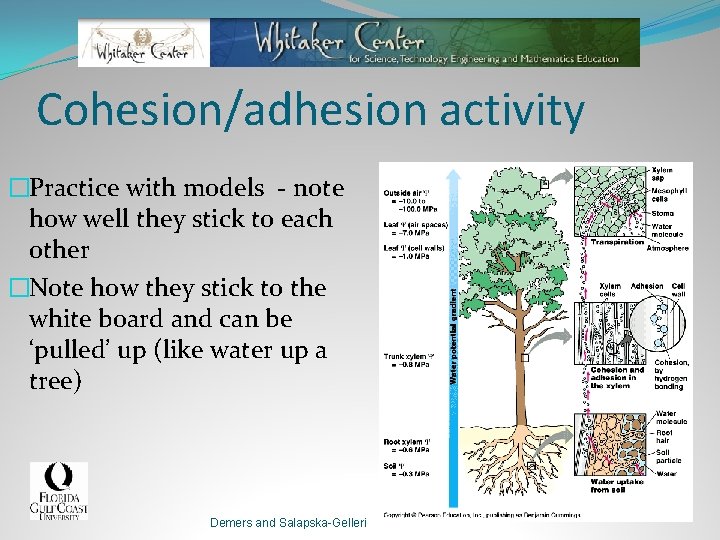
Cohesion/adhesion activity �Practice with models - note how well they stick to each other �Note how they stick to the white board and can be ‘pulled’ up (like water up a tree) Demers and Salapska-Gelleri 10/29/2020
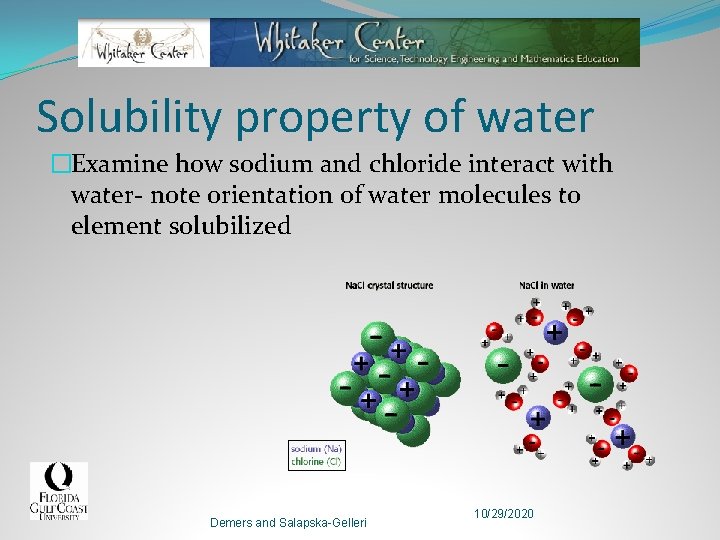
Solubility property of water �Examine how sodium and chloride interact with water- note orientation of water molecules to element solubilized Demers and Salapska-Gelleri 10/29/2020
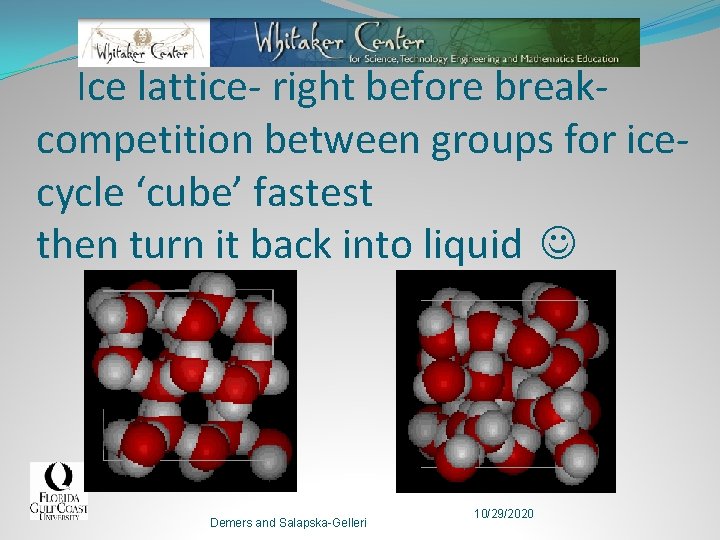
Ice lattice- right before breakcompetition between groups for icecycle ‘cube’ fastest then turn it back into liquid Demers and Salapska-Gelleri 10/29/2020
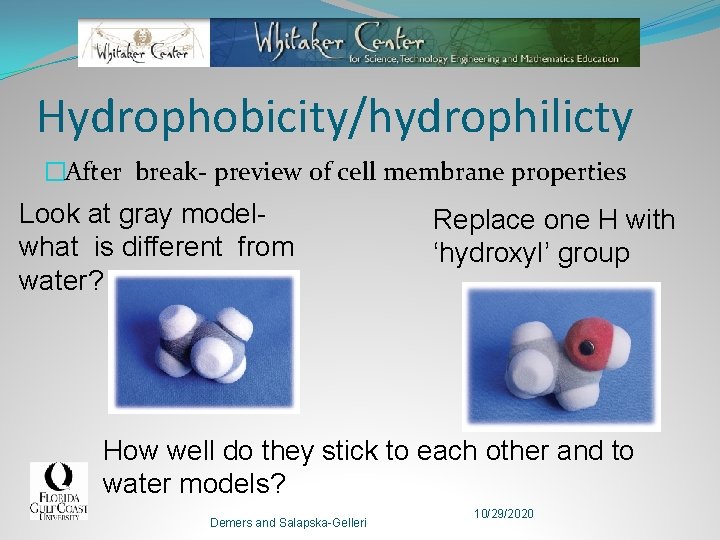
Hydrophobicity/hydrophilicty �After break- preview of cell membrane properties Look at gray modelwhat is different from water? Replace one H with ‘hydroxyl’ group How well do they stick to each other and to water models? Demers and Salapska-Gelleri 10/29/2020
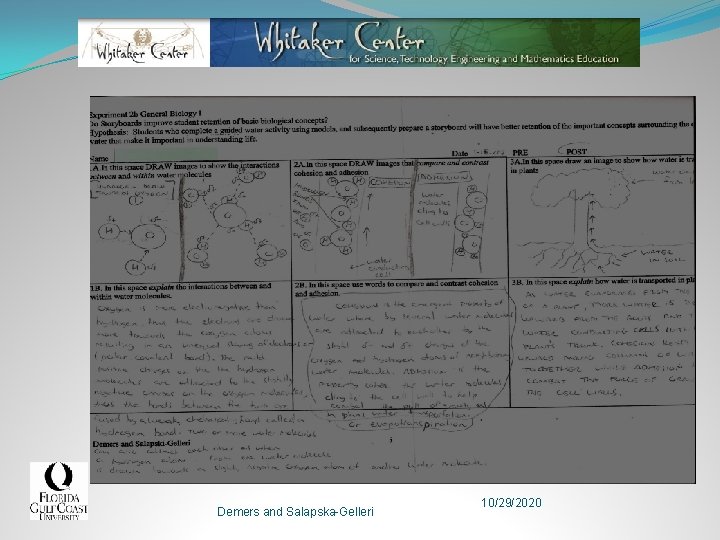
What we did �What is a “fundamental and powerful concept” in Biology (and other natural sciences)? �Drafted storyboard to assess student understanding of knowledge before and after using cool magnets in hands-on learning approach in Gen Bio I �Approach Ed. Researcher with idea- she suggested 3 rd box to extend to assess their understanding of higher level application – how does water go up a tree? �Submit IRB and devise informed consent Demers and Salapska-Gelleri 10/29/2020
Demers and Salapska-Gelleri 10/29/2020
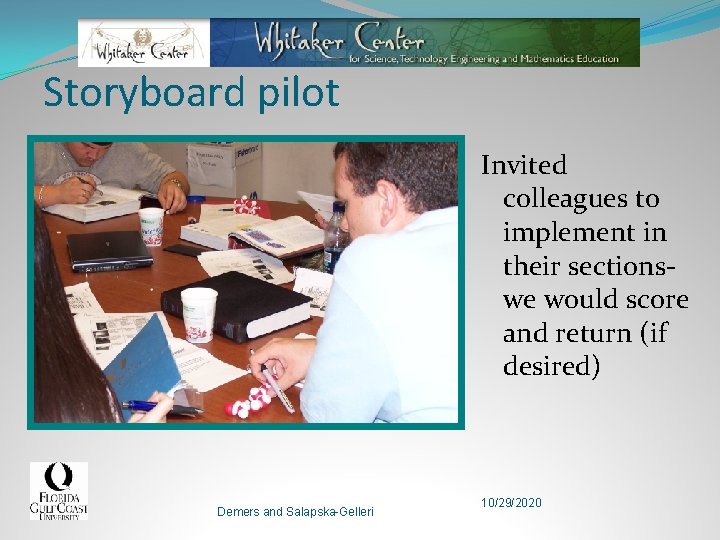
Storyboard pilot Invited colleagues to implement in their sectionswe would score and return (if desired) Demers and Salapska-Gelleri 10/29/2020
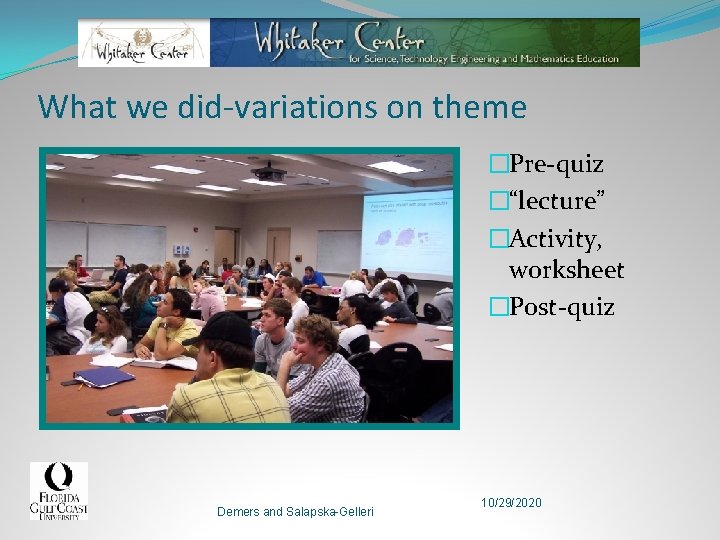
What we did-variations on theme �Pre-quiz �“lecture” �Activity, worksheet �Post-quiz Demers and Salapska-Gelleri 10/29/2020
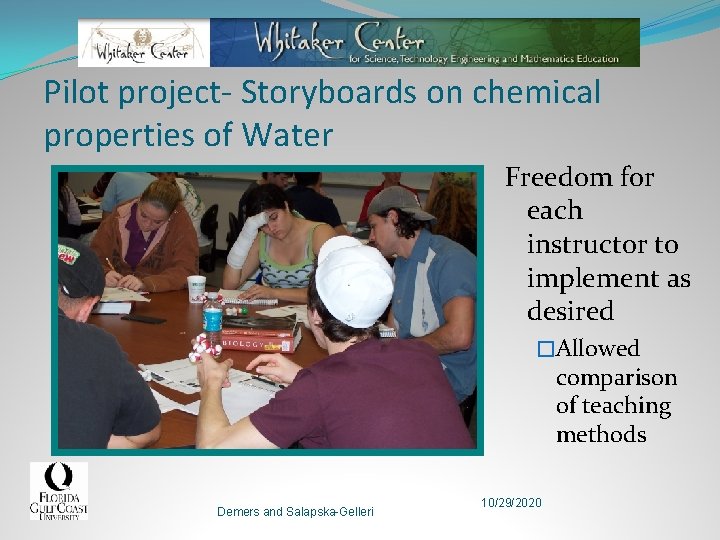
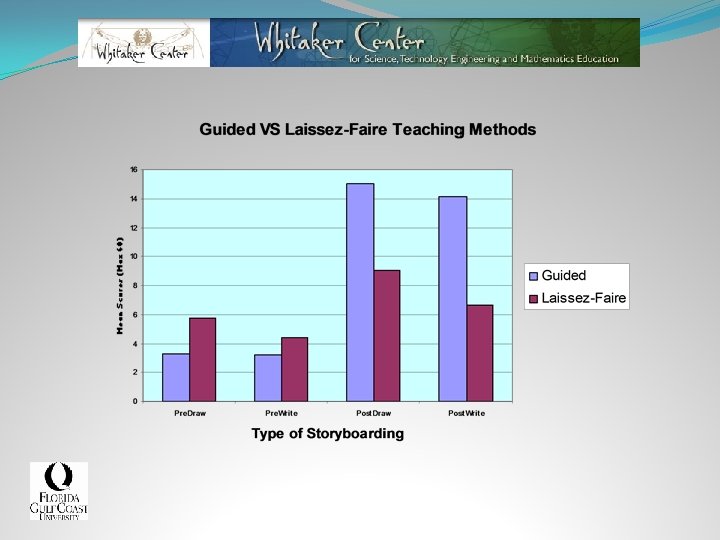
Pilot project- Storyboards on chemical properties of Water Freedom for each instructor to implement as desired �Allowed comparison of teaching methods Demers and Salapska-Gelleri 10/29/2020
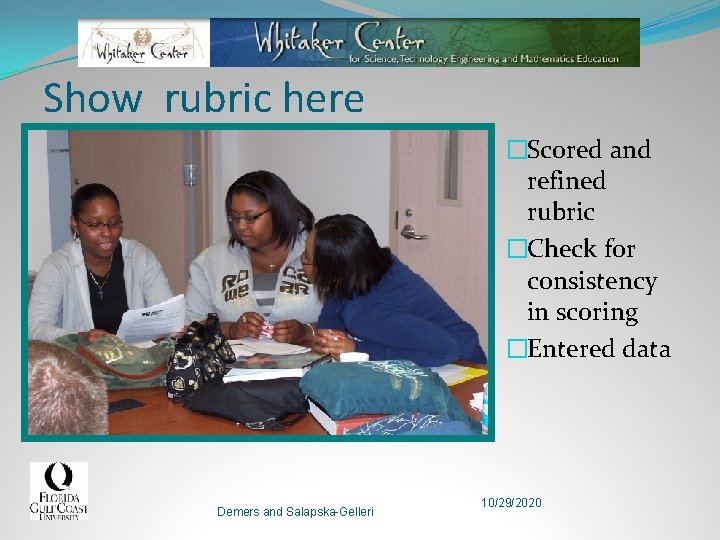
Show rubric here �Scored and refined rubric �Check for consistency in scoring �Entered data Demers and Salapska-Gelleri 10/29/2020
Preliminary Analyses Conducted �Scores based on collapsed values for Boxes 1 and 2. �Comparison of baseline knowledge for written versus graphic water properties. �Gains from class activity as a function of Pre and Post test performance. �Evaluation techniques: concurrent, homework, inclass post.
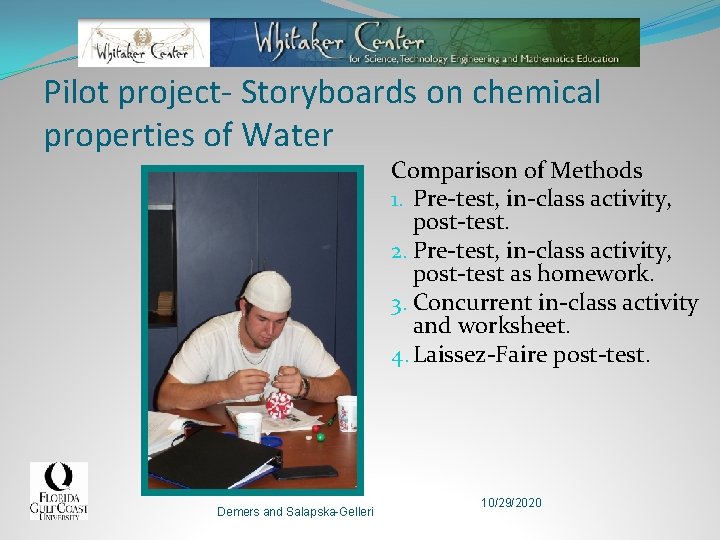
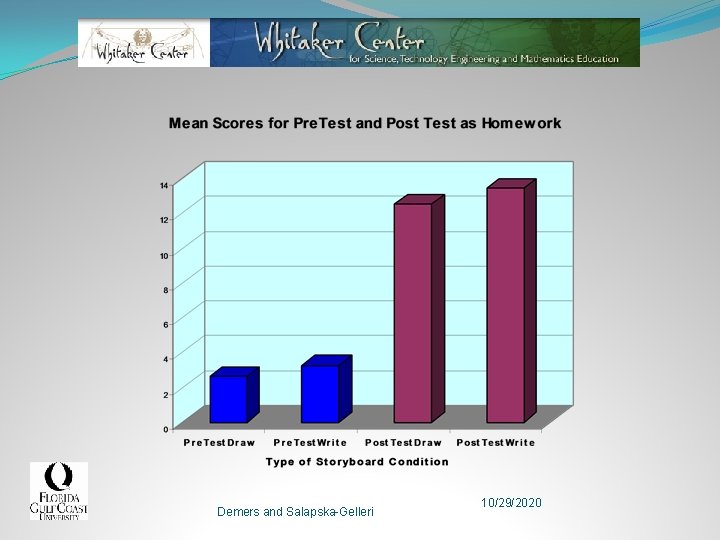
Pilot project- Storyboards on chemical properties of Water Comparison of Methods 1. Pre-test, in-class activity, post-test. 2. Pre-test, in-class activity, post-test as homework. 3. Concurrent in-class activity and worksheet. 4. Laissez-Faire post-test. Demers and Salapska-Gelleri 10/29/2020
Demers and Salapska-Gelleri 10/29/2020
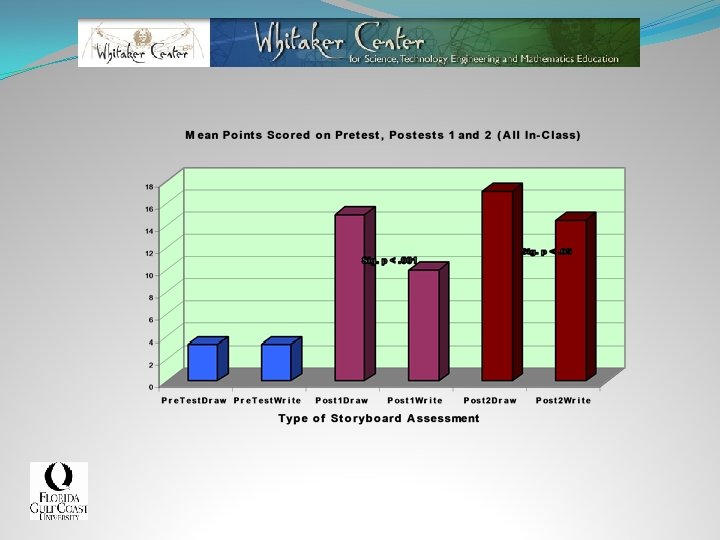
What did they retain? �In two of sections the post was done again during DNA replication chapter �Tried to reinforced importance of distinguishing hydrogen and covalent bonding properties �Those data showed: Demers and Salapska-Gelleri 10/29/2020
What we’ve learned so far- qualitative �Motivation to complete task influences success at demonstrating concepts �Motivations that are effective include grading (most importantly--it has to count!) �They showed better learning on “post” that was homework or filled out during activity �They need very careful guidance to be able to demonstrate even basic knowledge immediately after activity (spoon feeding? ) Demers and Salapska-Gelleri 10/29/2020
What else we’ve done �Reassessed later in term and in upper-division classes �Compare to other benchmarks class grade, etc �Intro to Geology using models for role of water in properties of clay- comparing and refining teaching techniques. One faculty member now designs her entire class around water! �(less success in getting biology colleagues to use models or assess learning of the concept as fully) �How might this be achieved? Demers and Salapska-Gelleri 10/29/2020
Does knowledge of water properties relate to scores in upper-division courses? Vertebrate Form and Function grade compared to worksheet score: worksheet completed first week of class as ungraded un-announced task. Very strong correlation to final grade in class (totally unrelated content). Does this just tell us ‘good students’ are good at everything? Can we find a way to see if knowledge of water improves success in other topics? Demers and Salapska-Gelleri 10/29/2020
Do students recall properties of water in upper-division biology classes? � In a word- NO --students currently enrolled recall very little diagramatically or textually �Will their understanding improve as we get current students who have used the models in these classes? �(Will need to alter worksheet to collect information on whether they used the models (and how) Demers and Salapska-Gelleri 10/29/2020
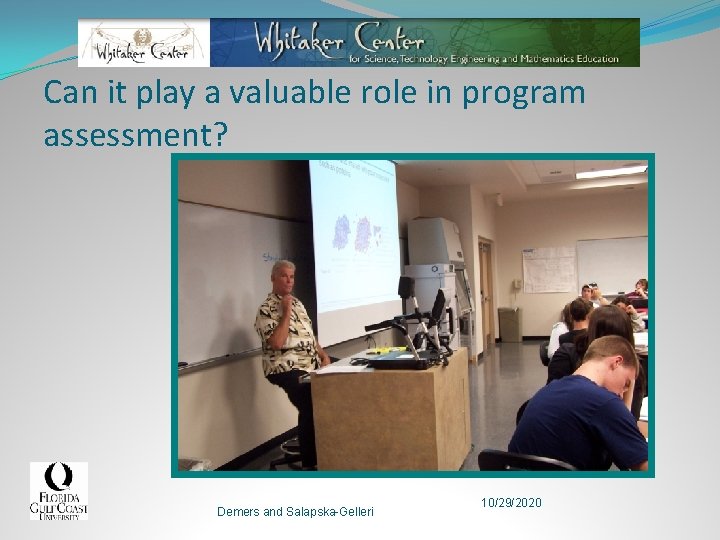
Can it play a valuable role in program assessment? Demers and Salapska-Gelleri 10/29/2020