
USGS Water Quality Programs and the Water Quality

- Slides: 11
USGS Water Quality Programs and the Water Quality Monitoring Framework CONTACTS: Tim Miller tlmiller@usgs. gov (703) 648 -6868 Herb Buxton hbuxton@usgs. gov (609) 771 -3944
Monitoring Objectives and Support • Monitoring: Determination of Status and Trends of water quality conditions at regional and national scales (datacollection intensive). • Assessment: Understanding Water-Quality Conditions by connecting monitoring data to land activities and natural conditions (ancillary data provides the context and causal factors). • Research & Development: Evaluates New Issues and Develops New Methods, Tools and Capabilities (keeps monitoring activities evolving to remain useful).
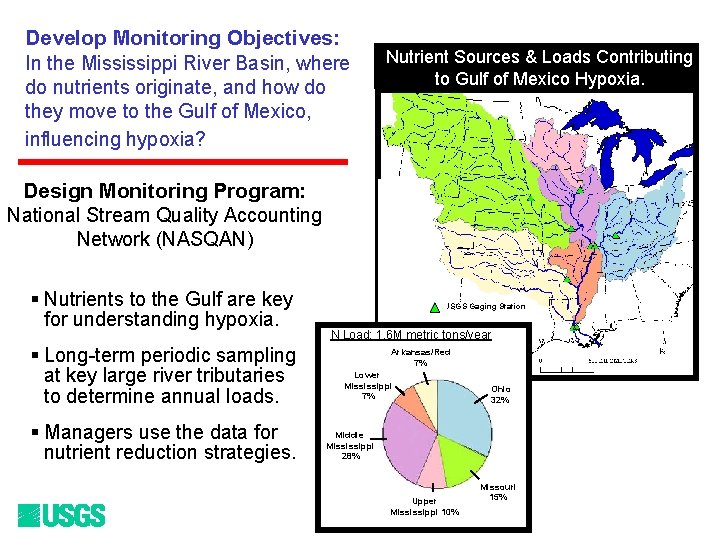
Develop Monitoring Objectives: In the Mississippi River Basin, where do nutrients originate, and how do they move to the Gulf of Mexico, influencing hypoxia? Nutrient Sources & Loads Contributing to Gulf of Mexico Hypoxia. Design Monitoring Program: National Stream Quality Accounting Network (NASQAN) § Nutrients to the Gulf are key for understanding hypoxia. § Long-term periodic sampling at key large river tributaries to determine annual loads. § Managers use the data for nutrient reduction strategies. USGS Gaging Station N Load: 1. 6 M metric tons/year Arkansas/Red 7% Lower Mississippi 7% Ohio 32% Middle Mississippi 28% Upper Mississippi 10% Missouri 15%
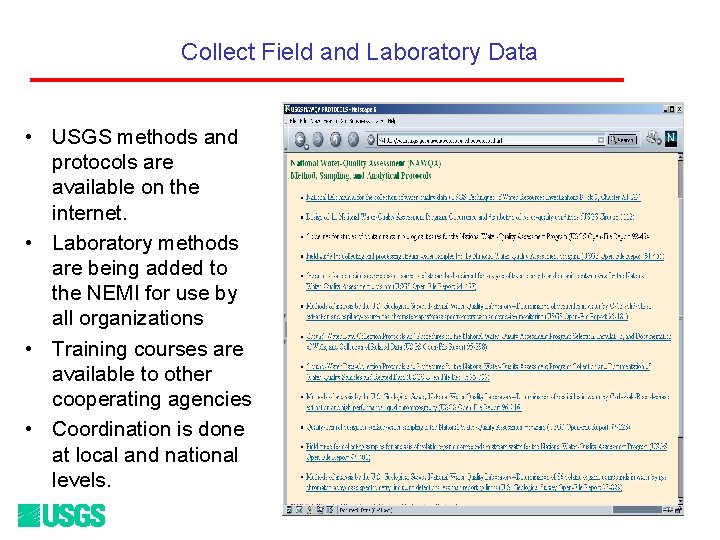
Collect Field and Laboratory Data • USGS methods and protocols are available on the internet. • Laboratory methods are being added to the NEMI for use by all organizations • Training courses are available to other cooperating agencies • Coordination is done at local and national levels.
USGS Infrastructure Supports Field and Lab Data, also Compiling and Managing Data • National protocols to collect samples for trace analysis, provides environmental information other organizations typically do not have. • A National team of professional field technicians collect samples for many organizations reducing duplication and ensuring consistent data collection. • Laboratory methods measuring trace levels with supporting quality assurance, demonstrates the quality of analytical data. • Regional and National-scale monitoring networks provide perspectives not duplicated by the states or other federal agencies. • Long-term field research sites develop new tools applied to monitoring efforts of the future. • The National Water Information System (NWIS) contains comparable data from across the nation, and has full public access.
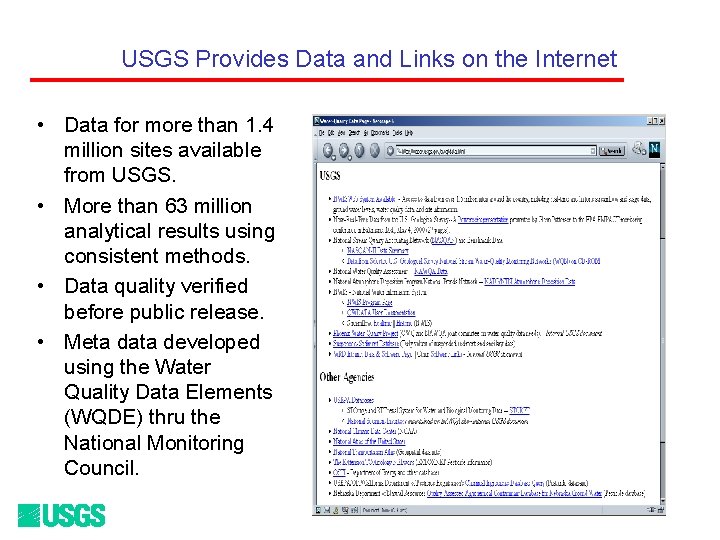
USGS Provides Data and Links on the Internet • Data for more than 1. 4 million sites available from USGS. • More than 63 million analytical results using consistent methods. • Data quality verified before public release. • Meta data developed using the Water Quality Data Elements (WQDE) thru the National Monitoring Council.
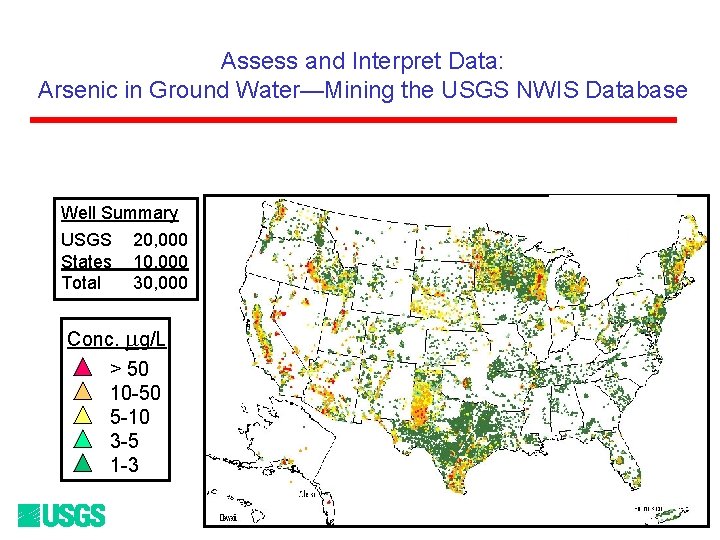
Assess and Interpret Data: Arsenic in Ground Water—Mining the USGS NWIS Database Well Summary USGS States Total 20, 000 10, 000 30, 000 Conc. mg/L > 50 10 -50 5 -10 3 -5 1 -3
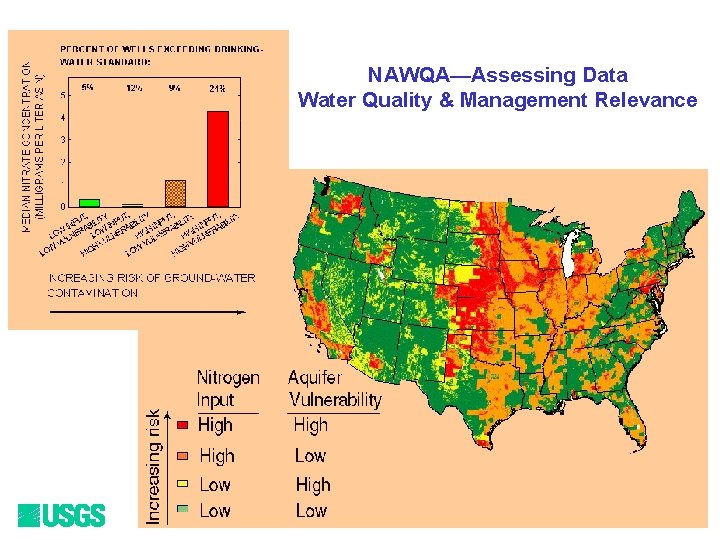
NAWQA—Assessing Data Water Quality & Management Relevance
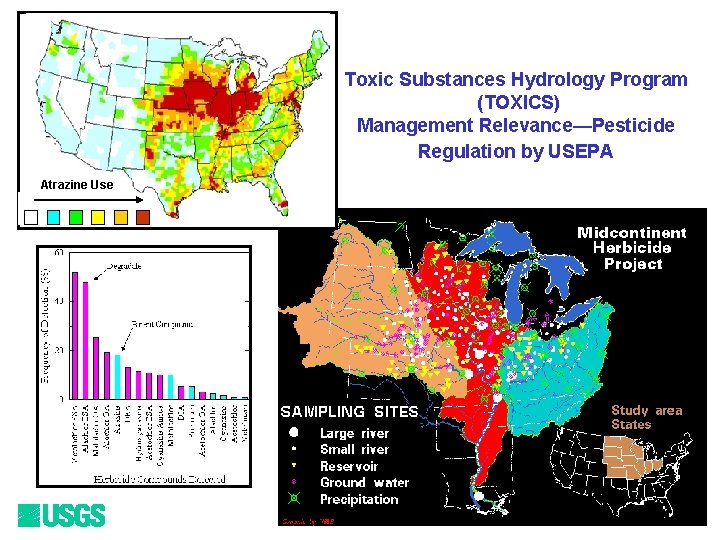
Toxic Substances Hydrology Program (TOXICS) Management Relevance—Pesticide Regulation by USEPA Atrazine Use
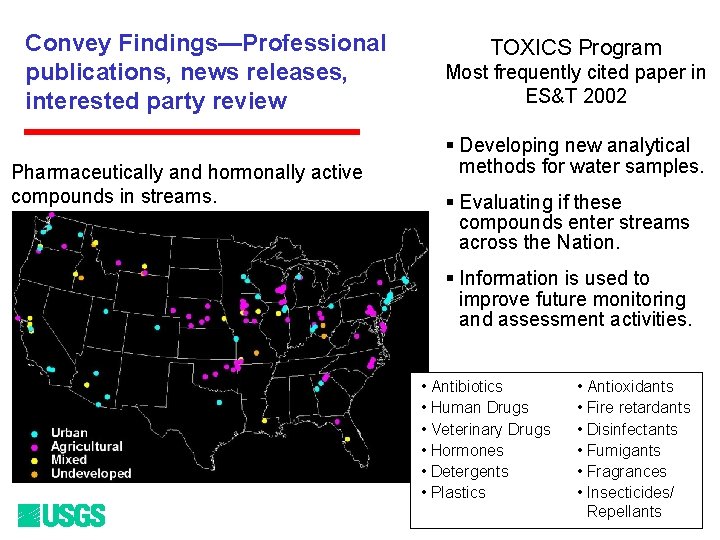
Convey Findings—Professional publications, news releases, interested party review Pharmaceutically and hormonally active compounds in streams. TOXICS Program Most frequently cited paper in ES&T 2002 § Developing new analytical methods for water samples. § Evaluating if these compounds enter streams across the Nation. § Information is used to improve future monitoring and assessment activities. • Antibiotics • Human Drugs • Veterinary Drugs • Hormones • Detergents • Plastics • Antioxidants • Fire retardants • Disinfectants • Fumigants • Fragrances • Insecticides/ Repellants
Collaborate Communicate & Coordinate • Participate in and funding for National Water Quality Monitoring Council (Methods Board, WQDE, NEMI), and USGS has co-sponsored the biannual NWQMC Conference for 5 years. • NAWQA has over 50 liaison committees, involving more than 1000 organizations and individuals. • Through the Federal Cooperative Program, USGS collaborates with more than 1400 agencies, providing consistent methods and data, and eliminating potential duplication of efforts.