
USGS Chesapeake Bay Watershed EDC Science The Next
USGS Chesapeake Bay Watershed EDC Science: The Next Five Years Kelly Smalling, NJ Water Science Center, Project Lead Chesapeake Bay TCW Group April 8, 2015
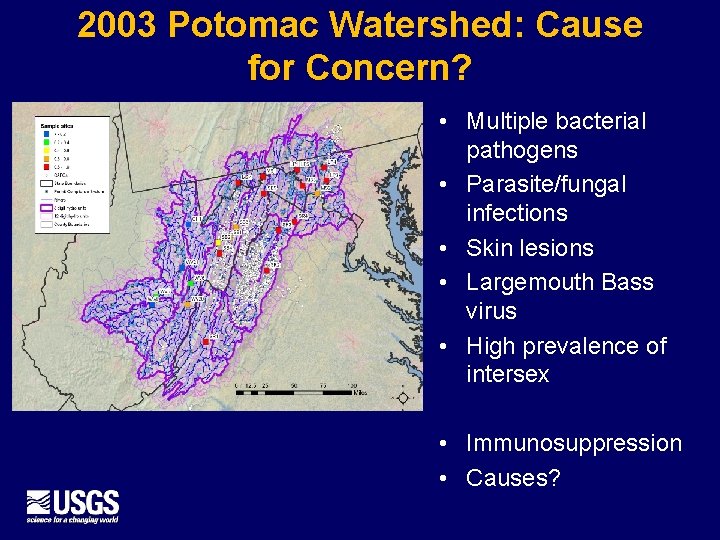
2003 Potomac Watershed: Cause for Concern? • Multiple bacterial pathogens • Parasite/fungal infections • Skin lesions • Largemouth Bass virus • High prevalence of intersex • Immunosuppression • Causes?
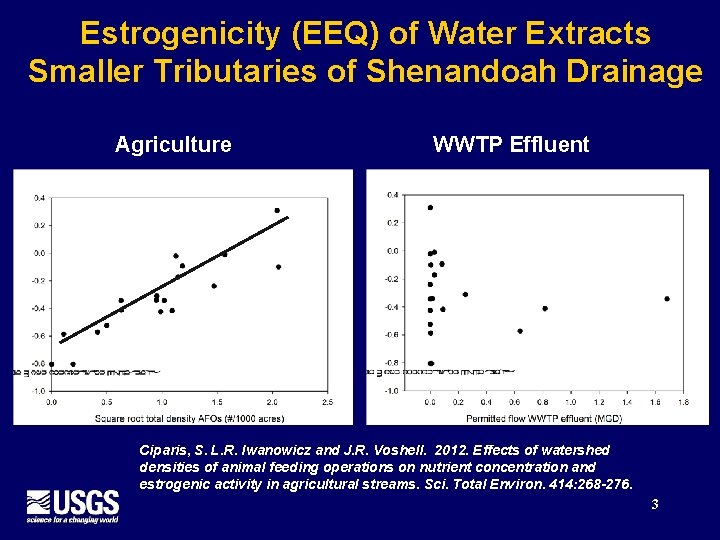
Estrogenicity (EEQ) of Water Extracts Smaller Tributaries of Shenandoah Drainage Agriculture WWTP Effluent Ciparis, S. L. R. Iwanowicz and J. R. Voshell. 2012. Effects of watershed densities of animal feeding operations on nutrient concentration and estrogenic activity in agricultural streams. Sci. Total Environ. 414: 268 -276. 3
Charge: Ensure that the Bay and its rivers are free of effects of toxic contaminants on living resources and human health.
Broad Strategic Goals 1. Identify and quantify the sources, fate, transport, distribution and exposure of EDCs 2. Evaluate the effects of EDCs on fish and wildlife in the environment 3. Determine the mechanism(s) and threshold for adverse effects on fish and wildlife species 4. Develop appropriate assessment tools and models for risk evaluation of EDCs on natural resources 5
Major Science Questions What are the most important sources and exposure pathways of EDCs ? What are the factors that influence these sources/pathways and can WQ management actions help minimize EDCs ? What chemical or mixtures are responsible for causing ED? What is the extent/magnitude of adverse effects on fish and wildlife populations associated with exposure to EDCs What are the causal agents and mechanisms of ED? Can a risk assessment model be developed? 6
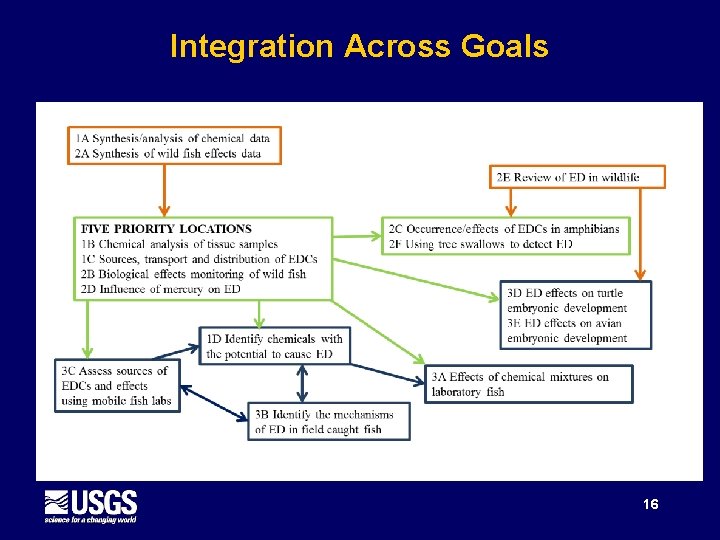
Goal 1: Identify and quantify the sources, fate, transport, distribution, and exposure of EDCs to fish and wildlife 1 A) Synthesis and analysis of existing USGS field chemical data from the Chesapeake Bay watershed 1 B) Chemical analysis of tissues to understand sources and the mechanisms of effects 1 C) Sources, transport and distribution of EDCs from agricultural and urban landuses 1 D) Effects-directed analysis (EDA) to identify candidate chemicals or chemical classes causing endocrine disruption 7
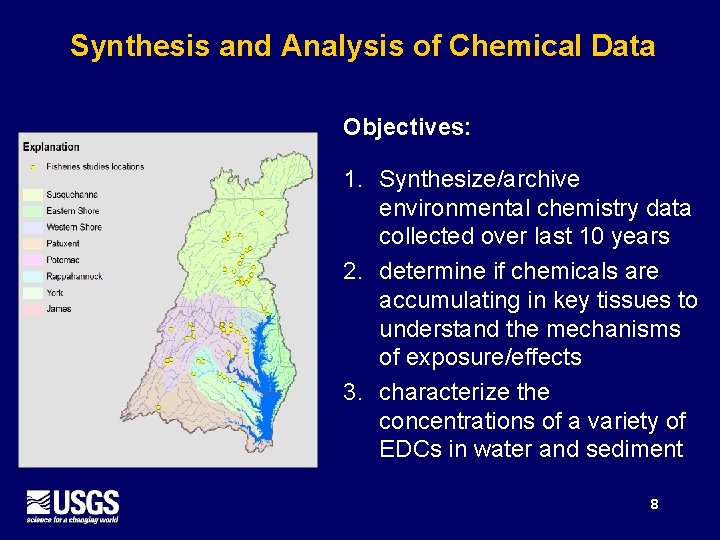
Synthesis and Analysis of Chemical Data Objectives: 1. Synthesize/archive environmental chemistry data collected over last 10 years 2. determine if chemicals are accumulating in key tissues to understand the mechanisms of exposure/effects 3. characterize the concentrations of a variety of EDCs in water and sediment 8
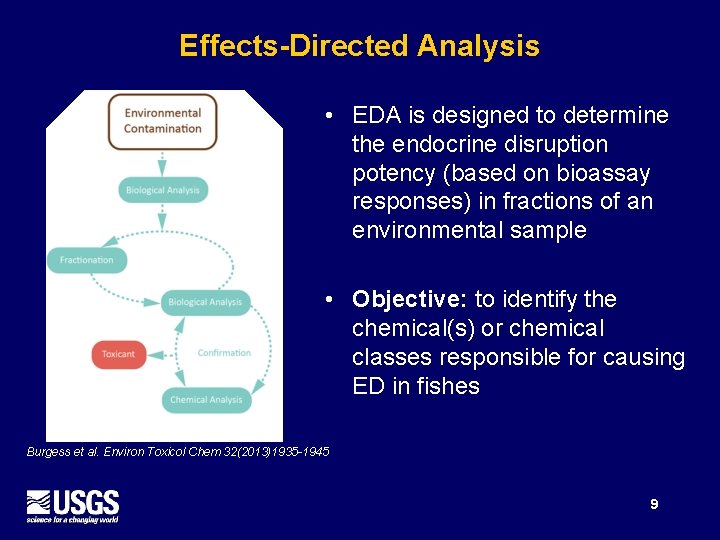
Effects-Directed Analysis • EDA is designed to determine the endocrine disruption potency (based on bioassay responses) in fractions of an environmental sample • Objective: to identify the chemical(s) or chemical classes responsible for causing ED in fishes Burgess et al. Environ Toxicol Chem 32(2013)1935 -1945 9

Goal 2 Evaluate the effects of EDCs on fish and wildlife in the environment 2 A) Synthesis of existing USGS biological effects data generated over the past decade 2 B) Biological effects monitoring of fishes 2 C) Occurrence and potential effects of EDCs in amphibians 2 D) Evaluating the influence of mercury bioaccumulation on endocrine disruption in fishes in relation to other EDCs 2 E) Endocrine-related effects in wildlife 2 F) Assessment of potential endocrine disruptive effects on birds and/or other aquatic associated vertebrates 10
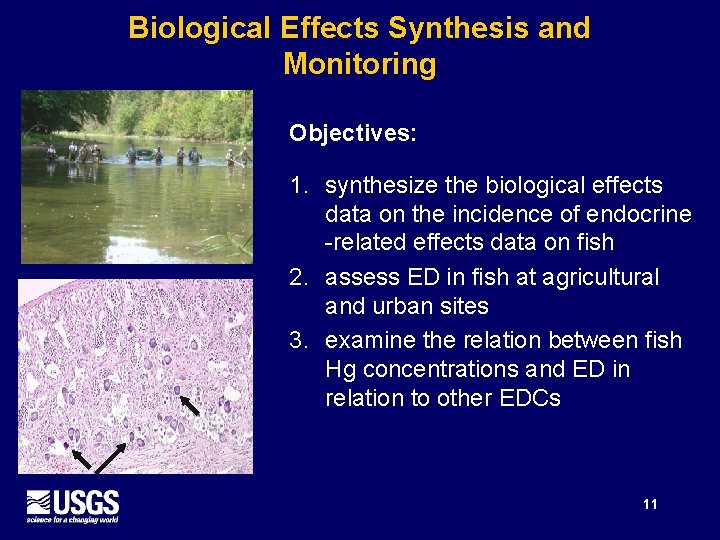
Biological Effects Synthesis and Monitoring Objectives: 1. synthesize the biological effects data on the incidence of endocrine -related effects data on fish 2. assess ED in fish at agricultural and urban sites 3. examine the relation between fish Hg concentrations and ED in relation to other EDCs 11
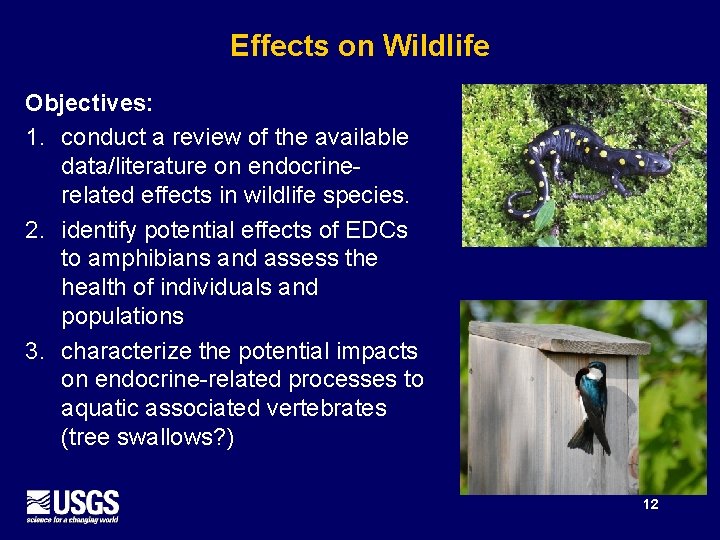
Effects on Wildlife Objectives: 1. conduct a review of the available data/literature on endocrinerelated effects in wildlife species. 2. identify potential effects of EDCs to amphibians and assess the health of individuals and populations 3. characterize the potential impacts on endocrine-related processes to aquatic associated vertebrates (tree swallows? ) 12
Goal 3: Determine the mechanism(s) and thresholds for adverse effects of EDCs on fish and wildlife species 3 A) ED caused by chemicals or mixtures: controlled lab and mesocosm fish exposure-effects studies 3 B) Identifying mechanisms of effect in wild fishes 3 C) Landscape-based experimental approach to assess sources of EDCs and ED in fish 3 D) ED effects on turtle embryonic development from exposure to field collected water 3 E) Assessment of avian embryonic effects of potential EDCs 13
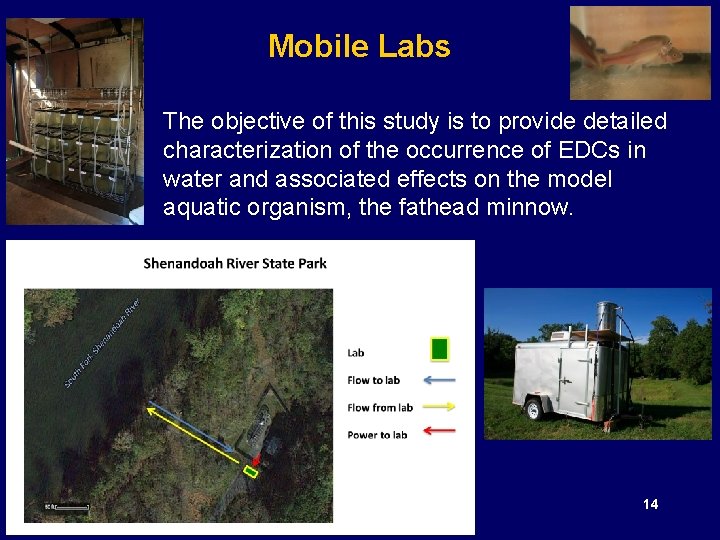
Mobile Labs The objective of this study is to provide detailed characterization of the occurrence of EDCs in water and associated effects on the model aquatic organism, the fathead minnow. 14
Goal 4: Develop appropriate assessment tools and models for risk evaluation of EDCs on fish and wildlife populations. 4 A) Establishing a plan to assess risk of EDCs to aquatic and terrestrial organisms. Objective: develop a plan for assessing the risk of EDCs to fish and wildlife populations that (1) explicitly incorporates uncertainty and expert opinion, (2) is transparent with regards to known or hypothesized causal relationships in systems of interest, and (3) develops a probabilistic representation of variability observed in nature. 15
Integration Across Goals 16
Outcomes • Synthesis of historical information into a comprehensive database and summary products • Comprehensive review of EDC effects on wildlife • Understand the chemical or mixtures responsible for impacts to fish and wildlife • Understand the mechanisms of ED • Develop a risk assessment strategy/model for fish and wildlife • All to inform management actions to improve WQ and the health of fish and wildlife in the Chesapeake Bay watershed 17
Identified Science Gaps • assessment of ED in important invertebrate species; • identification of other aquatic and terrestrial species that might be affected and the sources and mechanisms of these effects, and • identification of food web effects – i. e. sediment to benthic invertebrates or plants to fish, amphibian, reptiles and birds. It is the hope of the team that some of these studies will be conducted within the team and associated collaborators, should funding become available. 18
Chesapeake Bay Watershed EDC Research Team David Alvarez, CERC, Research Chemist Larry Barber, NRP, Research Geologist Vicki Blazer, LSC, Research Fish Biologist Collin Eagles-Smith, FRESC, Research Ecologist Luke Iwanowicz, LSC, Research Fish Biologist Dana Kolpin, IA WSC, Research Hydrologist Julia Lankton, NWHC, Veterinary Pathologist Natalie Karouna- Renier, PWRC, Research Ecologist Patrick Phillips, NY WSC, Hydrologist Donald Tillitt, CERC, Research Toxicologist James Winton, WRFC, Research Microbiologist 19
- Slides: 19