
Uses of Total Internal Reflection Optic Fibres l
Uses of Total Internal Reflection
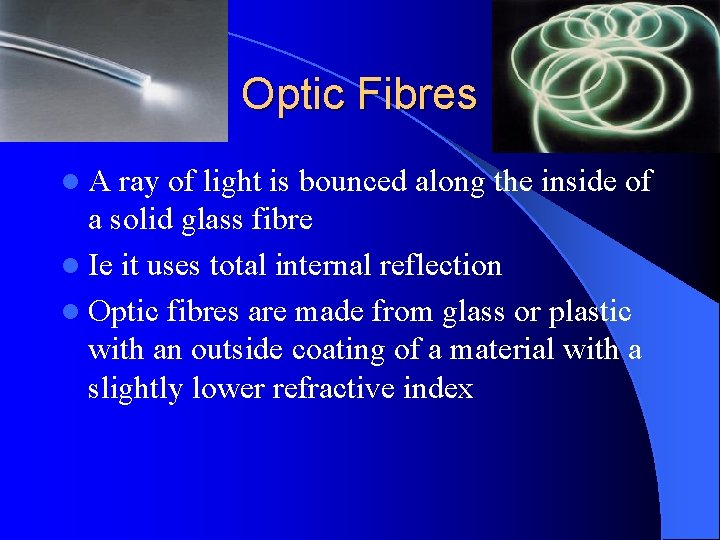
Optic Fibres l. A ray of light is bounced along the inside of a solid glass fibre l Ie it uses total internal reflection l Optic fibres are made from glass or plastic with an outside coating of a material with a slightly lower refractive index
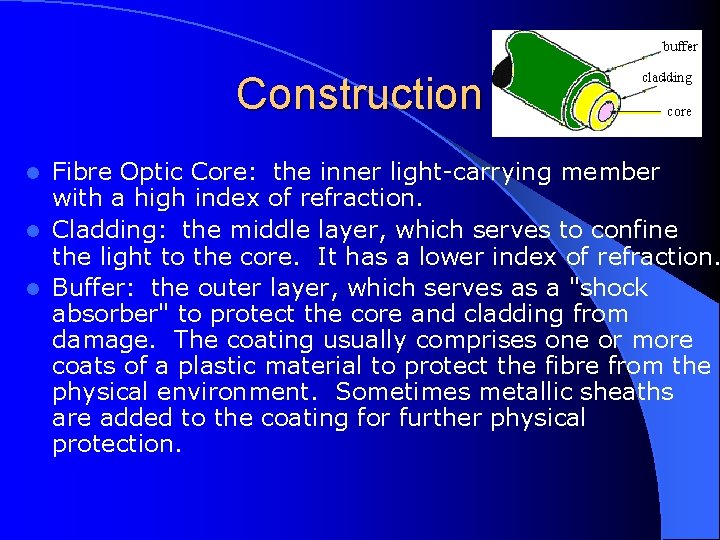
Construction Fibre Optic Core: the inner light-carrying member with a high index of refraction. l Cladding: the middle layer, which serves to confine the light to the core. It has a lower index of refraction. l Buffer: the outer layer, which serves as a "shock absorber" to protect the core and cladding from damage. The coating usually comprises one or more coats of a plastic material to protect the fibre from the physical environment. Sometimes metallic sheaths are added to the coating for further physical protection. l
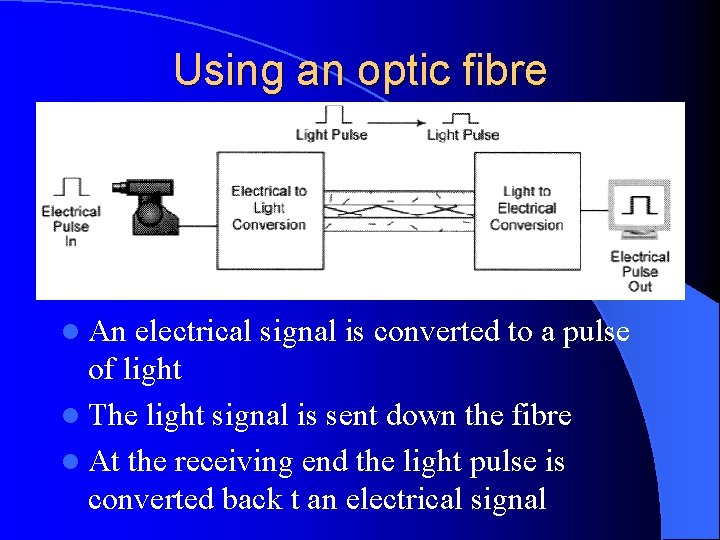
Using an optic fibre l An electrical signal is converted to a pulse of light l The light signal is sent down the fibre l At the receiving end the light pulse is converted back t an electrical signal
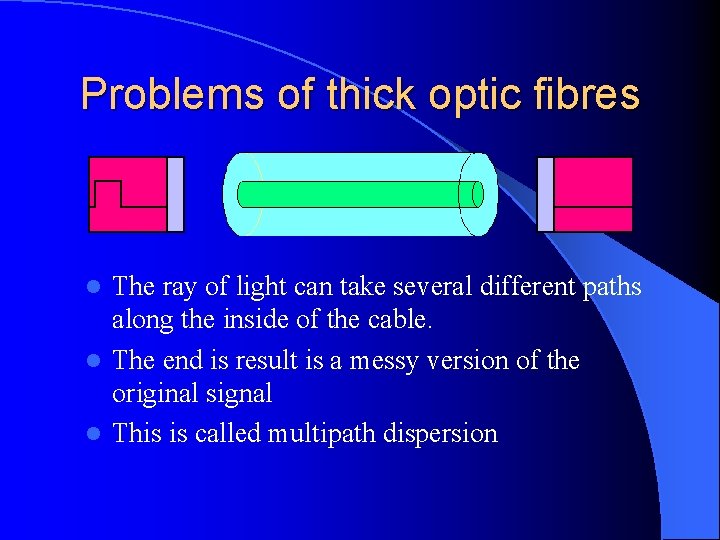
Problems of thick optic fibres The ray of light can take several different paths along the inside of the cable. l The end is result is a messy version of the original signal l This is called multipath dispersion l
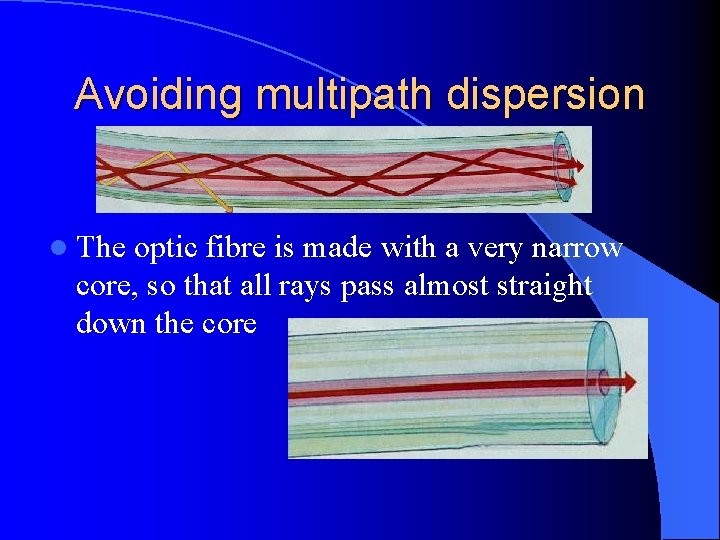
Avoiding multipath dispersion l The optic fibre is made with a very narrow core, so that all rays pass almost straight down the core
Advantages of Optic Fibres l l l Can carry huge amounts of data very quickly Require fewer signal boosters than copper wires Used for lighting and leisure Used in medicine e. g. to light small areas and internally Very difficult to ‘bug’ so are very secure for data transmission Cannot ‘spark’ so safe is volatile areas
- Slides: 7