
Uses for DNA in Law Enforcement Investigations Sgt

- Slides: 24
Uses for DNA in Law Enforcement Investigations Sgt. Kevin Mc. Kinney Investigations Division Elko County Sheriff’s Office
History of DNA Use in Law Enforcement �DNA typing was first described in 1985 by an English Geneticist named Dr. Alec Jeffreys. Dr. Jeffreys developed the ability to perform human identity tests from DNA. �The first court case involving the analysis of DNA was a 1985 English immigration case. �DNA was first used for criminal investigations in the late 1980’s.
History of DNA Use in Law Enforcement � 1986: The first criminal case utilizing DNA occurred during a double homicide investigation. Police in England collected 5000 blood samples from men in the community where the homicides occurred and a positive ID was made. � 1987: The first criminal conviction involving the use of DNA evidence in the US occurred in Florida on a rape case. � First time that the FBI Forensic Laboratory offered DNA testing for law enforcement was 1989. � Today, every state in the United States has at least one forensic laboratory capable of conducting DNA testing.
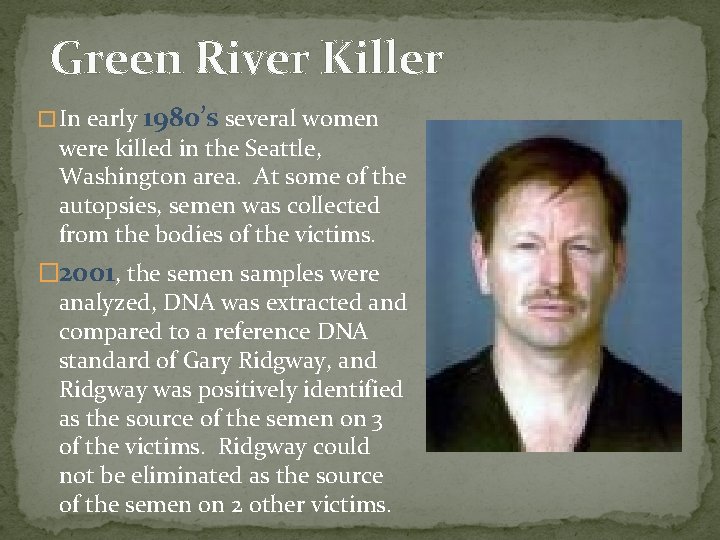
Green River Killer � In early 1980’s several women were killed in the Seattle, Washington area. At some of the autopsies, semen was collected from the bodies of the victims. � 2001, the semen samples were analyzed, DNA was extracted and compared to a reference DNA standard of Gary Ridgway, and Ridgway was positively identified as the source of the semen on 3 of the victims. Ridgway could not be eliminated as the source of the semen on 2 other victims.
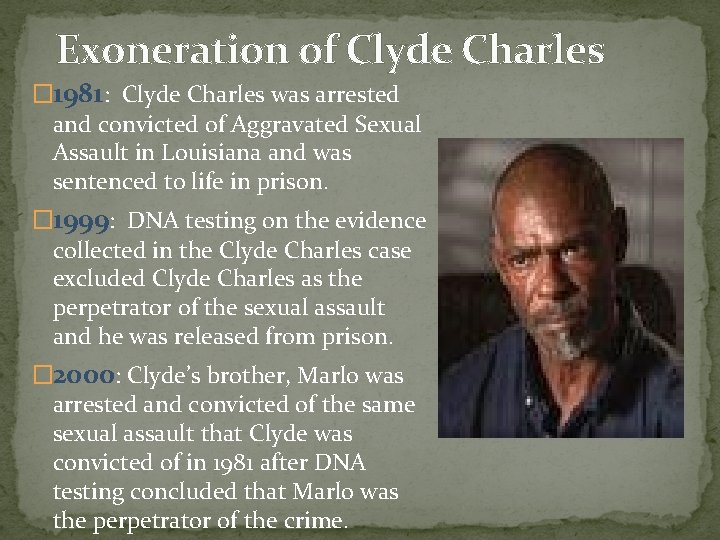
Exoneration of Clyde Charles � 1981: Clyde Charles was arrested and convicted of Aggravated Sexual Assault in Louisiana and was sentenced to life in prison. � 1999: DNA testing on the evidence collected in the Clyde Charles case excluded Clyde Charles as the perpetrator of the sexual assault and he was released from prison. � 2000: Clyde’s brother, Marlo was arrested and convicted of the same sexual assault that Clyde was convicted of in 1981 after DNA testing concluded that Marlo was the perpetrator of the crime.
Innocence Project �Chris Ochoa https: //www. youtube. com/watch? v=0 x. Jlsx. C Gw 9 w
CODIS � 1989: FBI developed Combined DNA Index System (CODIS) to house DNA profiles of unknown and convicted offenders. � 1991: a Minnesota Rape/Homicide was the first case solved through the use of CODIS. �As of August, 2007, CODIS contained over 5 million DNA profiles in its Convicted Offender Index and approximately 188, 000 unknown profiles collected from crime scenes.
DNA �Deoxyribo. Nucleic Acid �Principal Component of cellular chromosomes. �Responsible for hereditary characteristics in all life forms. �Double helix design �Composed of 4 nitrogenous bases: � Adenine � Guanine � Cytosine � Thymine
DNA �Human cell contains 46 chromosomes which have a DNA structure built from randomly alternating base pairs of nucleotide arrangements. �Combinations of nucleotide arrangements are almost infinite. �Vast majority of nucleotides are commonly shared by all human beings. 99. 5% similar �Small portion of nucleotides is sufficiently unique and variable in base pairings sequence to discriminate one individual from another individual. Regional or Ethnic differences
Analysis of DNA �Restriction Sites: Nucleotide combinations (RFLPs) repeat themselves in random intervals throughout the length of the DNA chain. �Extraction: DNA is extracted from biological sample. �Amplification: The DNA chain is broken down chemically at restriction sites and copied. �Sequencing: The DNA chain is then sequenced to find the “bar code” or banding pattern.
Investigative Uses of DNA �The basic use of DNA in law enforcement is for identification. �Identify Victims �Identify Suspects �Eliminate Suspects �Identify Persons at a Crime Scene
Types of Evidence that contain DNA �Blood �Hair �Semen �Nails �Saliva �“Touch DNA” �Tissue �Bones �Teeth
Investigative Uses of DNA �The difficulty with DNA in investigations is not the collection of crime scene or unknown DNA samples, but with being able to match the unknown DNA samples with individuals. �The DNA samples must be compared to known samples for a positive identification.
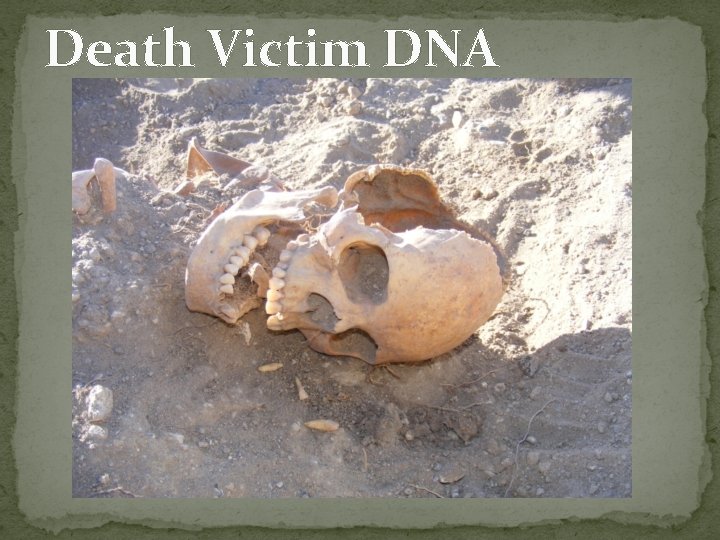
Identifying Victims �DNA is used to identify victims, often death victims, who have decomposed to the point that facial recognition or fingerprint comparison cannot be used. �DNA collected from a victim is most often compared to probable family members (parents, siblings, children) for identification.
Death Victim DNA
Identifying Suspects �DNA evidence can be used to either positively identify or eliminate a potential suspect as being the perpetrator of the crime. �Typically, a reference standard is collected from a potential suspect that is then compared to DNA evidence found on a victim or at a crime scene. �Occasionally transfer DNA evidence can be found on a suspect and collected, which is then compared to the victim’s DNA.
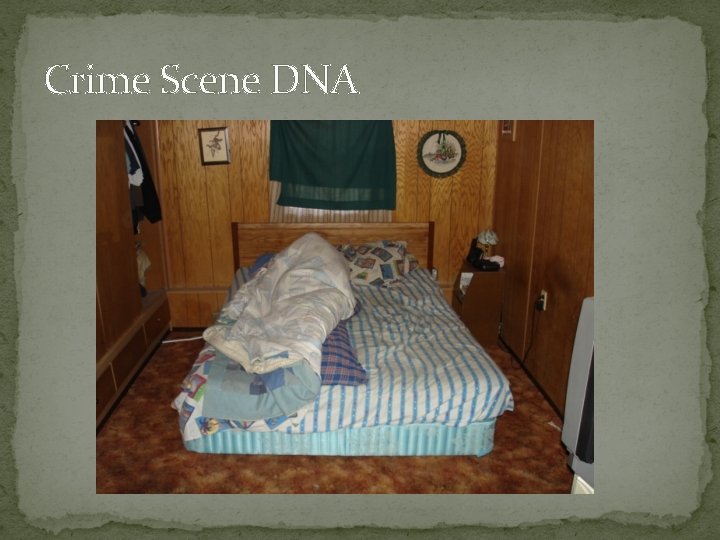
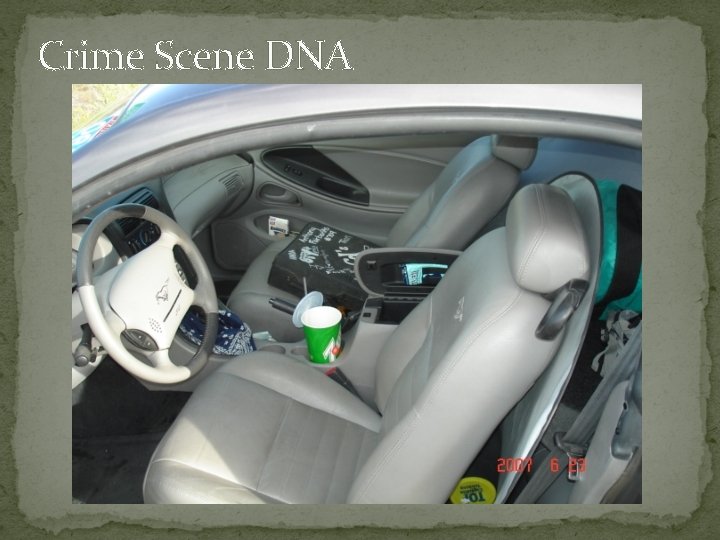
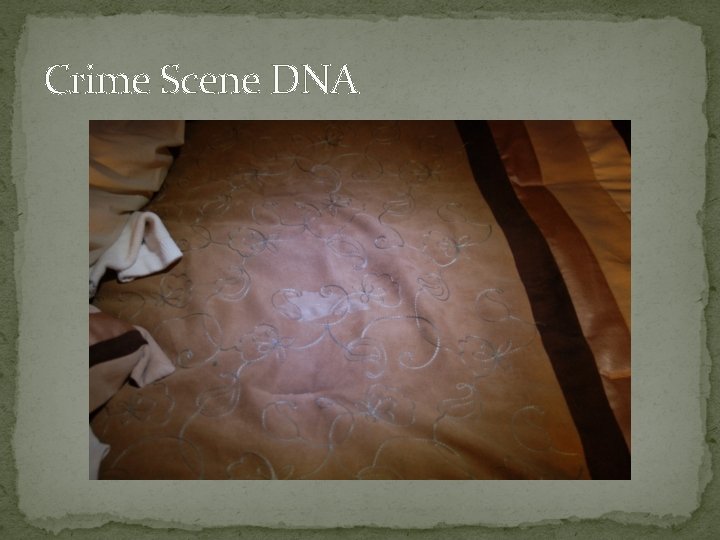
Crime Scene DNA �DNA evidence is collected at a crime scene to identify persons who were present at the scene, to develop information in regards to potential victims, witnesses and/or suspects. �The presence of DNA evidence at a crime scene does not positively conclude anything, without further investigation.
Crime Scene DNA
Crime Scene DNA
Crime Scene DNA
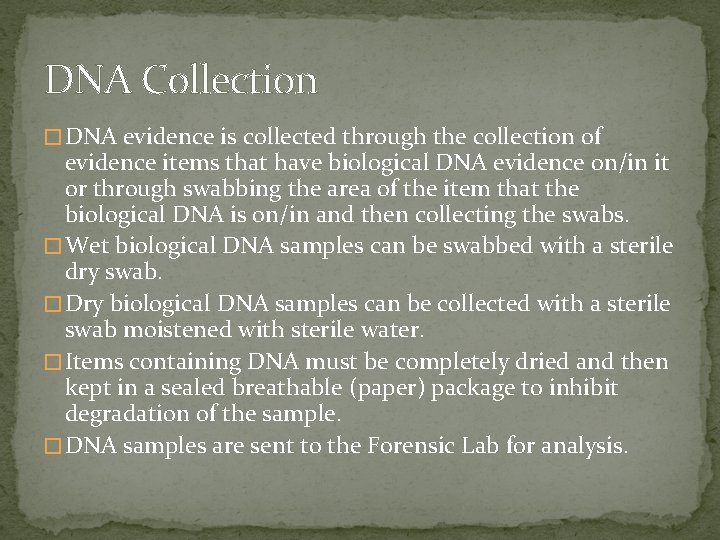
DNA Collection � DNA evidence is collected through the collection of evidence items that have biological DNA evidence on/in it or through swabbing the area of the item that the biological DNA is on/in and then collecting the swabs. � Wet biological DNA samples can be swabbed with a sterile dry swab. � Dry biological DNA samples can be collected with a sterile swab moistened with sterile water. � Items containing DNA must be completely dried and then kept in a sealed breathable (paper) package to inhibit degradation of the sample. � DNA samples are sent to the Forensic Lab for analysis.
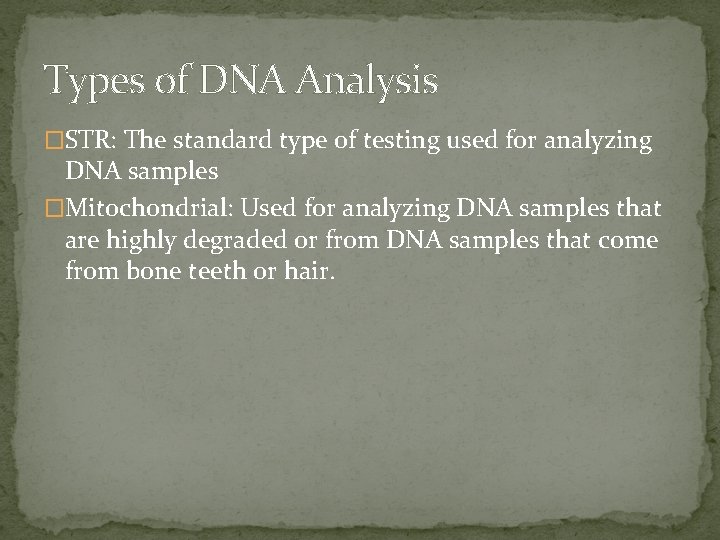
Types of DNA Analysis �STR: The standard type of testing used for analyzing DNA samples �Mitochondrial: Used for analyzing DNA samples that are highly degraded or from DNA samples that come from bone teeth or hair.
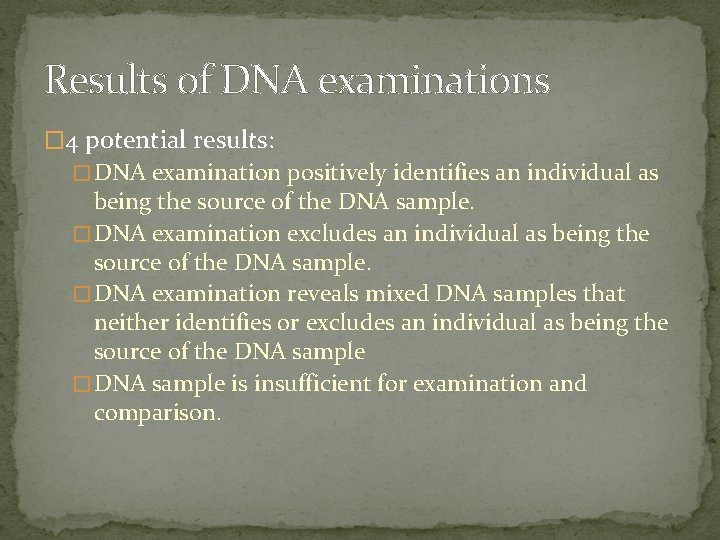
Results of DNA examinations � 4 potential results: � DNA examination positively identifies an individual as being the source of the DNA sample. � DNA examination excludes an individual as being the source of the DNA sample. � DNA examination reveals mixed DNA samples that neither identifies or excludes an individual as being the source of the DNA sample � DNA sample is insufficient for examination and comparison.
Questions? Thank You