
Uses and tabulation of data Part 1 United
Uses and tabulation of data Part 1 United Nations Statistics Division Workshop on the Production of Statistics on Informal Sector Employment and Informal Employment, Dar es Salaam, 28 September – 2 October 2009 1
Why do we need data? o Inform policy o Monitor development programmes and interventions o Inform general public and media o Stimulate research o Serve as advocacy tool Workshop on the Production of Statistics on Informal Sector Employment and Informal Employment, Dar es Salaam, 28 September – 2 October 2009 2

To be effective, data must: o Be relevant n Serve the needs of users o Be accurate n Measure what is supposed to measure n Measured with reasonable precision n Follow agreed standards and definitions o Be up-to-date n Regularity, frequency Workshop on the Production of Statistics on Informal Sector Employment and Informal Employment, Dar es Salaam, 28 September – 2 October 2009 3
To be effective, data must: (2) o Be easily understood by users n In a form and language that target users can easily understand n Use of simple indicators o Be accessible to users n Easily obtained n Widely disseminated n Easily accessible media Workshop on the Production of Statistics on Informal Sector Employment and Informal Employment, Dar es Salaam, 28 September – 2 October 2009 4
To be effective, data must: (3) o Incorporate a gender perspective n Fully reflect the different situation of women and men n Allow comparisons of women and men n Allow analysis of women’s and men’s participation and contribution in different social and economic areas o Be comparable across time and space o Allow comparison with or evaluation against other sources Workshop on the Production of Statistics on Informal Sector Employment and Informal Employment, Dar es Salaam, 28 September – 2 October 2009 5
Forms of data presentation o In the text – for emphasizing a point, but only with few numbers o Table – to show detailed information, display actual figures, highlight differences o Graph – to provide quick picture or overview. Should be simple, not crowded o Diagram o Thematic map Workshop on the Production of Statistics on Informal Sector Employment and Informal Employment, Dar es Salaam, 28 September – 2 October 2009 6
Useful principles o Simplify data by processing into indicators o Use easy to understand forms of calculation o Avoid unnecessary decimals (round numbers to integers in correspondence with the units, with some exceptions) o Cross-tabulations where possible Workshop on the Production of Statistics on Informal Sector Employment and Informal Employment, Dar es Salaam, 28 September – 2 October 2009 7
Great demand for statistics on informal sector o Direct users of this information include politicians, labour policy makers, poverty reduction strategists, development planners, analysts, economists, local government, gender analysts, etc. Workshop on the Production of Statistics on Informal Sector Employment and Informal Employment, Dar es Salaam, 28 September – 2 October 2009 8
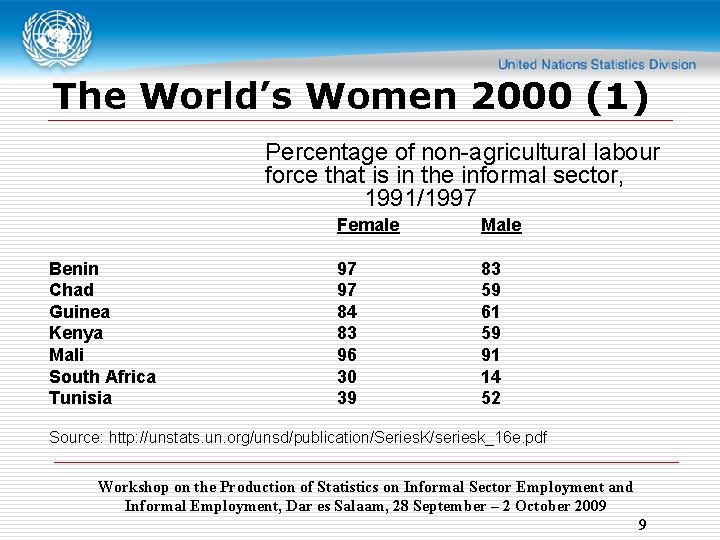
The World’s Women 2000 (1) Percentage of non-agricultural labour force that is in the informal sector, 1991/1997 Benin Chad Guinea Kenya Mali South Africa Tunisia Female Male 97 97 84 83 96 30 39 83 59 61 59 91 14 52 Source: http: //unstats. un. org/unsd/publication/Series. K/seriesk_16 e. pdf Workshop on the Production of Statistics on Informal Sector Employment and Informal Employment, Dar es Salaam, 28 September – 2 October 2009 9
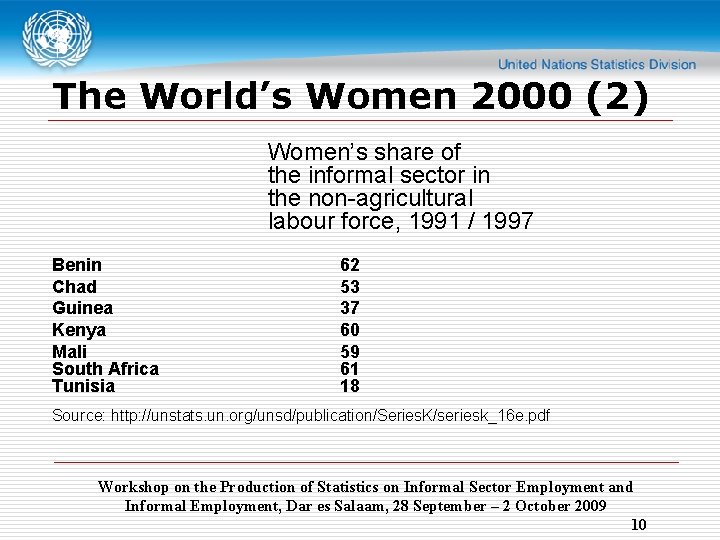
The World’s Women 2000 (2) Women’s share of the informal sector in the non-agricultural labour force, 1991 / 1997 Benin Chad Guinea Kenya Mali South Africa Tunisia 62 53 37 60 59 61 18 Source: http: //unstats. un. org/unsd/publication/Series. K/seriesk_16 e. pdf Workshop on the Production of Statistics on Informal Sector Employment and Informal Employment, Dar es Salaam, 28 September – 2 October 2009 10
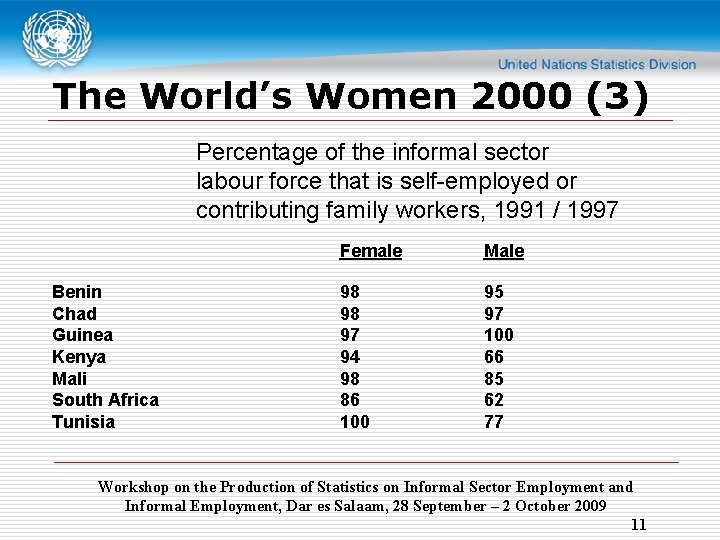
The World’s Women 2000 (3) Percentage of the informal sector labour force that is self-employed or contributing family workers, 1991 / 1997 Benin Chad Guinea Kenya Mali South Africa Tunisia Female Male 98 98 97 94 98 86 100 95 97 100 66 85 62 77 Workshop on the Production of Statistics on Informal Sector Employment and Informal Employment, Dar es Salaam, 28 September – 2 October 2009 11
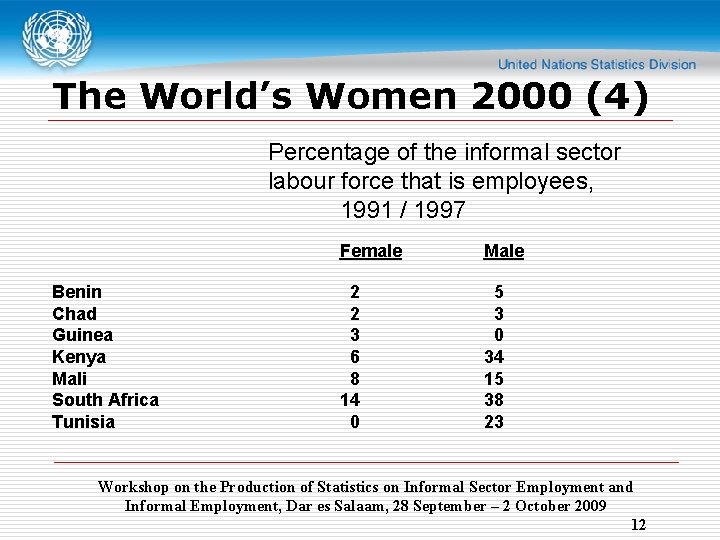
The World’s Women 2000 (4) Percentage of the informal sector labour force that is employees, 1991 / 1997 Benin Chad Guinea Kenya Mali South Africa Tunisia Female Male 2 2 3 6 8 14 0 5 3 0 34 15 38 23 Workshop on the Production of Statistics on Informal Sector Employment and Informal Employment, Dar es Salaam, 28 September – 2 October 2009 12
- Slides: 12