
Uses and misuses of intersectionality before the European
Uses and misuses of intersectionality before the European Court of Justice Equinet 2016 School of Law Professor Dagmar Schiek
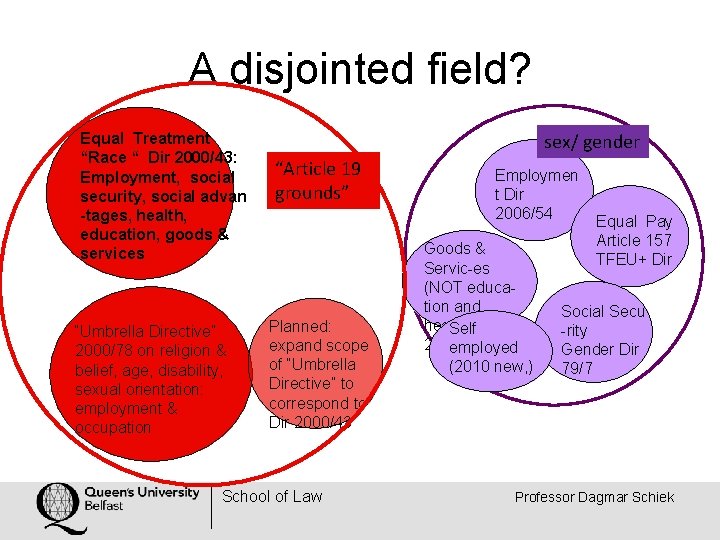
A disjointed field? Equal Treatment “Race “ Dir 2000/43: Employment, social security, social advan -tages, health, education, goods & services “Umbrella Directive” 2000/78 on religion & belief, age, disability, sexual orientation: employment & occupation sex/ gender “Article 19 grounds” Planned: expand scope of “Umbrella Directive” to correspond to Dir 2000/43 School of Law Employmen t Dir 2006/54 Goods & Servic-es (NOT education and health) Self. Dir 2004/113 employed (2010 new, ) Equal Pay Article 157 TFEU+ Dir Social Secu -rity Gender Dir 79/7 Professor Dagmar Schiek
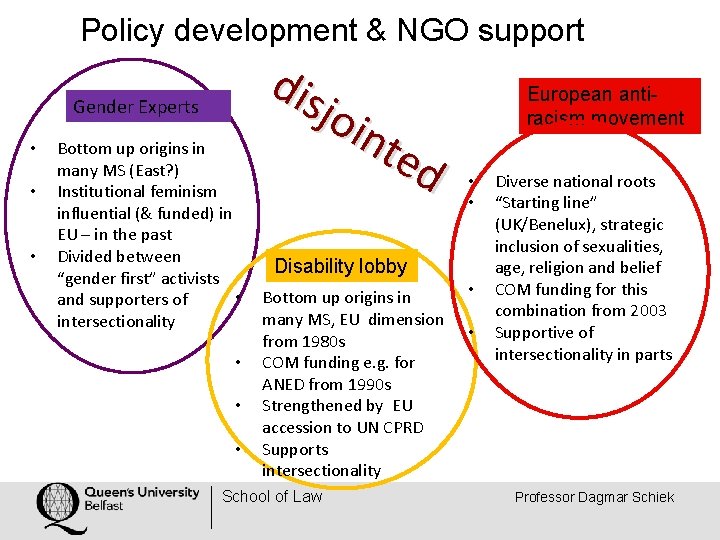
Policy development & NGO support Gender Experts • • • Bottom up origins in many MS (East? ) Institutional feminism influential (& funded) in EU – in the past Divided between “gender first” activists • and supporters of intersectionality • • • dis joi nte d European antiracism movement • • Disability lobby Bottom up origins in many MS, EU dimension from 1980 s COM funding e. g. for ANED from 1990 s Strengthened by EU accession to UN CPRD Supports intersectionality School of Law • • Diverse national roots “Starting line” (UK/Benelux), strategic inclusion of sexualities, age, religion and belief COM funding for this combination from 2003 Supportive of intersectionality in parts Professor Dagmar Schiek
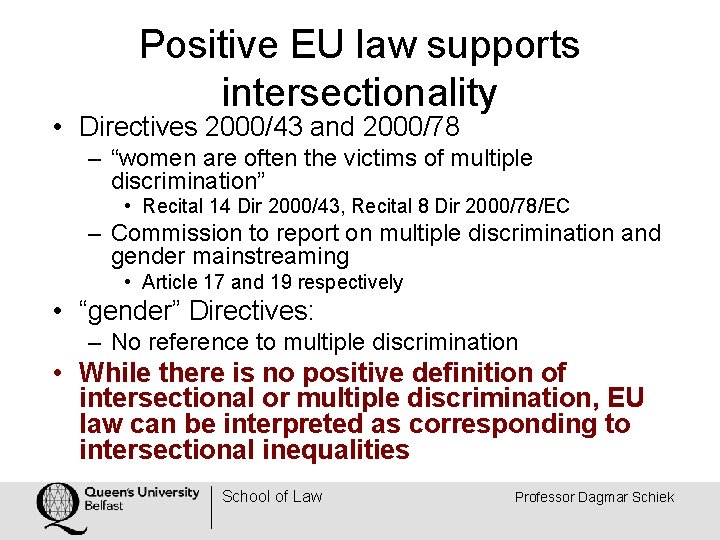
Positive EU law supports intersectionality • Directives 2000/43 and 2000/78 – “women are often the victims of multiple discrimination” • Recital 14 Dir 2000/43, Recital 8 Dir 2000/78/EC – Commission to report on multiple discrimination and gender mainstreaming • Article 17 and 19 respectively • “gender” Directives: – No reference to multiple discrimination • While there is no positive definition of intersectional or multiple discrimination, EU law can be interpreted as corresponding to intersectional inequalities School of Law Professor Dagmar Schiek
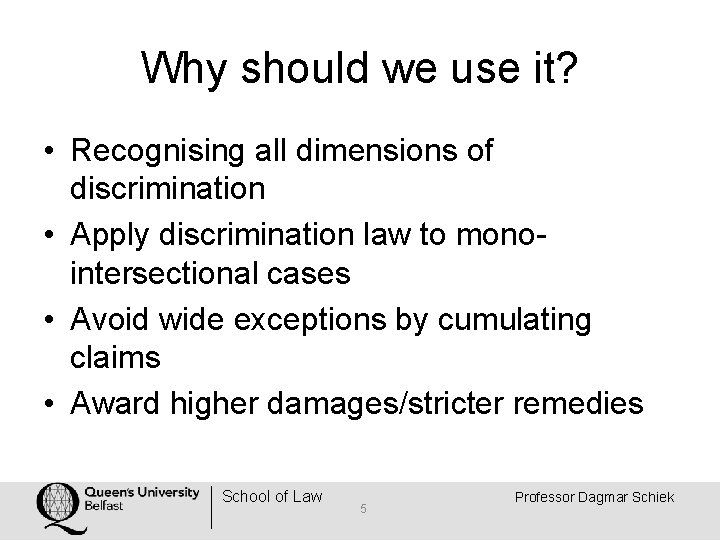
Why should we use it? • Recognising all dimensions of discrimination • Apply discrimination law to monointersectional cases • Avoid wide exceptions by cumulating claims • Award higher damages/stricter remedies School of Law 5 Professor Dagmar Schiek
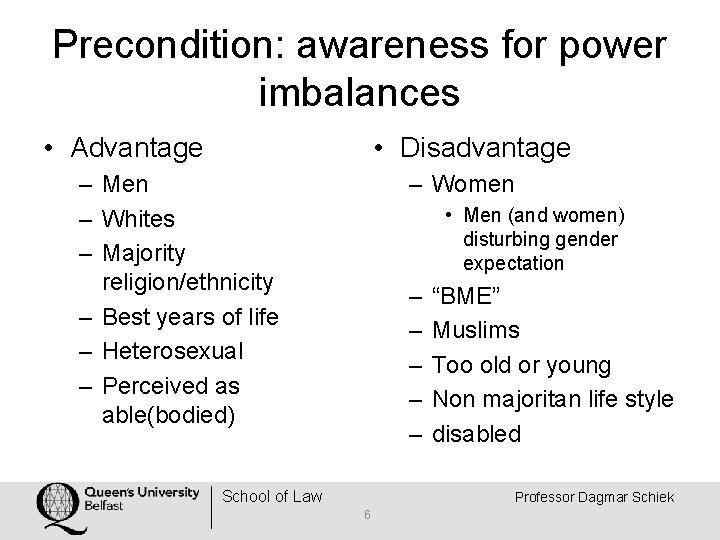
Precondition: awareness for power imbalances • Advantage • Disadvantage – Men – Whites – Majority religion/ethnicity – Best years of life – Heterosexual – Perceived as able(bodied) – Women • Men (and women) disturbing gender expectation – – – School of Law “BME” Muslims Too old or young Non majoritan life style disabled Professor Dagmar Schiek 6
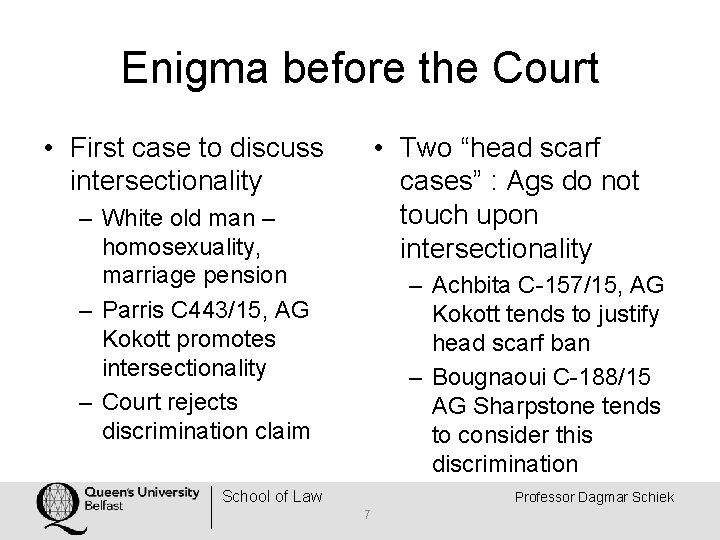
Enigma before the Court • First case to discuss intersectionality • Two “head scarf cases” : Ags do not touch upon intersectionality – White old man – homosexuality, marriage pension – Parris C 443/15, AG Kokott promotes intersectionality – Court rejects discrimination claim – Achbita C-157/15, AG Kokott tends to justify head scarf ban – Bougnaoui C-188/15 AG Sharpstone tends to consider this discrimination School of Law Professor Dagmar Schiek 7
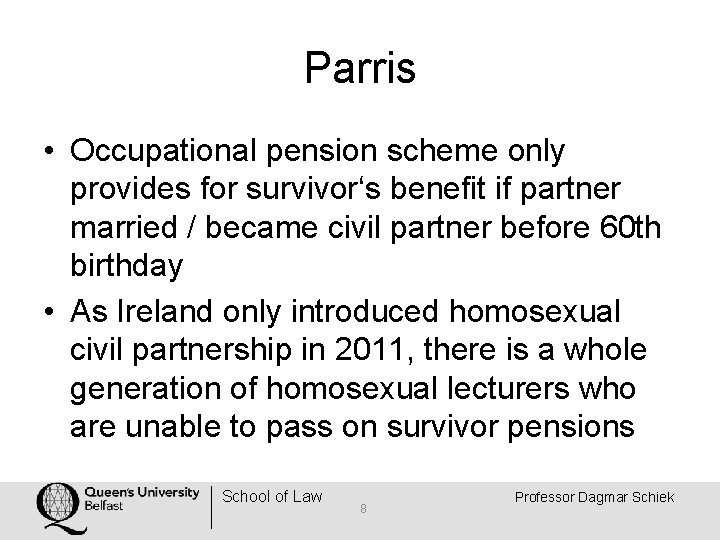
Parris • Occupational pension scheme only provides for survivor‘s benefit if partner married / became civil partner before 60 th birthday • As Ireland only introduced homosexual civil partnership in 2011, there is a whole generation of homosexual lecturers who are unable to pass on survivor pensions School of Law 8 Professor Dagmar Schiek
AG Kokott • Discrimination on grounds of homosexuality? • Indirect • Age discrimination – Direct age discrimination – Not justified – Legitimate aim (avoid abuse) – Disproportionate means „several factor discrimination“ is in evidence here requires stricter standards for justification School of Law Professor Dagmar Schiek 9
Court • No discrimination on grounds of homosexuality • Age discrimination is justified (Article 6 (2) Directive • No consideration of intersectionality! School of Law Professor Dagmar Schiek 10
Achbita case – AG Kokott • Stresses throughout that the claimant is a Muslim woman • However, the ban on religious, political and philosophical signifiers is NOT direct discrimination on grounds of religion and belief – General policy, several „grounds“ • The indirect discrimination is justified (business interest, neutral clothing) School of Law 11 Professor Dagmar Schiek
Bougnaoui case – AG Sharpstone • Individual demand to not wear headscarf when contacting customer is direct discrimination on grounds of religion • In principle, this could be justified by reference to genuine business requirement • In this specific case, the employer has not been convincing though School of Law 12 Professor Dagmar Schiek
Why use intersectionality? ? • Parris case – Seems the only way to recognise the specific harm • Achbita / Bougnaoui case – Gender & ethnic dimension of cases springs in the face –the law to recognise this? – Justification of gender and ethnic discrimination more demanding – Acknowledging intersectionality might lead to higher damages School of Law 13 Professor Dagmar Schiek
Thank you for your attention ! d. schiek@qub. ac. uk School of Law Professor Dagmar Schiek
- Slides: 14