
UserExpectations in shortconsecutive church interpreting Implications for training
![Contents [Part I] • Major Survey Questions on short-consecutive sermon interpreting: Eligibility and Best](https://slidetodoc.com/presentation_image_h2/83f33831e55db5af3841aecb62677f8c/image-2.jpg "Contents [Part I] • Major Survey Questions on short-consecutive sermon interpreting: Eligibility and Best")
![of Part I [Part II] • Introducing Graduate School of Interpretation & Translation, Handong](https://slidetodoc.com/presentation_image_h2/83f33831e55db5af3841aecb62677f8c/image-16.jpg "of Part I [Part II] • Introducing Graduate School of Interpretation & Translation, Handong")
- Slides: 24
User-Expectations in short-consecutive church interpreting: Implications for training of church interpreters Hayne Shin Visiting Professor Graduate School of Interpretation & Translation (GSIT) Handong Global University (HGU), Pohang, Korea
Contents [Part I] • Major Survey Questions on short-consecutive sermon interpreting: Eligibility and Best Practice • Questionnaire Survey Results • Interview with Rev. Billy Kim • Implications for Training Church interpreters [Part II] • Introduction of HGU/GSIT • Sermon (or Church) Interpreting Curriculum Offered at HGU • Q&A
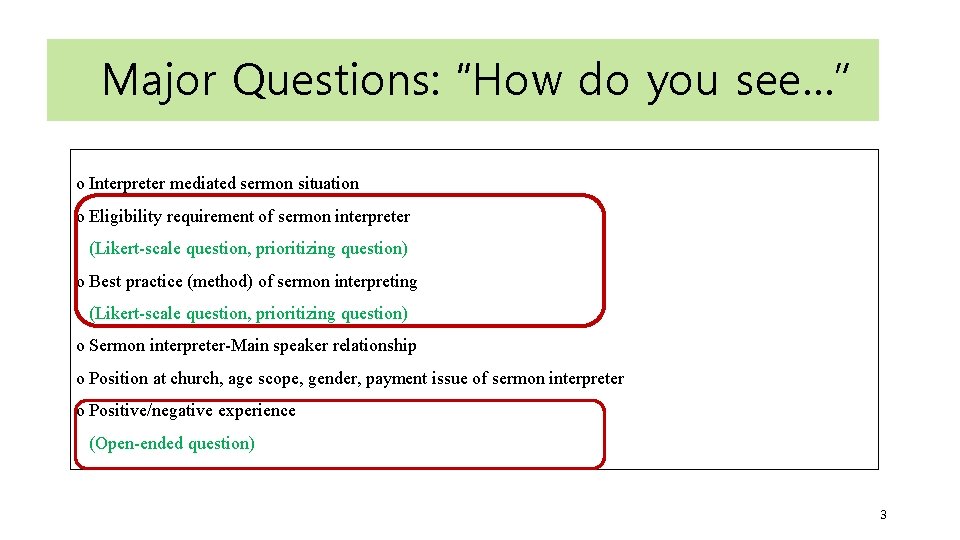
Major Questions: “How do you see…” o Interpreter mediated sermon situation o Eligibility requirement of sermon interpreter (Likert-scale question, prioritizing question) o Best practice (method) of sermon interpreting (Likert-scale question, prioritizing question) o Sermon interpreter-Main speaker relationship o Position at church, age scope, gender, payment issue of sermon interpreter o Positive/negative experience (Open-ended question) 3
Questionnaire Survey Results Carried out in October − November 2012 in 4 churches/organizations in Korea. 495 responses used for final analysis (from 530 responses)
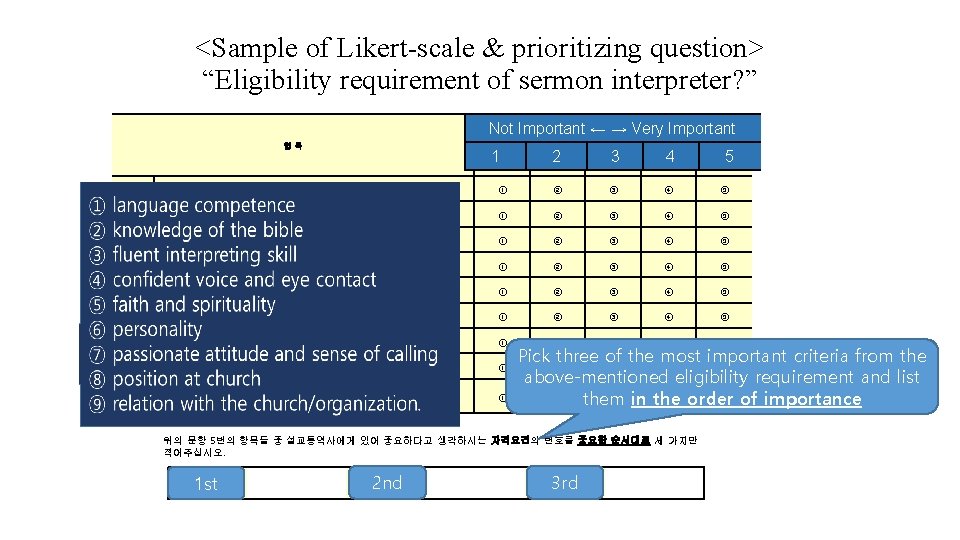
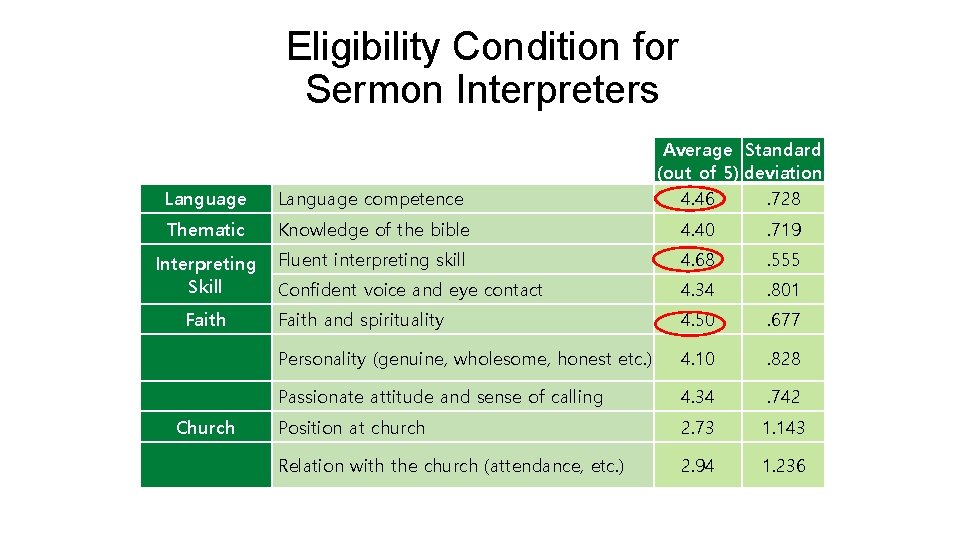
Eligibility Condition for Sermon Interpreters Average Standard (out of 5) deviation 4. 46. 728 Language competence Thematic Knowledge of the bible 4. 40 . 719 Interpreting Skill Fluent interpreting skill 4. 68 . 555 Confident voice and eye contact 4. 34 . 801 Faith and spirituality 4. 50 . 677 Personality (genuine, wholesome, honest etc. ) 4. 10 . 828 Passionate attitude and sense of calling 4. 34 . 742 Position at church 2. 73 1. 143 Relation with the church (attendance, etc. ) 2. 94 1. 236 Faith Church
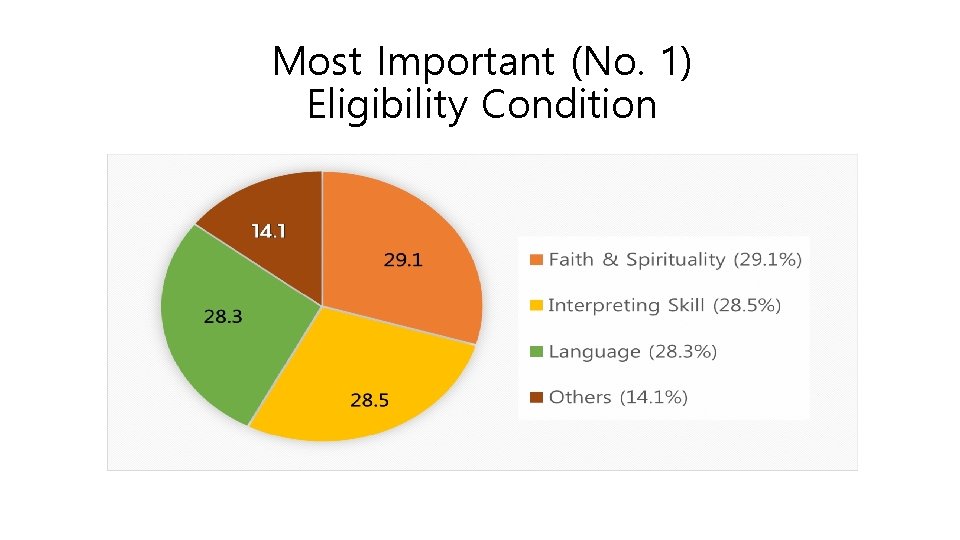
Most Important (No. 1) Eligibility Condition
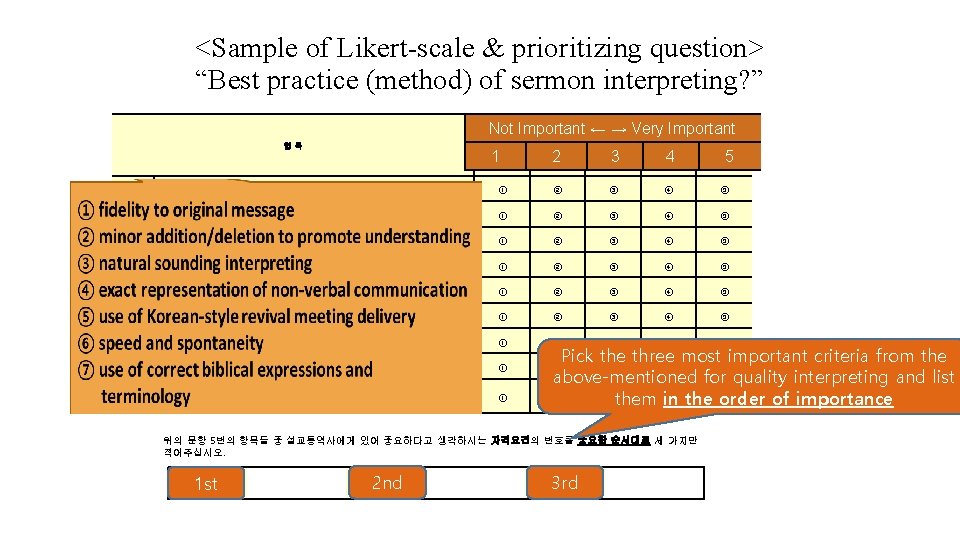
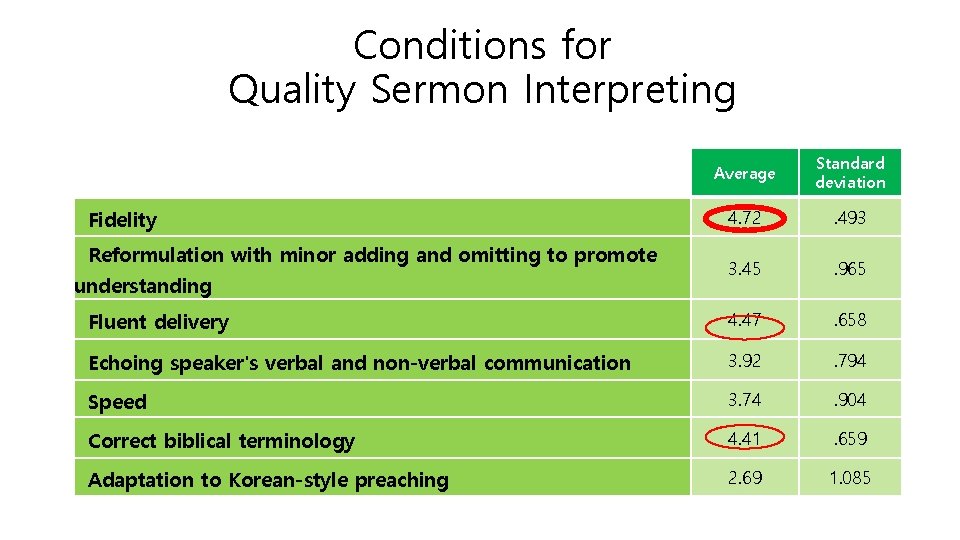
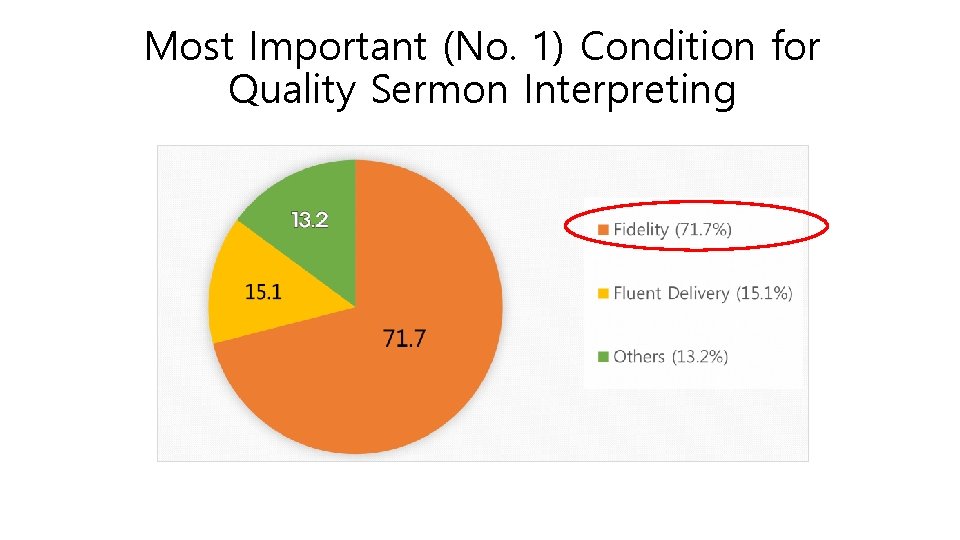
Conditions for Quality Sermon Interpreting Average Standard deviation 4. 72 . 493 3. 45 . 965 Fluent delivery 4. 47 . 658 Echoing speaker's verbal and non-verbal communication 3. 92 . 794 Speed 3. 74 . 904 Correct biblical terminology 4. 41 . 659 Adaptation to Korean-style preaching 2. 69 1. 085 Fidelity Reformulation with minor adding and omitting to promote understanding
Most Important (No. 1) Condition for Quality Sermon Interpreting
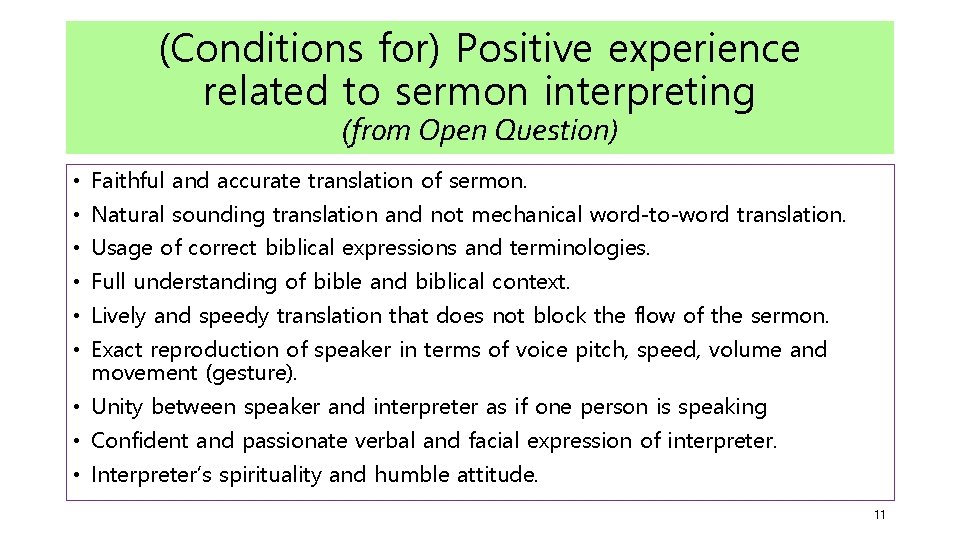
(Conditions for) Positive experience related to sermon interpreting (from Open Question) • Faithful and accurate translation of sermon. • Natural sounding translation and not mechanical word-to-word translation. • Usage of correct biblical expressions and terminologies. • Full understanding of bible and biblical context. • Lively and speedy translation that does not block the flow of the sermon. • Exact reproduction of speaker in terms of voice pitch, speed, volume and movement (gesture). • Unity between speaker and interpreter as if one person is speaking • Confident and passionate verbal and facial expression of interpreter. • Interpreter’s spirituality and humble attitude. 11
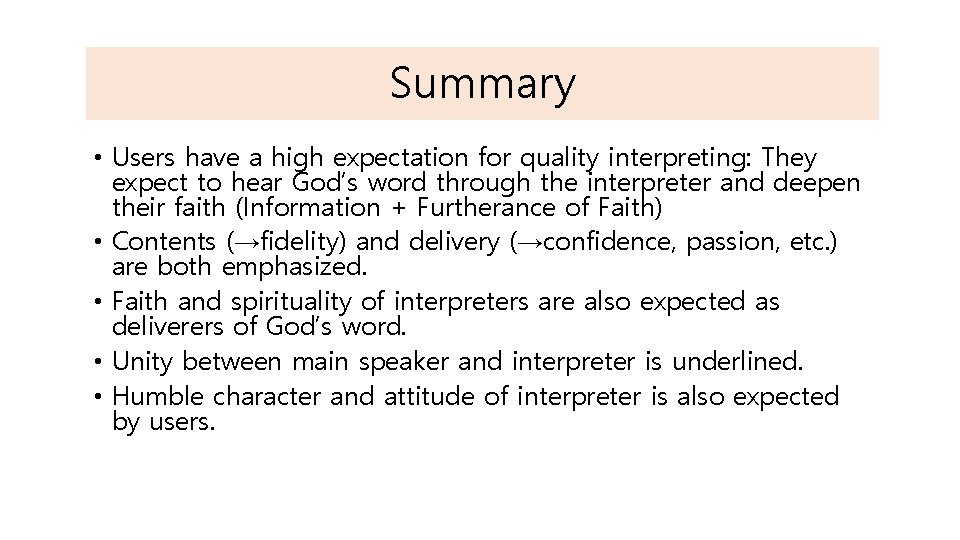
Summary • Users have a high expectation for quality interpreting: They expect to hear God’s word through the interpreter and deepen their faith (Information + Furtherance of Faith) • Contents (→fidelity) and delivery (→confidence, passion, etc. ) are both emphasized. • Faith and spirituality of interpreters are also expected as deliverers of God’s word. • Unity between main speaker and interpreter is underlined. • Humble character and attitude of interpreter is also expected by users.
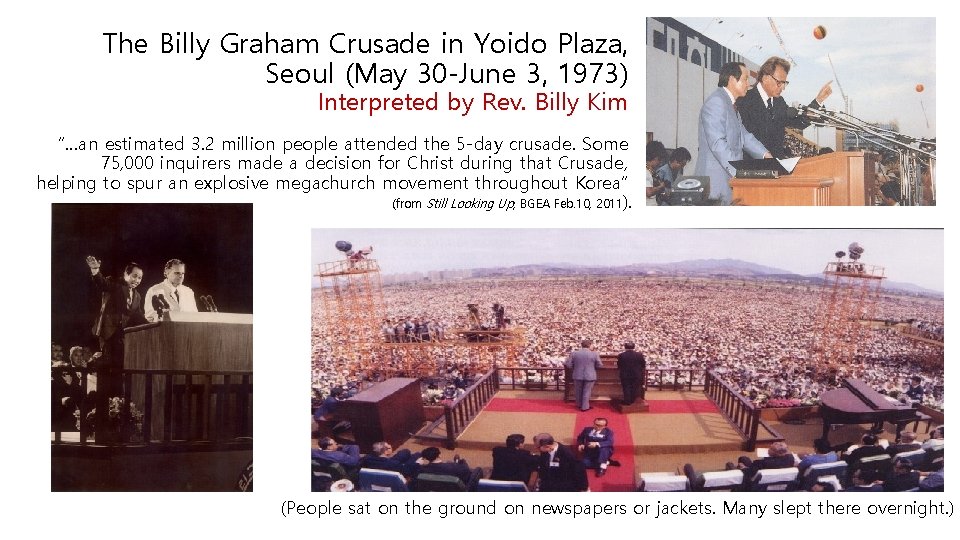
The Billy Graham Crusade in Yoido Plaza, Seoul (May 30 -June 3, 1973) Interpreted by Rev. Billy Kim “…an estimated 3. 2 million people attended the 5 -day crusade. Some 75, 000 inquirers made a decision for Christ during that Crusade, helping to spur an explosive megachurch movement throughout Korea” (from Still Looking Up , BGEA Feb. 10, 2011). (People sat on the ground on newspapers or jackets. Many slept there overnight. )
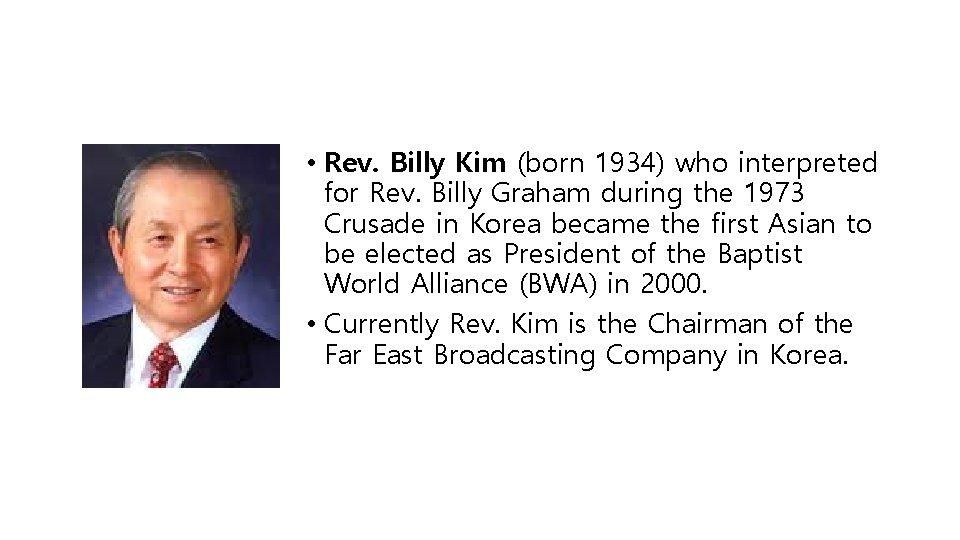
• Rev. Billy Kim (born 1934) who interpreted for Rev. Billy Graham during the 1973 Crusade in Korea became the first Asian to be elected as President of the Baptist World Alliance (BWA) in 2000. • Currently Rev. Kim is the Chairman of the Far East Broadcasting Company in Korea.
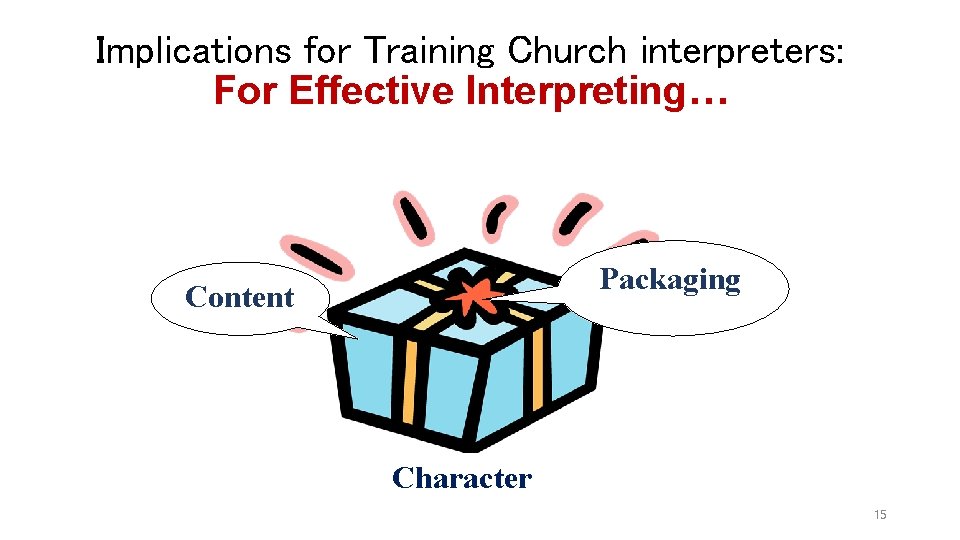
Implications for Training Church interpreters: For Effective Interpreting… Packaging Content Character 15
of Part I [Part II] • Introducing Graduate School of Interpretation & Translation, Handong Global University (HGU) • Sermon (or Church) Interpreting Curriculum Offered at HGU
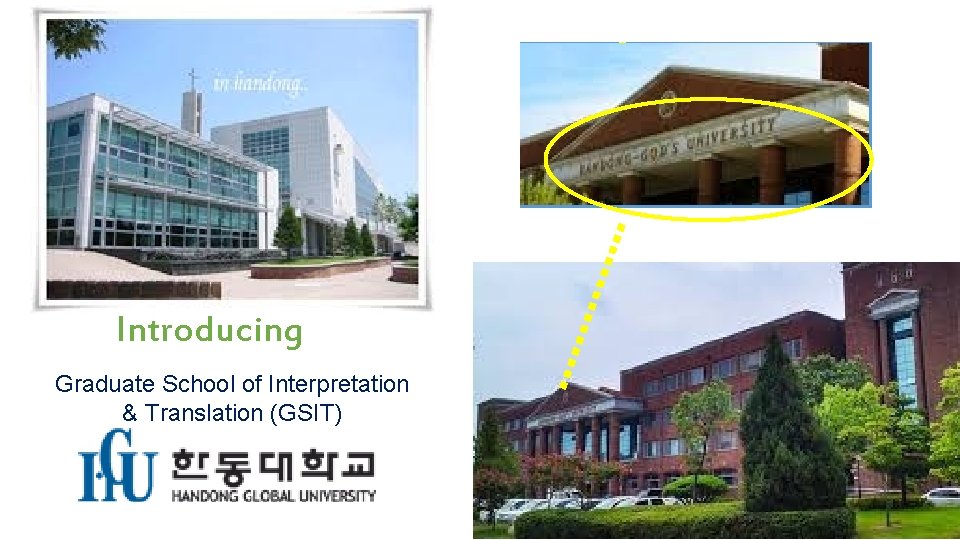
Introducing Graduate School of Interpretation & Translation (GSIT)
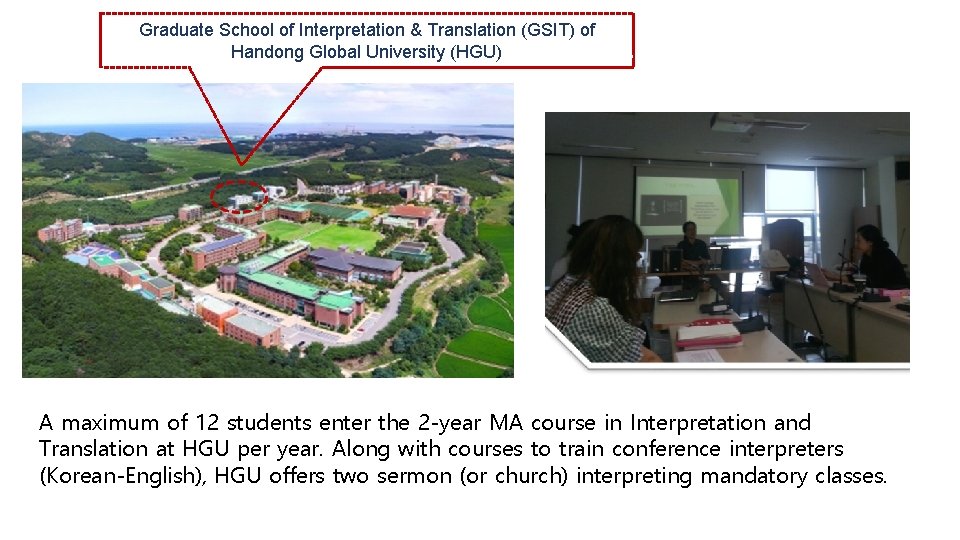
Graduate School of Interpretation & Translation (GSIT) of Handong Global University (HGU) A maximum of 12 students enter the 2 -year MA course in Interpretation and Translation at HGU per year. Along with courses to train conference interpreters (Korean-English), HGU offers two sermon (or church) interpreting mandatory classes.
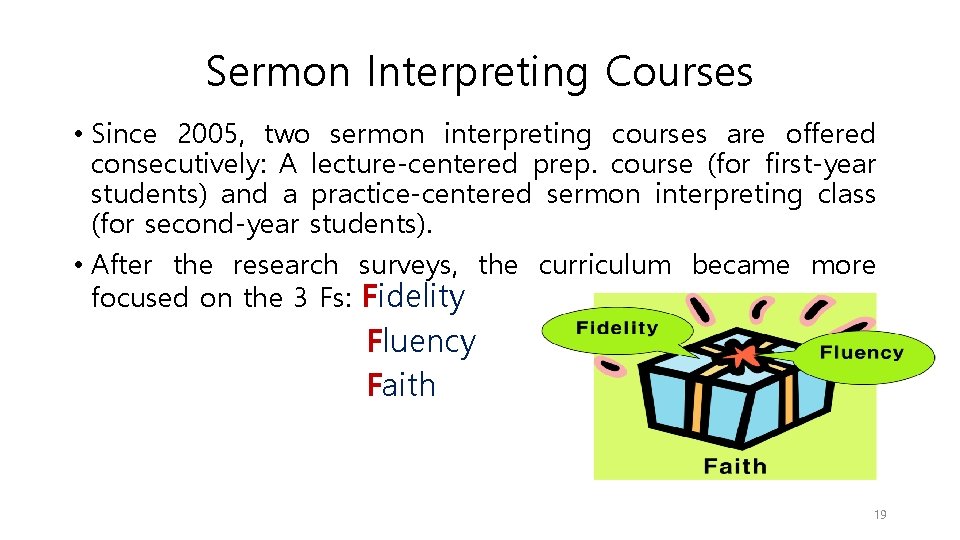
Sermon Interpreting Courses • Since 2005, two sermon interpreting courses are offered consecutively: A lecture-centered prep. course (for first-year students) and a practice-centered sermon interpreting class (for second-year students). • After the research surveys, the curriculum became more focused on the 3 Fs: Fidelity Fluency Faith 19
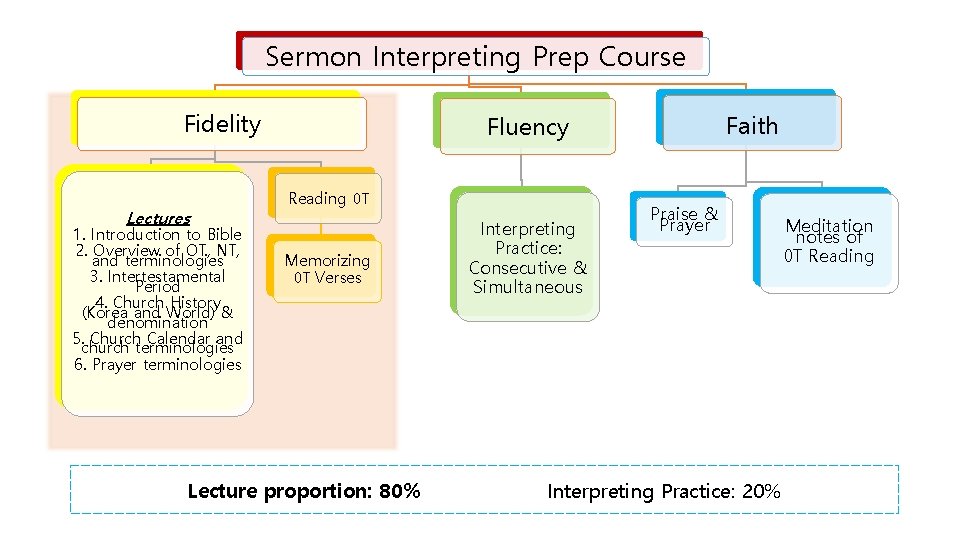
Sermon Interpreting Prep Course Fidelity Lectures 1. Introduction to Bible 2. Overview of OT, NT, and terminologies 3. Intertestamental Period 4. Church History (Korea and World) & denomination 5. Church Calendar and church terminologies 6. Prayer terminologies Faith Fluency Reading OT Memorizing OT Verses Lecture proportion: 80% Interpreting Practice: Consecutive & Simultaneous Praise & Prayer Interpreting Practice: 20% Meditation notes of OT Reading
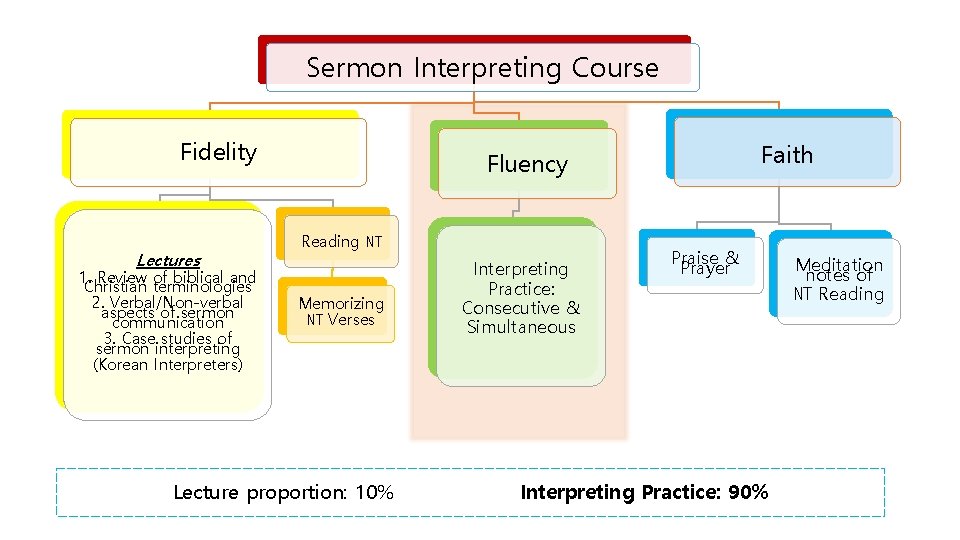
Sermon Interpreting Course Fidelity Lectures 1. Review of biblical and Christian terminologies 2. Verbal/Non-verbal aspects of sermon communication 3. Case studies of sermon interpreting (Korean Interpreters) Faith Fluency Reading NT Memorizing NT Verses Lecture proportion: 10% Interpreting Practice: Consecutive & Simultaneous Praise & Prayer Interpreting Practice: 90% Meditation notes of NT Reading
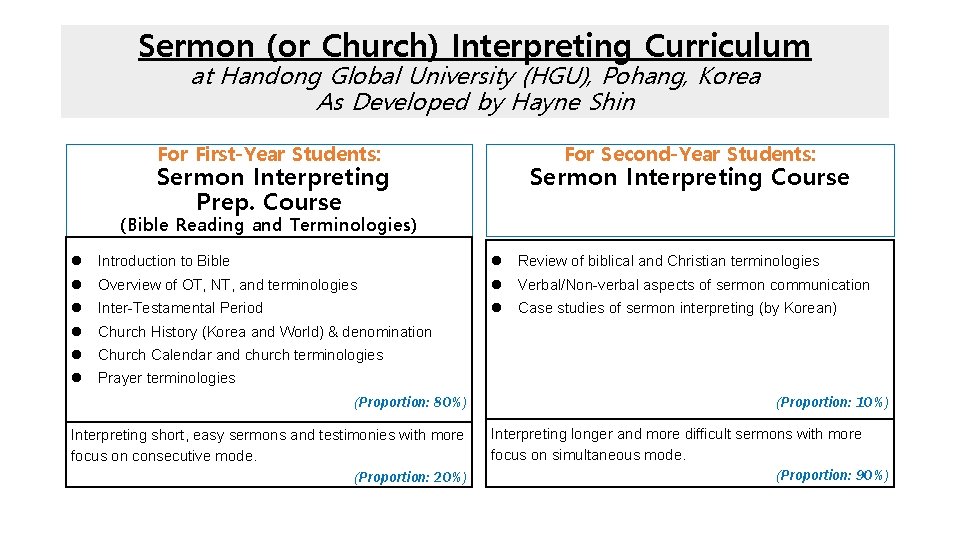
Sermon (or Church) Interpreting Curriculum at Handong Global University (HGU), Pohang, Korea As Developed by Hayne Shin For First-Year Students: Sermon Interpreting Prep. Course For Second-Year Students: Sermon Interpreting Course (Bible Reading and Terminologies) Introduction to Bible Review of biblical and Christian terminologies Overview of OT, NT, and terminologies Verbal/Non-verbal aspects of sermon communication Inter-Testamental Period Case studies of sermon interpreting (by Korean) Church History (Korea and World) & denomination Church Calendar and church terminologies Prayer terminologies (Proportion: 80%) (Proportion: 10%) Interpreting short, easy sermons and testimonies with more focus on consecutive mode. (Proportion: 20%) Interpreting longer and more difficult sermons with more focus on simultaneous mode. (Proportion: 90%)
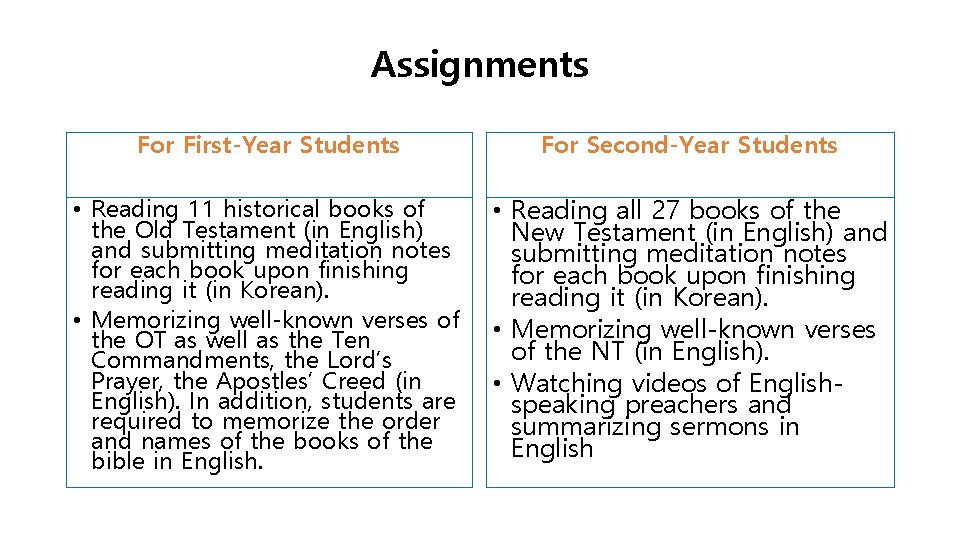
Assignments For First-Year Students For Second-Year Students • Reading 11 historical books of the Old Testament (in English) and submitting meditation notes for each book upon finishing reading it (in Korean). • Memorizing well-known verses of the OT as well as the Ten Commandments, the Lord’s Prayer, the Apostles’ Creed (in English). In addition, students are required to memorize the order and names of the books of the bible in English. • Reading all 27 books of the New Testament (in English) and submitting meditation notes for each book upon finishing reading it (in Korean). • Memorizing well-known verses of the NT (in English). • Watching videos of Englishspeaking preachers and summarizing sermons in English
Questions or Comments?