
User Story in Brief Merja Bauters 2 UX
User Story in Brief Merja Bauters
2
UX and Agile methods? More methods? – Place of User Stories • Both deal with Wicked problems (see Rittel & Webber 1984). • Software engineers dealing with ill‑defined problems move repeatedly between examining scenarios/Personas/User stories, clarifying requirements, defining their solution at a high level, and doing low‑level design for difficult elements. • ( Guindon, Raymonde. “Designing the Design Process: Exploiting Opportunistic Thoughts. ” Human‑Computer Interaction, June 1990. Retrieved October 4, 2009) 3
Scenario § “A narrative description of what people do and experience as they try to make use of computer systems and applications” (Carroll 1995) § Provides broader perspective into the needs, goals, tool ecology and practices 4
Storytelling – Personas • The goal is to obtain insight into the attributes of an experience that would help or delight people based on research evidence (Hawley 2009). 5
Having a good list of users/customers helps us understand functional scope How many different types of users/customers will use the tool? What goals will they be in pursuit of? What tasks will they need to perform? Which of those tasks will the tool to be designed support? © 2006 -2007 Jeff Patton, All rights reserved, www. agileproductdesign. com 6
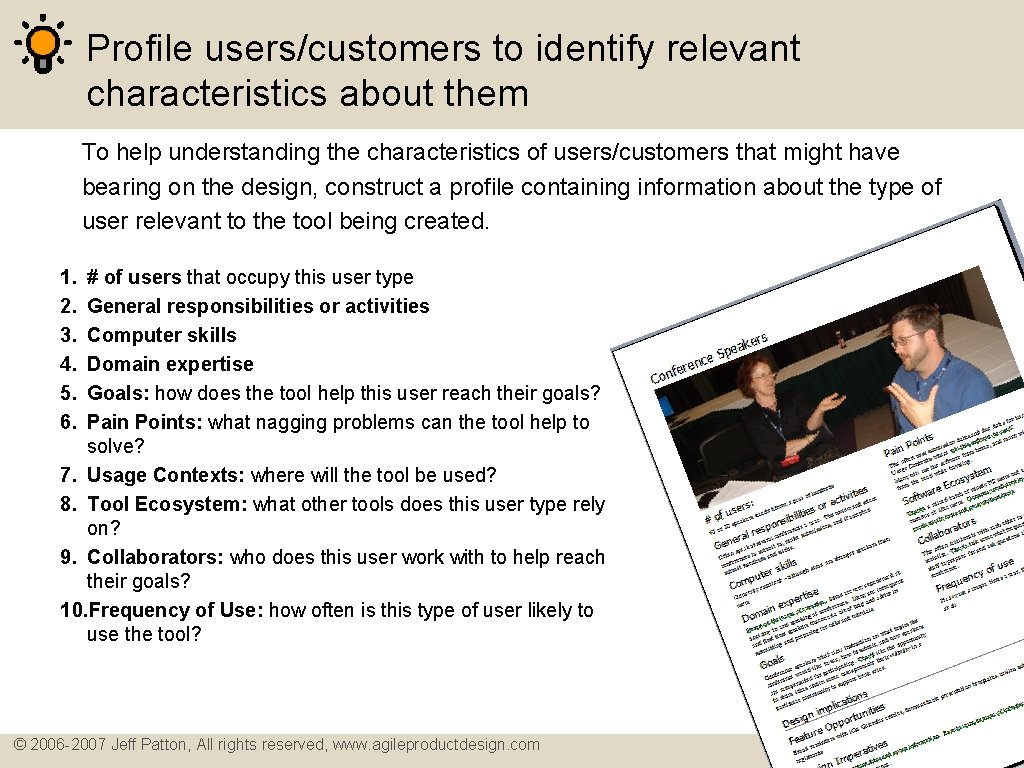
Profile users/customers to identify relevant characteristics about them To help understanding the characteristics of users/customers that might have bearing on the design, construct a profile containing information about the type of user relevant to the tool being created. 1. 2. 3. 4. 5. 6. # of users that occupy this user type General responsibilities or activities Computer skills Domain expertise Goals: how does the tool help this user reach their goals? Pain Points: what nagging problems can the tool help to solve? 7. Usage Contexts: where will the tool be used? 8. Tool Ecosystem: what other tools does this user type rely on? 9. Collaborators: who does this user work with to help reach their goals? 10. Frequency of Use: how often is this type of user likely to use the tool? © 2006 -2007 Jeff Patton, All rights reserved, www. agileproductdesign. com 7
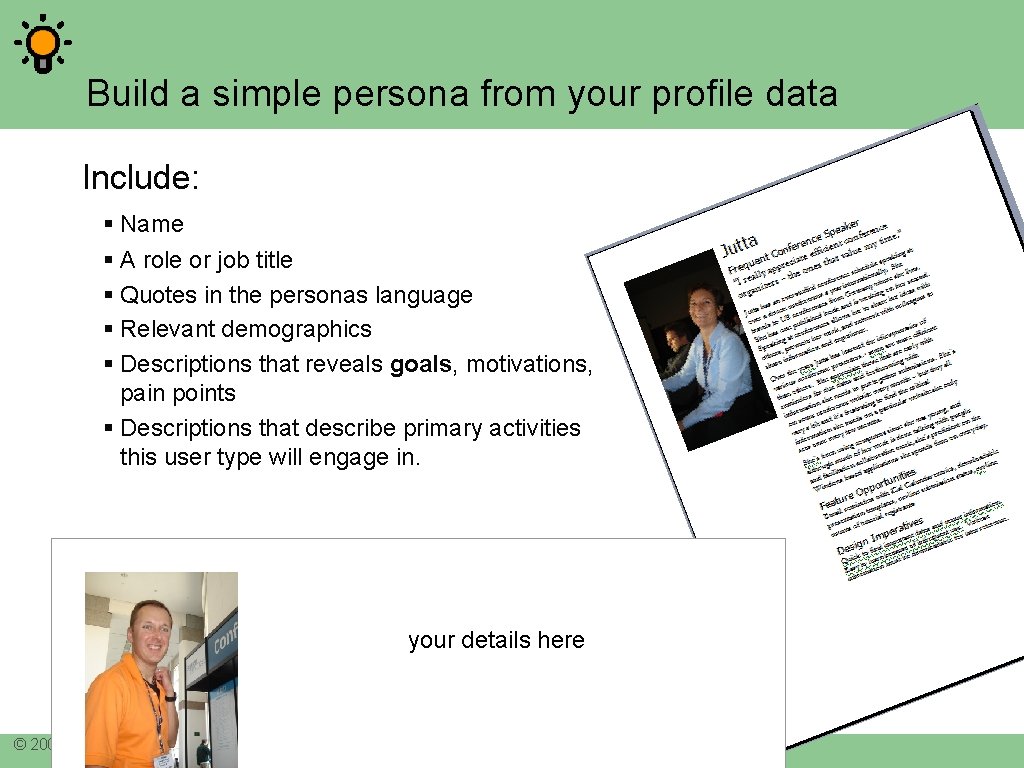
Build a simple persona from your profile data Include: § Name § A role or job title § Quotes in the personas language § Relevant demographics § Descriptions that reveals goals, motivations, pain points § Descriptions that describe primary activities this user type will engage in. your details here © 2006 -2007 Jeff Patton, All rights reserved, www. agileproductdesign. com 8
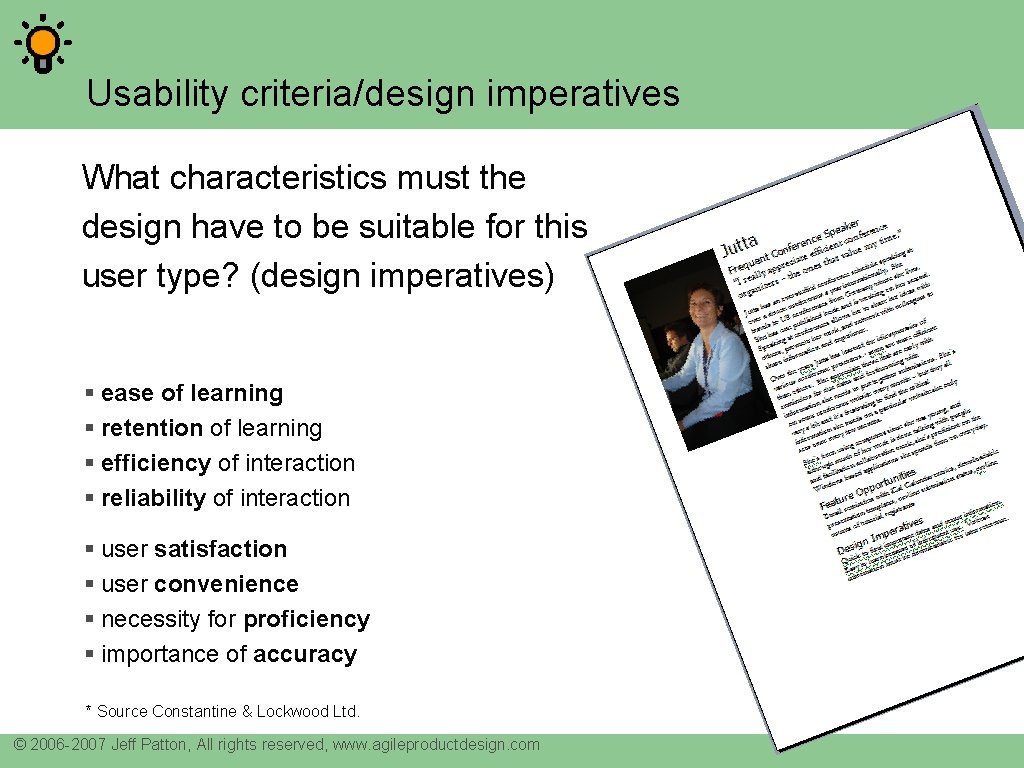
Usability criteria/design imperatives What characteristics must the design have to be suitable for this user type? (design imperatives) § ease of learning § retention of learning § efficiency of interaction § reliability of interaction § user satisfaction § user convenience § necessity for proficiency § importance of accuracy * Source Constantine & Lockwood Ltd. © 2006 -2007 Jeff Patton, All rights reserved, www. agileproductdesign. com 9
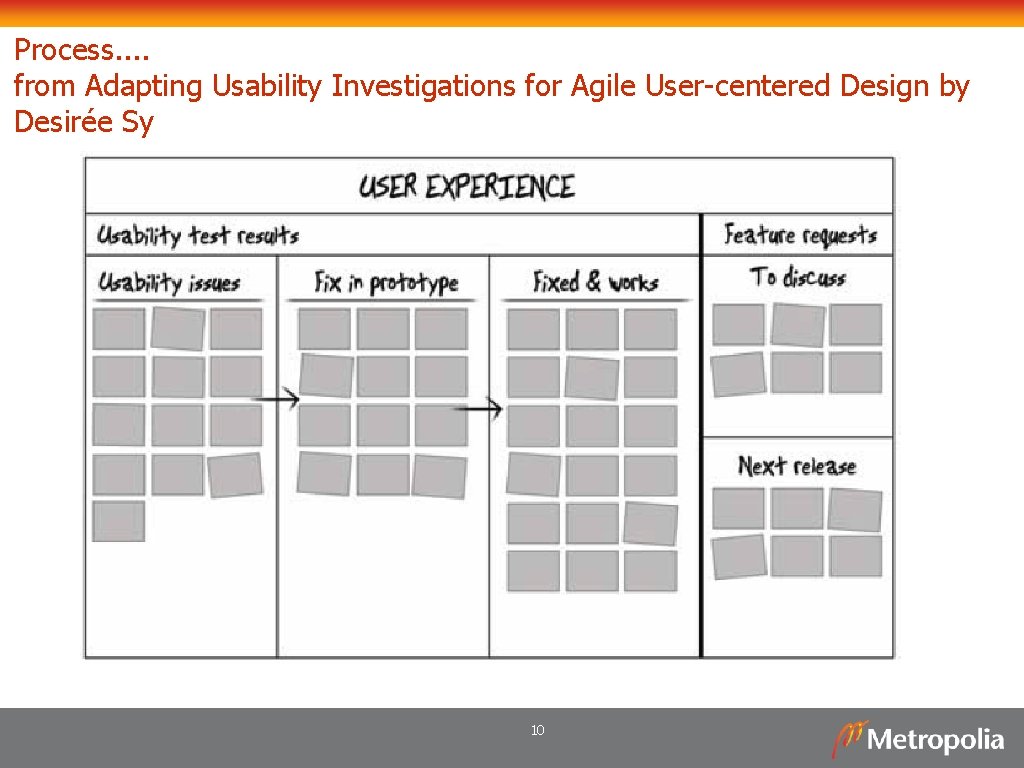
Process. . from Adapting Usability Investigations for Agile User-centered Design by Desirée Sy 10
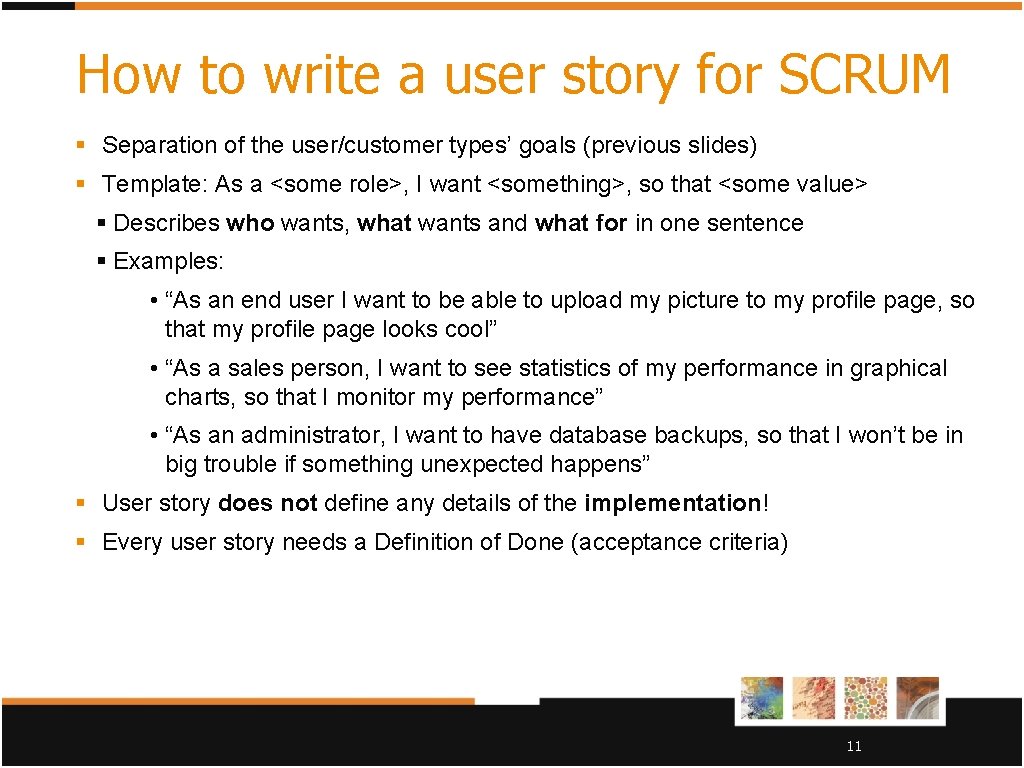
How to write a user story for SCRUM § Separation of the user/customer types’ goals (previous slides) § Template: As a <some role>, I want <something>, so that <some value> § Describes who wants, what wants and what for in one sentence § Examples: • “As an end user I want to be able to upload my picture to my profile page, so that my profile page looks cool” • “As a sales person, I want to see statistics of my performance in graphical charts, so that I monitor my performance” • “As an administrator, I want to have database backups, so that I won’t be in big trouble if something unexpected happens” § User story does not define any details of the implementation! § Every user story needs a Definition of Done (acceptance criteria) 11
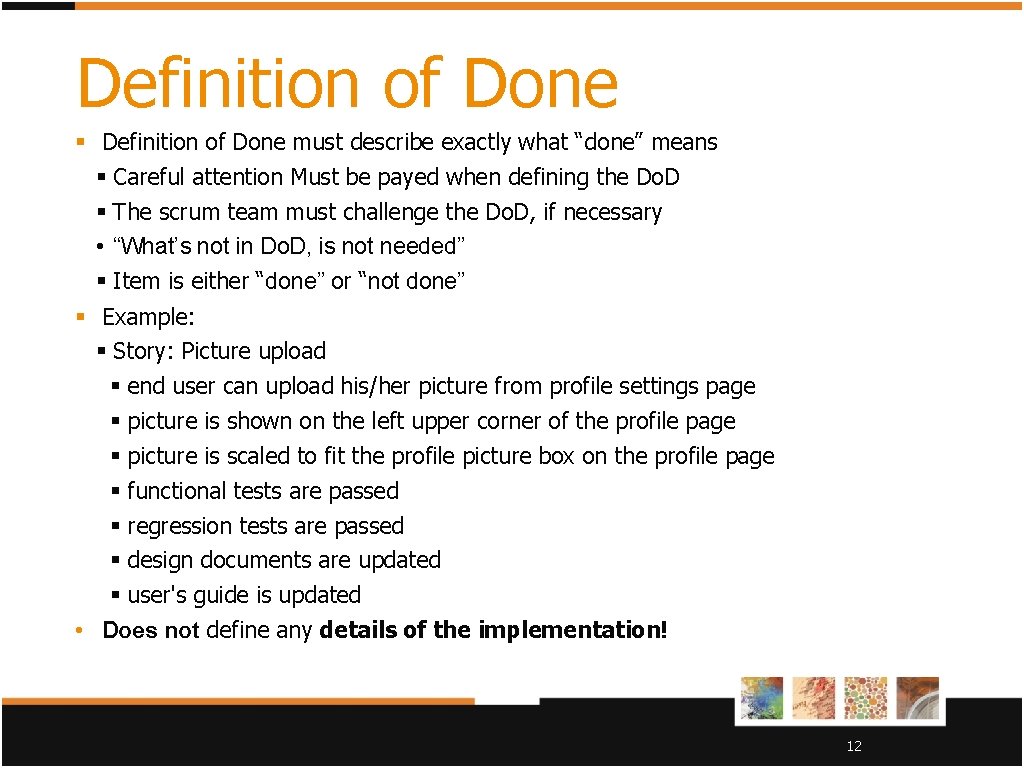
Definition of Done § Definition of Done must describe exactly what “done” means § Careful attention Must be payed when defining the Do. D § The scrum team must challenge the Do. D, if necessary • “What’s not in Do. D, is not needed” § Item is either “done” or “not done” § Example: § Story: Picture upload § end user can upload his/her picture from profile settings page § picture is shown on the left upper corner of the profile page § picture is scaled to fit the profile picture box on the profile page § functional tests are passed § regression tests are passed § design documents are updated § user's guide is updated • Does not define any details of the implementation! 12
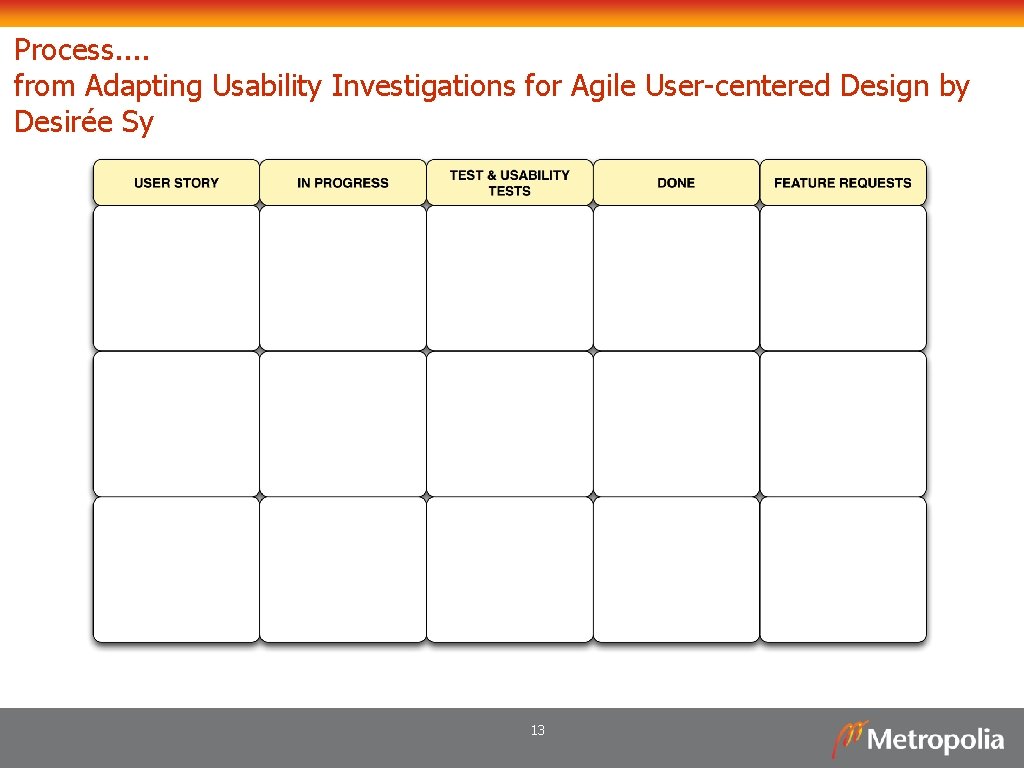
Process. . from Adapting Usability Investigations for Agile User-centered Design by Desirée Sy 13
Some characteristics and challenges to UX • UX designers to work in parallel with the rest of an agile team, developing the UX design slightly in advance of the next development cycle. • For software with multiple target user groups, care must be taken to avoid representing one user group over others – e. g. , using personas and scenarios to maintain Consistency! • Use of Rapid prototyping for user experience — e. g. , paper prototypes— can let you elicit rapid feedback on your designs. 14
Some characteristics and challenges to UX • Whenever possible, test the usability of your designs with representative users. • Heuristic evaluation techniques can provide high value for a minimal outlay of time and resources, and they can help other development team members understand the software’s user experience • Ensure that your testing focuses tightly on the areas of the user experience that a development release affects. • Contextual inquiry plays a critical role in our Agile UCD process. • Early design “chunks” must be low-level and fundamental — design attributes that will not change as more design chunks are added on top of them 15
Sources § Guindon, Raymonde. “Designing the Design Process: Exploiting Opportunistic Thoughts. ” Human‑Computer Interaction, June 1990. Last retrieved October 4, 2009 from http: //portal. acm. org/citation. cfm? id=1456616 § H. Rittel and M. M. Webber, "Planning Problems are Wicked Problems, " in N. Cross (ed. ), Developments in Design Methodology, John Wiley & Sons, New York, 1984, pp. 135 -144. § Jeff Patton. Personas, Profiles, Actors, & Roles: Modelling users to target successful product design. Retrieved October 4, 2009 www. agileproductdesign. com/downloads/patton_user_modeling. ppt § Carroll, J. M (1995) Introduction: The Scenario Perspective on System Development. In J. M. Carroll (ed. ) Scenario-Based Design: Envisioning work and Technology in System Development New York: Wiley § Adapting Usability Investigations for Agile User-Centered Design. Desiree Sy. Journal of Usability Studies, Volume 2, Issue 3, May 2007, pp. 112 -132 Last retrieved October 4, 2009 from: http: //www. upassoc. org/upa_publications/jus/2007 may/agile-ucd. html § Michael Hawley (2009). Design Research Methods for Experience Design. In UXmatters Last retrieved October 4, 2009 from http: //www. uxmatters. com/mt/archives/2009/01/design-research-methods-for-experiencedesign. php 16
Other Sources § Carroll John M. (2000). Making use: scenario-based design of humancomputer interactions. Cambridge, London, Massachusetts: The MITT Press. § And case example site: http: //ucs. ist. psu. edu/ § See description with examples about UX & Agile methods emerging to fuse them. . . http: //www. upassoc. org/upa_publications/jus/2007 may/agileucd. html, § Adapting Usability Investigations for Agile User – Centred Design http: //agileproductdesign. com/blog/emerging_best_agile_ux_practice. html 17
- Slides: 17