
User Readiness for GRB and HRITEMWIN Paul Seymour
User Readiness for GRB and HRIT/EMWIN Paul Seymour and Matthew Seybold NOAA/NESDIS/OSPO/Satellite Products and Services Division NCWCP College Park, MD and NSOF Suitland, MD Paul. Seymour@noaa. gov Matthew. Seybold@noaa. gov http: //www. goes-r. gov/ NOAA Satellite Conference (NSC) April 29, 2015 Non Export-Controlled Information
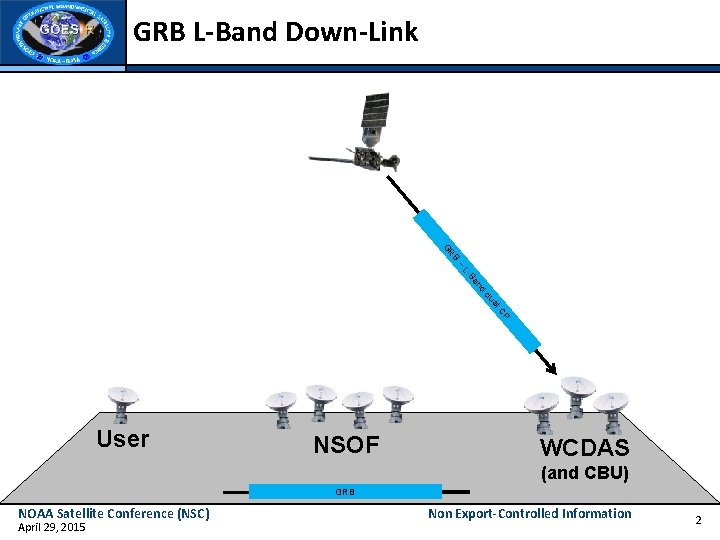
GRB L-Band Down-Link RB G – nd Ba Lal du CP User NSOF WCDAS (and CBU) GRB NOAA Satellite Conference (NSC) April 29, 2015 Non Export-Controlled Information 2
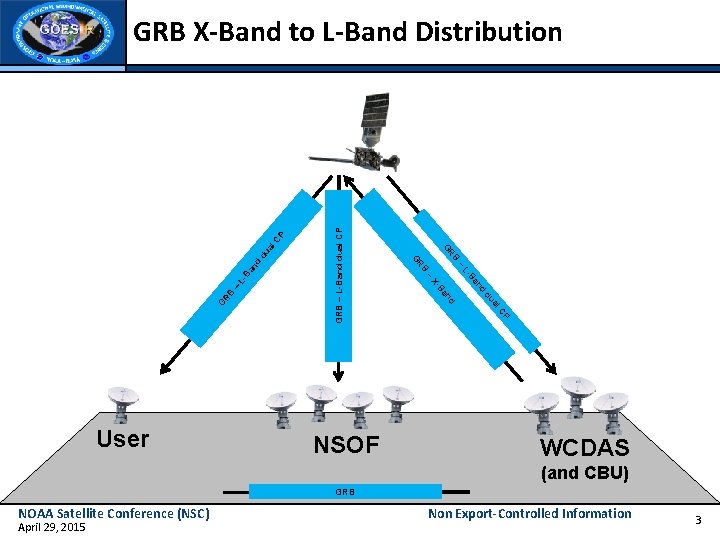
al du CP GRB – L-Band dual CP du nd Ba L– nd nd Ba X- Ba L- – G RB – RB NSOF G User RB G al CP GRB X-Band to L-Band Distribution WCDAS (and CBU) GRB NOAA Satellite Conference (NSC) April 29, 2015 Non Export-Controlled Information 3
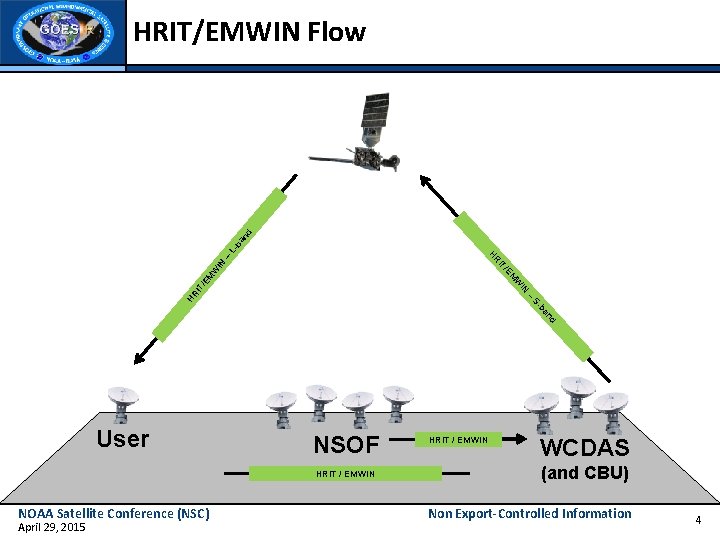
– HR IN W IT /E M W IN – M /E IT HR L- ba nd HRIT/EMWIN Flow Sd n ba User NSOF HRIT / EMWIN NOAA Satellite Conference (NSC) April 29, 2015 HRIT / EMWIN WCDAS (and CBU) Non Export-Controlled Information 4
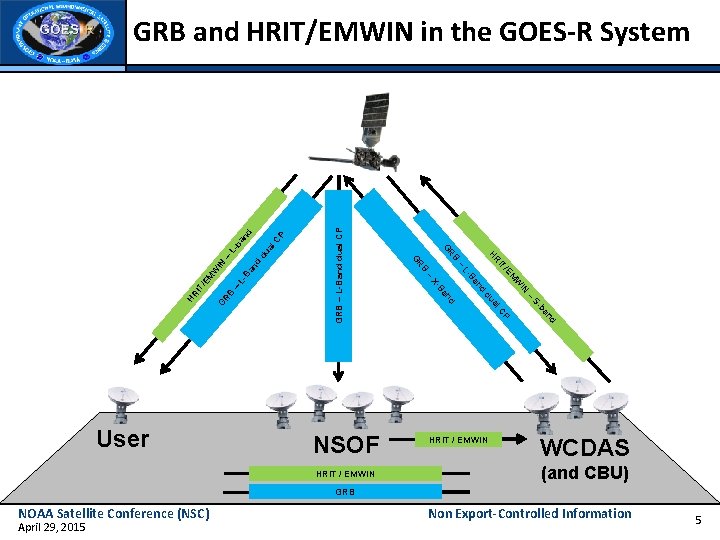
d n ba al du L- nd – IN Ba W – L- M GRB – L-Band dual CP S- CP HRIT / EMWIN – G RB IT /E IN al du HR W nd Ba L- nd Ba X- M /E IT HR – – HRIT / EMWIN RB NSOF G User RB G ba CP nd GRB and HRIT/EMWIN in the GOES-R System WCDAS (and CBU) GRB NOAA Satellite Conference (NSC) April 29, 2015 Non Export-Controlled Information 5
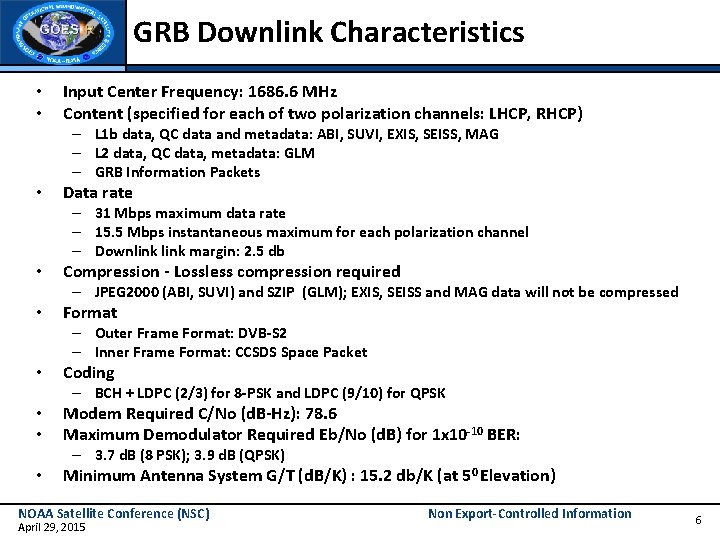
GRB Downlink Characteristics • • Input Center Frequency: 1686. 6 MHz Content (specified for each of two polarization channels: LHCP, RHCP) – L 1 b data, QC data and metadata: ABI, SUVI, EXIS, SEISS, MAG – L 2 data, QC data, metadata: GLM – GRB Information Packets • Data rate – 31 Mbps maximum data rate – 15. 5 Mbps instantaneous maximum for each polarization channel – Downlink margin: 2. 5 db • Compression - Lossless compression required – JPEG 2000 (ABI, SUVI) and SZIP (GLM); EXIS, SEISS and MAG data will not be compressed • Format – Outer Frame Format: DVB-S 2 – Inner Frame Format: CCSDS Space Packet • Coding – BCH + LDPC (2/3) for 8 -PSK and LDPC (9/10) for QPSK • • Modem Required C/No (d. B-Hz): 78. 6 Maximum Demodulator Required Eb/No (d. B) for 1 x 10 -10 BER: – 3. 7 d. B (8 PSK); 3. 9 d. B (QPSK) • Minimum Antenna System G/T (d. B/K) : 15. 2 db/K (at 50 Elevation) NOAA Satellite Conference (NSC) April 29, 2015 Non Export-Controlled Information 6

Transition from GVAR to GRB GOES Variable (GVAR) GOES Rebroadcast (GRB) Full Disk Image 30 Minutes 5 Minutes (Mode 4) 15 min (Mode 3) Other Modes Rapid Scan, Super Rapid Scan 3000 km X 5000 km (CONUS: 5 minute) 1000 km X 1000 km (Mesoscale: 30 seconds) Polarization None Dual Circular Polarized Receiver Center Frequency 1685. 7 MHz (L-Band) 1686. 6 MHz (L-Band) Data Rate 2. 11 Mbps 31 Mbps Antenna Coverage Earth Coverage to 50 Data Sources Imager and Sounder ABI (16 bands), GLM, SEISS, EXIS, SUVI, MAG Space Weather None ~2 Mbps Lightning Data None 0. 5 Mbps NOAA Satellite Conference (NSC) April 29, 2015 Non Export-Controlled Information 7
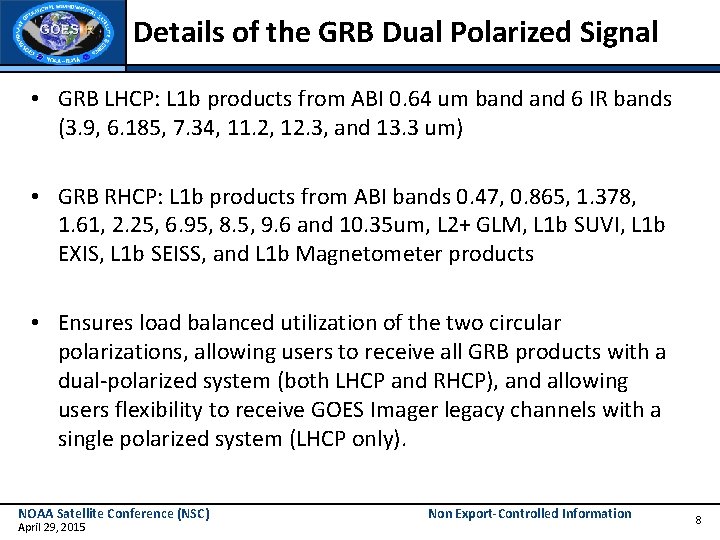
Details of the GRB Dual Polarized Signal • GRB LHCP: L 1 b products from ABI 0. 64 um band 6 IR bands (3. 9, 6. 185, 7. 34, 11. 2, 12. 3, and 13. 3 um) • GRB RHCP: L 1 b products from ABI bands 0. 47, 0. 865, 1. 378, 1. 61, 2. 25, 6. 95, 8. 5, 9. 6 and 10. 35 um, L 2+ GLM, L 1 b SUVI, L 1 b EXIS, L 1 b SEISS, and L 1 b Magnetometer products • Ensures load balanced utilization of the two circular polarizations, allowing users to receive all GRB products with a dual-polarized system (both LHCP and RHCP), and allowing users flexibility to receive GOES Imager legacy channels with a single polarized system (LHCP only). NOAA Satellite Conference (NSC) April 29, 2015 Non Export-Controlled Information 8
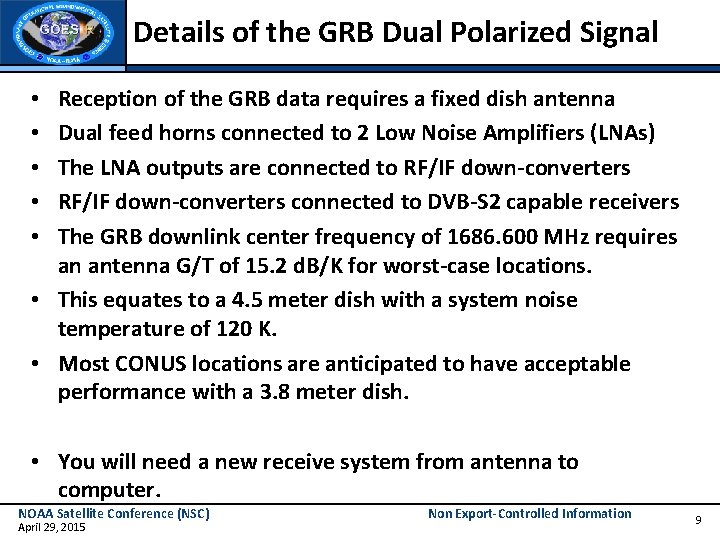
Details of the GRB Dual Polarized Signal Reception of the GRB data requires a fixed dish antenna Dual feed horns connected to 2 Low Noise Amplifiers (LNAs) The LNA outputs are connected to RF/IF down-converters connected to DVB-S 2 capable receivers The GRB downlink center frequency of 1686. 600 MHz requires an antenna G/T of 15. 2 d. B/K for worst-case locations. • This equates to a 4. 5 meter dish with a system noise temperature of 120 K. • Most CONUS locations are anticipated to have acceptable performance with a 3. 8 meter dish. • • • You will need a new receive system from antenna to computer. NOAA Satellite Conference (NSC) April 29, 2015 Non Export-Controlled Information 9
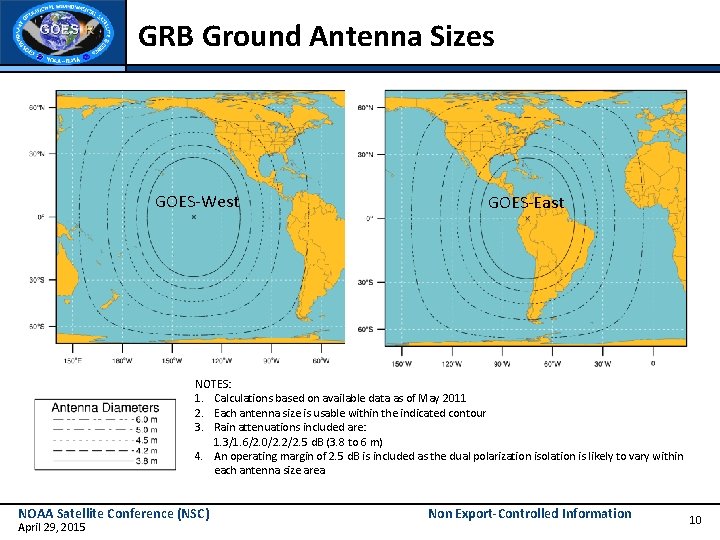
GRB Ground Antenna Sizes GOES-West GOES-East NOTES: 1. Calculations based on available data as of May 2011 2. Each antenna size is usable within the indicated contour 3. Rain attenuations included are: 1. 3/1. 6/2. 0/2. 2/2. 5 d. B (3. 8 to 6 m) 4. An operating margin of 2. 5 d. B is included as the dual polarization isolation is likely to vary within each antenna size area NOAA Satellite Conference (NSC) April 29, 2015 Non Export-Controlled Information 10
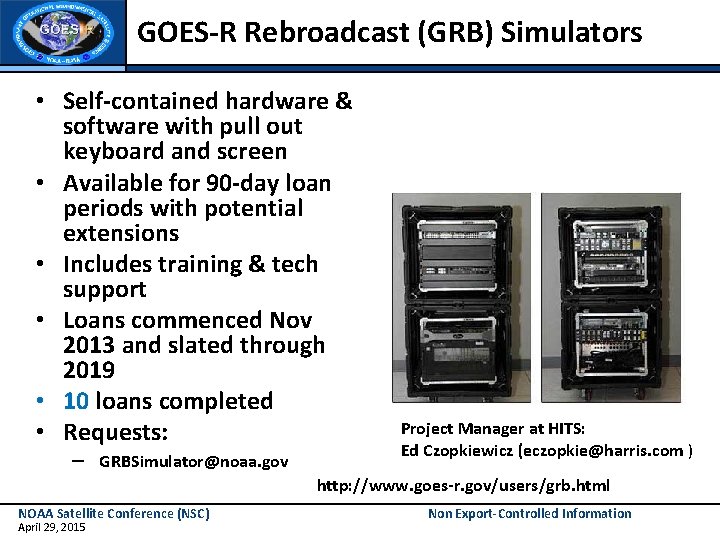
GOES-R Rebroadcast (GRB) Simulators • Self-contained hardware & software with pull out keyboard and screen • Available for 90 -day loan periods with potential extensions • Includes training & tech support • Loans commenced Nov 2013 and slated through 2019 • 10 loans completed • Requests: – GRBSimulator@noaa. gov Project Manager at HITS: Ed Czopkiewicz (eczopkie@harris. com ) http: //www. goes-r. gov/users/grb. html NOAA Satellite Conference (NSC) April 29, 2015 Non Export-Controlled Information
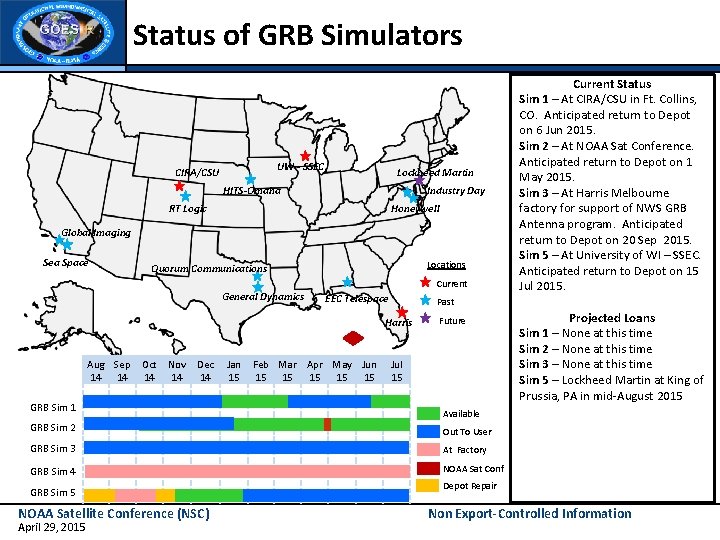
Status of GRB Simulators UW - SSEC CIRA/CSU Lockheed Martin HITS-Omaha Industry Day RT Logic Honeywell Global Imaging Sea Space Locations Quorum Communications General Dynamics Current EEC Telespace Past Harris Aug Sep Oct Nov Dec Jan Feb Mar Apr May Jun 14 14 14 15 15 15 Future Jul 15 GRB Sim 1 Available GRB Sim 2 Out To User GRB Sim 3 At Factory GRB Sim 4 GRB Sim 5 NOAA Satellite Conference (NSC) April 29, 2015 Current Status Sim 1 – At CIRA/CSU in Ft. Collins, CO. Anticipated return to Depot on 6 Jun 2015. Sim 2 – At NOAA Sat Conference. Anticipated return to Depot on 1 May 2015. Sim 3 – At Harris Melbourne factory for support of NWS GRB Antenna program. Anticipated return to Depot on 20 Sep 2015. Sim 5 – At University of WI – SSEC. Anticipated return to Depot on 15 Jul 2015. Projected Loans Sim 1 – None at this time Sim 2 – None at this time Sim 3 – None at this time Sim 5 – Lockheed Martin at King of Prussia, PA in mid-August 2015 NOAA Sat Conf Depot Repair Non Export-Controlled Information
GRB Summary • GRB allows real time distribution of all Level-1 b GOES-R data products for direct readout users. • Direct Readout users need to upgrade all equipment for GOES-R: – Significant increase in data rate!!! – New data format!!! • GRB simulators may be scheduled now for Direct Broadcast reception equipment development and testing. • GRB Simulator located in the Patuxent Room Thru Wednesday Afternoon • Documents and updates to be posted on the GOES-R web site: – http: //www. goes-r. gov/users/grb. html NOAA Satellite Conference (NSC) April 29, 2015 Non Export-Controlled Information 13
User Readiness for GRB and HRIT/EMWIN Paul Seymour and Matt Seybold NOAA/NESDIS/OSPO/Satellite Products and Services Division NCWCP College Park, MD and NSOF Suitland, MD Paul. Seymour@noaa. gov Matthew. Seybold@noaa. gov http: //www. goes-r. gov/ NOAA Satellite Conference (NSC) April 29, 2015 Non Export-Controlled Information
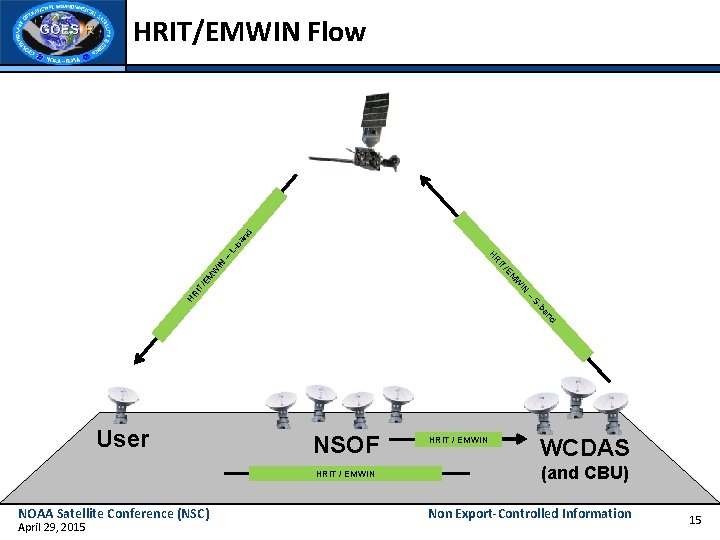
– HR IN W IT /E M W IN – M /E IT HR L- ba nd HRIT/EMWIN Flow Sd n ba User NSOF HRIT / EMWIN NOAA Satellite Conference (NSC) April 29, 2015 HRIT / EMWIN WCDAS (and CBU) Non Export-Controlled Information 15
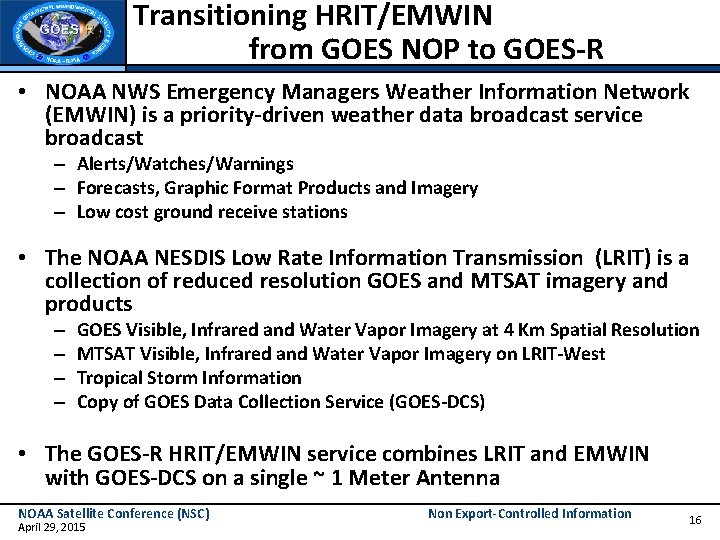
Transitioning HRIT/EMWIN from GOES NOP to GOES-R • NOAA NWS Emergency Managers Weather Information Network (EMWIN) is a priority-driven weather data broadcast service broadcast – Alerts/Watches/Warnings – Forecasts, Graphic Format Products and Imagery – Low cost ground receive stations • The NOAA NESDIS Low Rate Information Transmission (LRIT) is a collection of reduced resolution GOES and MTSAT imagery and products – – GOES Visible, Infrared and Water Vapor Imagery at 4 Km Spatial Resolution MTSAT Visible, Infrared and Water Vapor Imagery on LRIT-West Tropical Storm Information Copy of GOES Data Collection Service (GOES-DCS) • The GOES-R HRIT/EMWIN service combines LRIT and EMWIN with GOES-DCS on a single ~ 1 Meter Antenna NOAA Satellite Conference (NSC) April 29, 2015 Non Export-Controlled Information 16
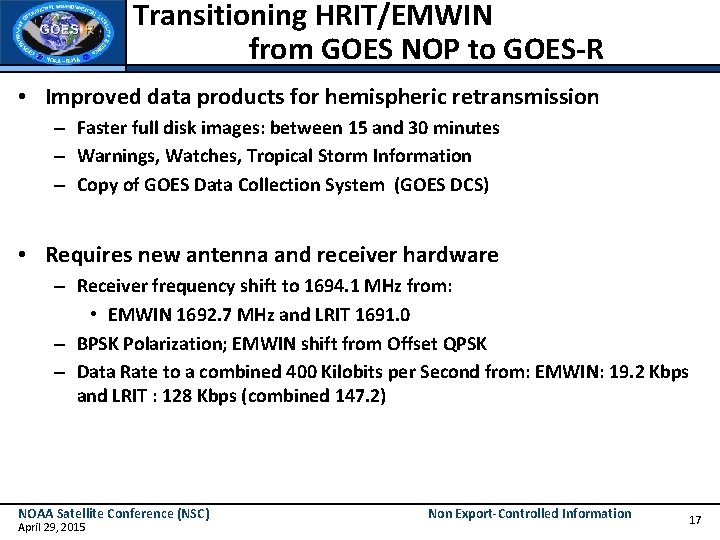
Transitioning HRIT/EMWIN from GOES NOP to GOES-R • Improved data products for hemispheric retransmission – Faster full disk images: between 15 and 30 minutes – Warnings, Watches, Tropical Storm Information – Copy of GOES Data Collection System (GOES DCS) • Requires new antenna and receiver hardware – Receiver frequency shift to 1694. 1 MHz from: • EMWIN 1692. 7 MHz and LRIT 1691. 0 – BPSK Polarization; EMWIN shift from Offset QPSK – Data Rate to a combined 400 Kilobits per Second from: EMWIN: 19. 2 Kbps and LRIT : 128 Kbps (combined 147. 2) NOAA Satellite Conference (NSC) April 29, 2015 Non Export-Controlled Information 17
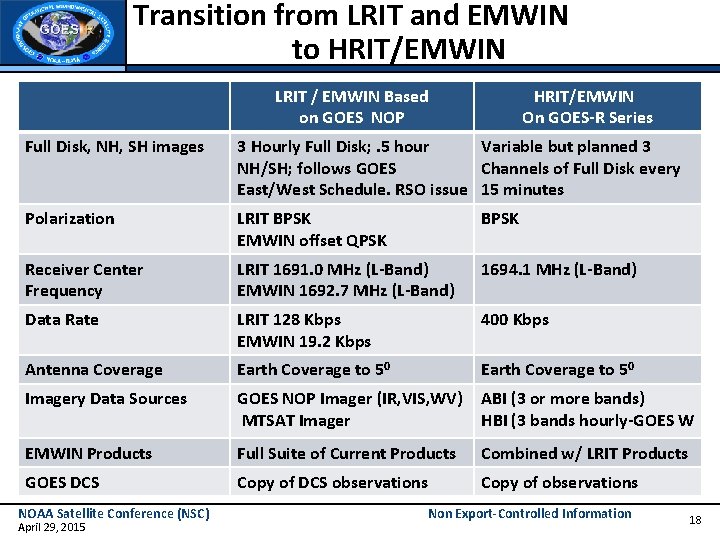
Transition from LRIT and EMWIN to HRIT/EMWIN LRIT / EMWIN Based on GOES NOP HRIT/EMWIN On GOES-R Series Full Disk, NH, SH images 3 Hourly Full Disk; . 5 hour Variable but planned 3 NH/SH; follows GOES Channels of Full Disk every East/West Schedule. RSO issue 15 minutes Polarization LRIT BPSK EMWIN offset QPSK BPSK Receiver Center Frequency LRIT 1691. 0 MHz (L-Band) EMWIN 1692. 7 MHz (L-Band) 1694. 1 MHz (L-Band) Data Rate LRIT 128 Kbps EMWIN 19. 2 Kbps 400 Kbps Antenna Coverage Earth Coverage to 50 Imagery Data Sources GOES NOP Imager (IR, VIS, WV) MTSAT Imager ABI (3 or more bands) HBI (3 bands hourly-GOES W EMWIN Products Full Suite of Current Products Combined w/ LRIT Products GOES DCS Copy of DCS observations Copy of observations NOAA Satellite Conference (NSC) April 29, 2015 Non Export-Controlled Information 18
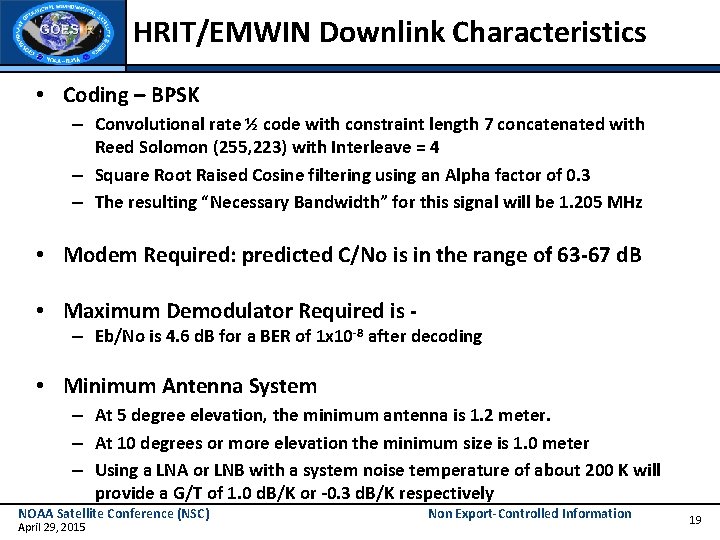
HRIT/EMWIN Downlink Characteristics • Coding – BPSK – Convolutional rate ½ code with constraint length 7 concatenated with Reed Solomon (255, 223) with Interleave = 4 – Square Root Raised Cosine filtering using an Alpha factor of 0. 3 – The resulting “Necessary Bandwidth” for this signal will be 1. 205 MHz • Modem Required: predicted C/No is in the range of 63 -67 d. B • Maximum Demodulator Required is - – Eb/No is 4. 6 d. B for a BER of 1 x 10 -8 after decoding • Minimum Antenna System – At 5 degree elevation, the minimum antenna is 1. 2 meter. – At 10 degrees or more elevation the minimum size is 1. 0 meter – Using a LNA or LNB with a system noise temperature of about 200 K will provide a G/T of 1. 0 d. B/K or -0. 3 d. B/K respectively NOAA Satellite Conference (NSC) April 29, 2015 Non Export-Controlled Information 19
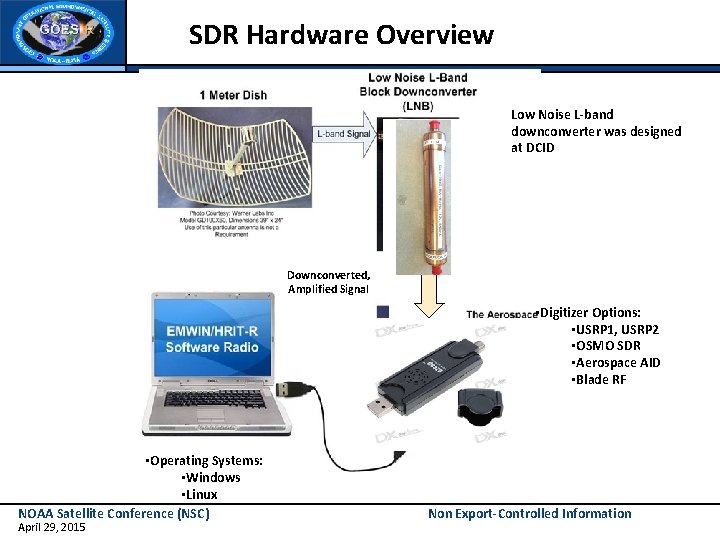
SDR Hardware Overview Low Noise L-band downconverter was designed at DCID Downconverted, Amplified Signal • Digitizer Options: • USRP 1, USRP 2 • OSMO SDR • Aerospace AID • Blade RF • Operating Systems: • Windows • Linux NOAA Satellite Conference (NSC) April 29, 2015 Non Export-Controlled Information
HRIT/EMWIN Summary • HRIT/EMWIN will provide at least 3 channels of GOES-NOP and / or GOES-R imagery along with warnings, watches and forecast products along with a copy of the GOES-DCS observations • New data rate, center frequency and modulation (EMWIN Users) • Ground receive stations are COTS utilizing a 1 – 1. 2 meter antenna • Take the time to talk to the vendors supplying LRIT Receive Stations • Prototype demo in the hallway through Thursday afternoon • Documents and updates to be posted on the GOES-R web site: – http: //www. goes-r. gov/ -- http: //www. goes-r. gov/users/hrit. html NOAA Satellite Conference (NSC) April 29, 2015 Non Export-Controlled Information 21
- Slides: 21