
User Defined Elements in ANSYS for Multiphysics Modeling
- Slides: 23
User Defined Elements in ANSYS for Multiphysics Modeling of Superconducting Devices July 10 th 2019 CHATS-AS, Szczecin, Poland Lucas Brouwer US Magnet Development Program Lawrence Berkeley National Laboratory
Outline A multiphysics approach in ANSYS for multi-filamentary conductor magnets • adding equivalent magnetization, quench, and material property fits at the • • • point of element matrix generation (user compiled ANSYS) coupling across electromagnetic, thermal, and circuit domains Ex. 1: simulating IFCC induced quench back in Nb 3 Sn undulators Ex. 2: simulating CLIQ for a Nb 3 Sn dipole (validation with STEAM/COMSOL) Implementing the E-J power law in ANSYS (initial verification studies) • field trapping in bulk cylinder (axisymmetric) • round filament magnetization (plane) Our initial effort to share these elements with the community 2
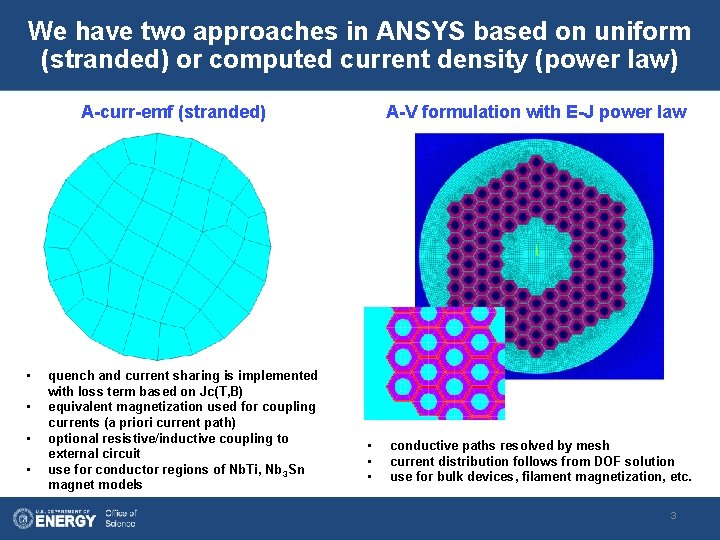
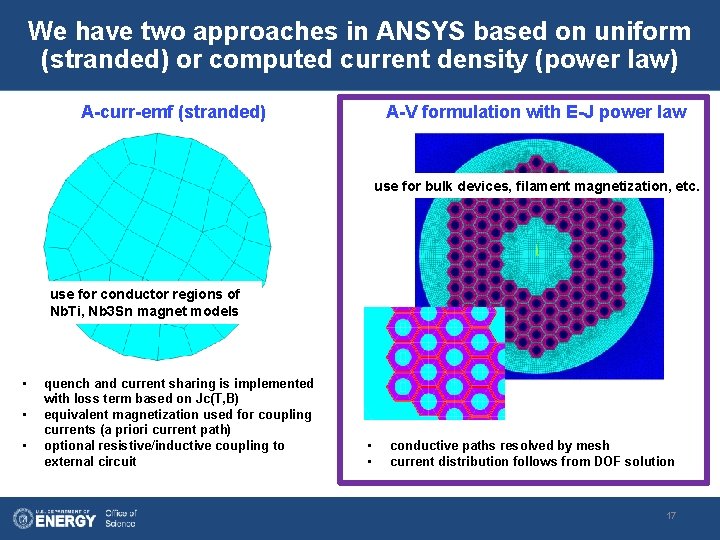
We have two approaches in ANSYS based on uniform (stranded) or computed current density (power law) A-curr-emf (stranded) • • quench and current sharing is implemented with loss term based on Jc(T, B) equivalent magnetization used for coupling currents (a priori current path) optional resistive/inductive coupling to external circuit use for conductor regions of Nb. Ti, Nb 3 Sn magnet models A-V formulation with E-J power law • • • conductive paths resolved by mesh current distribution follows from DOF solution use for bulk devices, filament magnetization, etc. 3
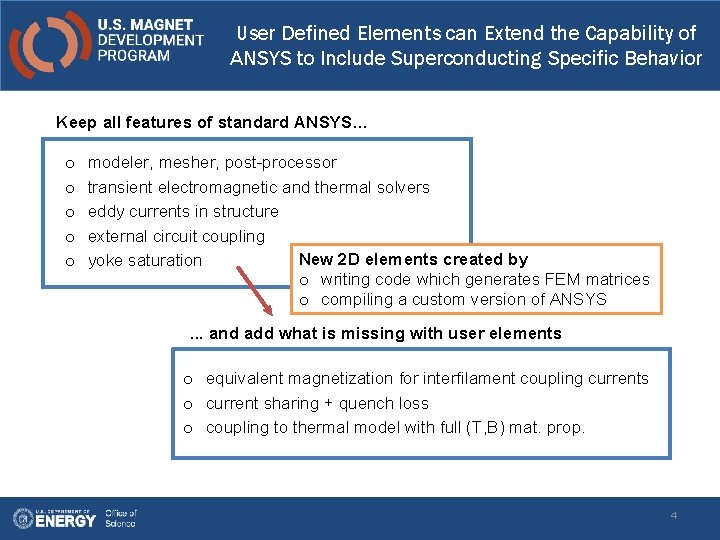
User Defined Elements can Extend the Capability of ANSYS to Include Superconducting Specific Behavior Keep all features of standard ANSYS… o o o modeler, mesher, post-processor transient electromagnetic and thermal solvers eddy currents in structure external circuit coupling New 2 D elements created by yoke saturation o writing code which generates FEM matrices o compiling a custom version of ANSYS. . . and add what is missing with user elements o equivalent magnetization for interfilament coupling currents o current sharing + quench loss o coupling to thermal model with full (T, B) mat. prop. 4
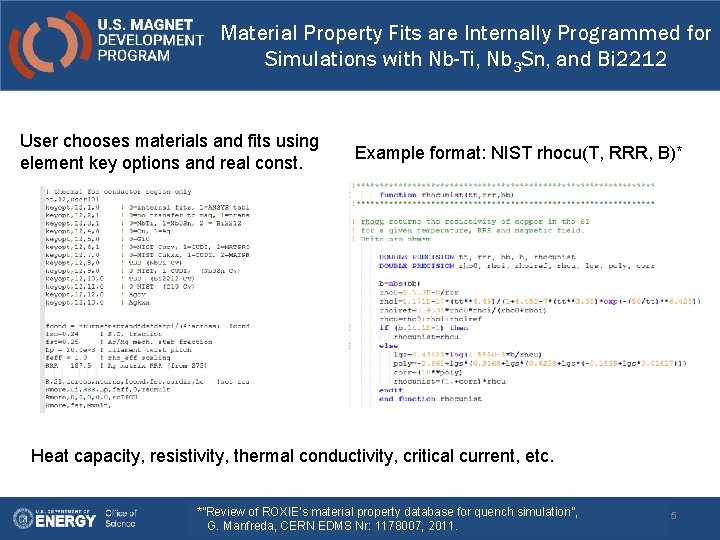
Material Property Fits are Internally Programmed for Simulations with Nb-Ti, Nb 3 Sn, and Bi 2212 User chooses materials and fits using element key options and real const. Example format: NIST rhocu(T, RRR, B)* Heat capacity, resistivity, thermal conductivity, critical current, etc. *”Review of ROXIE’s material property database for quench simulation”, G. Manfreda, CERN EDMS Nr: 1178007, 2011. 5
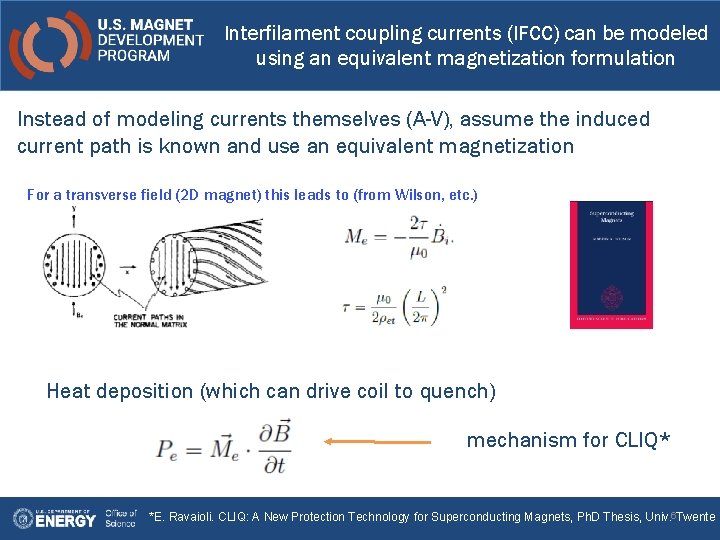
Interfilament coupling currents (IFCC) can be modeled using an equivalent magnetization formulation Instead of modeling currents themselves (A-V), assume the induced current path is known and use an equivalent magnetization For a transverse field (2 D magnet) this leads to (from Wilson, etc. ) Heat deposition (which can drive coil to quench) mechanism for CLIQ* *E. Ravaioli. CLIQ: A New Protection Technology for Superconducting Magnets, Ph. D Thesis, Univ. 6 Twente
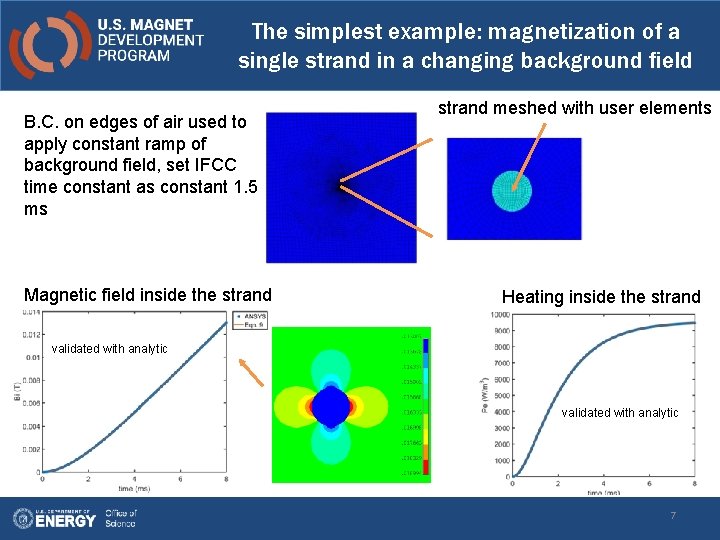
The simplest example: magnetization of a single strand in a changing background field B. C. on edges of air used to apply constant ramp of background field, set IFCC time constant as constant 1. 5 ms Magnetic field inside the strand meshed with user elements Heating inside the strand validated with analytic 7
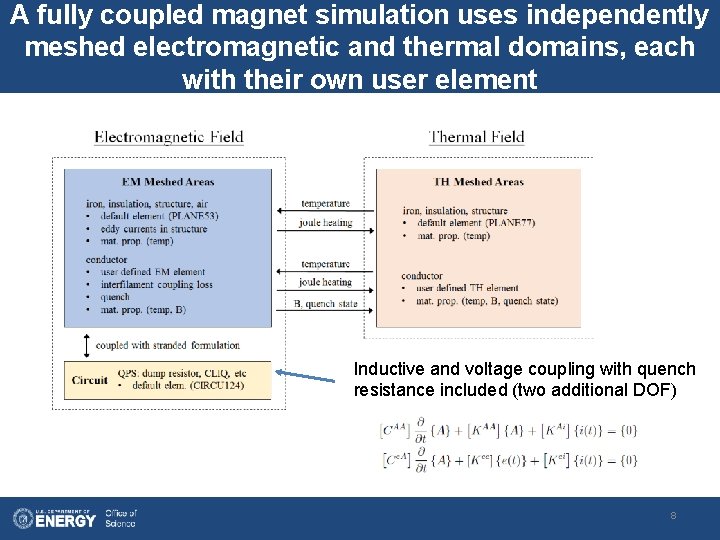
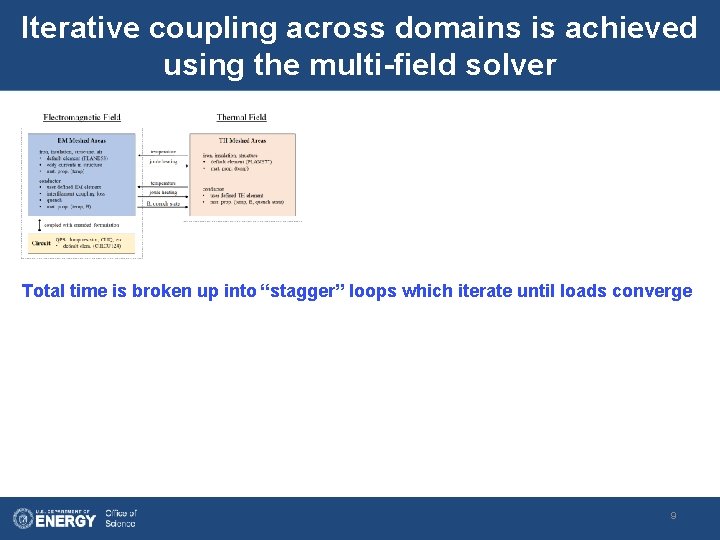
A fully coupled magnet simulation uses independently meshed electromagnetic and thermal domains, each with their own user element Inductive and voltage coupling with quench resistance included (two additional DOF) 8
Iterative coupling across domains is achieved using the multi-field solver Total time is broken up into “stagger” loops which iterate until loads converge 9
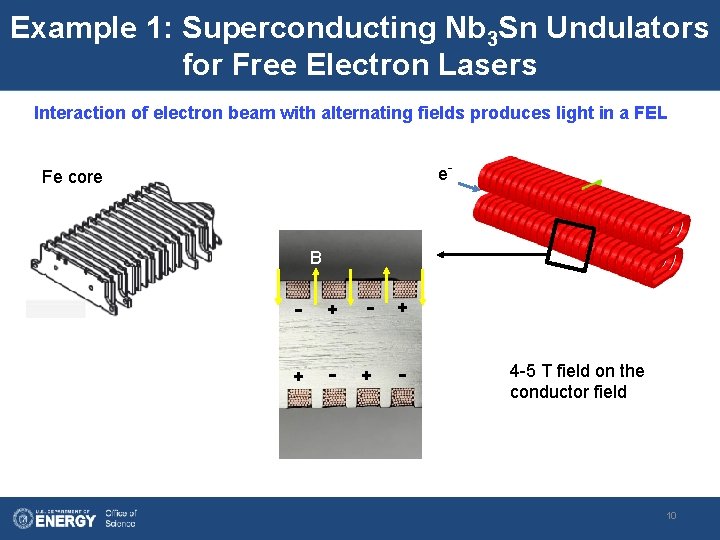
Example 1: Superconducting Nb 3 Sn Undulators for Free Electron Lasers Interaction of electron beam with alternating fields produces light in a FEL e- Fe core B - + + - 4 -5 T field on the conductor field 10
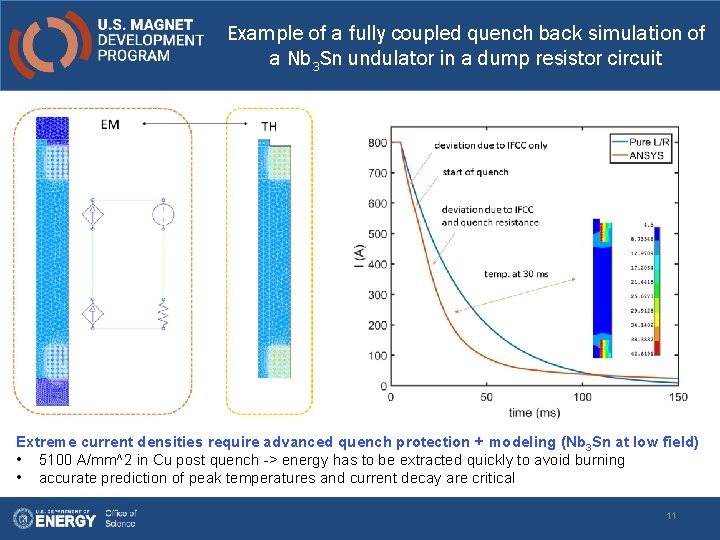
Example of a fully coupled quench back simulation of a Nb 3 Sn undulator in a dump resistor circuit Extreme current densities require advanced quench protection + modeling (Nb 3 Sn at low field) • 5100 A/mm^2 in Cu post quench -> energy has to be extracted quickly to avoid burning • accurate prediction of peak temperatures and current decay are critical 11
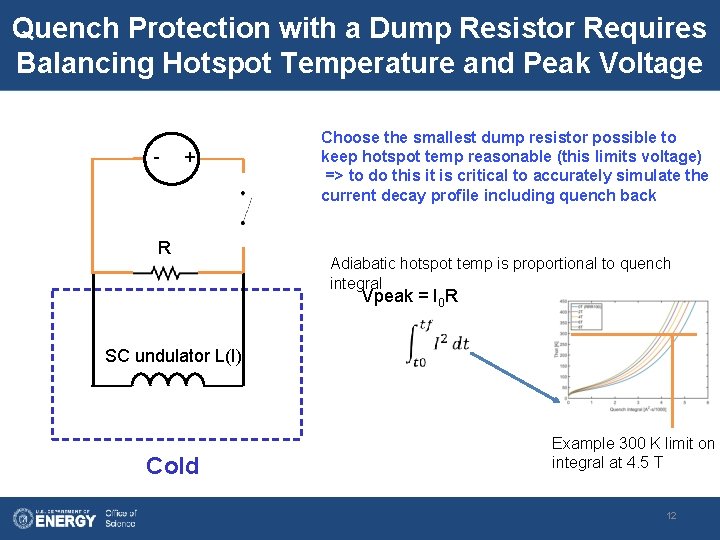
Quench Protection with a Dump Resistor Requires Balancing Hotspot Temperature and Peak Voltage - + R Choose the smallest dump resistor possible to keep hotspot temp reasonable (this limits voltage) => to do this it is critical to accurately simulate the current decay profile including quench back Adiabatic hotspot temp is proportional to quench integral Vpeak = I 0 R SC undulator L(I) Cold Example 300 K limit on integral at 4. 5 T 12
The user elements replicate quench back for a short undulator prototype tested at Berkeley ~ 34% less quench integral at high current allows us to reduce dump resistor (terminal voltage) 13
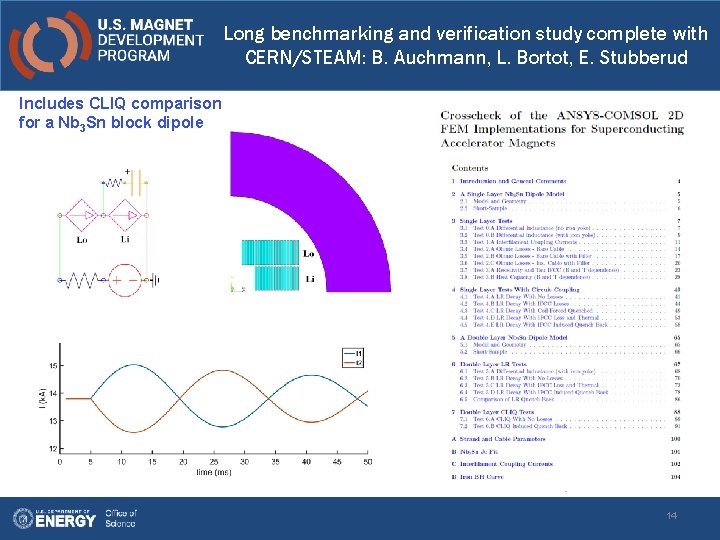
Long benchmarking and verification study complete with CERN/STEAM: B. Auchmann, L. Bortot, E. Stubberud Includes CLIQ comparison for a Nb 3 Sn block dipole 14
Comparison of coil and CLIQ currents to COMSOL (w/CERN) shows agreement 15
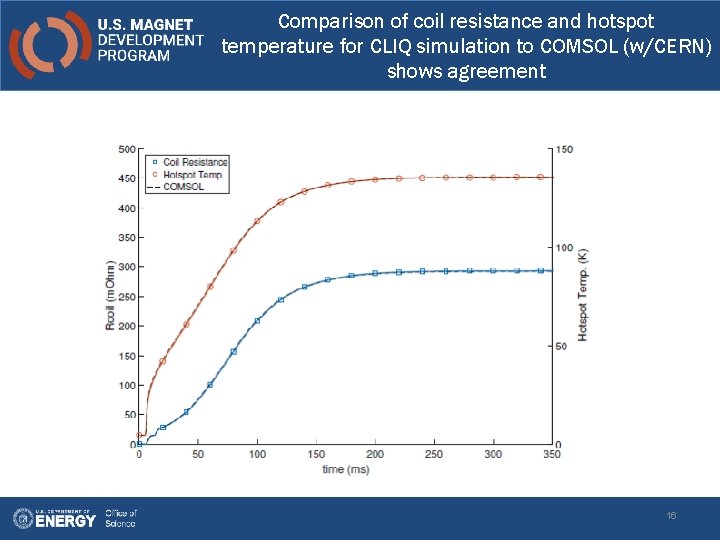
Comparison of coil resistance and hotspot temperature for CLIQ simulation to COMSOL (w/CERN) shows agreement 16
We have two approaches in ANSYS based on uniform (stranded) or computed current density (power law) A-curr-emf (stranded) A-V formulation with E-J power law use for bulk devices, filament magnetization, etc. use for conductor regions of Nb. Ti, Nb 3 Sn magnet models • • • quench and current sharing is implemented with loss term based on Jc(T, B) equivalent magnetization used for coupling currents (a priori current path) optional resistive/inductive coupling to external circuit • • conductive paths resolved by mesh current distribution follows from DOF solution 17
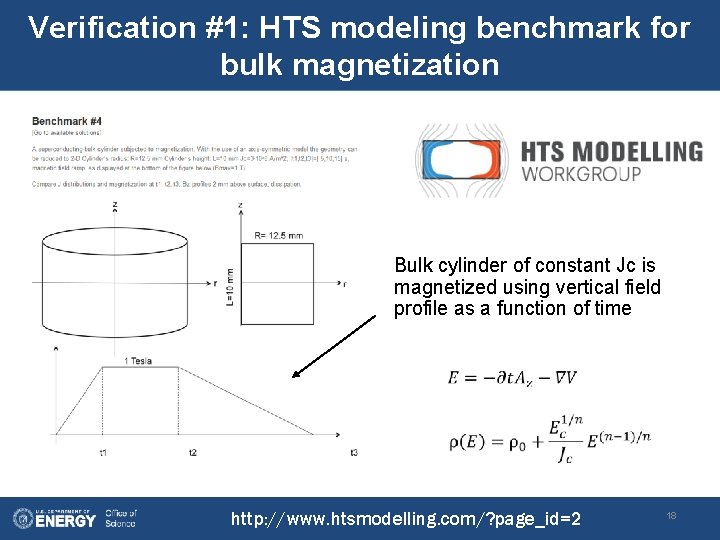
Verification #1: HTS modeling benchmark for bulk magnetization Bulk cylinder of constant Jc is magnetized using vertical field profile as a function of time http: //www. htsmodelling. com/? page_id=2 18
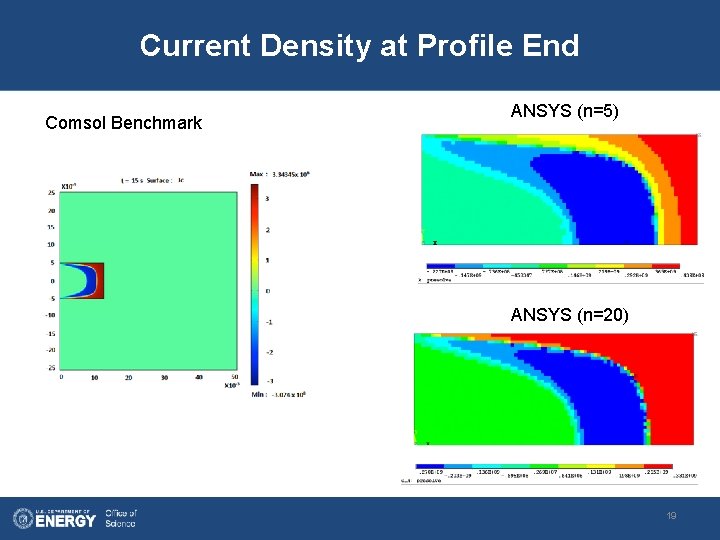
Current Density at Profile End Comsol Benchmark ANSYS (n=5) ANSYS (n=20) 19
Trapped field at profile end is converging towards benchmark 20
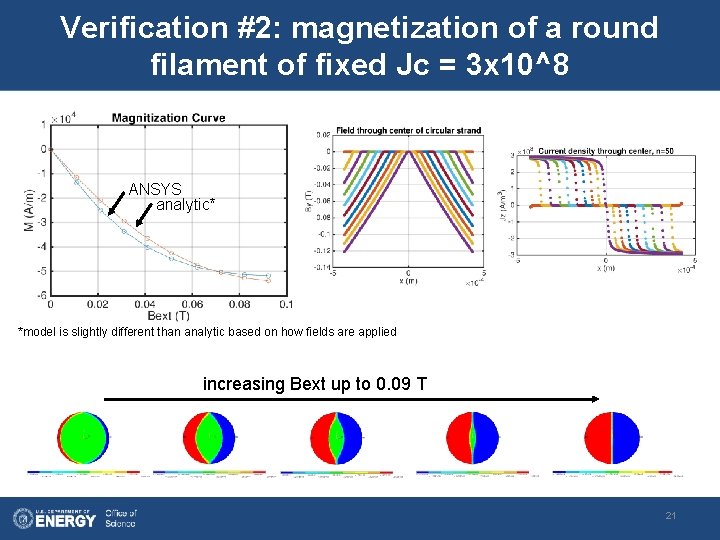
Verification #2: magnetization of a round filament of fixed Jc = 3 x 10^8 ANSYS analytic* *model is slightly different than analytic based on how fields are applied increasing Bext up to 0. 09 T 21
It is our goal to make these element available to those interested within the community FEM approach is geometry and material independent • accelerator magnets, solenoids, persistent switches, quench heaters, etc… • Nb-Ti, Nb 3 Sn, Bi 2212 (or mixed/hybrid) • very little additional knowledge beyond ANSYS needed We have a first package with examples and documentation to share with the community (see http: //usmdp. lbl. gov/scpack-code/ or contact me at lnbrouwer@lbl. gov) Initial publication: https: //doi. org/10. 1088/1361 -6668/ab 2 e 63 22
Summary A multiphysics approach in ANSYS for multi-filamentary conductor magnets • adding equivalent magnetization, quench, and material property fits at the • • • point of element matrix generation (user compiled ANSYS) coupling across electromagnetic, thermal, and circuit domains Ex. 1: simulating IFCC induced quench back in Nb 3 Sn undulators Ex. 2: simulating CLIQ for a Nb 3 Sn dipole (validation with STEAM/COMSOL) Implementing the E-J power law in ANSYS (initial verification studies) • field trapping in bulk cylinder (axisymmetric) • round filament magnetization (plane) Our initial effort to share these elements with the community 23