
User and Task Analysis Requirements Analysis in HCI
- Slides: 8
User and Task Analysis • Requirements Analysis in HCI. • Perform a comprehensive and systematic analysis of user task requirements through studying users to understand needs, expectations, tasks and work process and determine implications for the interface of this information. • The characteristics of the intended users/ User profile. Relevant factors may include the knowledge, skill, experience, education, training, physical attributes, habits and motor-sensory capabilities for the people concerned. Where distinctive groups of users exist (such as novices and experts) then their respective attributes should be identified and taken into account. • The tasks the users will perform. • The environment in which the users will use the system
Readings • The Usability Engineering Lifecycle: A Practitioner’s Handbook for Use Design available at books 24 x 7. com http: //www. umlib. um. edu. my • An example of system analysis: http: //courses. cs. vt. edu/%7 Ecs 3724/fall 2000/notes/printabl enotes/sys_analysis. htm
USER ANALYSIS • User expertise levels * Novice or first-timer user: may know application domain but does not know specifics of application * Intermittent user: uses several systems from time to time, knows application domains but does not remember details of different applications * Frequent user: uses application daily and knows both application and task domain very well
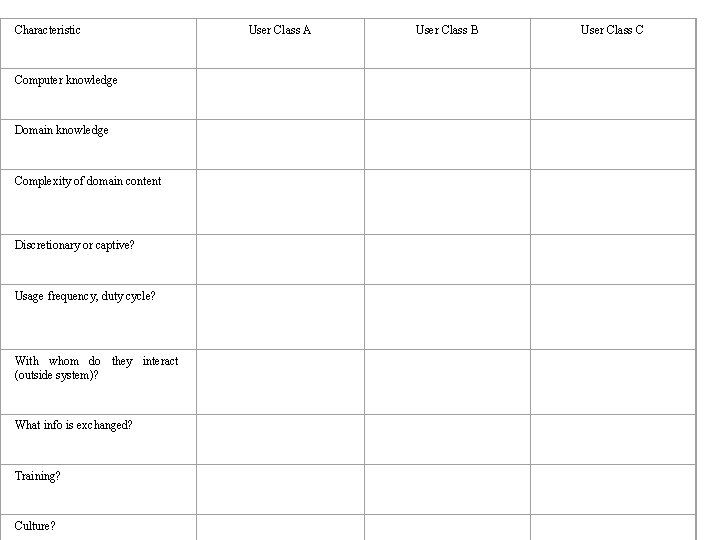
User Analysis User Class Characterization • • Set of users with similar characteristics and needs e. g. job description, location, level of responsibility, computer literacy, application domain knowledge Answer following questions for each class: What is knowledge of computer technology What is knowledge of application domain How complex is application content? Are users discretionary or captive? Frequency of usage, duty cycle With whom do users interact What are training needs What is user culture How receptive/resistant to product are users?
Characteristic Computer knowledge Domain knowledge Complexity of domain content Discretionary or captive? Usage frequency, duty cycle? With whom do they interact (outside system)? What info is exchanged? Training? Culture? User Class A User Class B User Class C
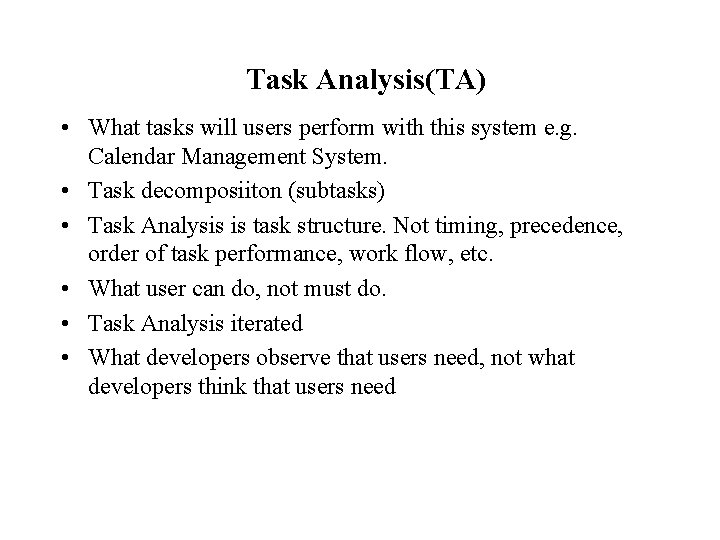
Task Analysis(TA) • What tasks will users perform with this system e. g. Calendar Management System. • Task decomposiiton (subtasks) • Task Analysis is task structure. Not timing, precedence, order of task performance, work flow, etc. • What user can do, not must do. • Task Analysis iterated • What developers observe that users need, not what developers think that users need
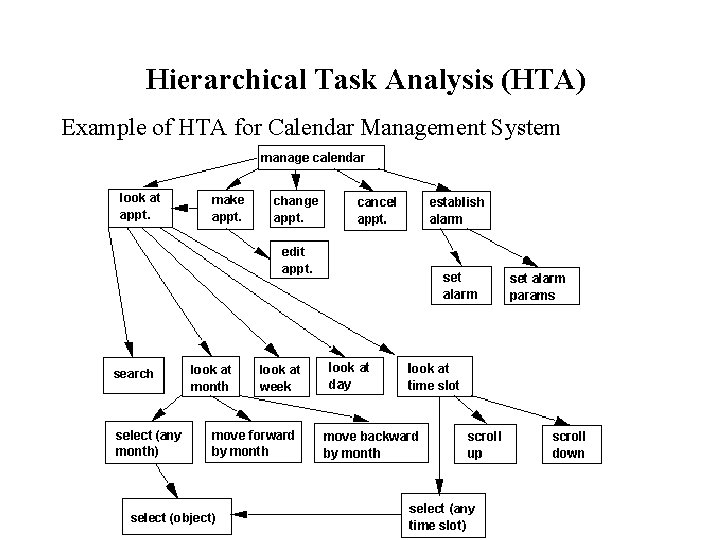
Hierarchical Task Analysis (HTA) Example of HTA for Calendar Management System
Usage Scenario • Scenarios are characterizations of users and their tasks in a specified context. They offer concrete representations of a user working with a computer system in order to achieve a particular goal. • Reading: RESPECT 5. 3 Handbook, Part C: 4. User Requirements Methods Usage Scenarios: http: //courses. cs. vt. edu/%7 Ecs 3724/fall 2000/notes/design/ design. htm