
USE YOUR TEXTBOOKS AS A SUCCESS TOOL Reading
USE YOUR TEXTBOOKS AS A SUCCESS TOOL Reading Effectively for Academic Success Student Success Programs Student. Success@pittstate. edu

“With hocked gems financing him, he defied all scornful laughter that tried to prevent his scheme. ‘Your eyes deceive, ’ they said. ‘It is like a table, not an egg. ’ Now three sturdy sisters sought truth. As they forged along, sometimes through calm vastness, yet more often over turbulent peaks and valleys, their days became weeks as many doubters spread fearful rumors about the edge. At last, from nowhere winged creatures appeared, signifying the journey’s end. ”
Textbooks � Sound familiar? � “The teacher assigned readings from the text, but those aren’t really important. I can get all I need from the course lecture. ” The instructor expects that students will read the assigned text before class and lectures.
Textbooks � “I bought a textbook and actually tried to read it a few times, but I fell asleep, got bored, didn’t understand, etc…” It’s possible to approach reading your textbooks in a way that is engaging, purposeful and will likely increase your success in courses.
Textbooks “I don’t have time to go to class, complete homework, go to work, have a social life and read all of the textbook assignments. ” You’re right, you probably don’t have time to do it all, unless you find ways to do it smarter. If you approach your reading assignments with a plan and a few useful tips, you’ll cut the time required to read the assignment and increase what you get out of texts.
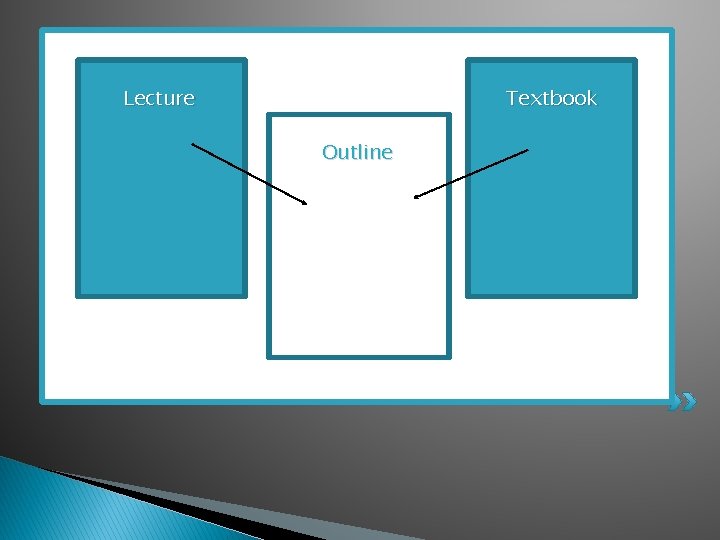
Lecture Textbook Outline
Do you know how to read? Types of Reading Focus: While You Read Turn Textbook & Lecture Notes Into Your Study Guide
Types of Reading furnishes the mind only with materials of knowledge; it is thinking that makes what we read ours. ~John Locke “It's good to know how to read, but it's dangerous to know how to read and not how to interpret what you're reading. ” ~Mike Tyson
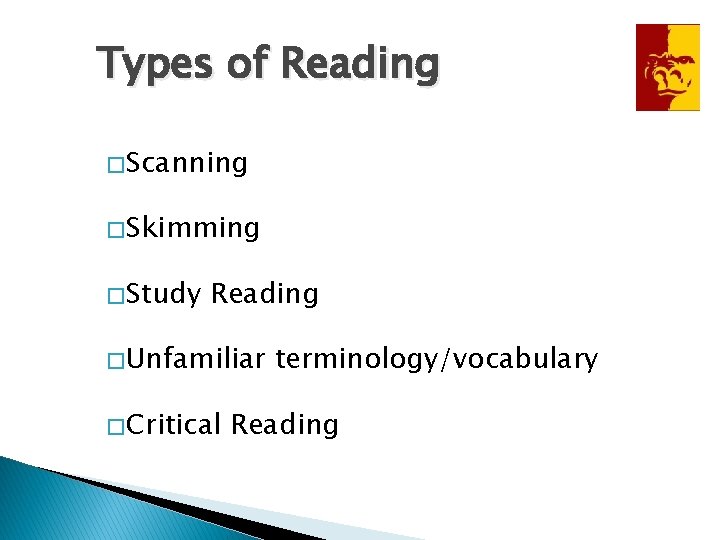
Types of Reading � Scanning � Skimming � Study Reading � Unfamiliar � Critical terminology/vocabulary Reading
Types of Reading � Scanning ◦ Looking for a specific piece of information ◦ You know what you’re looking for �Eyes move quickly or scan over the reading material � Use when you’ve already read the chapter or material and are revisiting it to study or reference for an assignment
Types of Reading � Skimming ◦ For a general idea of what you’re reading �When you have to read a large amount in a short time � 5 -10 minutes to familiarize yourself with the text �Find the main ideas in each paragraph or section �Ignore the details in the supporting sentences � Use when you’re pre-reading the chapter or revisiting the chapter for review
Terminology/Vocabulary � When scanning or skimming the text, look for any new words that appear repeatedly �Look for them in the glossary of your text (if available) and/or a dictionary �Note a quick definition for each term and adjust them as you read if necessary �Note a synonym or two ◦ Sound out the word ◦ Structure: Prefixes & suffixes ◦ Context: how it is used in the sentence or paragraph ◦ Confirm: check context, definition and synonyms to make sure you have a clear understanding of the new term �Check with your professor to confirm meaning
Types of Reading � Study Reading ◦ To read difficult material with a high level of comprehension �Slower rate of reading �Challenge to understand the material �May have to read sections more than once �Reading aloud is helpful �Read with a dictionary available � When you have pre-read the material and are now digging in for comprehension and learning.
Types of Reading �Critical Reading ◦ You’ve learned the material by pre-reading and study reading, and now you need to process and analyze the information ◦ When you need to write a review, summary or another type of assignment asking for analysis or opinion ◦ When studying for a test with essay questions
Types of Reading � Critical Reading (cont) ◦ To make judgments about how a text is argued ◦ To interpret or develop an interpretation �Reflective �Reading for ways of thinking about the subject ◦ How is the evidence (facts, examples, etc…) used and interpreted? ◦ How does the text reach its conclusions?
Types of Reading � Critical Reading (cont) ◦ What is the central claim or thesis? ◦ What audience is the text written for? �Historical context ◦ What kind of reasoning is used? �Concepts, theories, methods �How is the information broken down (analyzed) by the author? �Be aware: different disciplines (subject areas) will have different ways of arguing
Types of Reading �Critical Reading (cont) ◦ Examine the evidence �Supporting facts, examples �What counts as evidence: statistics, history, literature �What sources are used for evidence: primary or secondary
Types of Reading ◦ Evaluation �When you’re asked to determine the strength or weakness of an argument �Could it be argued differently �Gap in the argument �Evidence interpreted differently �Strong or weak conclusions �Opposing argument(s)
Focus: While You Read “A good plan is like a road map: it shows the final destination and usually the best way to get there. ” ~H. Stanley Judd
Focus Survey: Textbook Reconnaissance ◦ Read all bold-face subtitles ◦ Look at maps, diagrams, charts, graphs, tables, photos, captions: anything that displays information visually ◦ Read colored inserts within text
Focus Survey: Textbook Reconnaissance (cont) ◦ Read chapter summary: often at the beginning or end of each chapter ◦ Read chapter summary questions: often at the beginning or end of each chapter �Use the summary questions to create a basic outline for your notes Read with a goal in mind: mind Helps you focus, stay engaged and concentrate on the text.
Focus • Read With A Purpose: Turn Your Notes Into Your Study Guide • Use the summary questions to create a basic outline for your notes • Convert titles, subtitles, etc. into questions • Convert the underlined or highlighted main ideas in each section into an outline for your notes • If the chapter is long, take it section by section
Focus • Question: question as you Survey • For each section in the chapter, ask yourself 4 basic questions • What is the main point or idea? • What evidence/information supports the main point? • What are the applications or examples? • How is this related to the rest of the chapter, the book, the class, the world, to me? • Answer these questions in your own words.
Focus �Recite: talk to yourself ◦ Create a summary of the entire chapter when finished by compiling the section notes ◦ Read questions, answers & notes out loud ◦ Key ideas & new terms in your own words �If it seems unclear when you hear yourself speak it, you need to get more info, ask questions or listen for further info during the in-class lecture
Reading the Text � Review: re-read your notes ◦ Within 24 hrs �a week later �once a month ◦ Frequent review = better retention & less study time �Short, spaced review of your Textbook & Lecture Notes � Repetition: the 4 th ‘R’
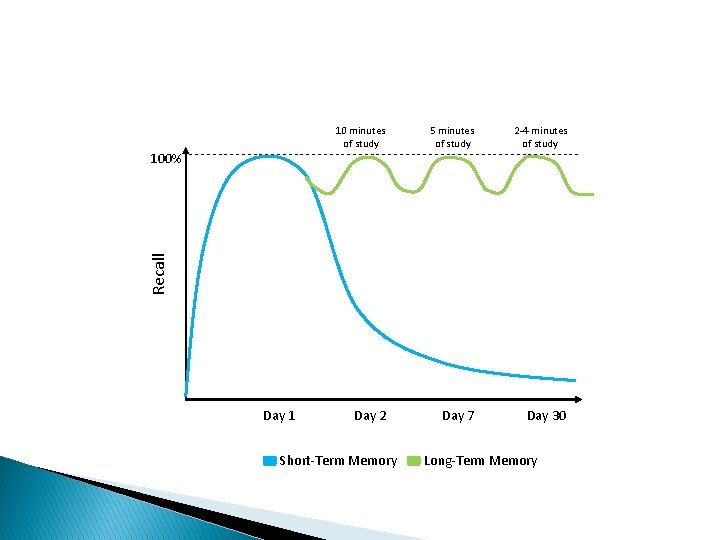
Recall 100% 10 minutes 5 minutes 2 -4 minutes of study ---------------------------------- Day 1 Day 2 Short-Term Memory Day 7 Day 30 Long-Term Memory
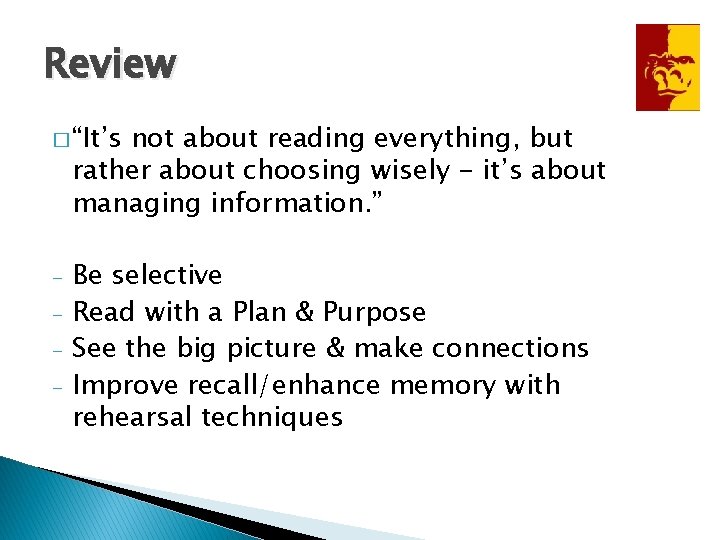
Review � “It’s not about reading everything, but rather about choosing wisely - it’s about managing information. ” - Be selective Read with a Plan & Purpose See the big picture & make connections Improve recall/enhance memory with rehearsal techniques
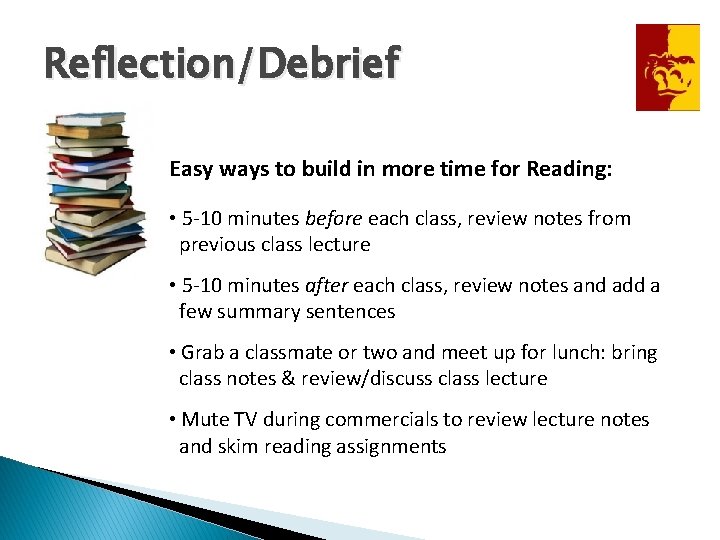
Reflection/Debrief Easy ways to build in more time for Reading: • 5 -10 minutes before each class, review notes from previous class lecture • 5 -10 minutes after each class, review notes and add a few summary sentences • Grab a classmate or two and meet up for lunch: bring class notes & review/discuss class lecture • Mute TV during commercials to review lecture notes and skim reading assignments
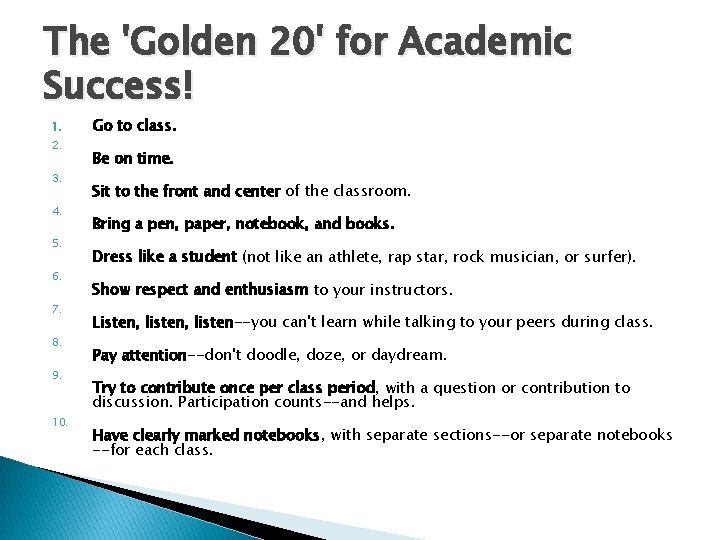
The 'Golden 20' for Academic Success! 1. 2. 3. 4. 5. 6. 7. 8. 9. 10. Go to class. Be on time. Sit to the front and center of the classroom. Bring a pen, paper, notebook, and books. Dress like a student (not like an athlete, rap star, rock musician, or surfer). Show respect and enthusiasm to your instructors. Listen, listen--you can't learn while talking to your peers during class. Pay attention--don't doodle, doze, or daydream. Try to contribute once per class period, with a question or contribution to discussion. Participation counts--and helps. Have clearly marked notebooks, with separate sections--or separate notebooks --for each class.
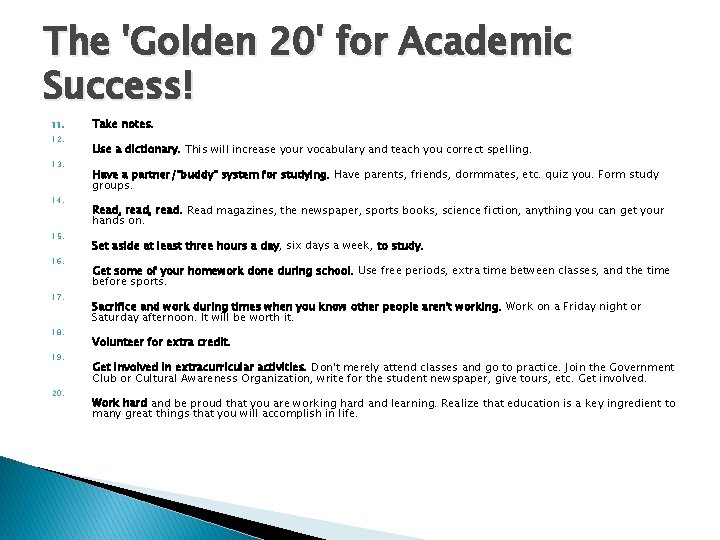
The 'Golden 20' for Academic Success! 11. 12. 13. 14. 15. 16. 17. 18. 19. 20. Take notes. Use a dictionary. This will increase your vocabulary and teach you correct spelling. Have a partner/"buddy" system for studying. Have parents, friends, dormmates, etc. quiz you. Form study groups. Read, read. Read magazines, the newspaper, sports books, science fiction, anything you can get your hands on. Set aside at least three hours a day, six days a week, to study. Get some of your homework done during school. Use free periods, extra time between classes, and the time before sports. Sacrifice and work during times when you know other people aren't working. Work on a Friday night or Saturday afternoon. It will be worth it. Volunteer for extra credit. Get involved in extracurricular activities. Don't merely attend classes and go to practice. Join the Government Club or Cultural Awareness Organization, write for the student newspaper, give tours, etc. Get involved. Work hard and be proud that you are working hard and learning. Realize that education is a key ingredient to many great things that you will accomplish in life.
Questions…? Follow us on Social Media: Facebook: PSU Student Success Center Instagram & Twitter: @psusuccess
References � � � Academic Resource Center, Sweet Briar College, VA. (accessed October 2010). Reading Methods: SQ 3 R. Retrieved from http: //www. arc. sbc. edu/sq 3 r. html. Academic Skills Program, University of Canberra, Australia. (accessed October 2010). Reading and Remembering. Retrieved from http: //www. canberra. edu. au/studyskills/learning/reading. Academic Tips. org. “The Golden 20 for Academic Success. ” Retrieved from http: //academictips. org/academic_success. html on January 29, 2013. Ellis, D. (1997). Becoming A Master Student(8 th ed. ). Boston, MA: Houghton Mifflin Company. (pgs 69 -89). Heiman, M. , & Slomianko, J. (2004). Learning to Learn(10 th ed. ). Somerville, MA: Learning to Learn, Inc. (pgs 102 -110). Landsberger, Joe. (accessed October 2010). Study Guides and Strategies. Retrieved from http: //www. studygs. net/crtread. htm.
References � � � Academic Resource Center, Sweet Briar College, VA. (accessed October 2010). Reading Methods: SQ 3 R. Retrieved from http: //www. arc. sbc. edu/sq 3 r. html. Academic Skills Program, University of Canberra, Australia. (accessed October 2010). Reading and Remembering. Retrieved from http: //www. canberra. edu. au/studyskills/learning/reading. Ellis, D. (1997). Becoming A Master Student(8 th ed. ). Boston, MA: Houghton Mifflin Company. (pgs 69 -89). Heiman, M. , & Slomianko, J. (2004). Learning to Learn(10 th ed. ). Somerville, MA: Learning to Learn, Inc. (pgs 102 -110). Landsberger, Joe. (accessed October 2010). Study Guides and Strategies. Retrieved from http: //www. studygs. net/crtread. htm.
USE YOUR TEXTBOOKS AS A SUCCESS TOOL Reading Effectively for Academic Success Student Success Programs Student. Success@pittstate. edu
- Slides: 34