
Use to infinitive After question words who what
![Make, let • make [someone] do something • let [someone] do something The teacher](https://slidetodoc.com/presentation_image_h2/1e00e5dd8f2aaa0feb0df1619fc37e87/image-15.jpg "Make, let • make [someone] do something • let [someone] do something The teacher")
- Slides: 15
Use to + infinitive • After question words (who, what, when, where, why, how): I didn’t know what to do next. He always knows where to go to have a good time.
Use to + infinitive • When you want to express a reason for something (infinitive of purpose): I went to the supermarket to buy some food. I visited my friends to have a good time.
Use to + infinitive • After adjectives: This recipe is difficult to make. English is very easy to learn.
Use to + infinitive • After some verbs: • Can’t afford, agree, decide, expect, forget, help, hope, learn, need, offer, plan, pretend, promise, refuse, remember*, seem, try*, want, would like (see SB p. 138)
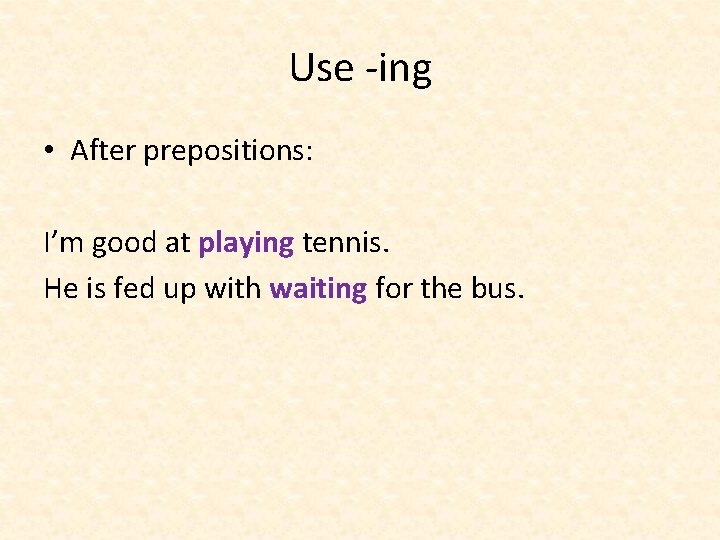
Use -ing • After prepositions: I’m good at playing tennis. He is fed up with waiting for the bus.
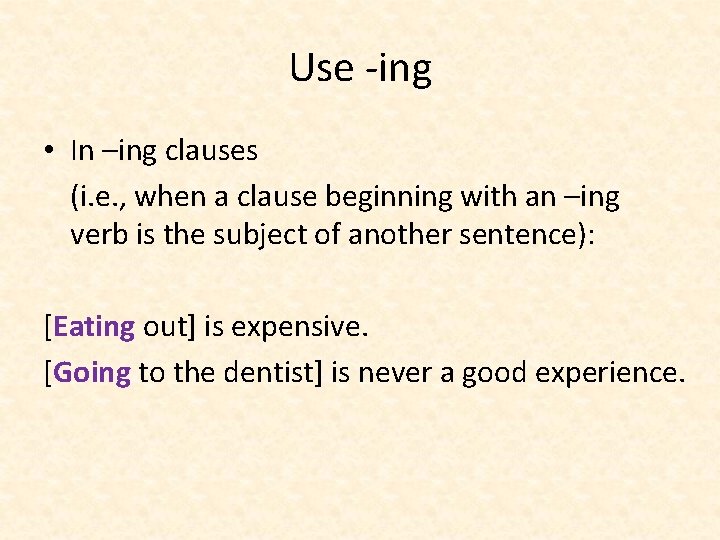
Use -ing • In –ing clauses (i. e. , when a clause beginning with an –ing verb is the subject of another sentence): [Eating out] is expensive. [Going to the dentist] is never a good experience.
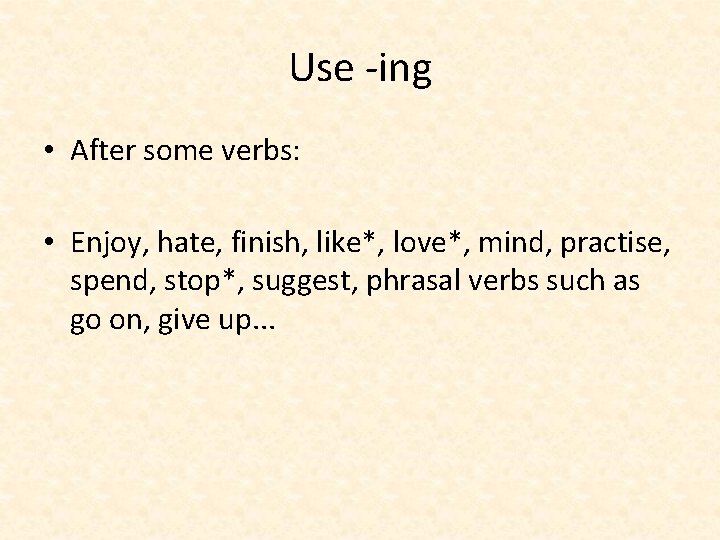
Use -ing • After some verbs: • Enjoy, hate, finish, like*, love*, mind, practise, spend, stop*, suggest, phrasal verbs such as go on, give up. . .
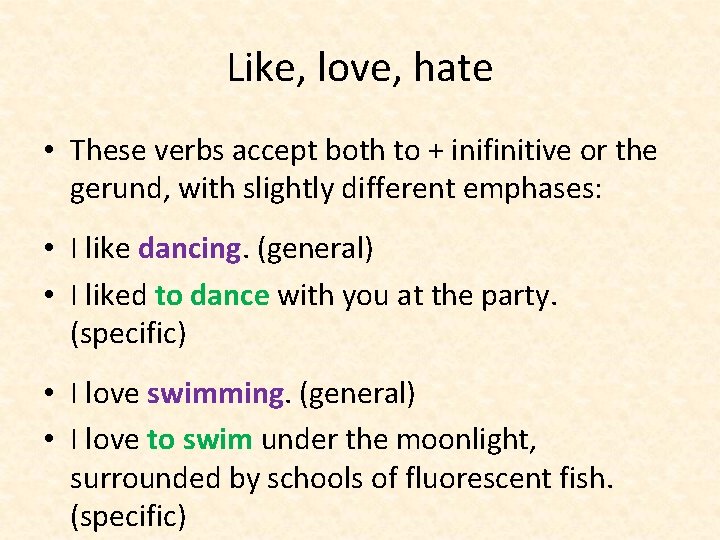
Like, love, hate • These verbs accept both to + inifinitive or the gerund, with slightly different emphases: • I like dancing. (general) • I liked to dance with you at the party. (specific) • I love swimming. (general) • I love to swim under the moonlight, surrounded by schools of fluorescent fish. (specific)
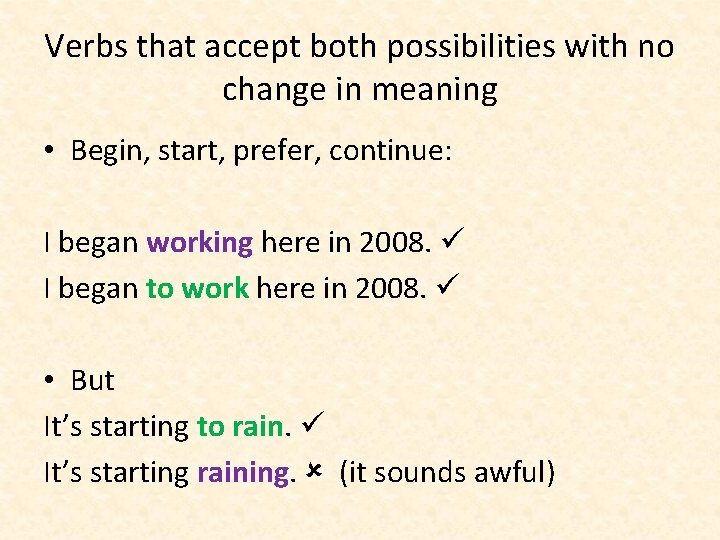
Verbs that accept both possibilities with no change in meaning • Begin, start, prefer, continue: I began working here in 2008. I began to work here in 2008. • But It’s starting to rain. It’s starting raining. (it sounds awful)
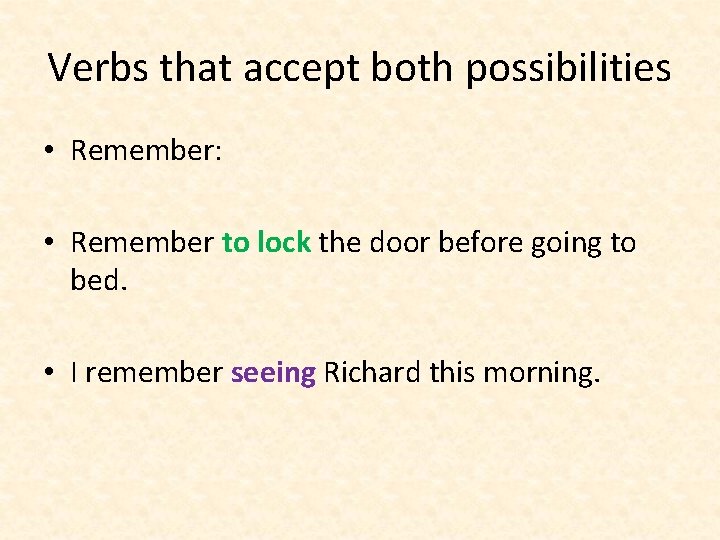
Verbs that accept both possibilities • Remember: • Remember to lock the door before going to bed. • I remember seeing Richard this morning.
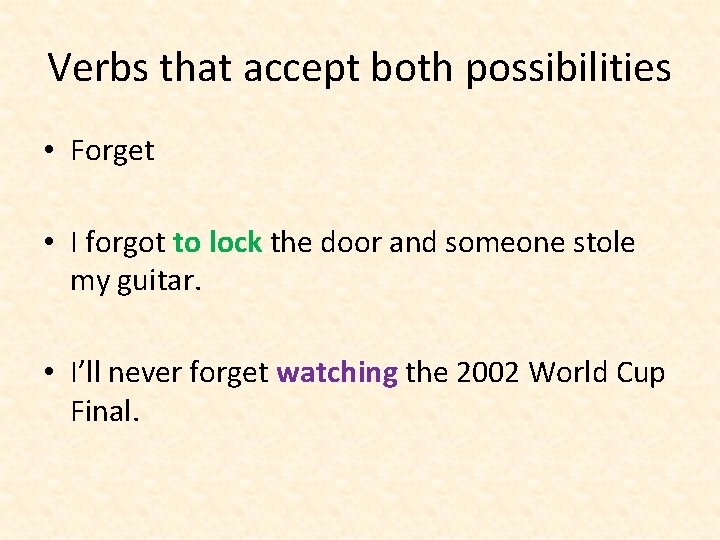
Verbs that accept both possibilities • Forget • I forgot to lock the door and someone stole my guitar. • I’ll never forget watching the 2002 World Cup Final.
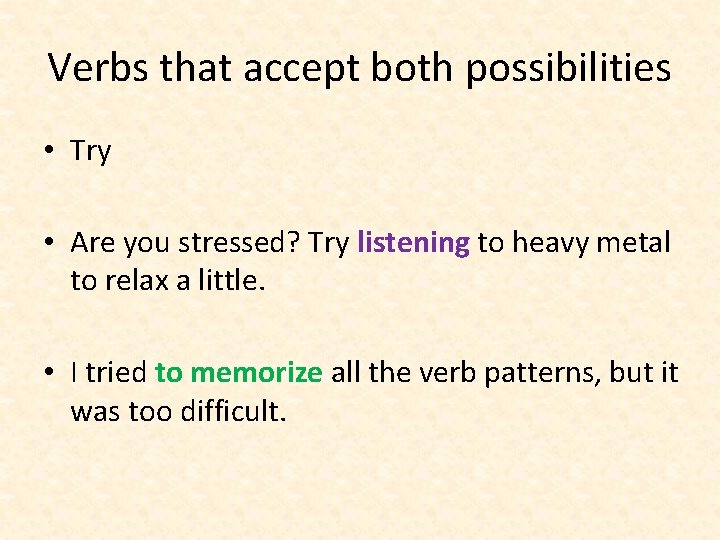
Verbs that accept both possibilities • Try • Are you stressed? Try listening to heavy metal to relax a little. • I tried to memorize all the verb patterns, but it was too difficult.
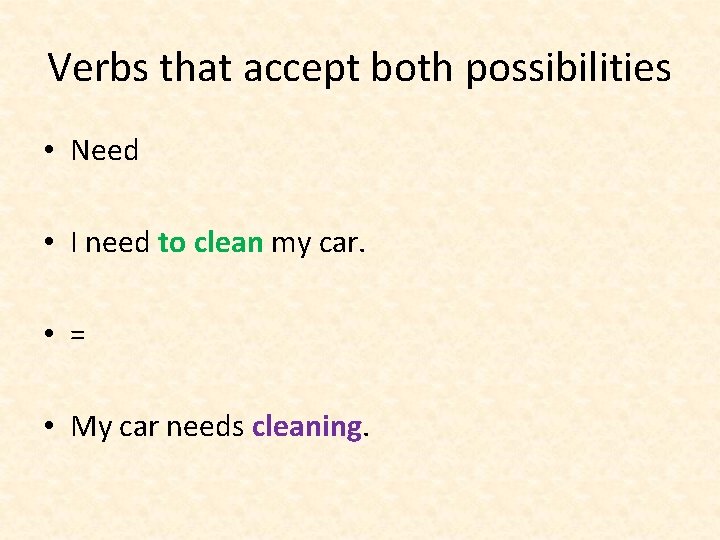
Verbs that accept both possibilities • Need • I need to clean my car. • = • My car needs cleaning.
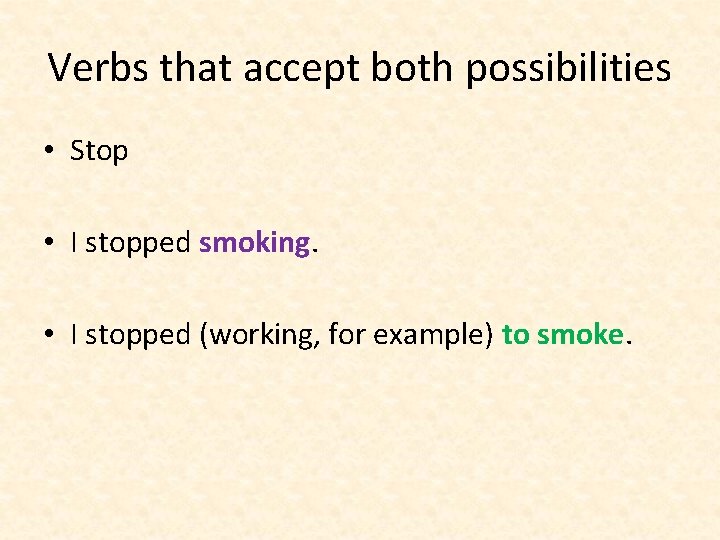
Verbs that accept both possibilities • Stop • I stopped smoking. • I stopped (working, for example) to smoke.
Make, let • make [someone] do something • let [someone] do something The teacher made us memorize a lot of verb patterns. My grandmother didn’t let me eat candy before meals.