
Use tables facts and place value to multiply
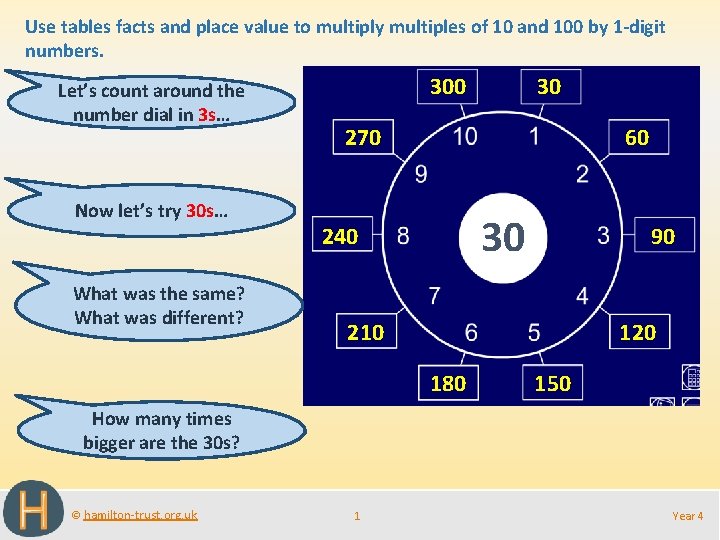
Use tables facts and place value to multiply multiples of 10 and 100 by 1 -digit numbers. Let’s count around the number dial in 3 s… Now let’s try 30 s… What was the same? What was different? 300 30 30 3 270 27 60 6 30 3 240 24 90 9 210 21 120 12 180 18 150 15 How many times bigger are the 30 s? © hamilton-trust. org. uk 1 Year 4
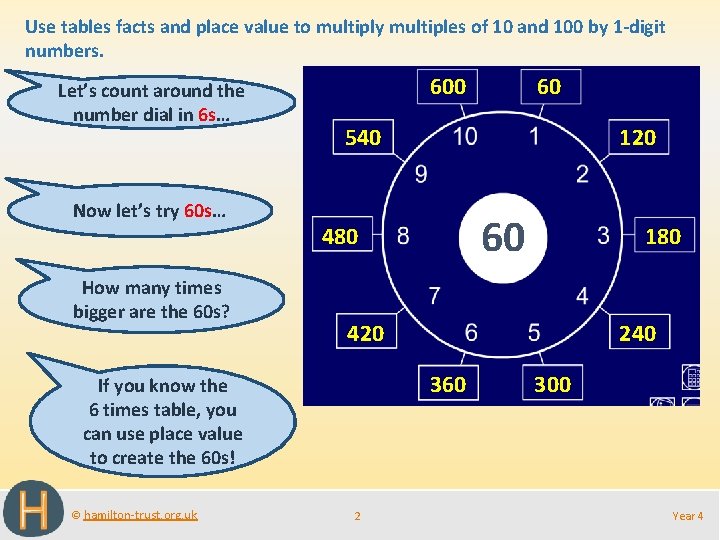
Use tables facts and place value to multiply multiples of 10 and 100 by 1 -digit numbers. Let’s count around the number dial in 6 s… Now let’s try 60 s… How many times bigger are the 60 s? 600 60 54 120 12 60 6 480 48 180 18 420 42 240 24 360 36 If you know the 6 times table, you can use place value to create the 60 s! © hamilton-trust. org. uk 60 6 2 300 30 Year 4
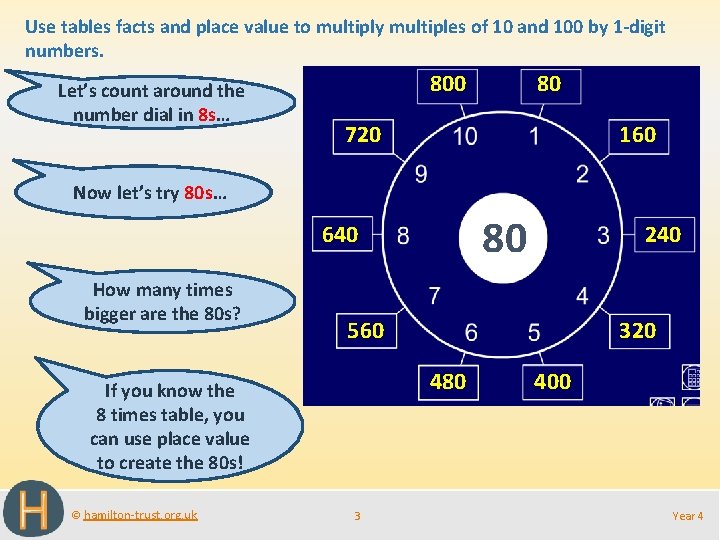
Use tables facts and place value to multiply multiples of 10 and 100 by 1 -digit numbers. Let’s count around the number dial in 8 s… 800 80 80 8 720 72 160 16 Now let’s try 80 s… 8 80 64 How many times bigger are the 80 s? 560 56 320 32 480 48 If you know the 8 times table, you can use place value to create the 80 s! © hamilton-trust. org. uk 240 24 3 400 40 Year 4
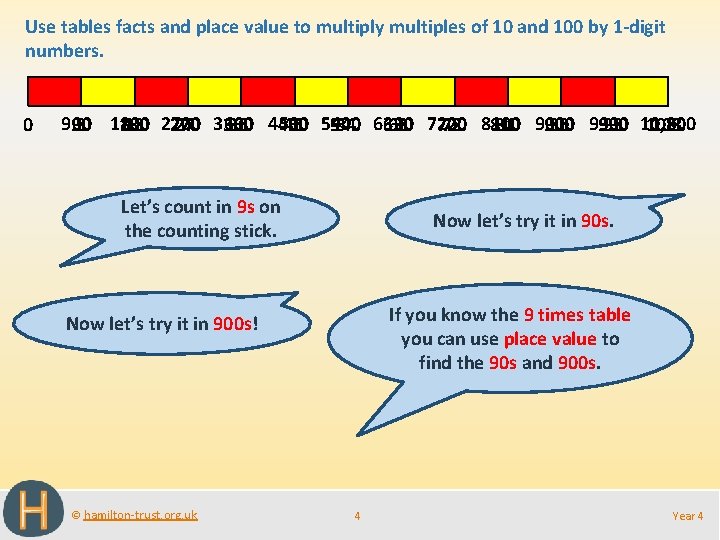
Use tables facts and place value to multiply multiples of 10 and 100 by 1 -digit numbers. 0 90 180 270 360 450 540 630 720 810 900 990 1080 9 1800 18 2700 27 3600 36 4500 45 5400 54 6300 63 7200 72 8100 81 9000 90 9900 99 10, 800 108 Let’s count in 9 s on the counting stick. Now let’s try it in 90 s. If you know the 9 times table you can use place value to find the 90 s and 900 s. Now let’s try it in 900 s! © hamilton-trust. org. uk 4 Year 4
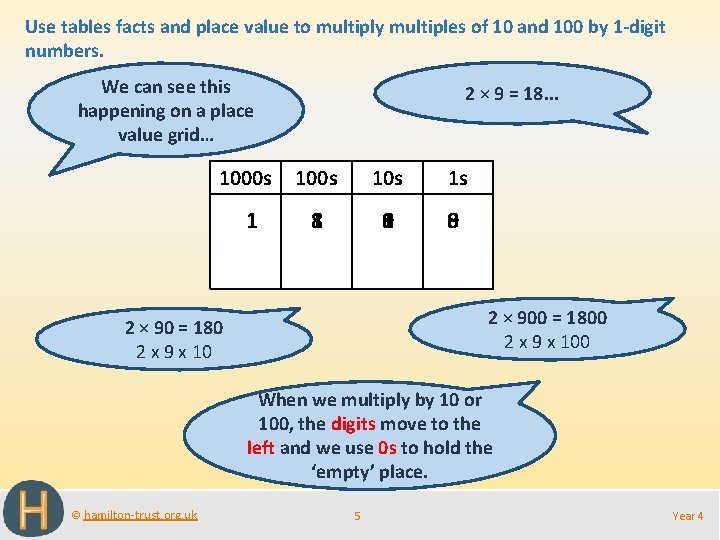
Use tables facts and place value to multiply multiples of 10 and 100 by 1 -digit numbers. We can see this happening on a place value grid… 2 × 9 = 18. . . 1000 s 10 s 1 s 1 1 8 0 8 0 2 × 900 = 1800 2 x 9 x 100 2 × 90 = 180 2 x 9 x 10 When we multiply by 10 or 100, the digits move to the left and we use 0 s to hold the ‘empty’ place. © hamilton-trust. org. uk 5 Year 4
- Slides: 5