
Use Properties of Parallelograms A CONSTRUCTION In suppose

- Slides: 24
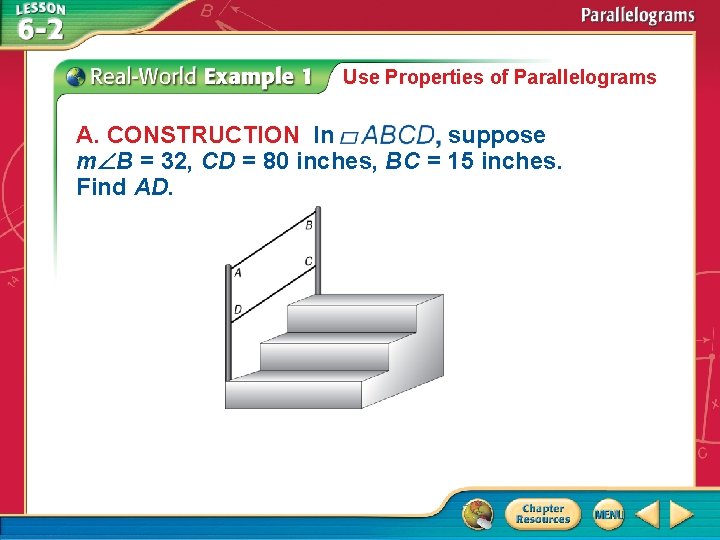
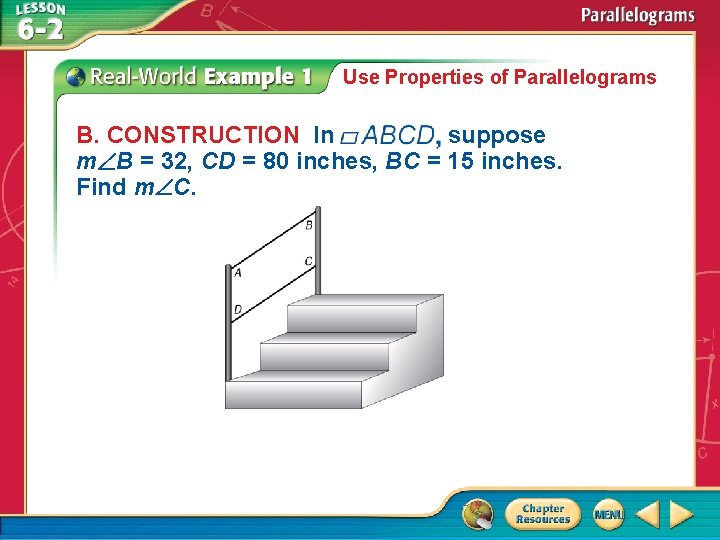
Use Properties of Parallelograms A. CONSTRUCTION In suppose m B = 32, CD = 80 inches, BC = 15 inches. Find AD.
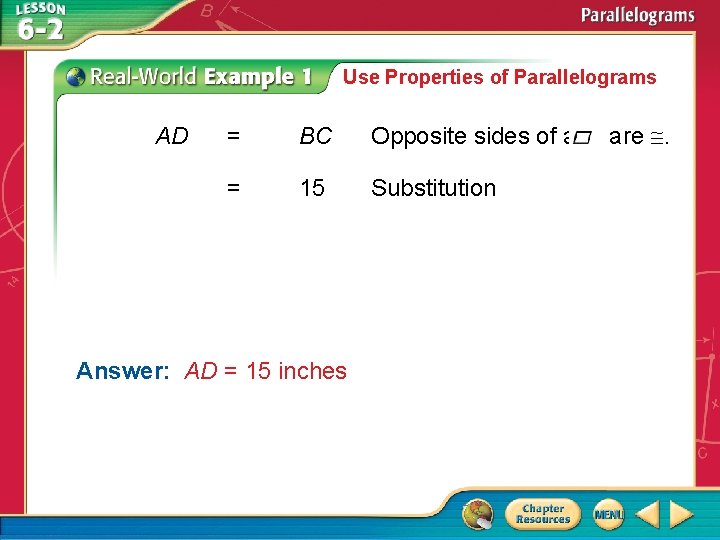
Use Properties of Parallelograms AD = BC Opposite sides of a = 15 Substitution Answer: AD = 15 inches are .
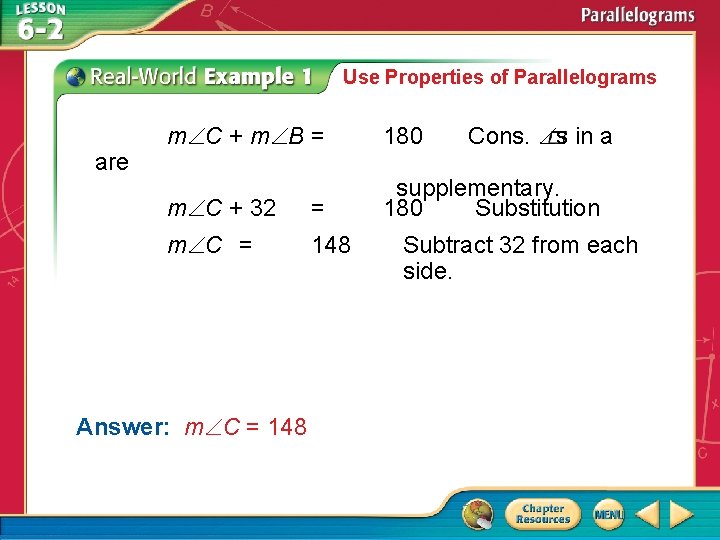
Use Properties of Parallelograms B. CONSTRUCTION In suppose m B = 32, CD = 80 inches, BC = 15 inches. Find m C.
Use Properties of Parallelograms are Cons. s in a m C + m B = 180 m C + 32 = supplementary. 180 Substitution m C = 148 Answer: m C = 148 Subtract 32 from each side.
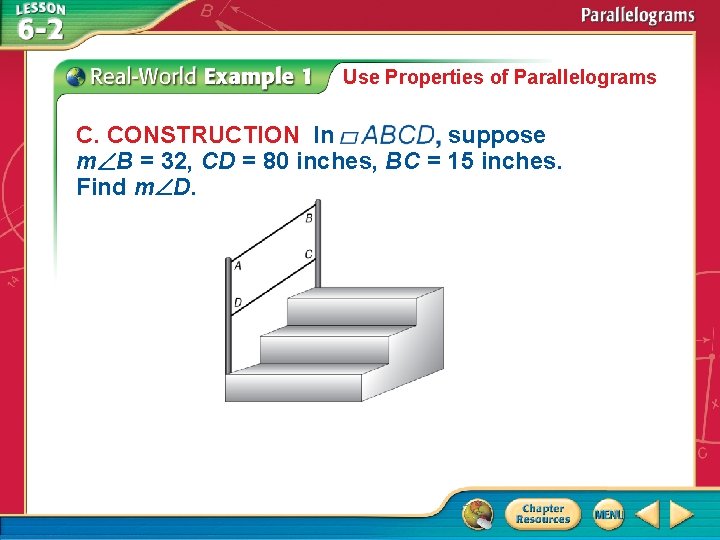
Use Properties of Parallelograms C. CONSTRUCTION In suppose m B = 32, CD = 80 inches, BC = 15 inches. Find m D.
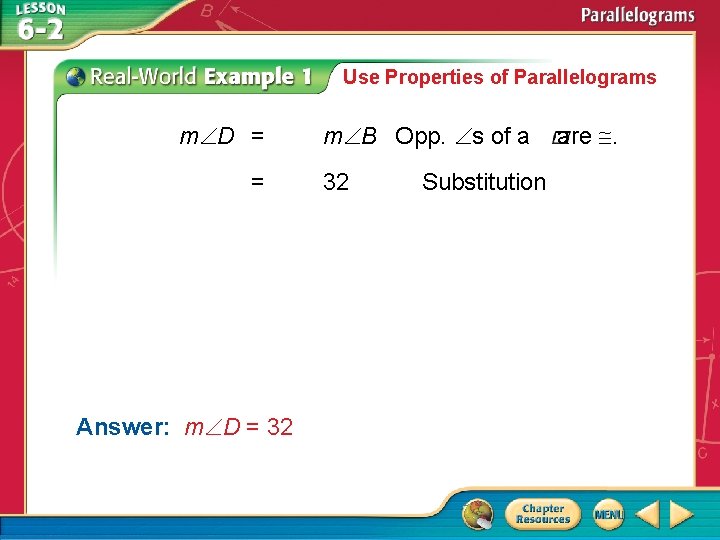
Use Properties of Parallelograms m D = = Answer: m D = 32 m B Opp. s of a 32 Substitution are .
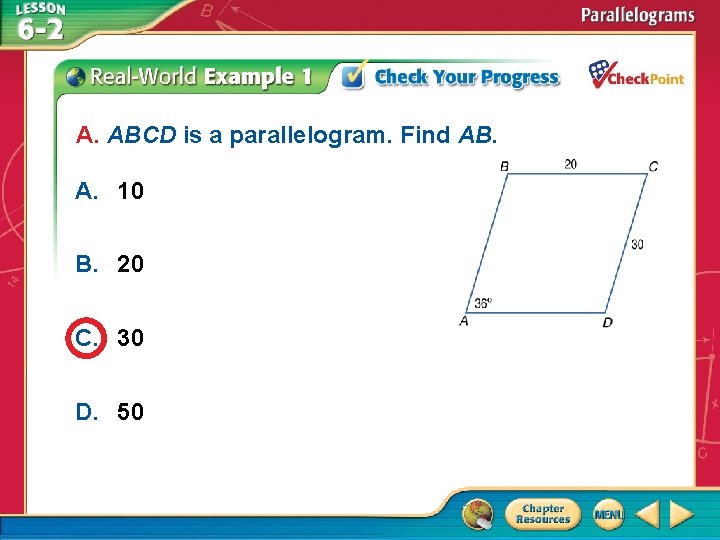
A. ABCD is a parallelogram. Find AB. A. 10 B. 20 C. 30 D. 50 A. B. C. D. A B C D
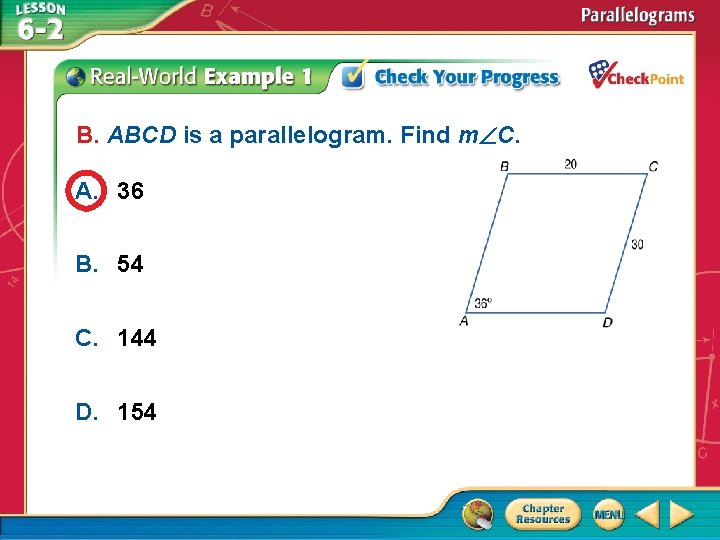
B. ABCD is a parallelogram. Find m C. A. 36 B. 54 C. 144 D. 154 A. B. C. D. A B C D
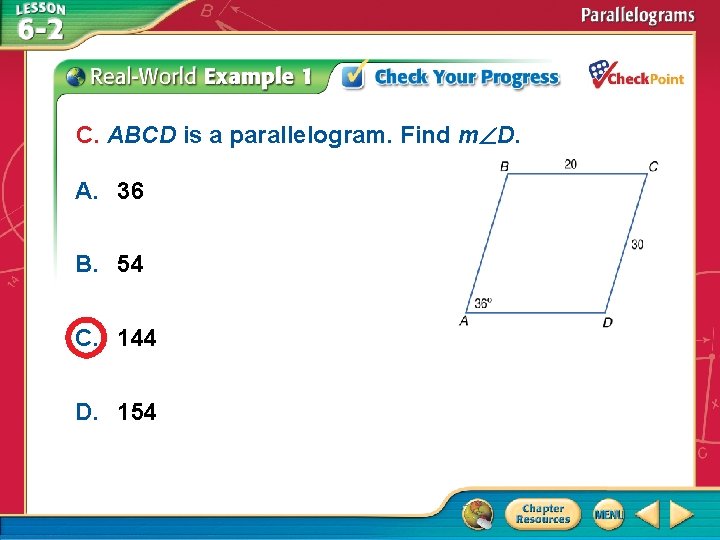
C. ABCD is a parallelogram. Find m D. A. 36 B. 54 C. 144 D. 154 A. B. C. D. A B C D
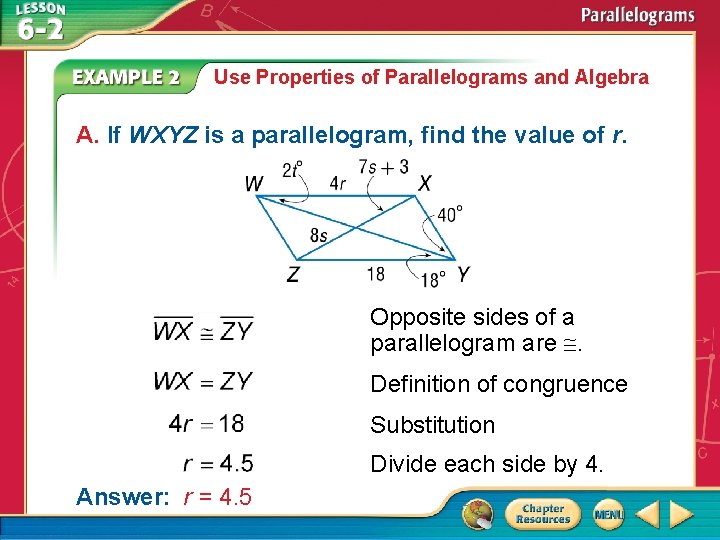
Use Properties of Parallelograms and Algebra A. If WXYZ is a parallelogram, find the value of r. Opposite sides of a parallelogram are . Definition of congruence Substitution Divide each side by 4. Answer: r = 4. 5
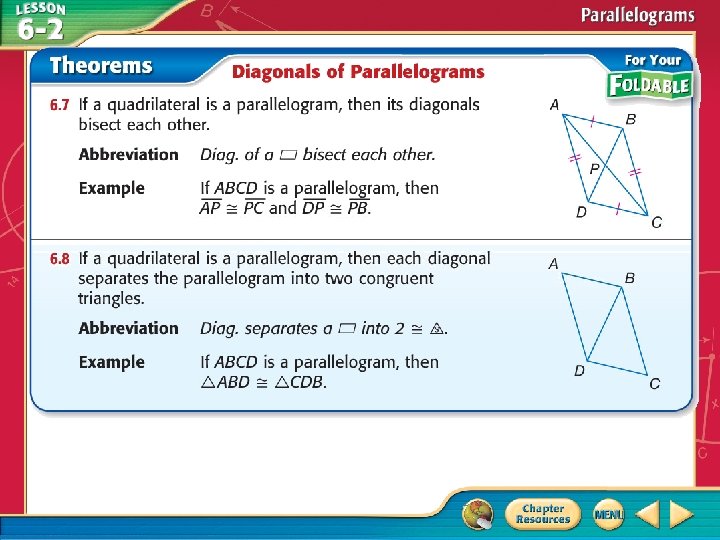
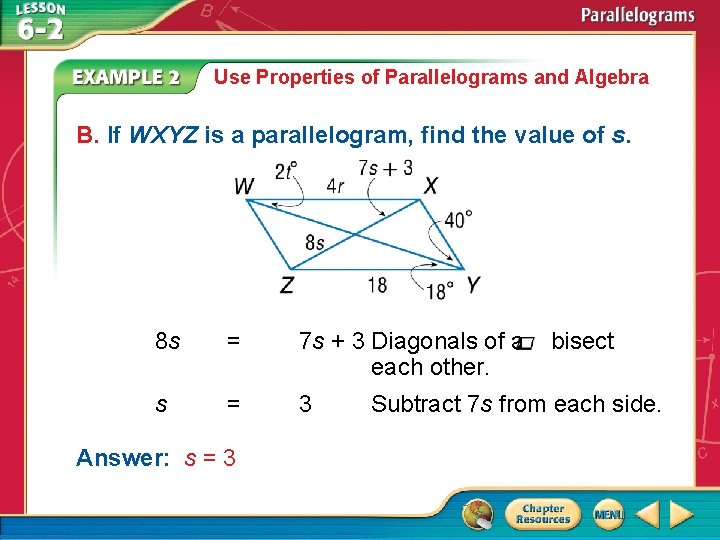
Use Properties of Parallelograms and Algebra B. If WXYZ is a parallelogram, find the value of s. 8 s = 7 s + 3 Diagonals of a each other. s = 3 Answer: s = 3 bisect Subtract 7 s from each side.
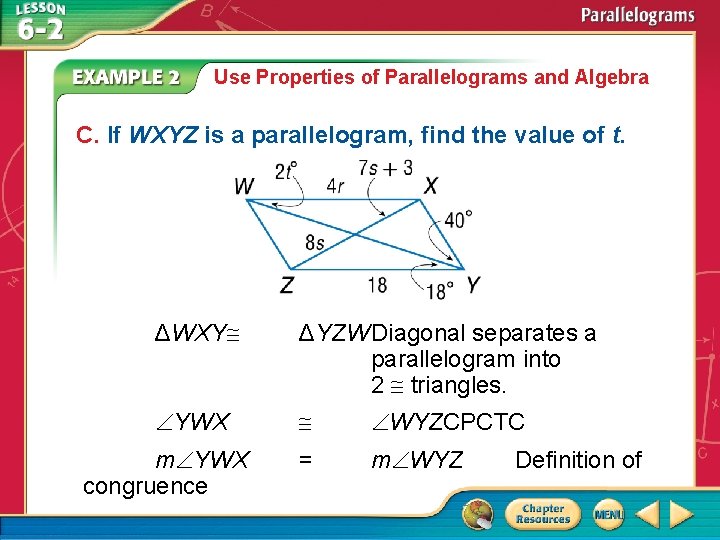
Use Properties of Parallelograms and Algebra C. If WXYZ is a parallelogram, find the value of t. ΔWXY ΔYZW Diagonal separates a parallelogram into 2 triangles. YWX WYZCPCTC = m WYZ m YWX congruence Definition of
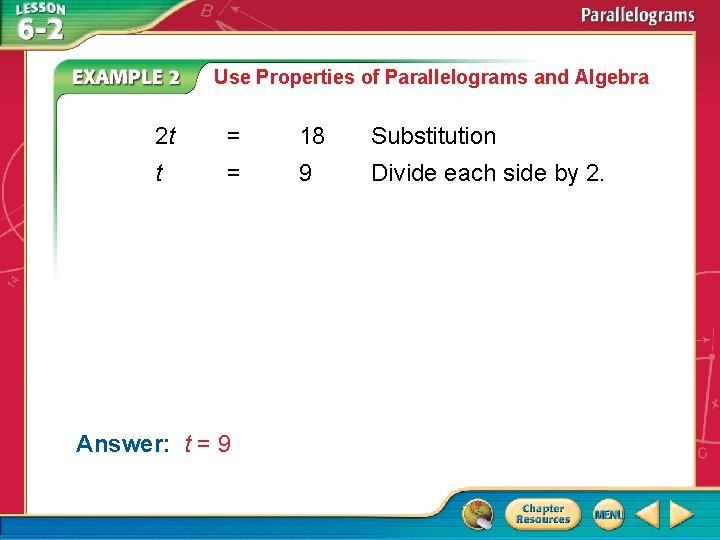
Use Properties of Parallelograms and Algebra 2 t = 18 Substitution t = 9 Divide each side by 2. Answer: t = 9
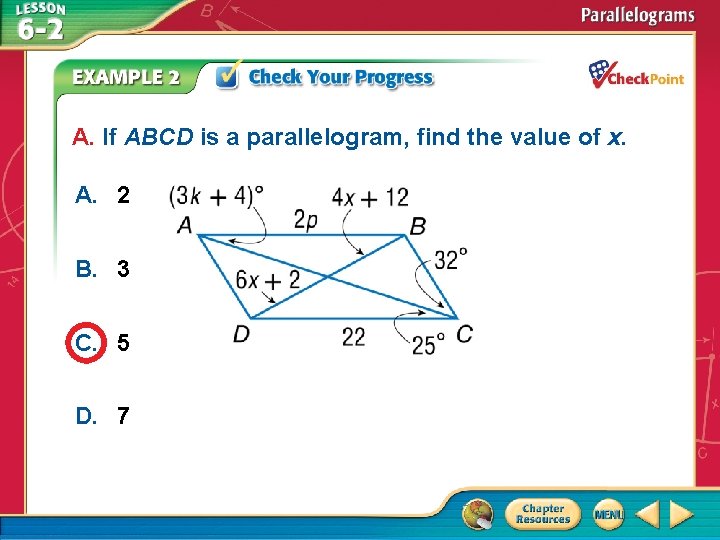
A. If ABCD is a parallelogram, find the value of x. A. 2 B. 3 C. 5 D. 7 A. B. C. D. A B C D
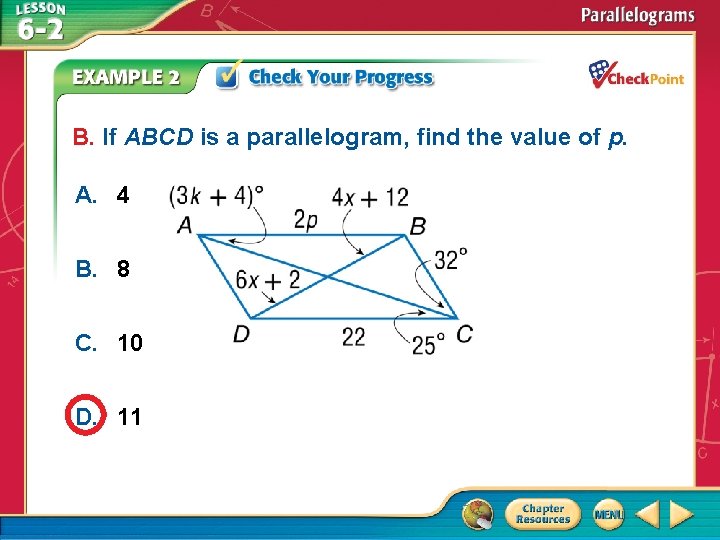
B. If ABCD is a parallelogram, find the value of p. A. 4 B. 8 C. 10 D. 11 A. B. C. D. A B C D
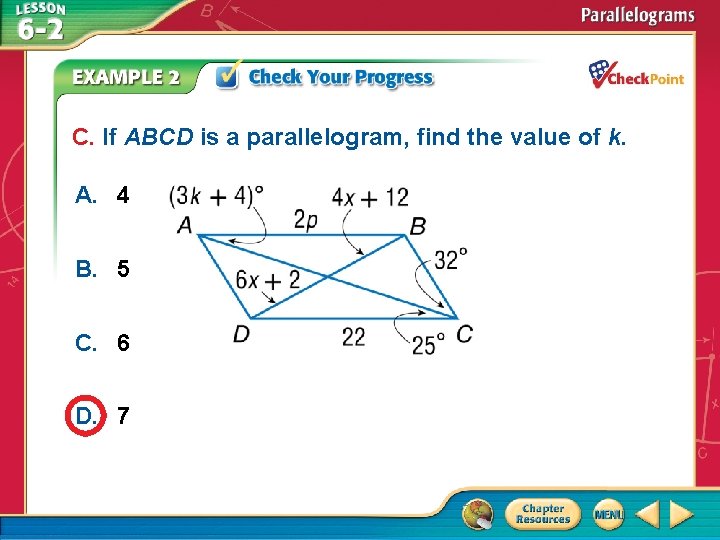
C. If ABCD is a parallelogram, find the value of k. A. 4 B. 5 C. 6 D. 7 A. B. C. D. A B C D
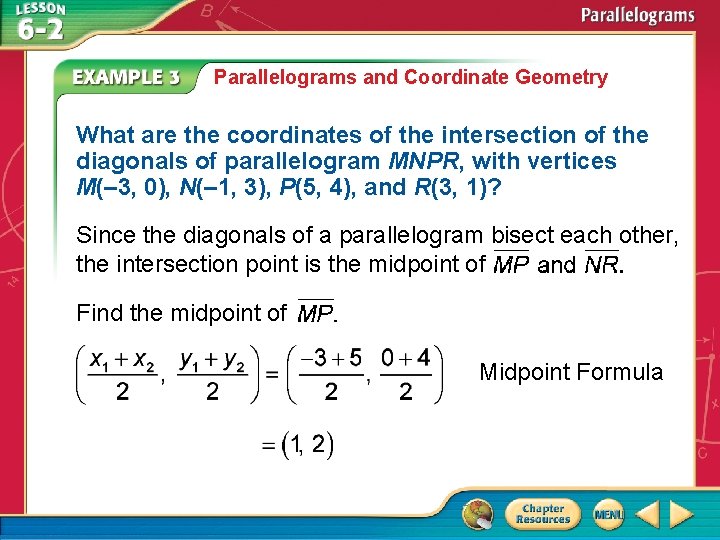
Parallelograms and Coordinate Geometry What are the coordinates of the intersection of the diagonals of parallelogram MNPR, with vertices M(– 3, 0), N(– 1, 3), P(5, 4), and R(3, 1)? Since the diagonals of a parallelogram bisect each other, the intersection point is the midpoint of Find the midpoint of Midpoint Formula
Parallelograms and Coordinate Geometry Answer: The coordinates of the intersection of the diagonals of parallelogram MNPR are (1, 2).
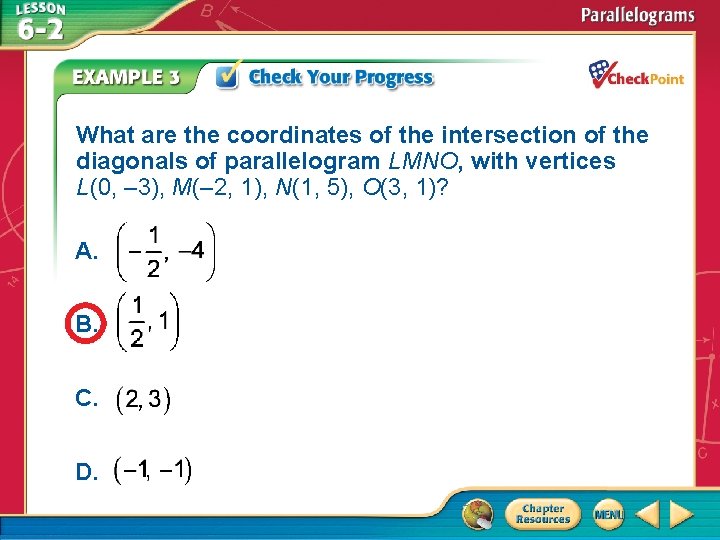
What are the coordinates of the intersection of the diagonals of parallelogram LMNO, with vertices L(0, – 3), M(– 2, 1), N(1, 5), O(3, 1)? A. B. C. D. A B C D
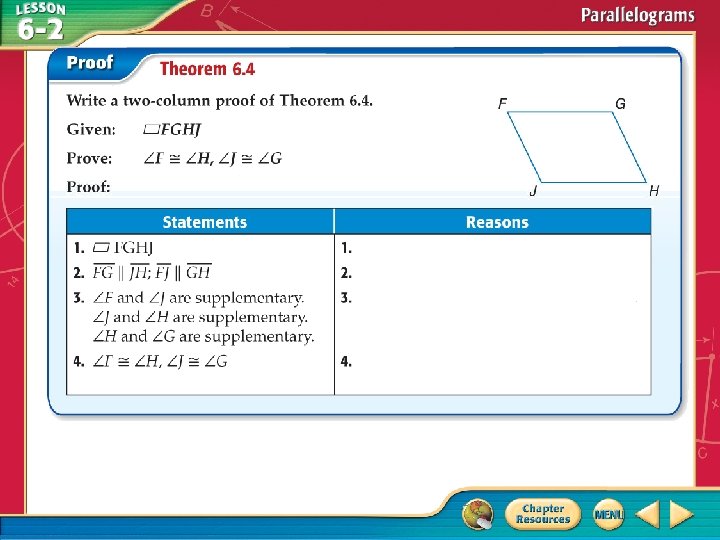
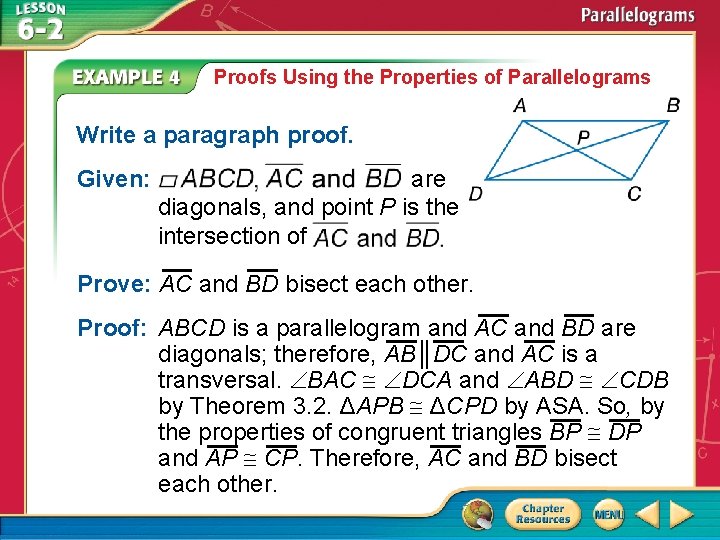
Proofs Using the Properties of Parallelograms Write a paragraph proof. Given: are diagonals, and point P is the intersection of Prove: AC and BD bisect each other. Proof: ABCD is a parallelogram and AC and BD are diagonals; therefore, AB║DC and AC is a transversal. BAC DCA and ABD CDB by Theorem 3. 2. ΔAPB ΔCPD by ASA. So, by the properties of congruent triangles BP DP and AP CP. Therefore, AC and BD bisect each other.
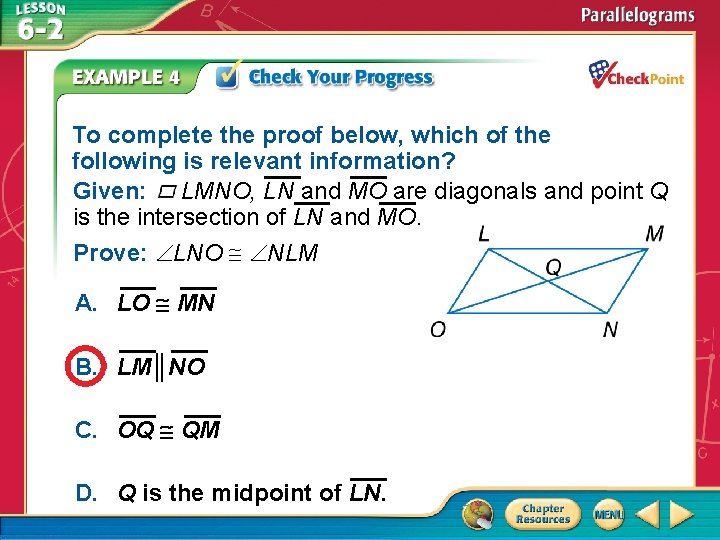
To complete the proof below, which of the following is relevant information? Given: LMNO, LN and MO are diagonals and point Q is the intersection of LN and MO. Prove: LNO NLM A. LO MN B. LM║NO C. OQ QM D. Q is the midpoint of LN. A. B. C. D. A B C D