
Use of WARP to Design a Monitoring Program
- Slides: 18
Use of WARP to Design a Monitoring Program to Identify Waters Potentially at Risk from Pesticides Nelson Thurman, U. S. Environmental Protection Agency Office of Pesticide Programs (OPP) National Water Quality Monitoring Conference 1/3/2022 San Jose, CA, May 12, 2006 1
Case Study: Atrazine Risk Assessment l Atrazine is a persistent, mobile herbicide with widespread use l In areas of high atrazine use § Potential adverse effects on sensitive aquatic populations and communities § Potential effects greatest where concentrations recurrently or consistently exceed 10 to 20 ug/L l 2 Concern is not a single endpoint, but magnitudeduration
Coordinated EPA Review of Atrazine l EPA Office of Water aquatic life criteria and Office of Pesticide Programs level of concern for aquatic organisms: § OW: http: //www. epa. gov/waterscience/criteria/atrazine/ § OPP: http: //www. epa. gov/oppsrrd 1/reregistration/atrazine/ l 3 The monitoring plan to evaluate ecological impacts was developed jointly to meet the needs of both programs
Goals for Monitoring Atrazine in Watersheds for Ecological Risk 4 l Identify an ecological level of concern, i. e. , magnitude and duration of exposure of aquatic plants to atrazine that potentially adversely affects aquatic communities and/or ecosystems. l Develop a tiered watershed monitoring & mitigation program that specifies the frequency, location, and timing of sampling + coordination w/TMDL programs and other watershed based remediation programs.
Monitoring Program Objectives l To WHAT EXTENT do waters exceed effects-based thresholds (primary productivity) for atrazine? § Fraction of watersheds have flowing water bodies exceeding the trigger with a specified level of confidence l WHERE are the waters that are exceeding effectsbased atrazine thresholds? § Use knowledge gained from the monitoring program to help identify additional watersheds of likely concern 5
Acknowledging the Work of Many… 6 l US EPA OPP: Jim Lin, Doug Urban, Mary Frankenberry, Stephanie Irene, Kevin Costello, Nelson Thurman l USEPA OW: Laura Gabanski, Ruth Chemrys, Susan Holdsworth, David Wells, Donald Brady l USEPA ORD: Russell Erickson, Tony Olsen, Naomi Detenbeck l Syngenta Crop Science: Paul Hendley, Peter Hertl, Juan Gonzalez-Valero, Alan Hosmer l Waterborne Environmental: Chris Harbourt
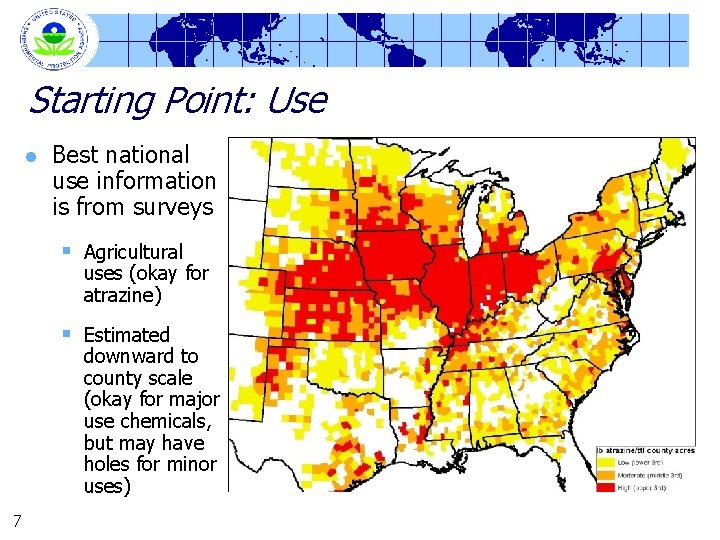
Starting Point: Use l 7 Best national use information is from surveys § Agricultural uses (okay for atrazine) § Estimated downward to county scale (okay for major use chemicals, but may have holes for minor uses)
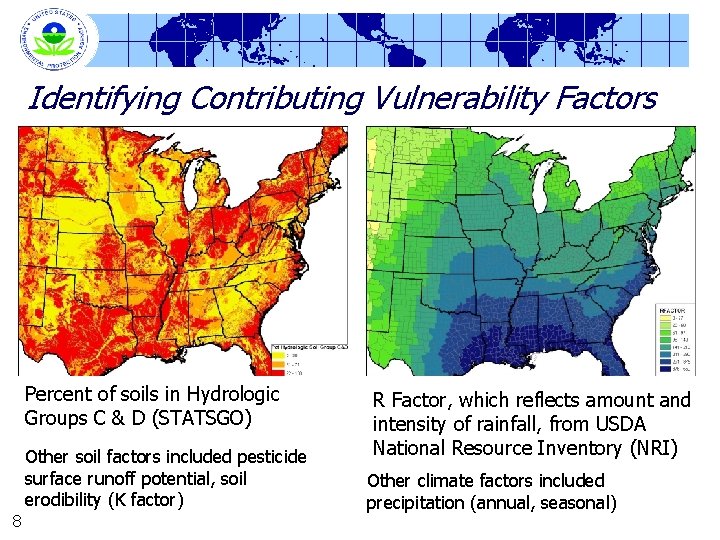
Identifying Contributing Vulnerability Factors Percent of soils in Hydrologic Groups C & D (STATSGO) Other soil factors included pesticide surface runoff potential, soil erodibility (K factor) 8 R Factor, which reflects amount and intensity of rainfall, from USDA National Resource Inventory (NRI) Other climate factors included precipitation (annual, seasonal)
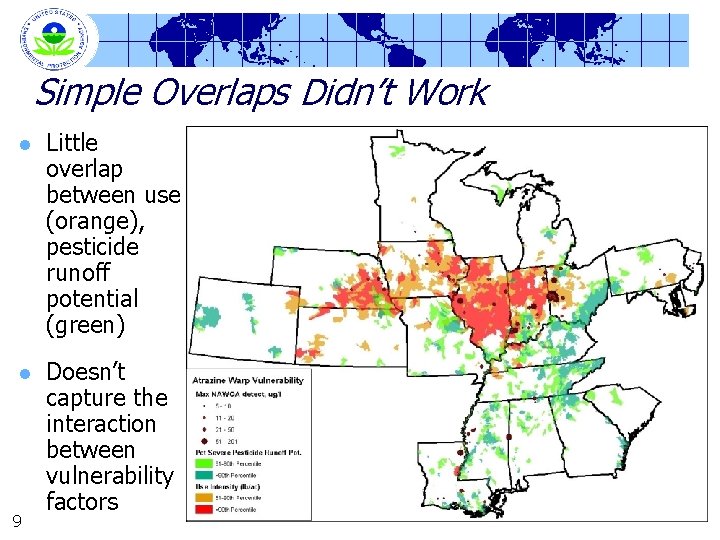
Simple Overlaps Didn’t Work l Little overlap between use (orange), pesticide runoff potential (green) l Doesn’t capture the interaction between vulnerability factors 9
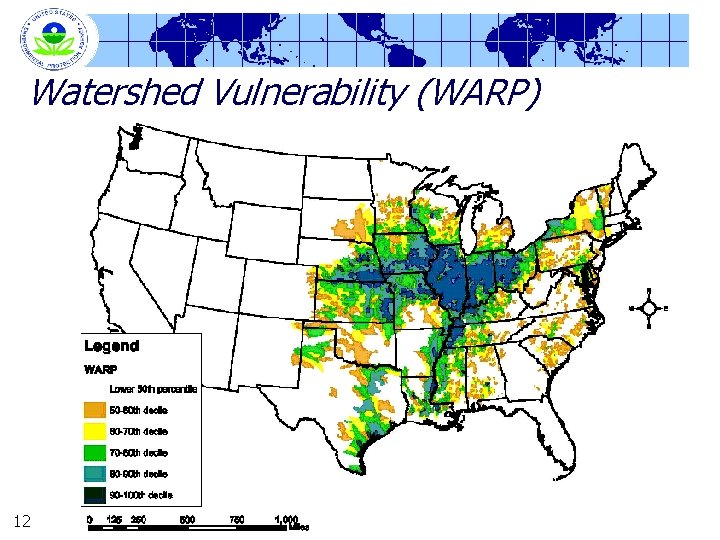
WARP Approach 10 l Empirical model integrates use with basin, soil, hydrology, climate factors l Use WARP to estimate atrazine concentrations for HUC-10 watersheds (where available) covering the atrazine use area (focused on corn, sorghum) l Rank the watersheds based on estimates of 95 th percentile annual concentrations of atrazine l Use the most vulnerable watersheds, based on WARP ranking, as a sampling pool for further monitoring
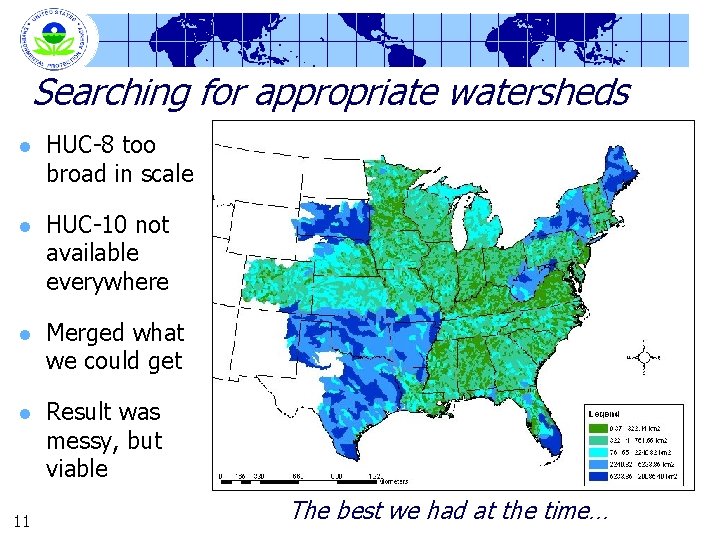
Searching for appropriate watersheds l HUC-8 too broad in scale l HUC-10 not available everywhere l Merged what we could get l Result was messy, but viable 11 The best we had at the time…
Watershed Vulnerability (WARP) 12
How Well Does It Work? l Compared WARP vulnerability to atrazine surface water monitoring data § 1581 stations in 797 HUC’s in 37 -state group l How well does WARP separate: § Upper 20 th %ile of stations ranked by detections (roughly concentrations >3. 0 ppb) § Lowest 20 th %ile of stations ranked by detections (<0. 1 ppb) l 13 Do additional factors add to the WARP model?
Additional factors considered l USDA NRCS pesticide surface runoff potential § Based on inherent soil properties § Potential based on slope, soil hydrologic group, erosivity l Flow accumulation under row crops § Calculated from Natl. Elevation Data (NED), Natl. Land Cover Data (NLCD) § Reflects channelized flow, percent row crop area 14
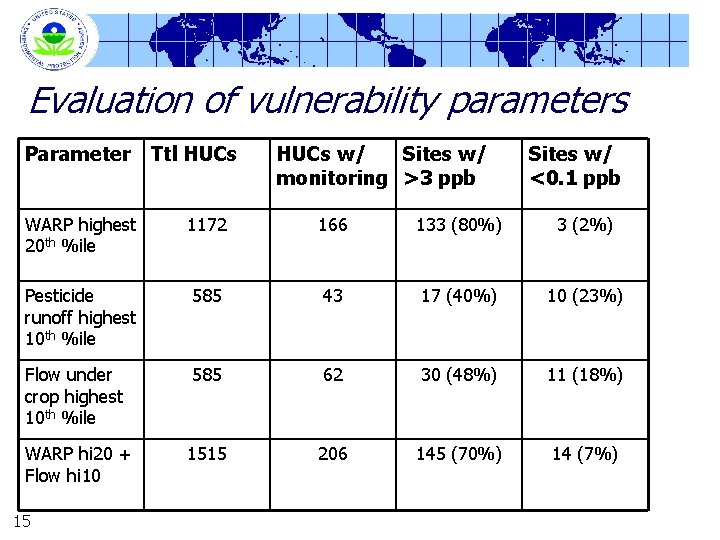
Evaluation of vulnerability parameters Parameter Ttl HUCs w/ Sites w/ monitoring >3 ppb Sites w/ <0. 1 ppb WARP highest 20 th %ile 1172 166 133 (80%) 3 (2%) Pesticide runoff highest 10 th %ile 585 43 17 (40%) 10 (23%) Flow under crop highest 10 th %ile 585 62 30 (48%) 11 (18%) WARP hi 20 + Flow hi 10 1515 206 145 (70%) 14 (7%) 15
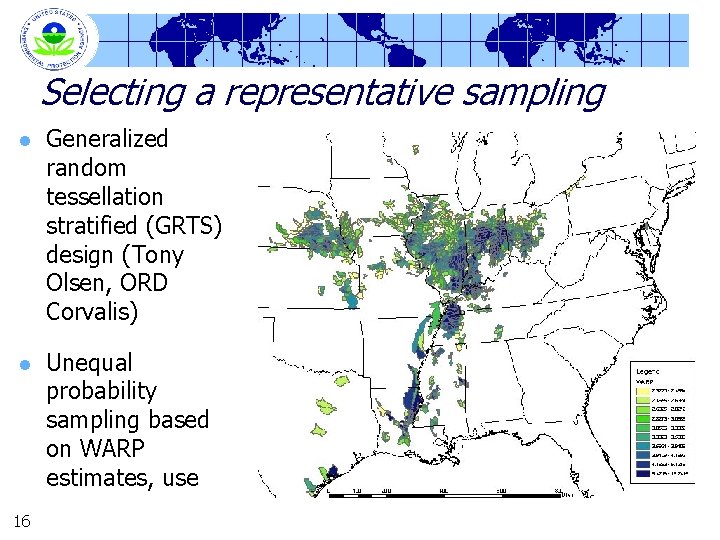
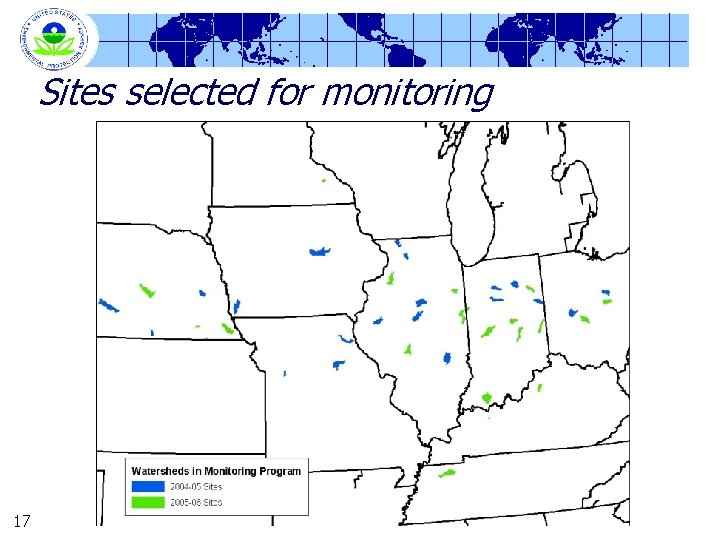
Selecting a representative sampling l Generalized random tessellation stratified (GRTS) design (Tony Olsen, ORD Corvalis) l Unequal probability sampling based on WARP estimates, use 16
Sites selected for monitoring 17
Summary 18 l A vulnerability ranking of watersheds in the atrazine use area using WARP effectively separated monitoring stations with high atrazine detections from stations with low or no detections l WARP was used to target a monitoring survey of 40 flowing water bodies in the most vulnerable watersheds. The monitoring study will allow EPA to estimate the fraction of watersheds with water bodies exceeding effects-based thresholds l Vulnerability based on physical attributes that can be used to predict other watersheds of concern. Site-specific watershed characteristics will help improve our understanding of drivers